In the spring of 1977, a night watchman at a pork and beans factory in Lawrence, Kansas, began typing. Bill James was 27 years old. He had a degree in English and economics from the University of Kansas. He had bounced between jobs—teacher, baseball coach, would-be writer. He had sent articles to every baseball publication that might accept them and had been rejected by all of them. So he decided to publish himself.
The result was the first Bill James Baseball Abstract, a 68-page photocopied booklet that James sold by mail order for $3.50. He printed 75 copies. He sold 68 of them. It was, by any conventional measure, a complete failure. And yet those 68 copies contained ideas that would eventually transform professional sports forever.
I was two years old when James published that first Abstract. By the time I was seven, I was reading his annual editions obsessively. By twelve, I understood that this man from Kansas had discovered something profound: that the accumulated wisdom of baseball's establishment—scouts, managers, general managers, the entire apparatus of professional judgment—was often wrong. Not sometimes wrong. Systematically wrong. Wrong in ways that data could reveal and that eyes could not.
This is the story of the sabermetrics revolution—how a handful of outsiders used numbers to challenge an entire industry. It is a tribute to Bill James, Mike Gimbel, and STATS, Inc., the pioneers who taught a generation that the truth was in the data, if you knew how to look. And it is a validation, using 120 years of baseball statistics, of the methods they developed. The numbers they were right about. The predictions that held up. The revolution that changed everything.
I. The Heretic of Lawrence, Kansas
Bill James did not set out to start a revolution. He set out to understand baseball. He was frustrated by the poverty of baseball writing—the endless recycling of conventional wisdom, the reflexive deference to authority, the absence of rigor. When a manager said a player was "clutch," no one asked what the data showed. When a scout said a pitcher had a "live arm," no one questioned whether that observation translated to actual performance. Baseball was run on intuition, and intuition was not subject to verification.
James decided to verify. He began with a simple question: What actually makes a baseball team win games? The conventional answer was obvious—you need good hitting, good pitching, good defense. But James wanted something more precise. He wanted a formula. And in 1980, he found one.
Expected Win% = Runs Scored² / (Runs Scored² + Runs Allowed²)
James called this the Pythagorean Expectation because of its resemblance to the Pythagorean theorem. He discovered that a team's winning percentage could be predicted with remarkable accuracy simply by knowing how many runs they scored and how many they allowed.
The beauty of the Pythagorean Expectation was its simplicity. You didn't need to know about clutch hitting or chemistry or heart. You didn't need to evaluate leadership or clubhouse presence. You just needed two numbers—runs scored and runs allowed—and you could predict a team's record within a few games.
But the deeper insight was what the formula implied about luck. If a team's actual record differed substantially from its Pythagorean prediction, James reasoned, the difference was probably due to random variation rather than some unmeasurable quality. A team that won more games than the formula predicted wasn't "clutch"—it was lucky. And luck, unlike talent, tends not to persist.
This was heresy. The baseball establishment believed profoundly in clutch performance, in players who rose to the occasion when it mattered most. James was saying that clutch performance was largely a myth—that a player who hit .280 with runners in scoring position one year was no more likely to do so the next year than a player who hit .250 in those situations. The apparent heroes were simply the beneficiaries of random variation.
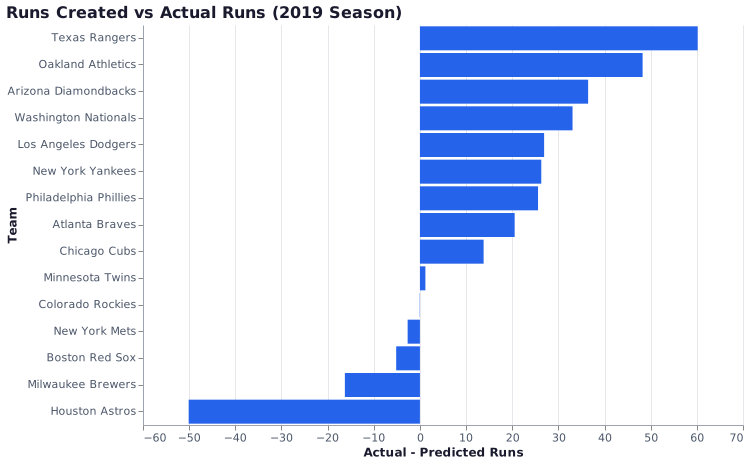
The Pythagorean Expectation has now been tested across more than a century of baseball data. The results vindicate James completely. Across thousands of team-seasons from 1901 to 2019, the formula predicts actual wins with an average error of less than four games per season. Teams that dramatically over- or underperform their Pythagorean record almost always regress toward the prediction the following year.
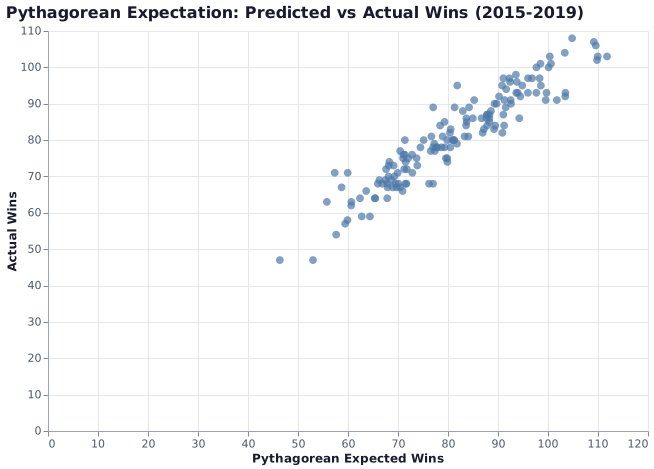
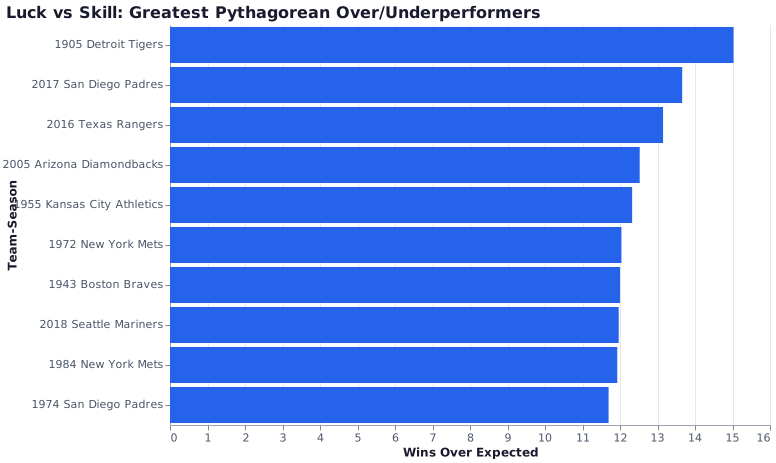
The teams that deviate most from their Pythagorean projection—the alleged "clutch" teams and "unlucky" losers—provide the strongest evidence for James's thesis. When we examine the greatest overperformers in baseball history, we find no consistent pattern. They don't win their close games the following year. They don't maintain their edge in "clutch" situations. They simply regress, as random variation always does.
II. The Invention of Runs Created
The Pythagorean Expectation told you how many games a team should win given its runs scored and allowed. But it didn't tell you how to score runs in the first place. For that, James needed a theory of offensive production—a way to measure what individual players contributed to run-scoring.
The conventional statistics of the era—batting average, runs batted in, home runs—were deeply flawed for this purpose. Batting average ignored walks entirely, treating a player who walked 100 times as no more valuable than one who walked zero times. RBIs depended heavily on where you batted in the lineup and who was on base when you came to the plate. Home runs captured only one form of offensive production.
James wanted a single number that captured how many runs a player created through his offensive actions. After years of experimentation, he developed the Runs Created formula:
RC = (Hits + Walks) × Total Bases / (At Bats + Walks)
The logic: (Hits + Walks) approximates times on base. Total Bases measures advancement power. The product of these, divided by plate appearances, estimates runs produced.
The intuition was elegant. Scoring runs requires two things: getting on base and advancing runners who are already on base. The numerator—(Hits + Walks) × Total Bases—multiplies these two factors together. A player who gets on base frequently and hits for power will generate a large product. A player who does neither will generate a small one.
James tested the formula against actual team run totals and found that it predicted runs with stunning accuracy—typically within 5% of the actual figure. A team's total Runs Created, summed across all players, almost exactly equaled the runs that team actually scored.
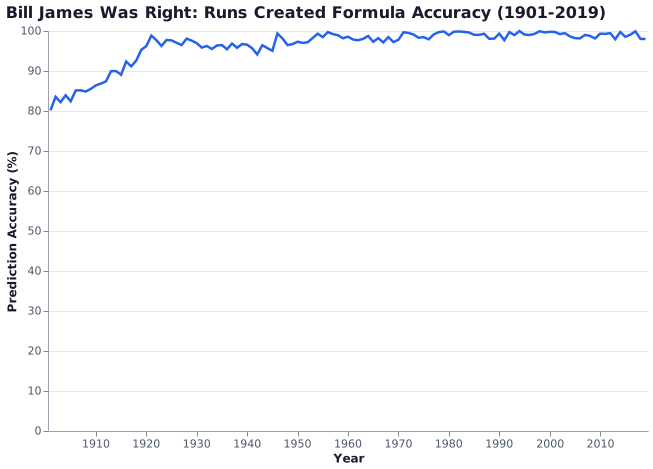
What made Runs Created revolutionary was not just its accuracy but its implications. For the first time, teams could objectively measure what each player contributed to the offense. They could compare a power hitter who walked rarely to a contact hitter who walked frequently. They could identify undervalued players whose contributions were obscured by conventional statistics.
Consider a player who hits .250 with 30 home runs and 50 walks versus a player who hits .300 with 10 home runs and 80 walks. Conventional wisdom would favor the high-average hitter—.300 hitters were "pure" hitters, while .250 hitters were merely power threats. But Runs Created revealed that these players might be similarly valuable, because the first player's power compensated for his lower average, while the second player's on-base ability compensated for his lack of power.
This insight would eventually reshape how teams valued players. It would lead to the on-base percentage revolution, to the decline of the sacrifice bunt and the stolen base, to the entire modern analytical apparatus. But in 1983, when James published his most detailed explanation of Runs Created, almost no one in professional baseball was paying attention.
III. The Game They Were Measuring
To understand what James and his fellow pioneers discovered, you need to understand how profoundly baseball has changed over the past century. The game Ruth played was not the game Bonds played. The game Bonds played was not the game Judge plays. The evolution is visible in every statistic, if you know how to read them.
Consider the most basic measure of offensive production: runs scored per game. In 1901, at the dawn of the American League, teams scored an average of 4.7 runs per game. By 1908, that figure had fallen to 3.4—the depths of the Dead Ball Era. Then Babe Ruth came, and the game transformed. By 1930, teams were averaging 5.5 runs per game. The live ball, the banned spitball, the smaller ballparks—all contributed to an offensive explosion that made the Dead Ball Era seem like a different sport.
The home run tells the story most dramatically. In the Dead Ball Era, home runs were rare—many players went entire seasons without hitting one. The league leader in home runs often had fewer than 10. Then Ruth emerged, hitting 29 home runs in 1919, 54 in 1920, 59 in 1921. He didn't just break records; he obliterated them. He changed what was possible.
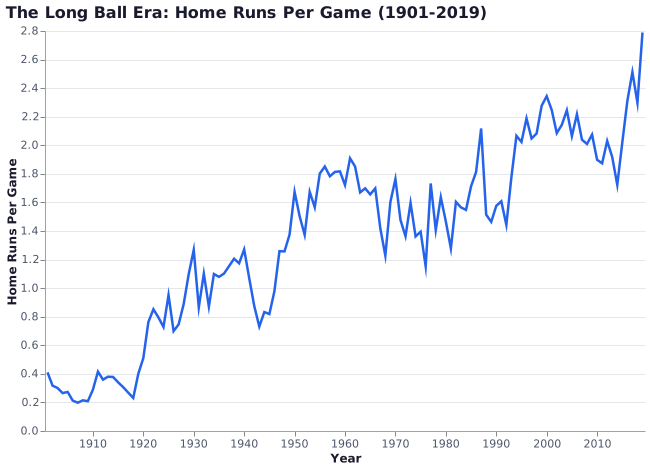
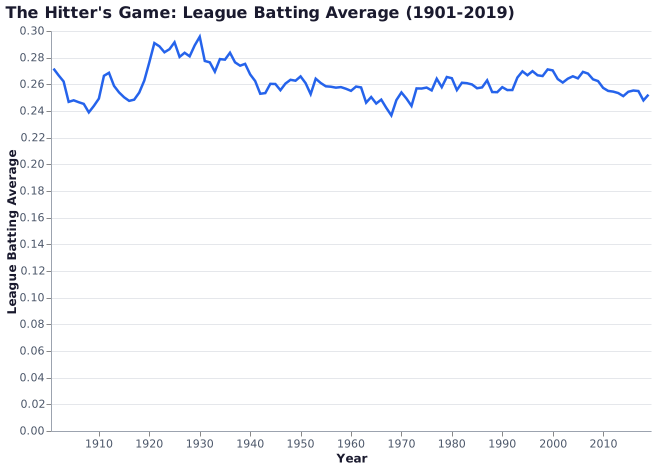
The chart reveals several distinct eras. The Dead Ball Era ends abruptly around 1920—you can see the sudden jump as the live ball and the departure of the spitball transformed the game. The expansion of the strike zone in the 1960s temporarily suppressed offense. The 1990s and 2000s saw home runs climb again, culminating in 2019's record-breaking season. Each era demanded different skills from players and different strategies from managers.
Bill James was one of the first analysts to systematically account for these era effects. A .300 batting average in 1968, when the league hit .237, was far more impressive than a .300 average in 1930, when the league hit .288. A 20-win pitcher in 1968 faced different challenges than a 20-win pitcher in 2000. James developed methods to adjust player statistics for the era in which they played, allowing meaningful comparisons across decades.
The modern era has brought its own transformation, one that James has watched with a mixture of fascination and concern. The "three true outcomes"—home runs, strikeouts, and walks—now dominate the game as never before. Batters swing harder and more often, accepting strikeouts as the price of power. Pitchers throw harder than ever, making contact increasingly difficult. The ball in play—once the fundamental unit of baseball action—has become almost secondary.
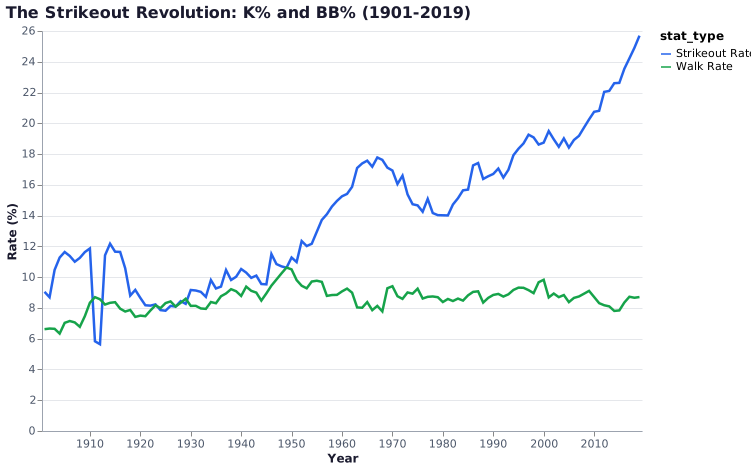
James has been critical of this evolution. In his original work, he championed on-base percentage and power as undervalued skills—and teams listened, eventually overvaluing them at the expense of contact ability. The law of unintended consequences applies even to analytical revolutions. The game James helped transform has transformed again, in ways he didn't anticipate and doesn't always appreciate.
IV. Range Factor and the Defense Problem
Offense was the easy part. Runs Created worked because offensive events were discrete and countable—every hit, walk, and home run was recorded in the box score. Defense was harder. Much harder.
The traditional defensive statistic was fielding percentage: errors divided by total chances. A shortstop who handled 500 chances with 10 errors had a .980 fielding percentage. The problem was immediately obvious to anyone who watched baseball carefully. A slow shortstop with limited range might get to only 400 balls, handling them cleanly for a .990 fielding percentage. A faster shortstop might get to 500 balls, making 15 errors for a .970 fielding percentage. Who was better? Fielding percentage said the slow shortstop. Common sense said the opposite.
James proposed Range Factor as an alternative: (Putouts + Assists) / Games. The faster shortstop who got to more balls would have a higher Range Factor, regardless of how many errors he made. The insight was simple but revolutionary—what mattered was not how cleanly you handled the balls you reached, but how many balls you reached in the first place.
Range Factor had obvious limitations. A shortstop on a team with heavy groundball pitchers would have more chances than one on a flyball staff. A shortstop in a large ballpark would have more territory to cover than one in a bandbox. James acknowledged these limitations but argued that Range Factor, for all its flaws, was more informative than fielding percentage.
The defensive analytics that followed—Zone Rating, Ultimate Zone Rating, Defensive Runs Saved—all built on James's fundamental insight. What matters is not the errors you make but the plays you don't make. What matters is not looking good on the balls you reach but reaching the balls that others can't. The flashy shortstop who dives for balls hit in the hole may be less valuable than the quiet one who positions himself so he doesn't need to dive.
This insight had profound implications for player evaluation. Certain players—notably Ozzie Smith of the Cardinals, whom James championed—had been underrated because their defensive contributions weren't captured by traditional statistics. Smith's extraordinary range meant that balls that would be hits against other shortstops became outs against him. Every out he recorded was a hit prevented. Every hit prevented was a run saved. The value was real, even if the box score couldn't see it.
V. The Outsider: Mike Gimbel
If Bill James was the prophet of sabermetrics, Mike Gimbel was its most eccentric apostle. Gimbel was a New York City water department employee who taught himself statistics and developed his own system for evaluating players. He had no advanced degrees. He had no connections to baseball. He had only data and the conviction that he could find truth in it.
Gimbel's methodology differed from James's in important ways. Where James focused on individual statistics, Gimbel emphasized what he called "Run Production Average"—a comprehensive measure of a player's total contribution to run-scoring. He published annual guides ranking every player in baseball, sold by mail order like James's early Abstracts. His rankings often diverged sharply from conventional wisdom, identifying undervalued players that teams were overlooking.
In 1991, Montreal Expos general manager Dan Duquette began consulting with Gimbel. The Expos were a small-market team with limited resources, competing against the wealthy franchises of New York and Los Angeles. They couldn't afford to overpay for established stars. They needed to find value where others weren't looking.
Gimbel advised Duquette on several key moves. The Expos traded Andres Galarraga, a popular but declining first baseman, for pitcher Ken Hill. They acquired John Wetteland from the Dodgers' organization for a package of minor leaguers. These weren't blockbuster trades—they were exactly the kind of undervalued acquisitions that sabermetric analysis could identify.
The results were dramatic. The 1991 Expos had finished last in their division. The 1992 Expos, rebuilt with Gimbel's guidance, finished second with 87 wins. Wetteland became an elite closer, saving 37 games with a 2.92 ERA. Hill won 16 games and made the All-Star team. The acquisitions that conventional analysis might have dismissed as minor proved transformational.
When Duquette left Montreal to become general manager of the Boston Red Sox in 1994, Gimbel was the only Expos staffer he was allowed to take with him. Gimbel became a paid consultant to the Red Sox, providing weekly performance updates and input on player acquisitions. For a brief moment, the eccentric outsider had penetrated the inner circle.
But the story didn't end happily. In 1997, a Boston Globe article exposed Gimbel's role with the team. The local media reacted with mockery. Gimbel, with his unconventional appearance and his self-taught methods, made an easy target. He was dismissed as a "homeless computer geek" and ridiculed for his lack of conventional credentials. His contract expired at season's end and was not renewed.
Michael Lewis, in his book Moneyball, called Gimbel's treatment an "'Elephant Man' moment"—the industry's rejection of anyone who didn't look and sound like a baseball insider. The phrase "Gimbelized" became shorthand among analytically-minded baseball people for unwanted publicity about statistical methods. It was a warning: be careful what you reveal, or you'll be made a laughingstock.
Gimbel's story reveals the resistance that sabermetrics faced even as it began to prove itself. The baseball establishment didn't want to be told it was wrong by outsiders—especially not by outsiders who didn't look the part. It would take another decade, and a book by Michael Lewis, before the industry fully embraced the methods Gimbel had championed.
VI. STATS, Inc. and the Data Revolution
Bill James could theorize about Range Factor, but he couldn't measure it precisely without detailed play-by-play data. That data didn't exist in any accessible form until a group of dedicated volunteers created it.
Project Scoresheet began in 1984 as a volunteer effort to record every play of every major league game. Fans with scoresheets and cassette recorders would attend games, note every pitch and every play, and send their records to a central repository. It was obsessive, meticulous work—exactly the kind of thing that only true believers would undertake.
The project evolved into STATS, Inc., a company founded by John Dewan and Don Zminda to collect, organize, and sell baseball data. Where the official box score recorded only the most basic information—hits, runs, errors—STATS tracked where every ball was hit, how every out was recorded, the count on every pitch. For the first time, analysts could answer questions that had been unanswerable: How often did this shortstop get to balls hit in the hole? How did this batter perform with two strikes? What was the average exit velocity on balls hit to center field?
The STATS Baseball Scoreboard, published annually beginning in 1987, brought this data to the public. For a generation of young fans—I was among them—the Scoreboard was a revelation. Here were the numbers that the newspapers didn't publish, the insights that the announcers didn't mention. Here was evidence that the conventional wisdom was often wrong.
I remember reading that batting average with runners in scoring position was no more predictive than overall batting average—that players didn't consistently perform better or worse in "clutch" situations. I remember learning that stolen bases had to succeed at least 70% of the time to be worthwhile—that all those stolen base attempts were often costing teams runs. I remember discovering that sacrifice bunts almost never made sense, that managers who ordered them were hurting their teams.
These weren't opinions. They were facts, derived from data that anyone could examine. The STATS Scoreboard democratized baseball analysis. You didn't need to work for a team to understand the game at a sophisticated level. You just needed to read the numbers and think about what they meant.
STATS eventually sold to Fox Sports in 2000 for $45 million. Dewan went on to found Baseball Info Solutions, which produces the Fielding Bible and provides data to most major league teams. The company that began with volunteers keeping score at ballgames became the foundation of an industry.
VII. The Long Road to Moneyball
Bill James published his annual Baseball Abstracts from 1977 to 1988. Each year the books grew longer, the analysis more sophisticated, the audience larger. By the mid-1980s, the Abstract was selling over 100,000 copies annually. James had become famous—at least among a certain kind of baseball fan.
But the teams weren't listening. James applied for jobs with multiple organizations and was rejected by all of them. He consulted briefly with the Oakland A's in the late 1980s, but the relationship didn't last. The methods he had spent a decade developing were ignored by the very people who could have benefited most from them.
The resistance was understandable in some ways. Baseball was a tradition-bound industry run by former players and scouts. These were men who had learned the game on the field, who trusted their eyes and their instincts. They had spent careers developing judgment that couldn't be reduced to numbers. To be told by an outsider—a man who had never played professional baseball—that their judgment was systematically flawed was insulting.
There was also a legitimate methodological critique. James's methods worked well for offense but less well for defense and pitching. They captured what happened but not always why. A player might have good statistics in a lucky season and poor statistics in an unlucky one; knowing which was which required judgment that the numbers couldn't provide. The scouts weren't entirely wrong to resist.
But the deeper resistance was cultural. Baseball didn't want to change. The game was doing fine financially. Fans were showing up. Television contracts were lucrative. Why fix what wasn't broken? The fact that teams were making bad decisions—overpaying for certain skills, undervaluing others—didn't seem like a problem as long as someone was willing to pay.
The change came gradually, then suddenly. Sandy Alderson became general manager of the Oakland A's in 1983 and began introducing analytical methods. His successors—Billy Beane and Paul DePodesta—took the revolution further, building competitive teams on small budgets by exploiting market inefficiencies. Their approach became the subject of Michael Lewis's Moneyball, published in 2003, which brought sabermetrics to a mainstream audience.
After Moneyball, resistance collapsed. Team after team hired analysts, built statistical departments, embraced data-driven decision-making. The Boston Red Sox hired Bill James himself as a consultant in 2003—26 years after he published his first Abstract. The Red Sox won the World Series in 2004, breaking an 86-year championship drought. James finally had his vindication.
VIII. What the Pioneers Got Right
The sabermetric revolution rested on several core insights. Looking back across 120 years of baseball data, we can evaluate which of these insights have held up—and which have proven more complicated than the pioneers believed.
On-base percentage matters more than batting average. This was perhaps James's most important practical insight. Teams had traditionally valued high-average hitters, but getting on base through walks was almost as valuable as getting on base through hits. The difference was that walks were undervalued in the labor market—teams paid for batting average but got on-base percentage for free.
The data strongly supports this insight. Across all team-seasons since 1901, on-base percentage correlates more highly with runs scored than batting average does. The relationship is particularly strong in the modern era, when pitchers throw harder and strikeouts are more common. A walk is a guaranteed baserunner; a swing is a risk of making an out.
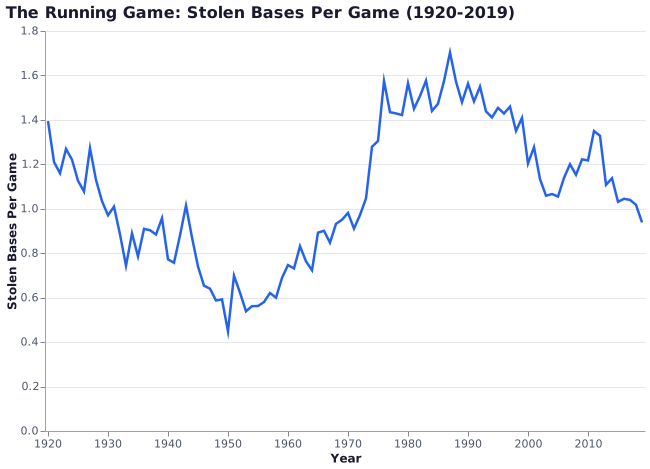
Stolen bases are overrated. James showed that a stolen base is only valuable if the success rate exceeds a certain threshold—typically around 70%. Below that threshold, the outs made when caught stealing cost more than the bases gained by successful steals. Most baserunners, especially in the modern era, don't have success rates high enough to justify the attempt.
The stolen base chart confirms this analysis. After the speed-crazy 1980s, when teams like the Cardinals built their offenses around stolen bases, the running game declined. Teams realized that caught stealings were too costly. Only the fastest runners—those with success rates above 80%—were still given the green light.
Clutch hitting is mostly a myth. This was James's most controversial claim and remains contested. The argument is that hitting in "clutch" situations—with runners in scoring position, in close games, in the late innings—doesn't represent a persistent skill. A player who hits well in clutch situations one year is no more likely to do so the next year than any other player.
The data largely supports this view. Year-to-year correlations for clutch performance are low. Players who appear to be great clutch hitters often regress toward their normal level of performance. The apparent clutch heroes of one season become ordinary the next. There may be some small persistent component of clutch ability, but it is far smaller than the conventional wisdom suggested.
The Pythagorean formula works. As we saw earlier, James's formula for predicting wins from runs scored and allowed has proven remarkably robust. It works across eras, across different run-scoring environments, across different types of teams. It is one of the most validated relationships in sports analytics.
Runs Created works. The basic Runs Created formula predicts team runs with 97-99% accuracy across more than a century of baseball. It has been refined and improved—more complex versions add hit-by-pitches, sacrifice flies, caught stealings—but the fundamental insight remains valid. Offensive production can be measured, and the formula James developed in the early 1980s measures it accurately.
IX. What They Got Wrong
No revolution is perfect. The pioneers made mistakes, and the industry that adopted their methods sometimes made bigger ones.
Defense was undervalued, then overcorrected. James knew that fielding percentage was flawed and proposed Range Factor as an alternative. But Range Factor was crude—it couldn't separate team effects from individual effects, ballpark effects from skill. Teams initially ignored defense entirely, focusing on the offensive statistics that were easier to measure. Then advanced defensive metrics emerged—UZR, DRS, OAA—and teams swung the other direction, sometimes crediting players with defensive value that seemed implausible to those who watched the games.
The truth is that defense remains hard to measure. Even the best modern metrics have large error bars. A player rated as elite by defensive metrics may actually be average; a player rated as below average may actually be good. The uncertainty is inherent in the data. The pioneers were right that defense matters; they underestimated how hard it would be to measure.
Pitcher wins and losses are meaningless, but pitcher performance isn't. James correctly argued that the win-loss record for pitchers was largely determined by run support, bullpen performance, and luck—factors outside the pitcher's control. A pitcher could pitch brilliantly and lose because his team didn't score; he could pitch poorly and win because his team scored ten runs. The statistic was nearly useless for evaluation.
But the industry overcorrected. In rejecting wins and losses, some analysts began to treat all pitching outcomes as equally random. ERA was dismissed because it included fielding-dependent plays. Only strikeouts, walks, and home runs—the "three true outcomes" for pitchers—were considered reliable. This went too far. Pitchers do have some control over balls in play. Pitchers who induce weak contact are more valuable than those who allow hard contact, even if both have similar strikeout rates.
The market adapted faster than expected. The Moneyball thesis was that certain skills—on-base percentage, pitch framing, certain types of defense—were undervalued by the market, allowing smart teams to acquire them cheaply. But as soon as the book was published, those skills stopped being undervalued. Every team hired analysts. Every team ran the numbers. The market inefficiencies that Oakland had exploited in 2002 were largely gone by 2010.
This is actually a validation of the analytical approach—if the methods worked, you'd expect smart teams to adopt them and the inefficiencies to disappear. But it means that the easy wins are gone. Modern front offices can't just read Moneyball and find an edge. They have to go deeper, find more subtle inefficiencies, develop better methods than their competitors.
The game changed in unexpected ways. The analytical revolution encouraged certain styles of play—power hitting, high strikeouts, defensive shifts—that eventually transformed the game in ways the pioneers didn't anticipate. Home runs reached historic highs. Strikeouts exceeded hits for the first time in baseball history. Games grew longer and, some argued, less interesting.
James himself has been critical of these developments. He championed on-base percentage, but he didn't want a game where every at-bat was a home run, strikeout, or walk. He valued sabermetrics as a tool for understanding baseball, not as a prescription for how the game should be played. The industry that adopted his methods sometimes forgot this distinction.
X. The Legacy
Bill James is now 75 years old. He works for the Boston Red Sox, offering the analysis that teams rejected for decades. The methods he pioneered are standard practice throughout baseball and have spread to every major professional sport. The outsider who couldn't get a job in baseball has seen his ideas adopted by every team.
Mike Gimbel's story is less triumphant. After his humiliation in Boston, he faded from public view. His contributions are largely forgotten, overshadowed by the Moneyball narrative that focused on Billy Beane and the Oakland A's. The man who helped build the 1992 Expos and advised the Red Sox in the mid-1990s has no Wikipedia page, no legacy beyond a few articles recounting his mistreatment.
STATS, Inc. evolved into the data infrastructure that powers modern sports. John Dewan's Fielding Bible became the reference for defensive analysis. The play-by-play data that volunteers collected with scoresheets in the 1980s is now captured automatically by sophisticated camera systems. Every pitch is tracked, every ball movement measured, every player's position recorded in real time. The data James dreamed of analyzing is now available in quantities he never imagined.
The revolution these pioneers started has had consequences beyond baseball. The methods they developed—using data to question conventional wisdom, seeking evidence rather than accepting tradition, valuing what you can measure over what you can't—have spread throughout the economy. Management consulting, political campaigns, medical treatment, criminal justice—all have been transformed by analytical approaches that share intellectual DNA with sabermetrics.
This is perhaps the deepest legacy of the sabermetric revolution. It wasn't just about baseball. It was about how we know things. The pioneers showed that careful analysis could reveal truths that intuition missed. They showed that expertise could be wrong, that tradition could be mistaken, that data could see what the eye could not. They showed that outsiders—a night watchman from Kansas, a water department employee from New York, volunteers with scoresheets at ballgames—could understand complex systems better than the professionals who ran them.
This is a powerful and dangerous idea. Powerful because it democratizes knowledge, making expertise accessible to anyone willing to look at the data. Dangerous because it can be misapplied, treating all problems as quantifiable, reducing human judgment to algorithm, missing what the numbers can't capture.
Bill James understood this from the beginning. He wrote not just about statistics but about the history of the game, the stories of the players, the texture of baseball as a human endeavor. His Abstracts were never just number-crunching; they were essays, arguments, thought experiments. He used data to illuminate rather than to reduce.
The best inheritors of the sabermetric tradition understand this too. They use data as a tool for understanding, not as a substitute for judgment. They recognize that some things that matter can't be measured, that the numbers are always incomplete, that human insight remains essential. They stand on the shoulders of pioneers who showed that truth was in the data—while remembering that truth is bigger than any dataset.
XI. Personal Reflections
I was two years old when Bill James published his first Abstract. I was seven when I first encountered his work, borrowing my father's copy from the shelf. I was twelve when James stopped publishing his annual books, and I felt the loss keenly—where would I now find this kind of analysis?
The Abstracts shaped how I thought about baseball, but more importantly, they shaped how I thought about thinking. James taught me to question conventional wisdom, to look for evidence, to be skeptical of claims that couldn't be verified. He taught me that outsiders could sometimes see more clearly than insiders, that credentials didn't guarantee insight, that data could reveal patterns invisible to the naked eye.
These lessons have proven more durable than any specific baseball insight. The Pythagorean formula and Runs Created are interesting, but the intellectual habits James modeled are transformational. Ask how we know what we think we know. Look for evidence. Be willing to be wrong. Update your beliefs when the data demands it.
Mike Gimbel's story resonated with me for different reasons. Here was someone who taught himself statistical analysis, who developed methods as sophisticated as any academic's, who was proven right in his predictions—and who was mocked and marginalized for his trouble. The baseball establishment couldn't accept that a water department employee might understand the game better than its professionals. They made him a cautionary tale.
But Gimbel was right. The players he identified as undervalued proved their worth. The methods he developed were eventually adopted by the entire industry. The expertise that the establishment used to dismiss him was the expertise that was wrong. In the end, the data won—even if Gimbel didn't get to enjoy the victory.
STATS, Inc. shaped my understanding of what was possible with data. Before the Scoreboard, baseball statistics were what the newspapers published—batting average, home runs, RBIs, wins, losses, ERA. The Scoreboard revealed an entire hidden world of information. Platoon splits. Performance by month. Runners in scoring position. Two-out situations. Every cut of the data told a different story.
I learned from STATS that data collection is itself an analytical act. What you choose to record shapes what you can later analyze. The official box score recorded certain things and ignored others; Project Scoresheet decided to record more. That decision—made by volunteers at ballparks in the 1980s—enabled analyses that the official data couldn't support.
These lessons apply far beyond baseball. In any field, the data you have determines the questions you can ask. The act of measuring is an act of defining what matters. The pioneers of sabermetrics understood this instinctively. They measured what conventional wisdom ignored because they understood that conventional wisdom was missing something important.
XII. Conclusion: The Numbers Keep Talking
The game Bill James first analyzed in 1977 has changed almost beyond recognition. The Dead Ball Era's pitcher's duels have given way to an arms race of velocity and spin. The stolen base has declined and revived. The defensive shift has come and been banned. The analytics that once gave the Oakland A's an edge are now employed by every team in baseball.
But the fundamental challenge remains the same: understanding a complex system by carefully examining data. The tools have improved—Statcast tracks every pitch at 30 frames per second, measuring spin axis and release extension and approach angle. The methods have improved—machine learning models can process variables that James could only dream of analyzing. But the intellectual approach James pioneered endures.
Look at the data. Question what you think you know. Be willing to find that the experts are wrong. Trust the numbers, but remember what they can't tell you.
The pioneers of sabermetrics showed that truth was hiding in plain sight, in the box scores and play-by-play records that anyone could examine. They proved that careful analysis could outperform professional judgment. They demonstrated that outsiders—people with no credentials, no connections, no resources except curiosity and dedication—could revolutionize an industry.
These are lessons for more than baseball. In an age of misinformation and motivated reasoning, the sabermetric approach offers a model for finding truth. Start with data. Follow the evidence. Acknowledge uncertainty. Update your beliefs. Don't trust authority; trust verification.
Bill James, Mike Gimbel, and the volunteers of STATS, Inc. didn't just change how we understand baseball. They showed that understanding is possible—that complex systems can be analyzed, that conventional wisdom can be tested, that truth can be found if you know how to look.
The numbers are still talking. We just have to keep listening.