In 2023, something remarkable happened at the European Parliament. Over a thousand delegates gathered in Brussels for a conference with an audacious title: "Beyond Growth." The event was hosted by twenty Members of Parliament from five different political groups and opened by the President of the European Parliament herself. For three days, economists, activists, and policymakers debated a question that would have seemed absurd just a decade earlier: What if economic growth is not the solution to our problems, but the cause of them?
The conference marked a turning point. Ideas that had long circulated on the margins of academia—degrowth, post-growth economics, ecological limits—were suddenly being discussed in the halls of power. Kate Raworth presented her "Doughnut Economics" framework. Jason Hickel argued that rich countries need to deliberately scale down their material throughput. Vandana Shiva spoke of the violence embedded in GDP-driven development. The gathering was nicknamed the "Woodstock of Degrowth."
This essay explores the intellectual foundations of that movement. It draws heavily on two thinkers who have done more than perhaps anyone else to challenge our assumptions about economic growth: Jason Hickel, the economic anthropologist whose work on ecological economics and unequal exchange has reshaped development thinking, and David Graeber, the late anthropologist and activist whose explorations of debt, work, and human possibility opened new ways of imagining economic life. Their perspectives, while distinct, converge on a fundamental insight: the economy we have inherited is not the only one possible, and the growth imperative that drives it is neither natural nor inevitable.
Part I: The Growth Imperative
Every government in the world pursues economic growth. It is the shared assumption of left and right, of democracies and authoritarian regimes, of the Global North and Global South. Growth is how we measure success, how we promise prosperity, how we justify sacrifice. A government that fails to deliver growth faces electoral punishment; an economy that stops growing is said to be "stagnant" or "in crisis." We speak of growth as if it were oxygen—something we cannot live without.
But growth is a relatively recent obsession. For most of human history, economies did not grow in any meaningful sense. Living standards were roughly stable for millennia. The idea that the economy should expand continuously, that this year should produce more than last year and next year more still, emerged only in the twentieth century, and became the dominant organizing principle of global politics only after World War II.
The institutionalization of growth as a policy goal occurred at the Bretton Woods conference in 1944, where the architects of the postwar economic order adopted Gross Domestic Product as the primary measure of national success. Simon Kuznets, who had developed the GDP framework, explicitly warned against using it this way. "The welfare of a nation can scarcely be inferred from a measurement of national income," he wrote. His warnings went unheeded. GDP became the scoreboard, and growth became the game.
Jason Hickel argues that the growth imperative is not an accident of policy but a structural feature of capitalism itself. In a capitalist economy, businesses must grow or die. A company that fails to expand is quickly overtaken by competitors who do. This competitive pressure cascades through the entire system: workers must produce more to keep their jobs, consumers must consume more to keep demand high, governments must ensure growth to maintain tax revenues and social peace. The result is an economic system that requires perpetual expansion regardless of whether that expansion serves human needs.
"Capitalism is not just an economy that happens to be growing," Hickel writes. "It is a system that must grow to survive." This is the growth imperative—not a choice we make but a compulsion built into the very structure of our economic institutions.
The Arithmetic of Forever
To understand why perpetual growth is problematic, consider some simple arithmetic. An economy growing at 3 percent per year—a rate most governments consider healthy—doubles in size roughly every 23 years. Over a century, it grows more than nineteen-fold. Over two centuries, it grows over 360-fold. The mathematics are relentless: exponential growth on a finite planet eventually hits limits.
Global GDP has grown roughly fifty-fold since 1900. If it continues growing at historical rates, it will need to expand another fifty-fold by 2100, and another fifty-fold by 2200. Each doubling requires extracting more resources, consuming more energy, generating more waste. At some point, these demands exceed what the Earth can provide.
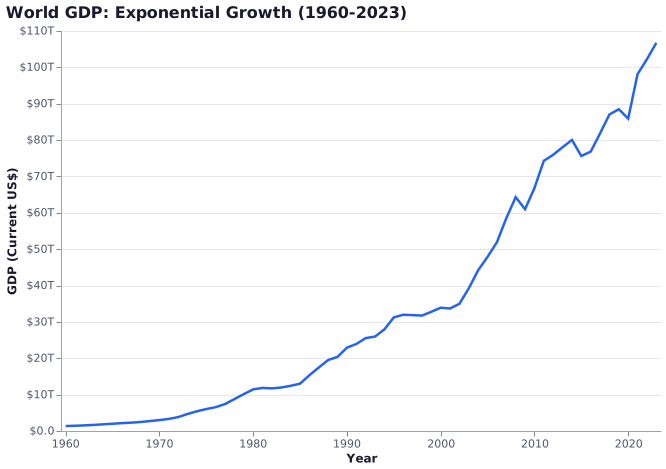
The chart above shows the relentless curve of exponential growth. What looks gradual in early decades becomes nearly vertical in recent years. This is not sustainable. An economy that must grow forever on a planet with finite resources will eventually hit walls—not because of policy choices or market failures, but because of physics.
Defenders of growth often respond that we can "decouple" economic expansion from material throughput—that we can grow the economy while reducing its physical footprint. This is the promise of "green growth." But the evidence for absolute decoupling at the scale required is thin. While some wealthy countries have reduced their domestic emissions while growing their economies, they have often done so by offshoring production to other countries. When we account for the emissions embedded in imports, the picture looks much less encouraging.
A 2023 study published in The Lancet Planetary Health examined the rates of decoupling actually achieved by high-income countries and calculated how long it would take them to reduce emissions by 95 percent at those rates. The answer: more than 220 years. In the process, they would emit 27 times their fair share of the remaining carbon budget consistent with limiting warming to 1.5 degrees Celsius. To meet climate targets, decoupling rates would need to increase by a factor of ten—and there is no evidence that such rates are achievable.
Part II: What Is Wealth, Really?
David Graeber spent his career asking questions that seemed naive but proved profound. In his masterwork, "Debt: The First 5,000 Years," he asked: Where does money come from? The answer he found challenged the story economists have told for centuries.
The standard account, dating to Adam Smith, holds that money emerged from barter. People trading goods found it inefficient to always require a "double coincidence of wants"—I have wheat and want shoes; you have shoes and want wheat. Money solved this problem by providing a universal medium of exchange. First came barter, then money, then credit.
Graeber, drawing on anthropological and historical evidence, showed that this story is backwards. Credit came first. For thousands of years before the invention of coins, people traded on the basis of IOUs and running tabs. Ancient Sumerian temples kept elaborate records of who owed what to whom. Medieval English villagers tracked debts in their heads and settled accounts periodically. Money—physical tokens of exchange—emerged later, and often in contexts of war and violence rather than peaceful commerce.
This matters because it changes how we think about economic relations. In the standard story, the economy is fundamentally about exchange between equals—you give me something, I give you something of equal value. But if credit came first, then the economy is fundamentally about social relationships, obligations, trust, and power. The question is not "what is this worth?" but "what do we owe each other?"
Graeber identified what he called "baseline communism"—the foundation of mutual aid on which all societies rest. "From each according to their abilities, to each according to their needs" is not a utopian slogan but a description of how people actually behave in families, among friends, and in communities. We help those who need help without demanding immediate repayment. We share what we have with those who lack it. This is not saintly altruism but ordinary human behavior—the default mode of social life.
Markets and precise accounting emerge, Graeber argued, when this baseline of trust breaks down—often due to violence. Coins were invented to pay soldiers. Cash becomes necessary when dealing with strangers you may never see again. The cold calculations of the marketplace are not the natural state of human economic life but an aberration produced by specific historical circumstances.
Bullshit Jobs and the Meaning of Work
In 2013, Graeber published an essay titled "On the Phenomenon of Bullshit Jobs" that went viral. It argued that a substantial proportion of workers in modern economies secretly believe their jobs are pointless—that they contribute nothing of value to the world. The essay touched a nerve. Thousands of people wrote to Graeber confirming his thesis, describing their work as corporate lawyers, public relations specialists, financial consultants, and middle managers whose disappearance would leave the world unchanged or even improved.
Graeber expanded the essay into a book, defining bullshit jobs as positions "so completely pointless, unnecessary, or pernicious that even the employee cannot justify their existence, though as part of the conditions of employment, they feel obligated to pretend that this is not the case." He identified five types: flunkies (who exist to make someone else feel important), goons (who exist only because competitors have them), duct tapers (who fix problems that should not exist), box tickers (who create the appearance of doing something useful), and taskmasters (who assign work to others or create bullshit jobs for them).
The existence of bullshit jobs poses a puzzle for economic theory. If markets are efficient, why do so many useless positions persist? Graeber's answer was that we have confused productivity with value and confused the appearance of work with work itself. The economy rewards looking busy, attending meetings, and producing reports that nobody reads. Meanwhile, the people who do obviously useful work—caring for the sick, teaching children, picking up garbage—are often paid the least.
Subsequent research has partially confirmed and partially complicated Graeber's thesis. Surveys find that fewer workers—perhaps 15 to 20 percent rather than the 40 percent Graeber estimated—describe their jobs as completely pointless. But even this lower number represents millions of people spending their lives on activities they believe serve no purpose. And the perception of uselessness is strongly associated with depression, anxiety, and other measures of poor wellbeing.
The deeper point is about what economies are for. If GDP growth requires the proliferation of bullshit jobs—positions that exist only to keep people employed and consuming—then growth is not the same as progress. An economy could shrink in GDP terms while improving in actual human welfare, if the shrinkage came from eliminating pointless work while expanding genuinely valuable activities like care, education, and ecological restoration.
Part III: The Extraction Machine
Jason Hickel's research has quantified something that Global South scholars have long argued: the wealth of rich countries depends substantially on the ongoing extraction of labor and resources from poor countries. This is not merely a historical legacy of colonialism but a continuing process embedded in the structure of the global economy.
Hickel and his collaborators have calculated the scale of this extraction using data on trade flows, wages, and prices. Their findings are staggering. In 2021, the Global North net-appropriated 826 billion hours of embodied labor from the Global South—labor embedded in the goods that flow from poor countries to rich ones. Valued at Northern wage rates, this represents approximately 16.9 trillion euros in value transferred annually from South to North.
The mechanism is straightforward: workers in the Global South are paid far less than workers in the Global North for equivalent work. A garment worker in Bangladesh producing clothes for European consumers earns perhaps one-fiftieth what a European worker would earn for the same hours of labor. This wage gap is not primarily due to differences in skill or productivity but to global power imbalances—the legacy of colonialism, structural adjustment programs, and trade rules written by and for wealthy countries.
Hickel's research shows that since 1960, the total value drained from the Global South through unequal exchange amounts to $242 trillion in constant 2010 dollars. To put this in perspective, the total aid flows from rich countries to poor countries over the same period are dwarfed by a factor of thirty. For every dollar of aid that flows south, roughly thirty dollars of value flows north through the normal operation of trade.
This extraction is not limited to labor. It includes land (Southern agriculture increasingly produces export crops rather than food for local consumption), energy (fossil fuels extracted from Southern countries and burned in Northern ones), and raw materials of all kinds. The Global North is responsible for 74 percent of excess material use since 1970—consumption beyond what the planet can sustainably provide.
Carbon Colonialism
The pattern is even starker when we consider carbon emissions. The richest 1 percent of the global population produces 17 percent of emissions—from just 1 percent of the world's people. Add the next 9 percent, and this top 10 percent accounts for nearly half of all emissions. Meanwhile, the poorest 50 percent—nearly 4 billion people—produces just 12 percent.
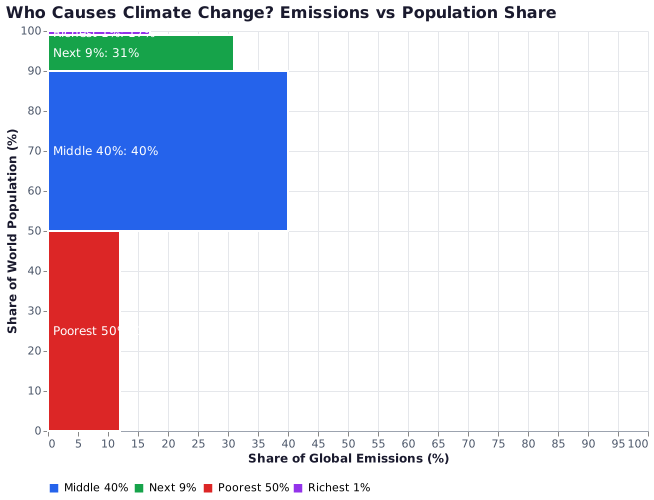
The chart above shows this disparity in striking terms. Each bar's height represents that group's share of world population—the Poorest 50% dominates the vertical space because they are half of humanity. The bar width shows emissions share. Notice how the tiny Richest 1% bar extends nearly as far on the horizontal axis as the massive Poorest 50% bar—despite representing 1/50th of the population. These four groups are mutually exclusive and sum to 100 percent on both dimensions.
What does this mean in practice? The data shows that the richest 1 percent emits roughly 75 times their fair share of carbon—if emissions were distributed equally across all people. Even the richest 10 percent as a whole emits nearly 5 times their fair share. Meanwhile, the poorest half of humanity emits less than a quarter of what an equal distribution would allow.
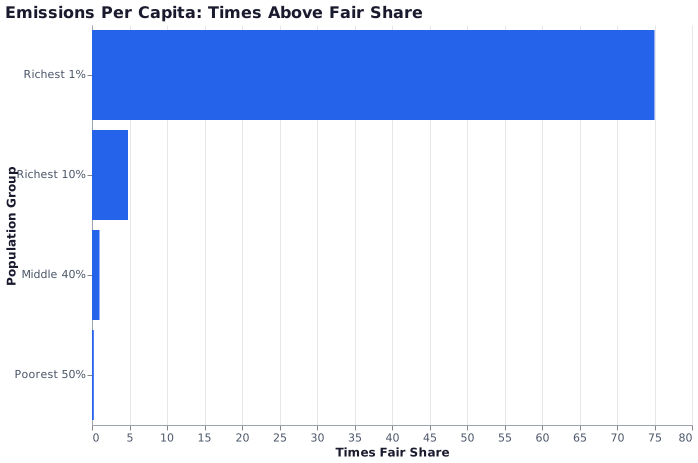
This is not merely an abstract statistical pattern. It represents a profound injustice. The atmosphere does not distinguish between a ton of CO2 emitted in New York and one emitted in Nairobi, but the people who benefit from that emission—and the people who suffer its consequences—are very different.
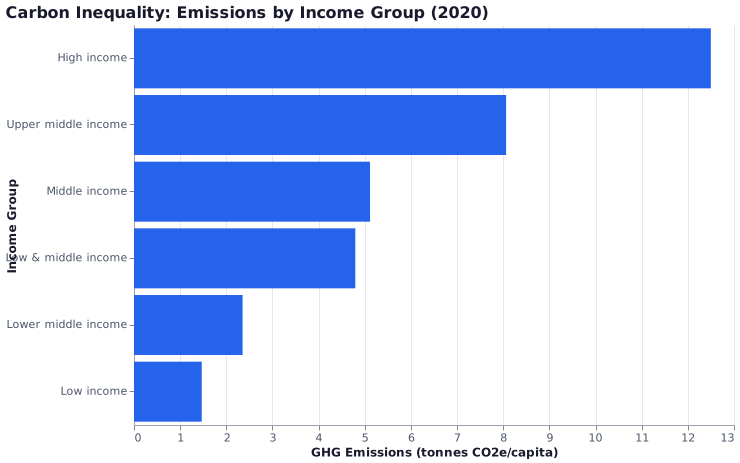
When we look at emissions per capita by World Bank income group, the pattern is unmistakable. High-income countries emit roughly five times more greenhouse gases per person than low-income countries. This is not ancient history but ongoing extraction: every year, the consumption patterns of the wealthy continue to destabilize the climate that everyone depends on.
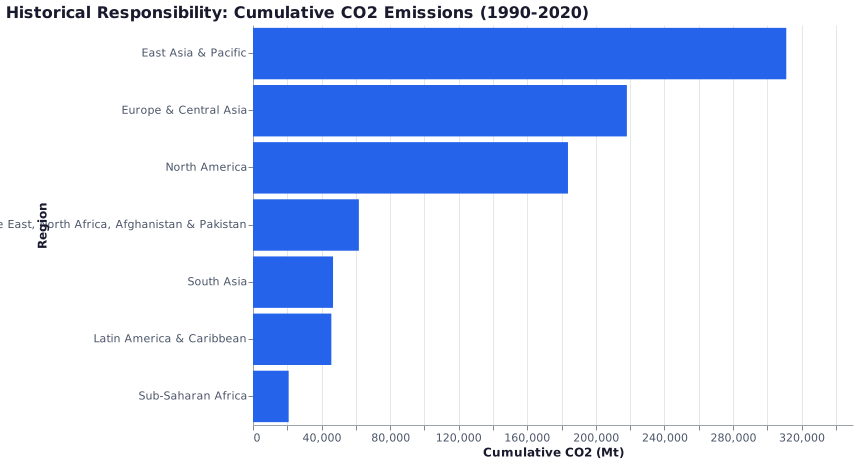
Historical responsibility matters too. Looking at cumulative CO2 emissions from 1990 to 2020, East Asia and the Pacific has now overtaken Europe as the largest regional emitter—driven largely by China's industrialization. But Europe and North America still carry the weight of earlier industrialization, and when we consider per-capita cumulative emissions, the Global North's responsibility becomes even clearer.
Yet the impacts of climate change fall disproportionately on those least responsible for causing it. The floods in Pakistan, the droughts in East Africa, the hurricanes in the Caribbean—these are consequences of consumption patterns in wealthy countries imposed on populations that have contributed almost nothing to the problem. This is what some scholars call "climate colonialism" or "atmospheric violence."
Hickel argues that this reality fundamentally changes how we should think about development and growth. The standard narrative holds that poor countries need to grow their economies to catch up with rich ones—to climb the same ladder of development that wealthy countries climbed before them. But if the ladder was built partly through extraction from those same poor countries, and if climbing it requires a level of resource consumption that the planet cannot support, then the narrative collapses.
What is needed, Hickel argues, is not for poor countries to replicate the development path of rich ones but for rich countries to reduce their material throughput to sustainable levels while poor countries use the ecological space thereby freed up to meet the genuine needs of their populations. This is not about poor countries remaining poor but about redefining what development means—measuring progress by wellbeing rather than GDP, by sufficiency rather than growth.
Part IV: Hitting the Ceiling
In 2009, a team of Earth system scientists led by Johan Rockstrom proposed a framework for understanding the ecological limits of human activity. They identified nine "planetary boundaries"—thresholds beyond which human civilization risks triggering abrupt and potentially irreversible environmental changes. These boundaries define the "safe operating space for humanity."
When the framework was first published, three of the nine boundaries had already been crossed. By 2024, the count had risen to six. Humanity has now transgressed the safe limits for climate change, biosphere integrity, land system change, freshwater change, biogeochemical flows (nitrogen and phosphorus cycles), and novel entities (synthetic chemicals like PFAS). Only three boundaries remain within safe limits: stratospheric ozone (the one environmental success story, thanks to the Montreal Protocol), atmospheric aerosol loading, and ocean acidification—though this last is rapidly approaching its threshold.
The transgression of these boundaries is not abstract. It manifests in the lived experience of people around the world: unprecedented heatwaves, more intense hurricanes, crop failures, water shortages, and the accelerating extinction of species. The Intergovernmental Panel on Climate Change has warned that limiting warming to 1.5 degrees Celsius—the target of the Paris Agreement—is now nearly impossible without rapid and far-reaching changes to economic systems.
What is striking about the planetary boundaries framework is how directly it challenges the growth paradigm. The boundaries are biophysical—they describe the material limits of what the planet can absorb and provide. An economy that grows indefinitely in material terms will eventually hit these limits. The only question is whether we manage the encounter deliberately or whether we crash into it catastrophically.
The Decoupling Fantasy
Proponents of continued growth argue that we can grow the economy while reducing its material and energy throughput. This is the hope behind "green growth"—that technological innovation will allow us to have our cake and eat it too, expanding GDP while shrinking our ecological footprint.
The evidence does not support this hope—at least not at the scale or speed required. While some wealthy countries have achieved modest reductions in territorial emissions while growing their economies, these gains are often offset by imported emissions (the carbon embedded in goods produced elsewhere) and by the rebound effects of efficiency improvements (when something becomes cheaper to produce, we tend to produce more of it).
More fundamentally, even if wealthy countries could fully decarbonize, they would still face limits related to material extraction, land use, freshwater consumption, and biodiversity loss. An electric car is better than a gasoline car for the climate, but it still requires mining for lithium and cobalt, manufacturing that consumes energy and materials, roads that cover land and fragment ecosystems. At some point, even green technologies bump up against biophysical limits.
Hickel and colleagues have calculated that for wealthy countries to reduce their emissions and material consumption to sustainable levels while continuing to grow their economies, they would need rates of decoupling far beyond anything ever observed. The gap between what is needed and what has been achieved is not a matter of incremental improvement but of orders of magnitude.
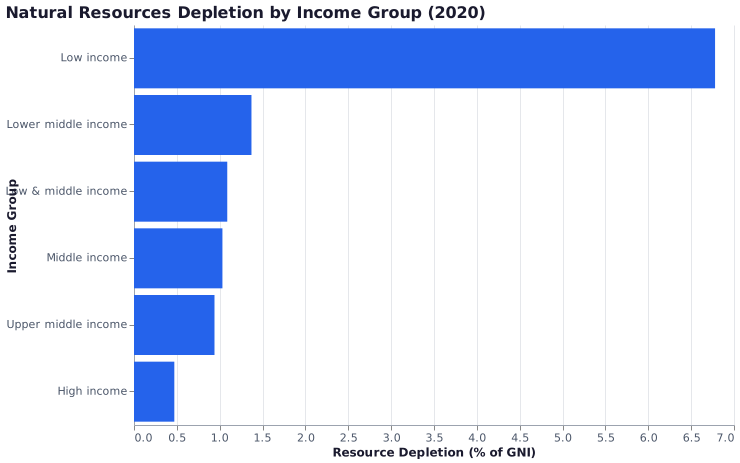
The pattern of resource depletion reveals another dimension of global inequality. Low-income countries deplete a far larger share of their national income through resource extraction than wealthy countries do. They are, in effect, selling off their natural capital to finance consumption elsewhere. This is not sustainable development; it is liquidation.
This does not mean technology is irrelevant—far from it. Renewable energy, efficient buildings, regenerative agriculture, and other innovations are essential components of any sustainable future. But technology alone cannot solve the problem if the growth imperative keeps pushing consumption upward faster than efficiency can reduce its impacts.
Part V: Drawing the Doughnut
If GDP growth cannot be sustained indefinitely and is not the same as human progress, what should we use as our compass? Kate Raworth, an economist who has worked with both Oxfam and the University of Cambridge, proposed an answer: the Doughnut.
Raworth's framework combines two sets of boundaries. The outer ring represents the ecological ceiling—the planetary boundaries beyond which we risk environmental collapse. The inner ring represents the social foundation—the minimum levels of wellbeing below which people lack the basics of a good life. The goal of economic policy should be to bring humanity into the space between these rings: the safe and just space where we meet everyone's needs without overshooting planetary limits.
The Doughnut makes visible what GDP obscures. A growing economy that pushes beyond the ecological ceiling is not succeeding—it is borrowing from the future. An economy that leaves people below the social foundation is not successful either, no matter how high its GDP. The only genuine success is an economy that provides for all within the means of the planet.
Raworth's framework has moved from academic idea to practical policy. In 2020, Amsterdam became the first city to formally adopt the Doughnut as a guide for post-pandemic recovery. The city commissioned a "Doughnut portrait" of Amsterdam, measuring its performance against both ecological and social thresholds. Where was the city overshooting planetary boundaries? Where was it failing to meet residents' needs? The answers guided policy priorities.
Since then, more than 70 cities around the world have embraced Doughnut principles, from Copenhagen to Portland to Brussels. The Doughnut Economics Action Lab, co-founded by Raworth, supports a global network of practitioners working to translate the framework into action.
Measuring What Matters
The Doughnut is one of several alternative frameworks that attempt to measure economic success differently. Others include the Genuine Progress Indicator (GPI), which adjusts GDP for factors like inequality, environmental damage, and the value of unpaid work; the Human Development Index (HDI), which combines income with health and education; and Bhutan's Gross National Happiness, which attempts to measure psychological wellbeing directly.
Each of these alternatives has limitations. GPI requires many subjective judgments about what to include and how to value it. HDI still uses income as one of its three components. Gross National Happiness is difficult to compare across cultures. But all of them share a common insight: what we measure shapes what we value, and what we value shapes what we do. If we measure only GDP, we will pursue only growth. If we measure wellbeing, sustainability, and equity, we might pursue those instead.
Several governments have begun experimenting with alternative measures. Scotland, Iceland, New Zealand, Wales, and Finland have formed the Wellbeing Economy Governments network, committed to putting wellbeing at the center of policy. New Zealand introduced "wellbeing budgets" in 2019, requiring government departments to show how their spending would improve five priority areas: mental health, child wellbeing, supporting Maori and Pacific peoples, building a productive economy, and transitioning to a sustainable and low-emissions economy.
These experiments have faced challenges. Political transitions can reverse progress; New Zealand's wellbeing focus has weakened under new leadership. Measuring wellbeing is harder than measuring GDP, and the data infrastructure is less developed. But the experiments demonstrate that alternatives are possible—that governments can make policy choices based on something other than the pursuit of endless growth.
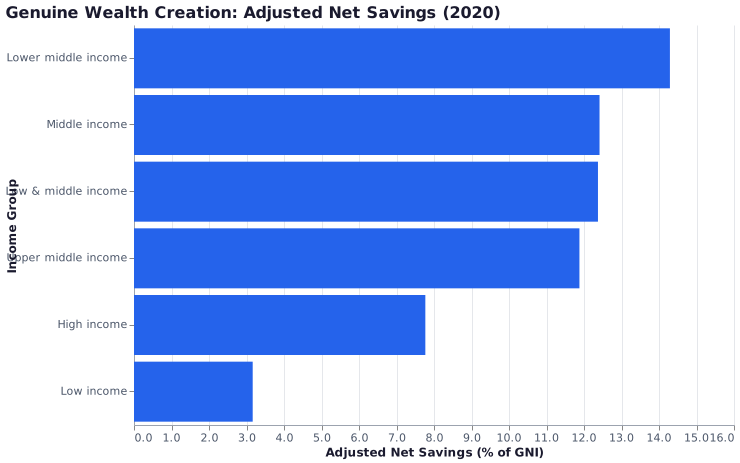
The World Bank's "adjusted net savings" indicator attempts to measure something closer to genuine wealth creation—what remains after accounting for resource depletion, pollution damage, and the depreciation of produced capital, while adding investments in human capital through education. By this measure, the picture looks quite different from GDP growth. Some countries that appear to be growing economically are actually running down their natural capital faster than they are building new wealth.
Part VI: What Degrowth Actually Means
Of all the alternatives to growth economics, degrowth is perhaps the most misunderstood. Critics imagine it as a call for recession, for poverty, for a return to pre-industrial living standards. Proponents argue that it means something quite different: a deliberate, democratic reduction in material and energy throughput designed to bring the economy into balance with ecological limits while improving—not worsening—human wellbeing.
The term "degrowth" (décroissance in French, where the concept originated) is admittedly provocative. Hickel has suggested that "post-growth" might be less likely to trigger misunderstanding. But the provocation is partly intentional: it forces confrontation with the assumption that more is always better, that shrinking any economic measure is necessarily bad.
Degrowth advocates distinguish sharply between degrowth and recession. A recession is an unplanned collapse in economic activity that causes unemployment, poverty, and misery. Degrowth is a planned transition that reduces material throughput while maintaining or improving quality of life. The key difference is intentionality and accompanying policies.
Degrowth
A planned reduction of excess energy and resource use to bring the economy back into balance with the living world in a way that reduces inequality and improves human wellbeing.
What would a degrowth transition look like in practice? The policy proposals most commonly discussed include: reducing working hours (with no loss of pay) to share employment and reduce production; expanding universal public services (healthcare, education, housing, transportation) so people need less income to meet their needs; capping resource use and emissions through declining quotas; and transitioning from ownership to sharing through libraries of things, tool shares, and similar institutions.
Critically, degrowth does not mean reducing everything equally. It means reducing those sectors that are ecologically destructive and socially unnecessary—fossil fuels, SUVs, fast fashion, planned obsolescence, food waste—while expanding sectors that improve wellbeing with minimal material throughput: care, education, arts, public health, ecological restoration. The goal is not austerity but sufficiency: enough for everyone, within planetary limits.
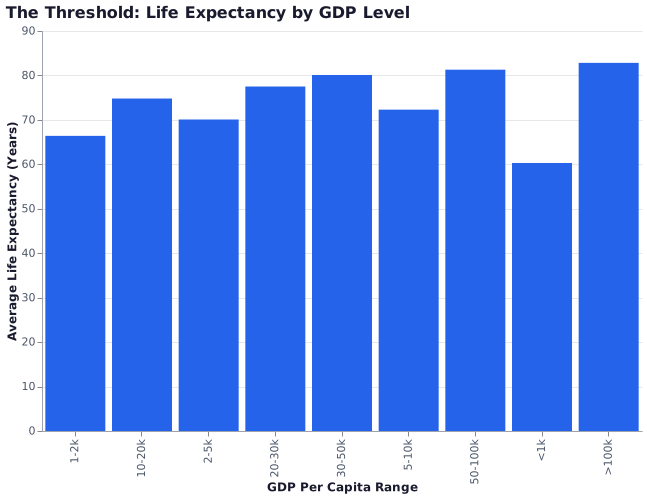
The data reveals a striking pattern. When we analyze life expectancy across all countries and bin them by GDP per capita level, the results are unambiguous. Countries with less than $1,000 per capita average 60 years of life expectancy. Moving to $2,000-5,000 per capita adds roughly 10 years. But moving from $30,000-50,000 to $50,000-100,000—despite more than doubling income—adds only about one year. And countries above $100,000 per capita live only 1.5 years longer than those at $50,000-100,000. The returns to growth diminish dramatically.
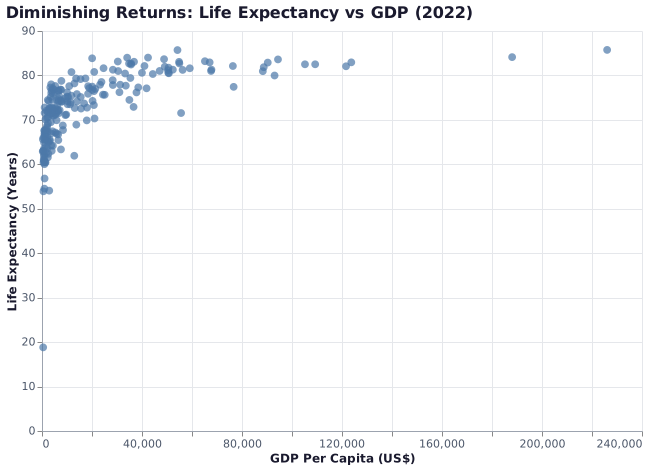
The scatter plot above shows the same pattern in individual country data. Life expectancy rises steeply with GDP at low income levels. But beyond roughly $20,000-30,000 per capita, additional GDP adds almost nothing to longevity. The curve flattens. Rich countries could have half their current GDP and still enjoy essentially the same life expectancy. Growth, at this point, is not buying health—it is buying consumption for its own sake.
A Survey of 530 Policies
A comprehensive 2022 survey identified 530 specific policy proposals in the degrowth literature, spanning thirteen policy themes from food systems to urban planning. The ten most frequently cited proposals were: universal basic incomes, work-time reductions, job guarantees with living wages, maximum income caps, declining caps on resource use and emissions, support for cooperatives and not-for-profit enterprises, citizen deliberative forums, reclaiming the commons, ecovillages, and housing cooperatives.
What is striking about this list is how many of the proposals are already being implemented somewhere. Four-day work week trials are underway in multiple countries. Universal basic income experiments have been conducted from Finland to Kenya. Housing cooperatives thrive in Germany and Switzerland. Citizen assemblies have influenced policy in Ireland and France. Degrowth is not a utopian fantasy requiring revolutionary transformation but a synthesis of reforms that are already being tested and, in many cases, succeeding.
Of course, implementing these reforms at scale—and in the context of an economic system structured around growth—presents enormous challenges. But the challenges are political and institutional, not technical. We know how to reduce working hours, expand public services, and cap emissions. The question is whether we can overcome the interests that benefit from the status quo.
Part VII: Buen Vivir—Perspectives from the Global South
The degrowth movement is sometimes criticized as a Northern phenomenon—wealthy Europeans proposing that economies should shrink, while billions in the Global South still lack basic necessities. This criticism deserves serious engagement. Hickel himself has emphasized that degrowth is primarily a prescription for rich countries, which have overshot their fair share of ecological space, and that the conversation looks different from the perspective of communities that have never experienced the excesses of industrial capitalism.
But critics of growth are not only found in the Global North. Indigenous and peasant communities around the world have articulated alternatives to development that predate and parallel the degrowth movement. Among the most influential is Buen Vivir, or Sumak Kawsay—concepts rooted in Andean Indigenous thought that have been enshrined in the constitutions of Ecuador and Bolivia.
Sumak Kawsay translates roughly as "life in plenitude" or "living well." Unlike the Western concept of development, it does not assume linear progress toward ever-greater material accumulation. Instead, it emphasizes harmony—with oneself, with community, and with nature. In Andean cosmology, there is no concept of "underdevelopment" because there is no assumption that all societies should be moving toward the same destination.
Ecuador's 2008 constitution was the first in the world to recognize rights of nature—to grant legal standing to ecosystems and require that they be "maintained and regenerated." Bolivia's 2011 Law of Mother Earth went further, establishing eleven specific rights of the natural world and creating the position of Ombudsman for Nature. These legal innovations reflect a fundamentally different relationship with the non-human world than that assumed by GDP-focused economics.
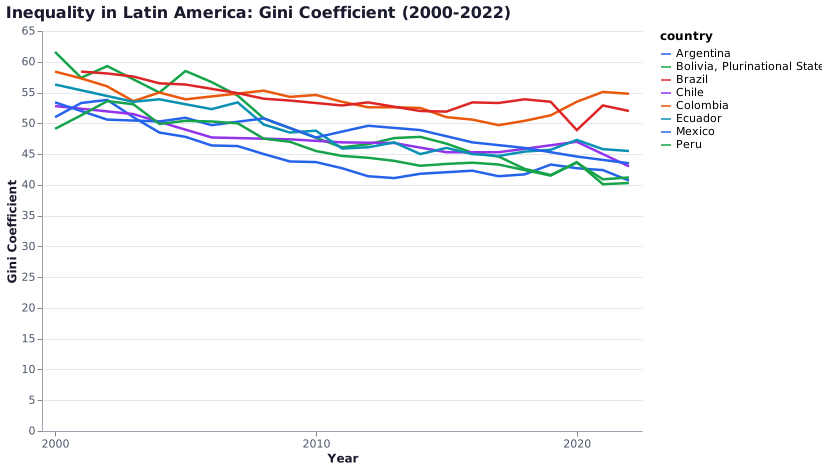
Latin America offers a complex picture. The region has historically had some of the world's highest inequality, but several countries—notably Bolivia and Ecuador during the Buen Vivir era—achieved significant reductions in inequality while also advancing environmental protections. This suggests that the trade-offs between equity and ecology that sometimes seem inevitable may be more malleable than assumed.
Similar concepts exist in other cultures: Ubuntu in South Africa, with its emphasis on interdependence ("I am because we are"); Swaraj in India, Gandhi's vision of self-rule extending from individuals to villages to nations; and numerous indigenous philosophies that understand humans as part of, rather than masters of, the web of life.
These perspectives challenge not only the growth imperative but the entire framework within which development is typically discussed. They suggest that the question is not "how can poor countries become rich like us?" but "what does flourishing look like in different contexts, and how can we achieve it without destroying the conditions for life on Earth?"
The Decolonial Challenge
Some scholars from the Global South have pushed back against degrowth itself, arguing that even this critical movement sometimes reproduces colonial patterns of thought. A 2024 collective formed after the Pontevedra degrowth conference issued a statement calling for "delinking" alongside or instead of degrowth—a term with roots in African and Latin American dependency theory that emphasizes breaking free from global structures of economic subordination.
The concern is that degrowth, as conceived in the Global North, might be implemented in ways that maintain or even deepen inequalities. If wealthy countries reduce their consumption without changing the terms of trade, without reparations for historical extraction, without technology transfer and debt cancellation, then the Global South might find itself with less demand for its exports and no alternative path to meeting its population's needs.
Hickel has engaged with these critiques directly, arguing that degrowth as he understands it must include what he calls "a redistribution of existing income and resources, moving money from the rich to the poor to ensure that the benefits of existing production are fairly shared." It must include cancellation of illegitimate debts imposed on Global South countries. It must include an end to the unequal exchange that drains value from South to North through trade. Degrowth that fails to address these structural injustices would indeed be a betrayal—but genuine degrowth, Hickel argues, is fundamentally a project of global justice.
Part VIII: The Transition
If perpetual growth is impossible and alternatives exist, why have they not been adopted? The answer lies partly in interests—those who benefit from the current system resist change—and partly in imagination. We find it difficult to envision a world organized differently from the one we have always known.
Graeber devoted much of his career to expanding the realm of the imaginable. "The ultimate, hidden truth of the world," he wrote, "is that it is something that we make, and could just as easily make differently." His historical and anthropological work was designed to show that the arrangements we take for granted—money, debt, markets, wage labor—are not eternal laws but contingent creations that have varied enormously across time and place.
In "The Dawn of Everything," co-authored with the archaeologist David Wengrow, Graeber challenged the standard story of human history: that we progressed from simple bands of hunter-gatherers through tribes to chiefdoms to states, gaining complexity and hierarchy as we went. Drawing on recent archaeological evidence, he showed that early human societies were far more varied and experimental than this narrative suggests. Some were egalitarian; some were hierarchical. Some oscillated between different modes depending on the season. The idea that complexity requires hierarchy is an artifact of our assumptions, not a law of nature.
The practical implication is hope. If human beings have organized their economic lives in radically different ways in the past, they can do so again in the future. The growth imperative is not a fact of nature but a product of specific historical circumstances—circumstances that can be changed.
Prefigurative Politics
How might change happen? One approach, emphasized by Graeber and by many in the degrowth movement, is prefigurative politics: building alternatives in the present rather than waiting for a revolution to create them. This means creating institutions—cooperatives, commons, mutual aid networks, time banks—that embody different values, and expanding them until they become viable alternatives to capitalist ways of organizing.
Examples abound. The Mondragon Corporation in Spain is a federation of worker cooperatives that employs over 80,000 people and generates billions in revenue—proof that large-scale enterprise is possible without traditional capitalist ownership. Community land trusts in cities around the world remove housing from the speculative market and keep it affordable in perpetuity. Platform cooperatives like Stocksy (for photography) and Resonate (for music streaming) offer alternatives to the extractive gig economy.
These experiments remain marginal compared to the mainstream economy. But they demonstrate possibility. They show that production can be organized democratically, that ownership can be shared, that growth is not the only logic that businesses can follow. Each successful example makes the next one easier to imagine.
At the same time, prefiguration has limits. Local experiments cannot on their own transform global structures. Cooperatives must still compete in capitalist markets. Alternative communities exist within legal and financial systems designed for other purposes. Systemic change requires not only building alternatives but also transforming the rules of the game—through policy, through politics, through power.
Part IX: The Politics of Post-Growth
Can a post-growth politics succeed? The obstacles are formidable. The growth imperative is not just ideology but is embedded in institutions: in pension systems that require returns on investment, in tax structures that assume expanding revenues, in labor markets that connect employment to production, in democratic politics that rewards governments for delivering rising living standards.
Hickel and others have sketched what institutional transformation might look like. Central banks could be mandated to pursue ecological stability rather than economic growth. Tax systems could shift from taxing labor and income (which we want) to taxing resource extraction and pollution (which we do not). Working hours could be reduced to share employment, with social policies ensuring that everyone has enough. Universal basic services—healthcare, education, housing, transportation—could guarantee access to necessities regardless of income, reducing the amount people need to earn.
Some proposals draw on Modern Monetary Theory (MMT), which holds that governments that issue their own currencies are not constrained in the way that households or businesses are. They can spend without first collecting taxes, as long as the spending does not push the economy beyond its productive capacity or ecological limits. This opens space for financing a transition—for investing in renewable energy, public services, and green jobs without requiring growth to pay for it.
The political coalitions for such changes are uncertain. Historically, organized labor has often aligned with capital in pursuing growth, seeing it as the source of jobs and rising wages. Environmentalists have sometimes advocated policies that threatened working-class livelihoods. Building a politics that unites these constituencies—that promises both ecological sustainability and economic security—is the central challenge.
Signs of Shift
Despite the obstacles, there are signs that the political terrain is shifting. The 2023 Beyond Growth conference at the European Parliament was one marker. The New Zealand wellbeing budgets were another. The youth climate movement has placed systemic change on the agenda in ways that incremental environmentalism never did. Public opinion polls in some wealthy countries show growing skepticism toward endless growth, especially among younger generations.
The economic disruptions of recent years—the 2008 financial crisis, the COVID-19 pandemic, the inflation and cost-of-living crises that followed—have also created openings. When the normal economy is disrupted, alternatives become easier to imagine. The pandemic demonstrated that governments could, when motivated, intervene dramatically in markets, providing income support, restricting activity, and prioritizing health over GDP. If we could do that for a virus, some asked, why not for the climate?
Whether these openings lead to transformation or are closed by a return to business-as-usual remains to be seen. History suggests that crises are moments of possibility—but not guarantee. They can lead to progress or reaction, to greater equality or deeper entrenchment of power. The outcome depends on what movements, ideas, and coalitions are ready to seize the moment.
Part X: The Economy We Need
What would an economy beyond growth actually look like? Not one thing but many: different societies would find different paths toward sufficiency and flourishing. But some elements might be common.
Work would look different. With productivity gains shared as leisure rather than accumulated as profits, the average workweek might be twenty or twenty-five hours. People would have more time for care—of children, of elders, of each other. Housework and child-rearing, currently invisible in economic statistics, would be recognized as the valuable labor they are. Some suggest schemes like "4-in-1"—four hours of wage work, four hours of care work, four hours of community engagement, and four hours of personal development—to reflect the multiple dimensions of a full life.
Consumption would look different. Rather than a throwaway culture of planned obsolescence and fast fashion, products would be designed for durability, repairability, and reuse. Libraries of things would let people borrow what they need occasionally without owning it. Sharing and borrowing would supplement (not replace) private ownership. Status would attach not to having the newest thing but to living well within limits.
Production would look different. Cooperatives and social enterprises would play a larger role, alongside reformed corporations with broader ownership and governance. Finance would serve the real economy rather than dominating it. The "care economy"—health, education, social services—would expand while extractive and wasteful sectors contracted. Agriculture would become more local and regenerative, healing soils rather than depleting them.
The relationship with nature would look different. Rather than treating the natural world as a resource to be exploited, societies would recognize themselves as part of ecosystems with obligations to other species and future generations. The legal innovations pioneered in Ecuador and Bolivia—rights of nature, standing for ecosystems—might become common. Development would be measured not by how much we take from nature but by how well we flourish within its bounds.
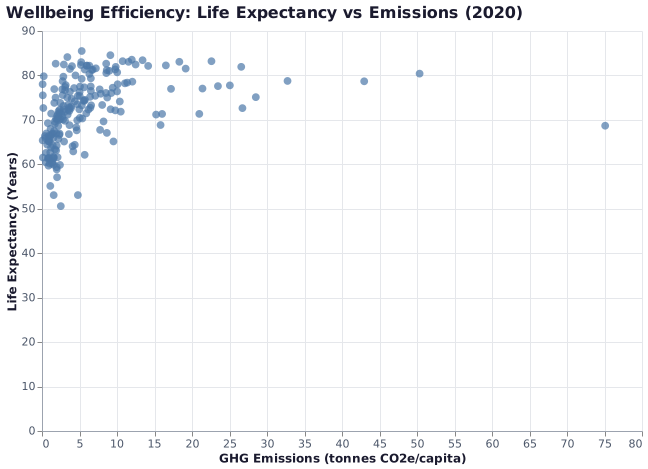
The scatter plot above reveals something striking: some countries achieve high life expectancy with relatively low emissions, while others emit vast amounts of carbon for only modest gains in longevity. This variation suggests that there is nothing inevitable about the high-emission, high-consumption model. Different paths to wellbeing are possible—some far more sustainable than others.
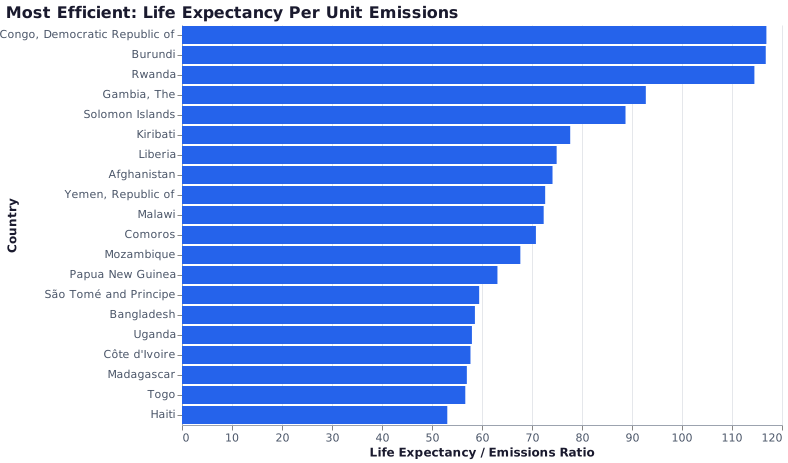
When we calculate an efficiency ratio—life expectancy divided by emissions per capita—a different set of countries emerges as leaders. These are places that achieve high human development outcomes with minimal environmental impact. The ranking challenges conventional assumptions about development: it is not the richest countries that perform best, but those that have found ways to provide healthcare, nutrition, and security without the material throughput that wealthy nations take for granted.
A Note on Technology
Critics sometimes portray degrowth as anti-technology—a romantic yearning for a pre-industrial past. This is a misunderstanding. Degrowth advocates generally embrace technology that serves human and ecological ends. Renewable energy, efficient buildings, agroecological farming, clean transport—these are essential tools for reducing material throughput while maintaining quality of life.
What degrowth challenges is not technology but the assumption that technology alone can solve our problems—that we can innovate our way to sustainability without changing how much we consume or how the economy is organized. Technology is necessary but not sufficient. A faster smartphone and a more efficient car will not save us if we also demand more smartphones and bigger cars.
Moreover, technology is not neutral. It is shaped by the social and economic systems within which it develops. Technology designed for maximizing profits in a growth economy will look different from technology designed for sufficiency and sustainability. A post-growth society might develop very different technologies than we have now—not necessarily less sophisticated but oriented toward different goals.
Part XI: Objections and Responses
The case for moving beyond growth attracts serious objections. These deserve honest engagement rather than dismissal.
Objection: Poor countries need growth. This is partly true. Billions of people lack basic necessities—adequate food, clean water, healthcare, education—and producing more of these goods is essential. But two points complicate this objection. First, what the Global South needs is not aggregate GDP growth but specific improvements in wellbeing, which might be achieved more efficiently through redistribution and targeted investment than through general growth. Second, the ecological space for this growth can only be created if wealthy countries reduce their own material throughput. Rich-country degrowth is the condition for poor-country development, not its enemy.
Objection: Degrowth would cause unemployment and poverty. Only if it is implemented badly—as recession rather than planned transition. The degrowth literature emphasizes that reducing production must be accompanied by policies that share work, guarantee incomes, and provide universal services. Unemployment is not a natural consequence of producing less; it is a consequence of linking livelihoods to jobs in a system where jobs require growth. Change the link—through shorter workweeks, job guarantees, universal basic income or services—and the problem is solved.
Objection: People will not accept lower living standards. This assumes that more consumption equals higher living standards, which is precisely the equation that degrowth challenges. Beyond a certain level of material sufficiency, additional consumption does not increase wellbeing. What makes people happy is relationships, meaningful work, health, security, community, leisure—not the accumulation of more stuff. A degrowth society might have lower GDP but higher quality of life.
Objection: Degrowth is politically impossible. Perhaps—but so is every other pathway to sustainability. A 1.5-degree future requires changes to the economy that no mainstream party is proposing. The choice is not between realistic and unrealistic options but between different kinds of disruption: the disruption of deliberate transition or the disruption of ecological collapse. Given that choice, it is worth fighting for the better option even if success is uncertain.
Objection: The term "degrowth" is counterproductive. This may be the strongest objection. Calling for degrowth invites misunderstanding and triggers immediate resistance. Terms like "post-growth," "wellbeing economy," or "steady-state economy" might communicate similar ideas with less baggage. Hickel himself has sometimes used "post-growth," and the language of the movement continues to evolve.
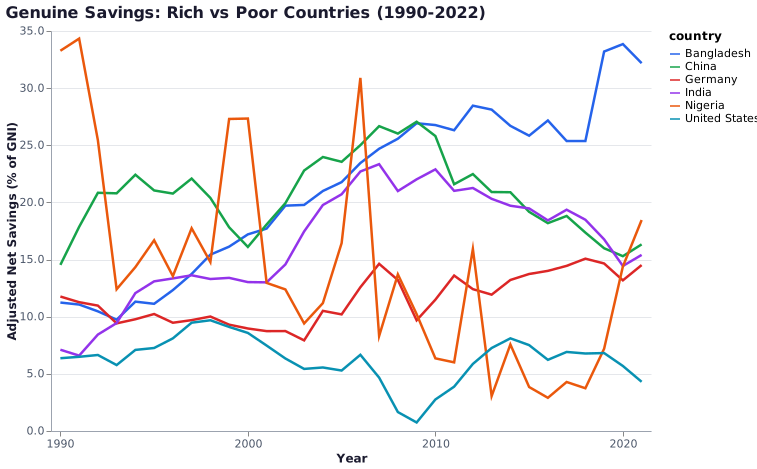
The chart above shows adjusted net savings—a measure of genuine wealth creation—for a selection of countries over time. The patterns are revealing. China and India show positive adjusted savings, meaning they are building genuine wealth even after accounting for environmental degradation. Some wealthy countries show surprisingly modest genuine savings despite high GDP. And some resource-dependent countries show negative adjusted savings in some periods—they are literally running down their wealth to finance current consumption.
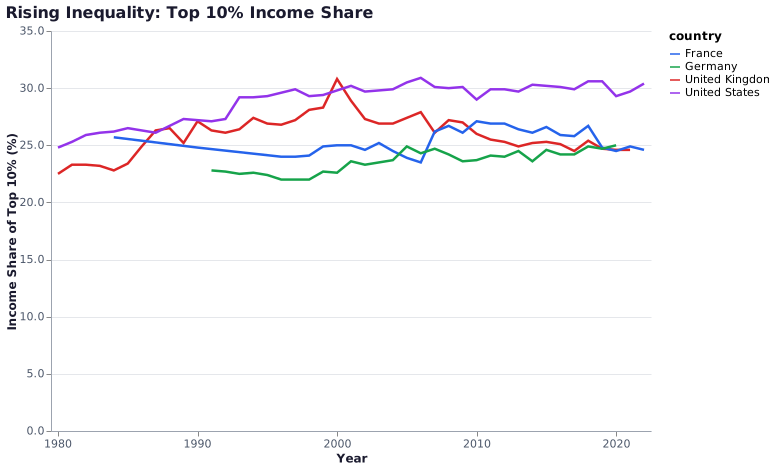
Meanwhile, inequality within wealthy countries has been rising for decades. The share of income going to the top 10 percent has increased substantially in the United States, the United Kingdom, and elsewhere. This matters for the post-growth argument because it suggests that even when GDP grows, the benefits are increasingly captured by a small elite. If growth does not translate into broadly shared prosperity, what exactly is it for?
Conclusion: The Possible World
David Graeber died in 2020, at the age of fifty-nine, before seeing whether the ideas he championed would gain the traction they deserved. He left behind a body of work that refuses to accept the world as it is—that insists, again and again, that human beings are capable of organizing their lives differently.
Jason Hickel continues the work, with research that quantifies what has been stolen and what must change. His numbers are staggering—$242 trillion drained from the Global South, 826 billion hours of embodied labor appropriated annually, 92 percent of excess emissions from the Global North. But behind the numbers is an argument about what economies are for: not to grow indefinitely but to provide good lives within ecological limits.
The transition they describe will not be easy. The interests aligned against it are powerful. The institutional changes required are profound. The imagination needed to see beyond growth—to envision prosperity without endless expansion—does not come naturally to those raised in growth-obsessed societies.
But the alternative is worse. A world that tries to maintain the growth imperative on a finite planet will hit limits eventually—through climate catastrophe, resource depletion, ecological collapse. Better to choose the transition than to have it forced upon us by circumstances we can no longer control.
"The ultimate hidden truth of the world is that it is something that we make, and could just as easily make differently." — David Graeber
The economy is not a natural phenomenon like the weather. It is a human creation—the product of choices made over centuries about how to organize production, distribution, and consumption. Those choices can be unmade. Different choices can be made in their place.
The work of Graeber and Hickel, and of the broader movements they represent, is not to predict the future but to open it—to demonstrate that alternatives exist, that they have worked before and can work again, that the story we tell about growth as inevitable and necessary is just that: a story. We can tell different stories. We can build different institutions. We can make a different world.
The question is not whether we will move beyond growth. Eventually, we must. The question is whether we do so deliberately, democratically, and justly—or whether we wait for limits to impose themselves upon us. The choice, for now, is still ours.