Blood Money
What the Median Citizen Pays for State Violence
Opening: The Receipt
Every April, I sign my tax return. The numbers are not abstract to me anymore. Last year, my federal tax bill came to $14,847. Of that sum, approximately $3,563 went to the Department of Defense and related military spending. Another $892 funded veterans' benefits—the ongoing cost of wars already fought. Together, nearly $4,500 of my annual contribution to the federal government went to the machinery of organized violence.
This is the receipt I never asked for but cannot refuse. It arrives not in the mail but in the form of a moral question I've spent years trying to answer: What did my money pay for?
The question sounds simple. The answer is anything but.
In 2024, the United States spent $886 billion on defense—more than the next ten countries combined. That spending employs 2.9 million people directly and supports millions more in the defense industrial base. It maintains 750 military bases in 80 countries. It funds the research that produced the internet, GPS, and countless medical advances. It deters adversaries and reassures allies. These are the arguments made in its favor.
But that same spending also funds drone strikes that kill wedding parties in Yemen. It purchases the bombs that flatten apartment buildings in Gaza. It maintains a nuclear arsenal capable of ending human civilization. It has funded coups, death squads, and torture programs on every continent. These are the facts that official rhetoric omits.
I am not a soldier. I have never fired a weapon at another human being. I have never ordered anyone killed. Yet every year, I write a check that makes all of it possible. I am one of 150 million American taxpayers whose collective contributions fund the world's most powerful military. The question I cannot escape is: What portion of the blood is on my hands?
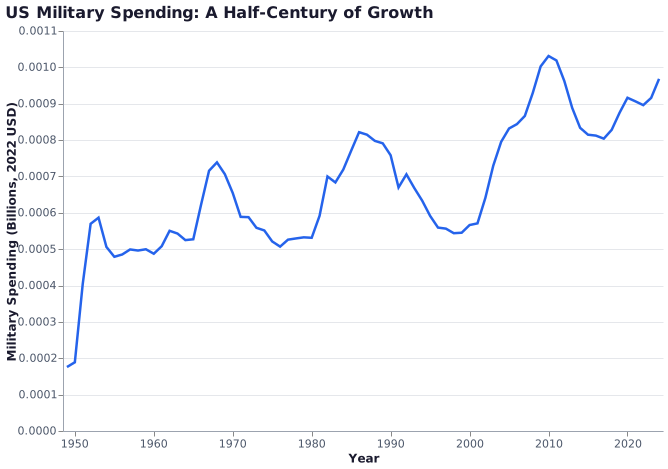
Figure 0.1: U.S. military spending in constant 2023 dollars, 1949-2024. The peaks correspond to Korea, Vietnam, the Reagan buildup, and the post-9/11 wars. Source: SIPRI Military Expenditure Database.
This book attempts to answer that question with data rather than rhetoric. It is not an anti-war polemic, though I have my views. It is not a defense of military spending, though I acknowledge its complexities. It is, instead, an accounting—a ledger of what citizens have paid and what that payment has purchased, measured in the coldest possible currency: human lives.
The Methodology
To calculate what a median taxpayer contributes to state violence, we need three things: income data, tax data, and military spending data. The first two tell us how much the typical citizen pays in taxes. The third tells us what share of those taxes goes to the military. From there, we can derive a simple metric: the Median Taxpayer Military Contribution (MTMC)—the amount a median-income citizen pays toward the military each year.
But money is only half the equation. To understand what that money buys, we need death data: how many people died as a result of military action, and how to attribute responsibility for those deaths. This is where the methodology becomes genuinely difficult.
Consider a single drone strike in Pakistan. The missile was built by Lockheed Martin with taxpayer funds. The drone was operated by CIA personnel whose salaries come from the black budget. The strike killed four people: two alleged militants, one woman, and one child. The militants were never charged with any crime or given a trial. The woman and child were described as "collateral damage."
How do we count these deaths? Are all four attributable to American taxpayers? Only the two civilians? Only the two militants, who were the intended targets? What about the Pakistani civilian who died three months later from injuries sustained in the blast—does she count? What about her son, who joined a militant group in response to his mother's death and was himself killed two years later?
These are not abstract questions. The answers determine whether the post-9/11 wars killed hundreds of thousands or millions. They determine whether American taxpayers funded a tragic but limited intervention or an epochal catastrophe. And they determine the moral weight each of us must carry.
Throughout this book, I will present multiple counts: conservative estimates that include only direct civilian deaths from official military action, and inclusive estimates that count combatants, indirect deaths, and violence by proxy forces. I will not tell you which count is correct. That is a moral judgment each reader must make for themselves.
The Scope
This investigation spans three dimensions.
Part I: The Price of Power examines history. From the Belgian Congo to Nazi Germany, from Stalin's purges to Pol Pot's killing fields, we calculate what median citizens in various societies paid toward state violence and what that payment purchased. The patterns are disturbing: some of history's worst atrocities were remarkably cheap, while modern warfare has become extraordinarily expensive per death.
Part II: American Reckoning focuses on a single country across fifty years—my own lifetime. I was born in 1975, the year Saigon fell. Since then, I have lived through the end of Vietnam, the Cold War's final chapter, the post-Cold War "peace dividend," and the Forever Wars that followed September 11, 2001. This section calculates year by year what the median American taxpayer contributed to military spending and what that spending produced.
Part III: The Economics of Violence compares different modes of killing. The Rwandan genocide killed 800,000 people in 100 days with $112 million in arms imports—roughly $140 per death. A single Tomahawk cruise missile costs $2 million and might kill a handful of people. What do these comparisons tell us about the nature of state violence and the taxpayer's role in funding it?
Part IV: The Moral Ledger confronts the philosophical questions that the data raises. What responsibility does a taxpayer bear for violence committed in their name? How should we weigh deaths caused by our own government against deaths prevented by its power? Is there any escape from complicity, or is the only honest response despair?
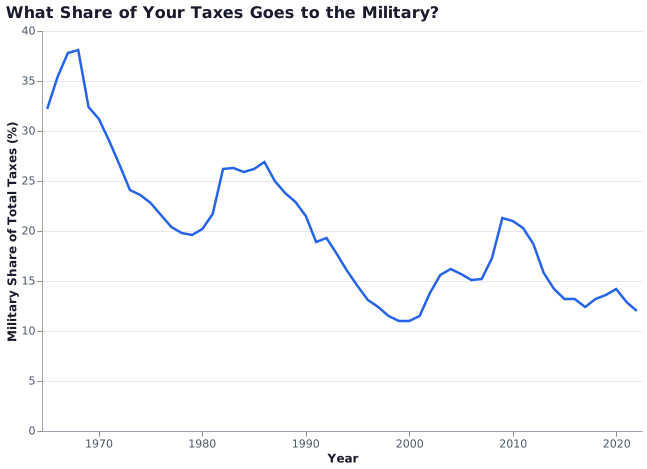
Figure 0.2: Military spending as a percentage of federal tax revenue, 1965-2023. At its peak during the Vietnam War, more than 40 cents of every tax dollar went to defense. Source: SIPRI, World Bank, IRS.
Why This Book
I have been thinking about these questions for decades. As a child of the 1980s, I grew up during the final phase of the Cold War, when nuclear annihilation seemed plausible and defense spending consumed a quarter of the federal budget. As a young adult in the 1990s, I watched the "peace dividend" evaporate into a series of humanitarian interventions that seemed, at the time, relatively benign. And as a middle-aged man in the 2000s and 2010s, I witnessed my country launch wars that would kill hundreds of thousands and cost trillions.
Through all of it, I paid my taxes.
This is not a confession. I do not believe I am personally guilty of murder, any more than I believe the German baker in 1943 was personally guilty of the Holocaust. But I do believe that citizenship creates obligations, and that one of those obligations is honesty about what our collective institutions do in our name and with our money.
Most discussions of military spending treat it as an abstraction—a line item in a budget, a percentage of GDP, a comparison to other countries. These framings obscure the fundamental reality: military spending exists to kill people. Sometimes that killing is justified; sometimes it is not. But every dollar spent on bombs and bullets is a dollar that could have been spent on schools or hospitals, and every death caused by those bombs and bullets is a death that might have been prevented.
This book makes the abstraction concrete. It names the dead. It tallies the cost. It presents the receipt.
What you do with that information is up to you.
Chapter 1: The Accounting of Death
Before we can calculate what citizens paid for atrocities, we must grapple with a problem that has haunted historians, demographers, and human rights researchers for generations: How do we count the dead?
The question seems straightforward. A person is either alive or dead. But in the context of mass violence, counting becomes an act of interpretation fraught with political implications. The number of deaths attributed to an event shapes how we understand its significance, assign blame, and draw lessons for the future. A massacre of hundreds is a tragedy; a massacre of millions is a historical pivot point. The stakes of counting correctly could not be higher.
Yet the obstacles to accurate counting are formidable. Wars destroy records. Governments conceal their crimes. Victims are often anonymous—peasants and villagers whose names were never written down, refugees who died fleeing across unmarked borders, prisoners who vanished into unmarked graves. Even when bodies can be counted, attributing cause of death requires judgments about what counts as violence and who bears responsibility.
This chapter surveys the major approaches to counting conflict deaths, explains their differences, and establishes the framework we will use throughout this book.
The Data Landscape
The systematic study of conflict mortality is surprisingly young. Before World War II, most death tolls were rough estimates based on anecdote and military records. The Holocaust forced a reckoning: the world needed better methods for documenting atrocity. In the decades since, several major research programs have emerged.
The Uppsala Conflict Data Program (UCDP), based at Uppsala University in Sweden, has tracked armed conflicts worldwide since 1946. UCDP maintains a database of "battle-related deaths"—fatalities resulting directly from armed combat between organized groups. Their methodology is conservative: they require documented evidence for each death, which means their counts are almost certainly underestimates but highly reliable.
R.J. Rummel's democide research, conducted at the University of Hawaii from the 1970s until his death in 2014, took a different approach. Rummel was interested in what he called "democide"—the murder of citizens by their own government, including genocide, mass murder, and deaths from government-created conditions like forced famine. His methodology emphasized comprehensive estimation, accepting wider uncertainty ranges in exchange for capturing deaths that other approaches might miss.
The Political Terror Scale (PTS), developed by political scientists in the 1980s, measures state repression on an ordinal scale from 1 (minimal) to 5 (widespread terror). Rather than counting individual deaths, PTS assesses the overall level of violence based on reports from Amnesty International and the State Department. This approach sacrifices precision for comparability across countries and time periods.
Project-specific investigations provide detailed counts for individual conflicts. The Iraq Body Count project has documented over 200,000 violent deaths in Iraq since 2003. The Bureau of Investigative Journalism tracks drone strikes in Pakistan, Yemen, Somalia, and Afghanistan. Brown University's Costs of War project provides comprehensive estimates for the post-9/11 wars. Each uses slightly different methods suited to its particular context.
These various approaches produce numbers that can differ by orders of magnitude. Iraq is the starkest example: Iraq Body Count documented approximately 200,000 violent civilian deaths between 2003 and 2020. The Lancet study published in 2006 estimated 655,000 excess deaths in just the first three years of the war. A 2013 PLOS Medicine study estimated 500,000 excess deaths. The true number remains unknown and may be unknowable.
The divergence between UCDP and Rummel illustrates how methodology shapes our understanding of history. For the Soviet Union between 1917 and 1987, UCDP's battle-death methodology captures approximately 500,000 deaths—primarily from the Civil War, World War II, and the Afghan conflict. Rummel's democide approach, by contrast, estimates 62 million deaths from the same period, including the Gulag system, forced collectivization, the Great Terror, and deaths from intentional famine. The ratio between these estimates—124 to 1—is not a failure of either methodology but a reflection of their different purposes. UCDP counts military conflict; Rummel counts state murder of citizens. Both are measuring real phenomena; neither captures the complete picture.
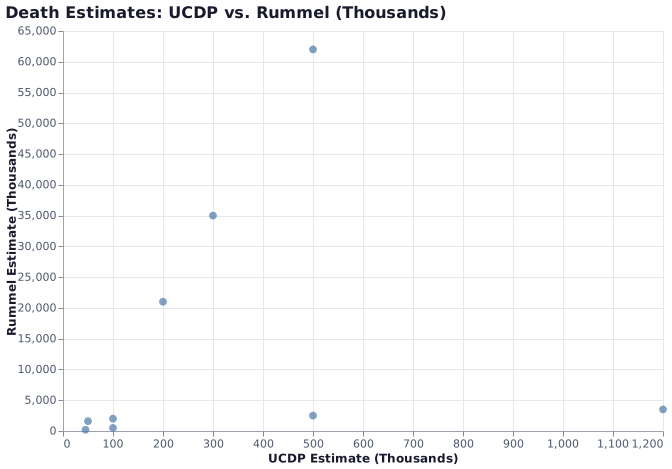
Figure 1.1: Comparing death estimates from UCDP (battle deaths) versus Rummel (democide) for major 20th century events. Note the logarithmic scales—differences often span two orders of magnitude. Source: Uppsala Conflict Data Program (UCDP), R.J. Rummel democide database.
The discrepancies are systematic. UCDP consistently produces lower counts because it requires documented evidence of each battle-related death and excludes deaths that occurred outside direct combat. Rummel consistently produces higher counts because he includes deaths from state-created conditions—famine, disease, forced labor—that would not appear in combat records. Neither approach is wrong; they are measuring different things.
Consider the Holodomor, the Ukrainian famine of 1932-1933. UCDP does not count these deaths at all because they did not result from armed combat. Rummel counts 5-7 million deaths as democide because the famine was caused by Soviet agricultural policies—requisitioning grain, restricting population movement, and deliberately withholding food aid. The historical record suggests Rummel's interpretation is correct: this was state murder, not natural disaster. But the distinction matters for our purposes because it determines which frameworks consider these deaths as "state violence" funded by taxpayers versus misfortune beyond human control.
The methodological challenges multiply when we attempt historical comparisons. How do we count deaths from European colonialism? The population of the Congo under Leopold II declined by perhaps 10 million people between 1885 and 1908. Were these deaths caused by violence, exploitation, disease, or some combination? Who bears responsibility—Leopold personally, the Belgian state that took over in 1908, the mercenary forces that enforced rubber quotas, the European consumers who purchased the rubber? There is no methodology that can resolve these questions with certainty. All we can do is present the evidence and make our assumptions explicit.
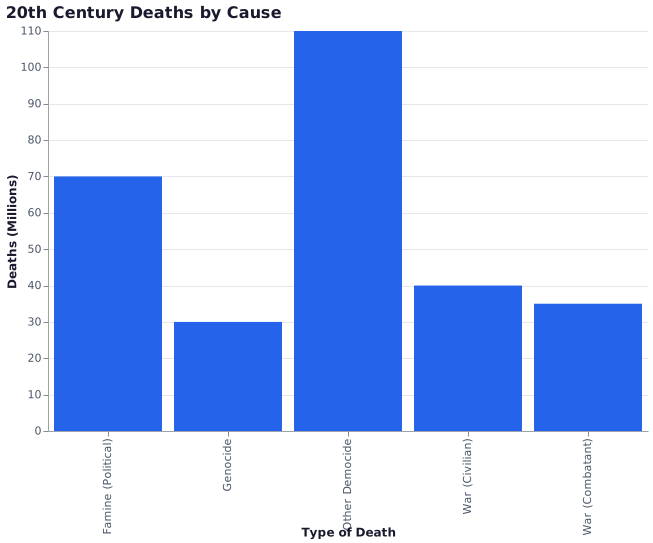
Figure 1.2: 20th century deaths by category, drawing on Rummel's democide research and war studies. "Other Democide" includes deaths from forced labor, political persecution, and state-created famine not classified as genocide. Source: R.J. Rummel democide research.
The chart above reveals a disturbing pattern: in the 20th century, governments killed more of their own citizens than died in all of that century's wars combined. The categories are inevitably imprecise—some deaths could be classified under multiple headings—but the overall picture is clear. Democide, broadly defined, was the century's leading cause of violent death. This is the phenomenon Rummel spent his career documenting, and it is central to our inquiry. If taxpayers fund governments, and governments commit democide, then taxpayers fund democide. The moral mathematics are stark.
Direct Versus Indirect Deaths
The most important distinction in conflict mortality is between direct and indirect deaths.
Direct deaths result from violence itself: bullets, bombs, shrapnel, executions. These are the deaths we typically imagine when we think of war. They are also the easiest to count, at least in principle, because they leave physical evidence and often occur in documented circumstances.
Indirect deaths result from the conditions created by violence: destroyed hospitals, contaminated water supplies, disrupted food distribution, collapsed economies. A child who dies from diarrhea because the water treatment plant was bombed is an indirect casualty. So is the cancer patient who dies because chemotherapy is unavailable due to sanctions. So is the refugee who dies of exposure while fleeing across a mountain pass.
The ratio of indirect to direct deaths varies by conflict but is consistently substantial. Brown University's Costs of War project estimates that the post-9/11 wars have caused 3.6-3.7 million indirect deaths, compared to approximately 940,000 direct deaths—a ratio of roughly 4:1. In some conflicts, particularly those involving siege or famine, the ratio is much higher. The siege of Leningrad killed approximately 1 million civilians, the vast majority from starvation rather than bombing.
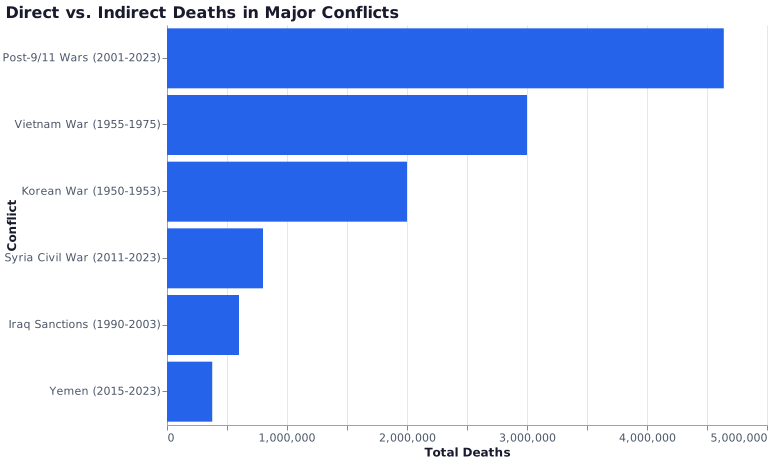
Figure 1.3: Total deaths (direct plus indirect) in major conflicts. The post-9/11 wars show a 4:1 indirect-to-direct ratio; sanctions on Iraq during the 1990s produced a ratio closer to 5:1. Source: Brown University Costs of War Project.
The variation in these ratios tells us something important about the nature of different conflicts. Short, intense conventional wars tend to produce lower indirect-to-direct ratios because the fighting ends before infrastructure collapse can cascade into mass mortality. Long counterinsurgency campaigns, economic sanctions, and siege warfare produce higher ratios because they systematically degrade the systems that keep populations alive: hospitals, water treatment, food distribution, electrical grids. The Iraq sanctions of the 1990s are the clearest example: relatively few people died from direct violence, but the collapse of the healthcare system—particularly for infants—produced an estimated 500,000 excess deaths.
The sanctions case raises particularly difficult questions about taxpayer responsibility. American and British taxpayers did not fund the bullets that killed Iraqi children; they funded the economic policies that made medicine unavailable. The causal chain from taxpayer to death is longer and more attenuated. But the deaths are no less real, and the policies that caused them were deliberate choices by elected governments.
The 4:1 Rule
For every person killed directly by violence in modern conflicts, approximately four more die from indirect causes: disease, malnutrition, lack of medical care, and exposure. This ratio is consistent across multiple studies and conflicts, though it varies based on the intensity and duration of fighting.
The epidemiological methods used to estimate indirect deaths are themselves controversial. The Lancet studies of Iraq mortality used cluster sampling and household surveys to estimate excess mortality—the difference between observed death rates and expected death rates in the absence of war. Critics challenged the methodology, sample sizes, and extrapolation from local observations to national estimates. The debate became politicized: supporters of the war favored lower estimates; opponents favored higher ones. Yet the underlying epidemiological approach is standard in public health research. The same methods are used to estimate mortality from natural disasters, famines, and disease outbreaks. The controversy surrounding Iraq estimates reflects the political stakes more than methodological weakness.
Should indirect deaths count equally with direct deaths in our accounting? The answer depends on your moral framework. From a utilitarian perspective, a death is a death regardless of mechanism—the child killed by a bomb and the child killed by cholera are equally dead. From a deontological perspective focused on intentions, there is a difference between killing and letting die, between targeting civilians and failing to protect them. A consequentialist might argue that foreseeable indirect deaths are morally equivalent to direct deaths: if you know that destroying the water treatment plant will cause a cholera epidemic, you bear responsibility for the epidemic even if you did not intend it. A virtue ethicist might focus on whether the decision-makers showed appropriate concern for civilian welfare, regardless of the specific death toll.
I will present both counts throughout this book. Readers can apply their own moral judgments. The data exists to support multiple ethical frameworks; what you do with it reflects your values, not the numbers themselves.
Combatants Versus Civilians
The second major distinction is between combatants and civilians.
Under international humanitarian law, combatants are legitimate targets during armed conflict. Killing an enemy soldier in battle is not murder; it is an act of war. The Geneva Conventions permit the targeting of military personnel, military equipment, and military installations. They prohibit the targeting of civilians, medical facilities, and cultural sites.
This distinction is central to just war theory, the dominant framework for evaluating the ethics of military action in Western philosophy. Just war theorists argue that some wars are morally justified and that, within justified wars, some killings are morally permissible. Killing enemy combatants falls into the permissible category; killing civilians does not.
But the combatant/civilian distinction is cleaner in theory than in practice. Modern warfare has blurred the line in several ways:
- Guerrilla warfare: Insurgents who fight out of uniform and blend with civilian populations make identification difficult. The Vietnam-era quip that "if it's dead and Vietnamese, it's Viet Cong" reflects the tragic reality that soldiers often cannot distinguish combatants from civilians.
- Drone warfare: The United States defines any military-age male in a strike zone as a "combatant" unless proven otherwise, effectively assuming guilt and counting the dead accordingly.
- Total war: When entire societies are mobilized for war, the distinction between military and civilian production breaks down. Was the German factory worker building tank components a legitimate target? Was the Japanese civilian growing rice to feed soldiers?
- Terrorism and counterterrorism: Non-state actors who target civilians deliberately, and state responses that kill civilians incidentally, both complicate the traditional framework.
The combatant/civilian distinction matters for our accounting because different moral frameworks treat these deaths differently. If you believe that killing enemy combatants is morally permissible, then only civilian deaths should weigh on the taxpayer's conscience. If you are a pacifist who believes all killing is wrong, then combatant deaths count equally. I will present both counts.
The historical trend is unmistakable and disturbing: civilians now constitute an increasingly large share of war deaths. In the pre-industrial era, wars were fought primarily between armies; civilians suffered from looting and disease but were rarely direct targets. World War I was still predominantly a soldiers' war—perhaps 85% of deaths were military. World War II marked the inflection point: strategic bombing, the Holocaust, and the Eastern Front's brutality pushed civilian deaths above 50% of the total. By the post-Cold War era, the ratio had inverted entirely. In conflicts from Bosnia to Syria to Yemen, civilians constitute 80-90% of casualties.
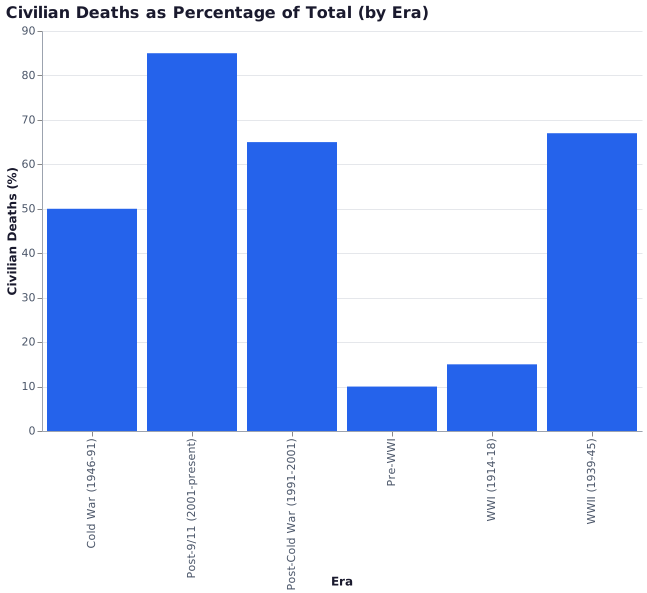
Figure 1.4: Civilian deaths as a percentage of total conflict deaths by era. Modern warfare increasingly kills non-combatants, inverting the historical pattern. Source: UCDP, academic research, historical records.
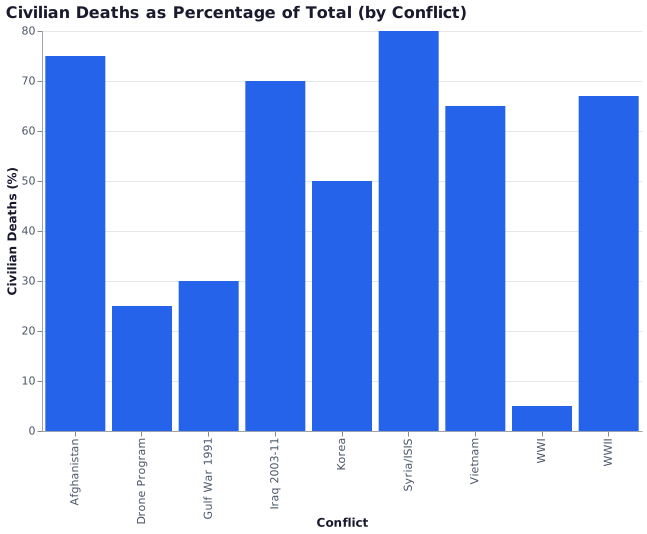
Figure 1.5: Civilian deaths as percentage of total by specific conflict. The Syrian civil war and Afghanistan show the highest civilian ratios; World War I remains an outlier with predominantly military deaths. Source: UCDP, academic research, historical records.
This shift reflects changes in both the nature of warfare and the methods of counting. Modern conflicts are more likely to involve counterinsurgency, urban warfare, and aerial bombardment—all of which produce higher civilian casualties than conventional state-on-state combat. Simultaneously, documentation has improved: we are better at counting civilian deaths than we were a century ago, which may inflate recent figures relative to historical ones. Still, the trend is real. The wars of the 21st century are primarily wars on civilian populations, not wars between armies.
For the taxpayer considering their moral complicity, this shift is significant. In a world where most war deaths were soldiers, the taxpayer funding the military was funding combat between consenting participants (to the extent conscripts can consent). In a world where most war deaths are civilians, the taxpayer is funding the killing of non-participants. The moral calculus changes accordingly.
Intentional Versus Incidental
The third distinction is between intentional and incidental deaths.
Intentional deaths result from deliberate targeting. The Holocaust was intentional: the Nazi regime set out to exterminate European Jews and murdered six million of them in systematic fashion. The Rwandan genocide was intentional: Hutu extremists organized the massacre of Tutsis and moderate Hutus. In these cases, the deaths were the goal, not a side effect.
Incidental deaths result from actions aimed at other targets. When a drone strike targets a terrorist leader and also kills his family, the family members are incidental casualties. When a bombing campaign destroys a weapons factory and also destroys the adjacent apartment building, the residents are incidental casualties. The military euphemism is "collateral damage."
Just war theory treats intentional and incidental deaths differently through the "doctrine of double effect." This principle, derived from Catholic moral theology, holds that an action with both good and bad effects may be permissible if:
- The action itself is not intrinsically wrong
- The good effect is intended, not the bad effect
- The bad effect is not the means to the good effect
- The good effect is proportionate to the bad effect
Under this framework, a military strike that kills civilians while destroying a legitimate military target may be permissible, while a strike that deliberately targets civilians to spread terror is not—even if the same number of people die.
Critics of this framework argue that the distinction between intended and foreseen consequences is morally irrelevant when the consequences are predictable and severe. If you know that your bombing campaign will kill thousands of civilians, does it matter that you didn't specifically intend their deaths? The dead are equally dead.
Once again, I present both perspectives. The numbers speak for themselves; the moral weight is yours to assign.
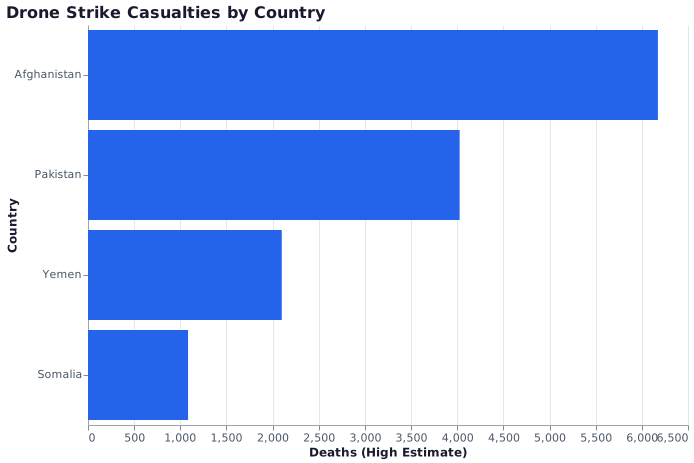
Figure 1.1: Documented drone strike casualties by country, 2002-2018. Pakistan bore the brunt of the early drone campaign, with thousands killed in strikes targeting alleged militants along the Afghan border. Source: Bureau of Investigative Journalism.
State Versus Non-State Violence
This book focuses primarily on state violence—violence perpetrated by governments or at their direction—because state violence is what taxes fund. When the U.S. military drops a bomb, American taxpayers paid for it. When the CIA funds a militia, American taxpayers funded that too. The chain of responsibility runs from the citizen's paycheck through the Treasury to the weapon and its victim.
Non-state violence—terrorism, organized crime, civil unrest—is not funded by ordinary taxation in the same way. The September 11 attacks were perpetrated by al-Qaeda, a non-state actor funded primarily by private donors and criminal enterprises. The deaths, tragic as they were, cannot be attributed to taxpayers in the way that state violence can.
But the boundary between state and non-state violence is often blurry:
- Proxy forces: States frequently fund, arm, and direct non-state actors to pursue their interests. The Contras in Nicaragua, the mujahideen in Afghanistan, and various Syrian rebel groups were all supported by the U.S. government. Their violence is partially taxpayer-funded.
- Paramilitaries: Many governments maintain informal armed groups that operate outside official military structures. Colombian paramilitaries, Indonesian death squads, and Russian "volunteers" in Ukraine blur the state/non-state line.
- Private military contractors: Companies like Blackwater (now Academi) perform military functions under government contract. When their employees kill civilians, is that state violence?
For our accounting, I include violence by forces that were substantially funded or directed by states, even if they were not formally part of the military. The taxpayer's moral responsibility extends to what their government enables, not just what it directly perpetrates.
Attribution and Causation
Even when we agree on what counts as a death, we must determine who caused it. Attribution is straightforward when a soldier shoots a civilian. It becomes murkier in complex conflicts with multiple parties, shifting alliances, and unclear chains of command.
Consider the Syrian civil war. Deaths have been caused by the Assad regime, various rebel groups, ISIS, Kurdish forces, Turkish forces, Russian forces, and American forces. American taxpayers funded some of the rebels, conducted airstrikes against ISIS, and supported Kurdish allies. How many of the war's 500,000+ deaths should be attributed to American taxpayers?
Several frameworks for attribution exist:
- Direct perpetrator: Attribute deaths only to the force that physically caused them. American taxpayers are responsible only for deaths caused by American weapons or American-directed forces.
- Command responsibility: Attribute deaths to whoever authorized the operation, regardless of who pulled the trigger. If American officials approved a strike, American taxpayers bear responsibility.
- Material support: Attribute deaths proportionally to whoever provided weapons, funding, or other material support. If the U.S. provided 30% of a rebel group's weapons, American taxpayers bear 30% of responsibility for that group's killings.
- But-for causation: Attribute deaths to whoever made them possible. Without American intervention, would these deaths have occurred? If not, American taxpayers bear responsibility.
Each framework produces different numbers. I will generally use direct perpetrator attribution, which produces the most conservative counts, while noting where other frameworks would assign additional responsibility.
Temporal Attribution
A final complication involves timing. When should a death be attributed to a taxpayer's contribution?
The simplest approach attributes deaths to the year they occurred. If a drone strike killed ten people in 2015, those deaths count against 2015 taxpayers. But this ignores the lag between funding and violence. The drone that killed those ten people in 2015 was purchased with appropriations from perhaps 2012. The pilot was trained years earlier. The targeting intelligence was gathered over months or years.
More importantly, some deaths result from decisions made decades ago. The 2003 invasion of Iraq was funded by 2002-2003 taxpayers, but the chaos it unleashed continues to kill people today. Should 2024 taxpayers bear responsibility for deaths caused by a war their predecessors chose?
For simplicity, I attribute deaths to the year they occurred. This makes the data tractable while acknowledging that responsibility is more complicated than any simple accounting can capture.
Uncertainty and Ranges
Given all these complications, death counts in conflict are never precise. Responsible researchers express uncertainty through ranges: the Iraq war killed somewhere between 200,000 and 1,000,000 people. Rummel estimated that Stalin killed between 10 million and 60 million Soviet citizens. The Rwandan genocide killed between 500,000 and 1,000,000 Tutsis.
These ranges are not failures of research; they are honest acknowledgments of irreducible uncertainty. We will never know exactly how many people died in most conflicts. Bodies were not counted. Records were destroyed. Witnesses died or fled. The dead cannot testify.
Throughout this book, I present low, middle, and high estimates where they exist. The middle estimate represents the researcher's best guess given available evidence. The low and high estimates represent the plausible range. Readers should understand that all numbers are approximations, not precise counts.
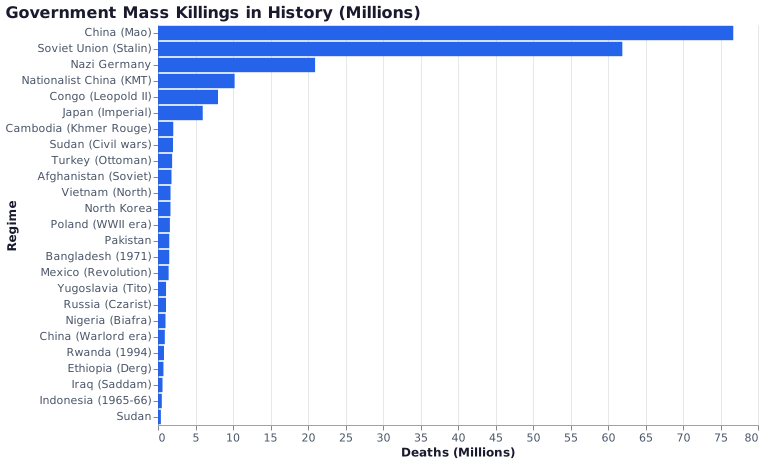
Figure 1.2: The twentieth century's largest democides, showing low, middle, and high estimates. The Soviet Union under Stalin and China under Mao dwarf all other cases, though significant uncertainty remains about the true death tolls. Source: R.J. Rummel democide database.
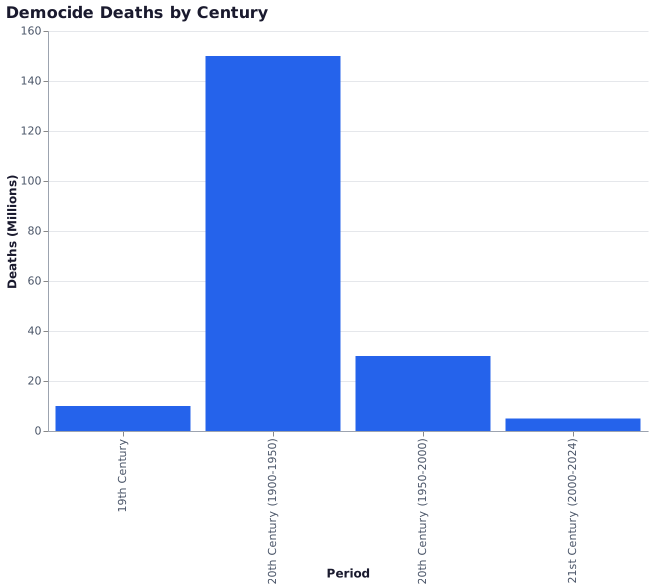
Figure 1.6: Democide deaths by century. The first half of the 20th century (1900-1950) was by far the bloodiest, with 150 million state-perpetrated deaths. The trend declined sharply after World War II. Source: R.J. Rummel democide research.
Our Framework
Having surveyed the methodological landscape, let me establish the framework we will use throughout this book:
- Primary sources: We draw primarily on UCDP for conflict deaths, Rummel for democide, and project-specific sources (Bureau of Investigative Journalism, Iraq Body Count, Brown Costs of War) for recent conflicts.
- Conservative and inclusive estimates: We present both conservative estimates (direct civilian deaths by official state forces) and inclusive estimates (all deaths including combatants, indirect deaths, and proxy forces).
- Attribution: We use direct perpetrator attribution as our baseline while noting where material support or but-for causation would expand responsibility.
- Uncertainty: We present ranges (low, middle, high) wherever available and acknowledge the irreducible uncertainty in all death counts.
- No moral prescription: We present the data under multiple ethical frameworks without telling readers which framework is correct. Whether combatant deaths count, whether indirect deaths count, whether incidental deaths count—these are moral judgments each reader must make.
This framework is imperfect. Any framework would be. The goal is not definitive answers but honest engagement with difficult questions. By the end of this book, you will have the data you need to calculate your own moral position. What you do with that calculation is up to you.
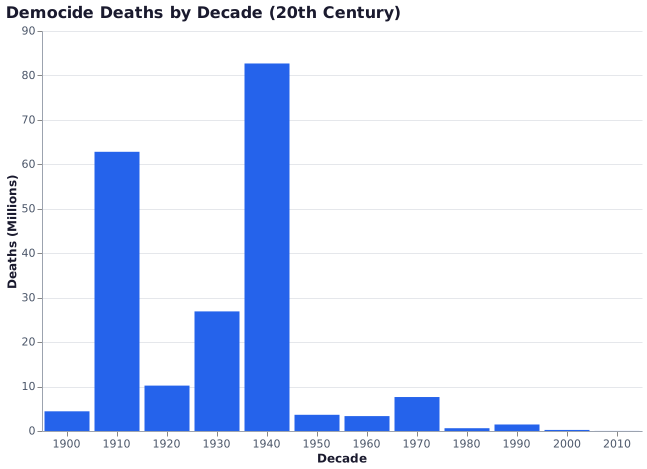
Figure 1.3: Global democide deaths by decade, 1900-2000. The mid-twentieth century stands out as the bloodiest era in human history, with peaks during the world wars and the totalitarian consolidations that followed. Source: R.J. Rummel democide research.
A Note on Sources
The data in this book comes from dozens of sources, each with its own methodology, biases, and limitations. Academic datasets from UCDP and the Correlates of War project are generally considered authoritative but may undercount deaths in conflicts with limited documentation. Human rights organizations like Amnesty International and Human Rights Watch provide detailed case documentation but cannot comprehensively count deaths in large-scale conflicts. Government sources are often biased toward understatement when the government is responsible and overstatement when adversaries are responsible.
I have tried to use the most reliable sources for each context and to acknowledge limitations where they exist. All source data is available for review in the appendix, and the complete database is published online for researchers who wish to verify or extend this analysis.
The next chapter turns from methodology to application. Having established how we count deaths, we now ask: what did median citizens across history pay toward the violence their governments perpetrated?
Chapter 2: The Median Citizen Through History
What did it mean to be a "median income" citizen in different eras? Before we can calculate what typical citizens paid toward state violence, we must understand their economic circumstances—what they earned, what they owed in taxes, and what portion of their contributions went to the machinery of war.
This chapter reconstructs the economic reality of ordinary citizens across the societies we will examine: Victorian Britain, Wilhelmine Germany, the Soviet Union under Stalin, the United States during various eras. The goal is to establish a consistent metric—the Median Taxpayer Military Contribution (MTMC)—that allows comparison across time and space.
The Maddison Project
Our primary source for historical income data is the Maddison Project, named after the late economic historian Angus Maddison. For decades, Maddison painstakingly reconstructed GDP per capita for countries going back centuries, in some cases to the year 1 CE. His work, continued by a team at the University of Groningen, provides the best available estimates of historical living standards.
Maddison's methodology converts all economic output to a common standard: 2011 international dollars, adjusted for purchasing power parity. This allows meaningful comparison across time and space. A British factory worker in 1850 earned roughly 2,100 international dollars per year—equivalent to about $2,500 in today's money. An American autoworker in 1970 earned roughly 23,000 international dollars—equivalent to about $28,000 today. The American was eleven times richer in real terms.
But GDP per capita is not the same as median income. GDP measures total economic output divided by population; it tells us nothing about distribution. In highly unequal societies, the median citizen (the person at the 50th percentile of the income distribution) earns far less than average. In more equal societies, median and mean incomes are closer.
To estimate median income, we must adjust for inequality. Economic historians have developed measures of historical inequality based on wage data, tax records, and other sources. The Gini coefficient—a standard measure where 0 represents perfect equality and 1 represents perfect inequality—provides a rough guide. Victorian Britain had a Gini coefficient around 0.5; modern Scandinavia is around 0.25; the contemporary United States is around 0.4.
Using the relationship between mean income and the Gini coefficient, we can estimate that the median income was roughly 60-70% of the mean in highly unequal societies and 80-90% in more equal ones. This gives us our median income estimates.
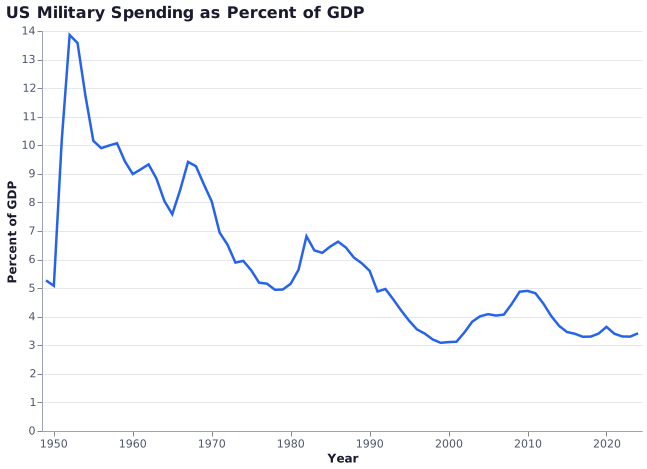
Figure 2.1: U.S. military spending as percentage of GDP, 1949-2024. During the Korean War peak, military spending exceeded 14% of the entire economy. Even today, at roughly 3.5%, it represents a substantial claim on national resources. Source: SIPRI Military Expenditure Database.
The Tax Burden
Knowing what people earned is only half the equation. We must also know what they paid in taxes—and specifically, what portion of those taxes went to military purposes.
Historical tax data is surprisingly rich, at least for governments that maintained records. We know, for example, that the British income tax (introduced in 1799 to fund the Napoleonic Wars) applied rates of 2 pence per pound (about 0.8%) on incomes above £60. We know that the United States extracted roughly 6% of GDP in federal taxes before World War I, rising to 20% during World War II and fluctuating between 15-20% ever since.
But tax systems are complex. The income tax is only one component. Consumption taxes, tariffs, property taxes, payroll taxes, and various fees all contribute to government revenue. In the 19th century, most government revenue came from tariffs and excise taxes, which fell disproportionately on consumers. The shift to income taxation in the 20th century changed not only the level of taxation but its distribution.
For each country and era, we estimate the effective tax rate on median-income citizens—the total tax paid as a percentage of income, including all forms of taxation. This is often quite different from the marginal rate or the official rate. A worker might face a marginal income tax rate of 25% but actually pay 12% of income in taxes after accounting for deductions, exemptions, and the tax-free threshold.
The OECD provides standardized tax burden data for modern economies. For historical periods, we rely on economic historians' reconstructions, which inevitably involve greater uncertainty.
The Military Share
Finally, we must determine what share of government spending goes to military purposes. This varies enormously across countries and eras.
In peacetime, military spending typically accounts for 2-5% of GDP in major powers and 1-2% elsewhere. During major wars, it can rise to 30-40% or more. The United States spent 41% of GDP on the military at the peak of World War II. Nazi Germany spent over 50% in 1944. The Soviet Union sustained military spending above 15% of GDP for decades.
For our purposes, we care not about military spending as a share of GDP but as a share of government spending. These are related but distinct. A government that spends 40% of GDP and devotes 20% of that to the military is spending 8% of GDP on defense. A government that spends 20% of GDP and devotes 60% to the military is spending 12% of GDP on defense.
The Stockholm International Peace Research Institute (SIPRI) provides standardized military spending data back to 1949 for most countries. For earlier periods, we rely on historical budget data and economic historians' reconstructions.
The MTMC Calculation
Combining these three elements—median income, effective tax rate, and military share of spending—we arrive at the Median Taxpayer Military Contribution:
MTMC = Median Income × Effective Tax Rate × Military Share of Government Spending
For a contemporary American, this might look like:
- Median income: $70,000
- Effective federal tax rate: 12%
- Federal taxes paid: $8,400
- Military share of federal spending: 24%
- MTMC: $2,016 per year
For a Soviet worker in 1950, the calculation is more complicated because the Soviet economy did not operate on market principles. We estimate:
- Real income in international dollars: ~$3,500
- Implicit tax rate (goods extracted by state): ~40%
- Military share of Soviet state budget: ~25%
- MTMC: ~$350 per year (in 2011 dollars)
The American paid six times more in absolute terms, but relative to income, the Soviet citizen's burden was heavier. This illustrates why we need both absolute numbers and income-adjusted comparisons.
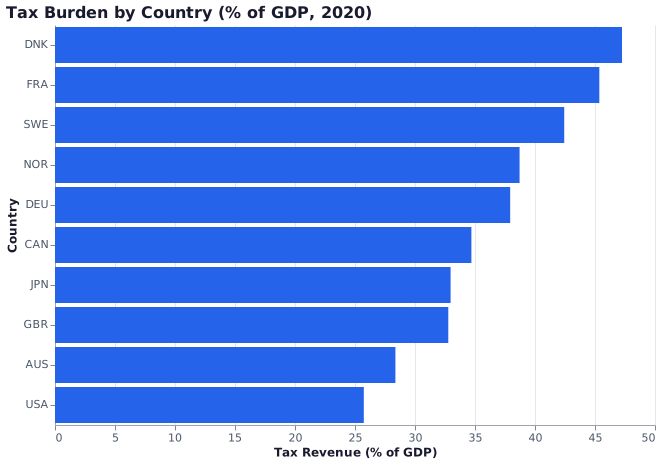
Figure 2.2: Tax structure comparison across major economies in 2020. Scandinavian countries extract far more in taxes but spend proportionally less on military, while the United States has lower overall taxation but higher military spending. Source: OECD Revenue Statistics.
Historical Comparisons
With this framework established, let us compare median citizens across several key societies.
Victorian Britain (1850-1900)
The British Empire at its height extracted relatively modest taxes from its domestic population while maintaining the world's largest navy and a substantial army. The typical British worker earned roughly 2,500-3,500 international dollars per year (in 2011 terms). Central government taxation absorbed perhaps 8-10% of GDP, of which roughly 40% went to military and naval purposes.
The median British taxpayer's military contribution was therefore modest in absolute terms—perhaps $80-120 per year in 2011 dollars. But this funded an empire that controlled a quarter of the world's land surface and inflicted enormous violence on colonized peoples. The gap between domestic taxation and imperial violence reflects the extractive nature of colonialism: much of the cost was borne by colonial subjects, not metropolitan taxpayers.
Wilhelmine Germany (1900-1914)
Imperial Germany invested heavily in military preparation for the coming war. The typical German worker earned roughly 4,000-5,000 international dollars per year. Government spending absorbed about 15% of GDP, with roughly 30% going to the military.
The median German taxpayer's military contribution was therefore roughly $180-225 per year in 2011 dollars—nearly double the British level. This funded the world's second-largest navy and largest standing army. When war came in 1914, these preparations would contribute to a slaughter unprecedented in human history.
The United States (1945)
At the peak of World War II, the American economy was a war machine like nothing seen before or since. Median income reached roughly 15,000 international dollars (depression-era levels had been much lower). Federal taxation peaked at over 20% of GDP. Military spending consumed 40% of GDP—roughly three-quarters of all federal spending.
The median American taxpayer's military contribution was roughly $2,250 per year in 2011 dollars. This funded the arsenal of democracy: 300,000 aircraft, 124,000 ships, 100,000 tanks, and the weapons that would ultimately kill hundreds of thousands of enemy combatants and civilians alike.
The Soviet Union (1937)
Stalin's USSR combined relatively low real incomes with massive state extraction and heavy military investment. The typical Soviet worker earned perhaps 2,500-3,500 international dollars in real terms. The Soviet state extracted an enormous share of national output—perhaps 40-50%—through a combination of direct taxation, forced procurement, and controlled prices. Military spending consumed 15-20% of GDP.
The implicit military contribution of the median Soviet citizen was roughly $150-200 per year in 2011 dollars. This funded not only the Red Army but the internal security apparatus—the NKVD—that was simultaneously conducting the Great Terror. The Soviet citizen paid a substantial share of income toward a military and security complex that would kill millions of their fellow citizens.
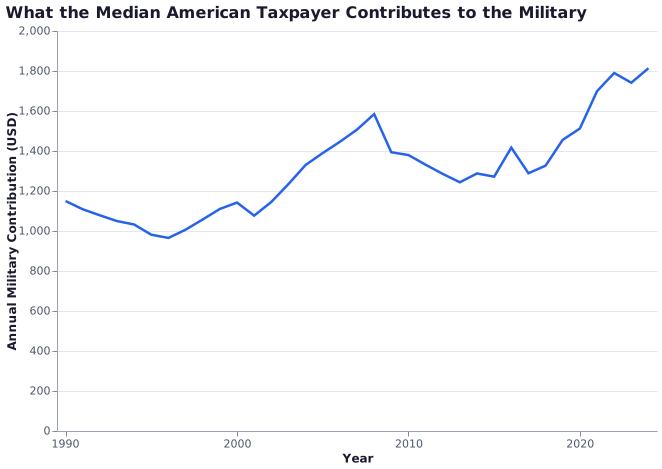
Figure 2.3: Median taxpayer military contribution for the United States, 1990-2020. Even in peacetime, the typical American pays over $2,000 annually toward military spending. Source: IRS, Census Bureau, SIPRI (author calculations).
What Money Buys
The MTMC tells us what citizens paid. But payment is meaningless without understanding what it purchased. The next chapters trace where this money went—to colonial armies in Africa, to the Wehrmacht in Europe, to drones over Pakistan—and what death tolls resulted.
The critical insight is that taxpayer contributions vary enormously, but so do the death tolls they fund. A low absolute contribution can fund genocide if the killing is cheap enough. A high contribution can fund relatively bloodless military posturing if the money goes to deterrence rather than combat.
The moral question is not simply how much you paid, but what your payment purchased. That is the question we take up next.
Chapter 3: The Colonial Balance Sheet
European colonialism represents the longest sustained program of state violence against civilians in recorded history. From the conquest of the Americas in the 16th century through African decolonization in the 1960s, European powers invaded, occupied, and exploited territories across the globe. The death toll is incalculable in any precise sense—estimates range from tens of millions to hundreds of millions depending on methodology and scope.
This chapter examines three case studies where data quality permits reasonably precise calculations: the Belgian Congo, British India, and German Southwest Africa. Each illustrates different dynamics of colonial violence and taxpayer complicity.
The Belgian Congo (1885-1908)
The Congo Free State was unique among colonial enterprises. It was not a colony of Belgium but the personal property of King Leopold II, who acquired it through diplomatic maneuvering at the Berlin Conference of 1884-85. Leopold ran the territory as a private business venture, extracting rubber and ivory through a system of forced labor enforced by systematic brutality.
The violence was extraordinary even by colonial standards. Villages that failed to meet rubber quotas were raided by the Force Publique, a private army composed of African soldiers under European officers. Hands were cut off to prove that bullets had been used on humans rather than wasted on game. Hostages were taken. Entire communities were destroyed.
Estimates of the death toll range from 1 million to 10 million, with most historians settling on a figure of 5-8 million. This represents between a quarter and half of the pre-colonial population. The killing continued for roughly 23 years until international pressure—particularly the Congo Reform Association led by E.D. Morel and Roger Casement—forced Leopold to cede the territory to Belgium in 1908.
How do we attribute these deaths to taxpayers? The Congo Free State was funded not by Belgian taxpayers but by Leopold's personal fortune, augmented by massive profits from rubber and ivory. The Belgian state provided diplomatic recognition and occasional military support but did not directly fund the enterprise. Only after 1908, when Belgium assumed direct control, did Belgian taxpayers become implicated in Congolese violence.
This illustrates an important limitation of our methodology: violence funded by private capital rather than taxation falls outside our framework. Leopold's Congo was a privately funded atrocity, more akin to a criminal enterprise than a state program. The millions who died were victims of profit-seeking, not tax-funded imperialism.
Yet Belgian taxpayers were not entirely innocent. They benefited from the cheap rubber and ivory that flowed from the Congo. Their government's diplomatic protection enabled Leopold's crimes. And after 1908, Belgian colonialism continued in the Congo—more moderately, but still violently—funded by Belgian taxpayers until independence in 1960.
British India (1757-1947)
The British Raj presents different challenges for our accounting. Unlike Leopold's personal fiefdom, British India was governed by the Crown (after 1858) with funding from both metropolitan taxpayers and colonial extraction. The violence was less concentrated than in the Congo but spanned nearly two centuries and affected hundreds of millions of people.
The most dramatic episodes of death were the famines. The Bengal famine of 1770 killed an estimated 10 million people—roughly a third of the regional population. The Great Famine of 1876-78 killed 5-10 million across southern and western India. The Bengal famine of 1943-44 killed 2-3 million. Smaller famines occurred throughout the colonial period.
Were these famines "state violence" in our sense? The question is contested. Colonial apologists argue that famines were natural disasters beyond government control. Critics point out that British policies—particularly the export of grain during famines, the destruction of traditional relief systems, and the refusal to provide adequate aid—turned food shortages into mass death. The economist Amartya Sen, who won the Nobel Prize partly for his work on famines, argues that no famine has ever occurred in a functioning democracy—the political will to prevent starvation exists when rulers are accountable to the starving.
If we count famine deaths as state violence, the toll of British rule in India reaches into the tens of millions. If we count only direct military violence—battles, massacres, executions—the toll is much lower but still substantial. The suppression of the 1857 rebellion killed perhaps 100,000 Indians. The Jallianwala Bagh massacre of 1919 killed 379 by official count (higher by other estimates). Countless smaller incidents of colonial violence accumulated over two centuries.
The British taxpayer's role was complex. The Indian Civil Service and British Indian Army were largely funded by revenues extracted from India itself—what economists call "colonial drain." Metropolitan taxpayers contributed relatively little to the apparatus of control. But they benefited from colonial trade, enjoyed goods produced by Indian labor, and elected governments that maintained the empire.
A rough estimate: the median British taxpayer's contribution to Indian military and police costs was perhaps £5-10 per year in the late 19th century, or roughly $100-200 in 2011 international dollars. If we attribute famine deaths to British policy, this modest contribution funded millions of deaths over the colonial period—an extraordinarily high death toll per taxpayer pound.
German Southwest Africa (1904-1908)
The Herero and Nama genocide provides our cleanest case study: a deliberate campaign of extermination with clear documentation of costs and deaths.
In January 1904, the Herero people of German Southwest Africa (modern Namibia) rose up against colonial rule, killing approximately 123 German settlers. The German response was annihilation. General Lothar von Trotha issued the Vernichtungsbefehl (extermination order): "Within the German borders every Herero, with or without a gun, with or without cattle, will be shot. I will no longer accept women and children; I will drive them back to their people or have them shot."
What followed was systematic genocide. Herero villages were destroyed. Survivors were driven into the Omaheke Desert, where German troops poisoned the few waterholes. Those who surrendered were placed in concentration camps where the death rate reached 45%. By 1908, the Herero population had declined from approximately 80,000 to 15,000. The Nama people, who joined the uprising, suffered comparable losses.
Total deaths are estimated at 65,000-100,000. The German military campaign cost approximately 600 million marks—roughly $150 million in 1905 dollars, or perhaps $4 billion in 2011 terms. German taxpayers paid for every bullet, every ration, every soldier's salary.
The median German taxpayer's contribution during these years was perhaps 10-15 marks annually to the Southwest African campaign—roughly $50-75 in 2011 international dollars. Dividing total cost by total deaths yields approximately $40,000-60,000 per death in 2011 dollars. This is expensive by historical standards but cheap compared to modern warfare.
Germany officially recognized the Herero and Nama genocide in 2021, more than a century after the events. It is one of the few colonial atrocities to receive formal acknowledgment.
The Colonial Balance Sheet
What patterns emerge from these case studies?
First, colonial violence was often self-funding. The costs of conquest and control were extracted from the colonized populations themselves, limiting the burden on metropolitan taxpayers. This helps explain why colonial empires persisted so long with relatively modest domestic opposition: the violence was hidden from those who funded it, and the financial costs were displaced onto the victims.
Second, indirect violence dwarfed direct violence. The famines, epidemics, and impoverishment caused by colonial rule killed far more than guns and gallows. Whether we count these deaths is a moral choice, but any honest accounting must acknowledge them.
Third, colonial violence was extraordinarily cheap per death. The combination of low labor costs, simple weapons, and the use of colonized populations as soldiers made killing inexpensive. This contrasts sharply with modern warfare, where precision weapons and force protection drive costs to millions of dollars per enemy killed.
Fourth, responsibility was diffused. The British taxpayer who paid a few pounds toward the Indian administration, the German citizen who voted for a colonial party, the Belgian subject who benefited from Congolese rubber—none of them directly ordered atrocities, yet all were implicated in a system that produced them. This diffusion of responsibility is not unique to colonialism; it characterizes all democratic violence.
The chapters ahead examine how these patterns evolved in the 20th century, when state violence reached unprecedented scales and taxpayer contributions grew proportionally.
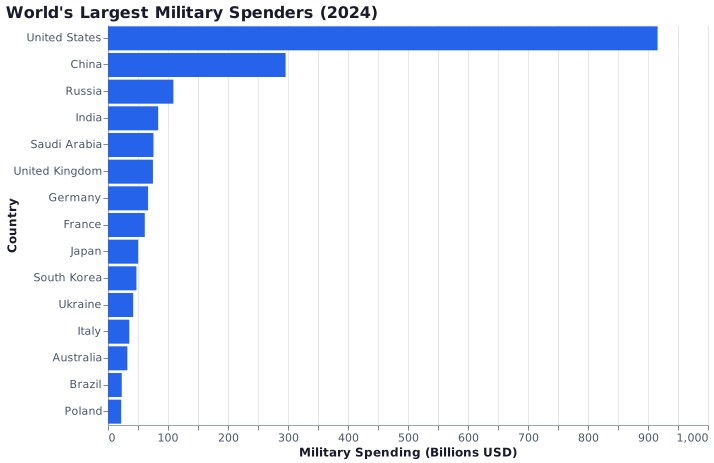
Figure 3.1: Top military spenders in 2023. The United States alone accounts for nearly 40% of global military spending, more than the next ten countries combined. Source: SIPRI Military Expenditure Database.
Chapter 4: The Totalitarian Century
The twentieth century was the bloodiest in human history. States killed more of their own citizens than died in all the century's wars combined. The term R.J. Rummel coined for this phenomenon—democide, the murder of people by their government—captures a scale of violence that still defies comprehension.
Rummel's calculations, compiled over decades of painstaking research, estimate that governments murdered approximately 262 million of their own citizens between 1900 and 1999. To put this in perspective: the combined military death toll of both world wars was roughly 36 million. Democide killed more than seven times as many.
This chapter examines the three largest perpetrators: the Soviet Union, Nazi Germany, and Maoist China. Together, these regimes account for over half of all democide deaths in the twentieth century. We calculate what citizens in each society paid toward this killing apparatus, whether through explicit taxation, implicit extraction, or forced contribution.
The Soviet Union (1917-1991)
Rummel's estimate of Soviet democide stands at 62 million deaths—a number so large it becomes abstract. To give it meaning: 62 million is roughly the combined population of California and Texas today. It is more than the entire population of Italy. It represents approximately one Soviet citizen in four killed by their own government over seven decades.
The killing began immediately after the Bolshevik seizure of power. The Russian Civil War (1918-1921) killed approximately 9 million people through combat, famine, and Red Terror. The collectivization campaign of 1929-1933, including the Ukrainian Holodomor, killed 7-14 million. The Great Terror of 1936-1938 murdered perhaps 1.2 million through execution and another 1.5 million in the Gulag. World War II brought additional millions of deaths from Soviet policies—deportation of ethnic minorities, blocking orders that prevented retreat, penal battalions sent on suicide missions.
The Gulag system operated continuously from 1930 to 1953, processing approximately 18 million prisoners over its history. The death rate varied by year and camp but averaged roughly 10% annually in the worst periods. Prisoners mined gold in Kolyma at minus 50 degrees, built the White Sea Canal with hand tools and inadequate food, felled timber in conditions designed to kill.
How do we attribute these deaths to Soviet citizens? The Soviet economy was not a market system with transparent taxation. The state controlled all production and extracted surplus through a combination of forced procurement, price controls, and suppressed wages. Estimating the effective "tax rate" requires calculating what share of production the state took versus what workers retained.
Economic historians estimate that the Soviet state extracted 40-50% of national output for its own purposes during the Stalin era. Of this, military and security spending consumed perhaps 15-25%—a figure that rose during wartime and fell (somewhat) after. The NKVD, with its 300,000 employees at peak, prison guards, and camp administrators, required substantial resources.
The median Soviet worker earned perhaps 2,500-3,500 international dollars (in 2011 purchasing power) during the 1930s and 1940s. Applying our methodology:
- Median income: ~$3,000 (2011 international dollars)
- Implicit extraction rate: ~45%
- State receipts per worker: ~$1,350
- Security/military share: ~20%
- MTMC equivalent: ~$270 per year
This is a rough estimate with wide uncertainty. But it suggests that over a working lifetime of 40 years, the median Soviet citizen contributed approximately $10,800 (in 2011 dollars) toward the security apparatus that killed 62 million people.
Dividing total implied contributions by total deaths is grotesque but illuminating. Approximately 150 million Soviet workers over 74 years, contributing an average of $200 per year to security spending, yields total contributions of roughly $2.2 trillion (2011 dollars). Spread across 62 million deaths, this implies a cost per death of roughly $35,000—cheap even by the standards of state violence.
The Soviet Union achieved its horrific death toll efficiently because it relied on starvation, exposure, and summary execution rather than expensive military hardware. The Gulag's economics were brutal: prisoners produced more value than they consumed until they died, at which point they were replaced. The cost of a bullet was trivial. The cost of withholding food was essentially zero.
Nazi Germany (1933-1945)
The Holocaust killed six million Jews. Nazi violence also killed approximately five million others: Roma, disabled people, Soviet prisoners of war, Polish civilians, political prisoners, homosexuals. The twelve-year Reich murdered eleven million civilians in systematic fashion, plus additional millions through aggressive war.
Unlike the Soviet Union, Nazi Germany operated largely within a capitalist framework, with explicit taxation and government budgets. We have detailed records of what Germans paid and what their government spent.
German military spending rose from 1% of GDP in 1933 to over 50% by 1944. At its peak, the Nazi war machine consumed more than half of everything Germany produced. The typical German worker saw their income taxed at rates that rose steadily through the 1930s and 1940s, reaching effective rates of 25-30% by war's end.
But this understates the true burden. Nazi Germany also financed its war through inflation, forced savings, and plunder from occupied territories. German citizens were compelled to purchase war bonds. Prices were controlled while wages stagnated. The occupation of Europe transferred enormous resources to the Reich.
We estimate the median German worker's military contribution during the war years:
- Median income: ~$5,000 (1940, 2011 international dollars)
- Explicit + implicit tax rate: ~35%
- Government receipts per worker: ~$1,750
- Military/security share: ~70% (wartime)
- MTMC: ~$1,225 per year
During the six years of war (1939-1945), the median German worker contributed approximately $7,350 toward the military and security apparatus. Approximately 35 million German workers during this period contributed a combined total of roughly $1.5 trillion (2011 dollars).
The Holocaust itself was remarkably cheap within this overall spending. The concentration camps were designed to be self-financing, using prisoner labor to fund operations. The gas chambers at Auschwitz killed with industrial efficiency using Zyklon B, a commercial pesticide. Trains that would otherwise return empty from the Eastern Front carried prisoners to their deaths. The machinery of genocide was optimized for cost-effectiveness.
Historians estimate the direct cost of the Holocaust—camps, transportation, administration—at roughly $2-3 billion in contemporary dollars, or perhaps $30-40 billion in 2011 terms. Divided by six million Jewish deaths, this implies a cost per death of roughly $5,000-7,000. Including all eleven million non-combat victims brings the cost down further.
The typical German taxpayer during the war years contributed perhaps $1,200 annually to military spending. Of this, only a tiny fraction—perhaps $50-100—went specifically to the Holocaust apparatus. The rest funded the Wehrmacht, the Luftwaffe, and the war effort more broadly. This raises a difficult question: does moral responsibility attach only to spending specifically allocated to genocide, or to the entire military budget that made genocide possible?
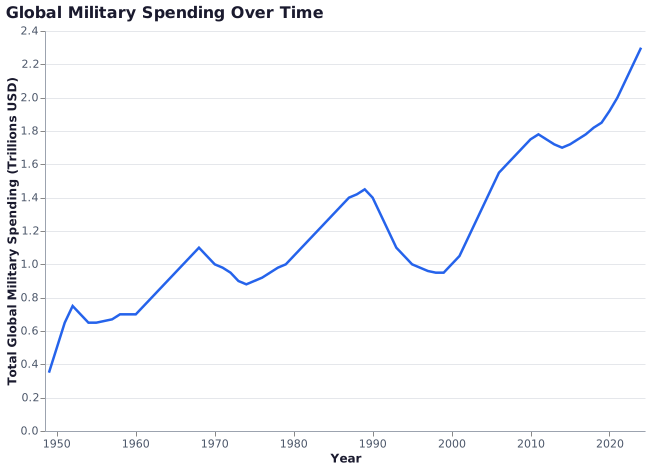
Figure 4.1: Global military spending 1949-2023 in constant dollars. The Cold War peak, Reagan buildup, post-Cold War decline, and post-9/11 surge are all visible. Total spending has now exceeded Cold War levels. Source: SIPRI Military Expenditure Database.
Maoist China (1949-1976)
The People's Republic of China under Mao Zedong killed more people than any other regime in history, with most estimates ranging from 35 to 80 million deaths. The Great Leap Forward (1958-1962) alone caused 15-55 million famine deaths—the largest famine in human history, entirely man-made.
The Chinese case presents unique challenges for our methodology. Like the Soviet Union, Maoist China was a command economy where the concept of taxation is problematic. The state controlled agricultural procurement, industrial production, and labor allocation. Citizens "contributed" not through tax payments but through confiscated grain, unpaid labor, and suppressed consumption.
During the Great Leap Forward, the state extracted grain from the countryside to feed cities and export abroad, even as peasants starved. This extraction was not "military spending" in any conventional sense, but it was state violence funded by coerced contributions from the population. The famine deaths were as much a product of state policy as any shooting.
Estimating the median Chinese citizen's contribution requires different methods:
- Median rural income: ~$400 (1960, 2011 international dollars)
- Implicit extraction rate: ~50-60%
- State-controlled resources per worker: ~$200-240
- Military share of state budget: ~15%
- Implied MTMC: ~$30-35 per year
These numbers are staggeringly low compared to Western societies. Chinese citizens were too poor to contribute much in absolute terms. But the death toll was also achieved cheaply—primarily through policy-induced famine rather than military expenditure.
The Great Leap Forward cost essentially nothing to implement. Mao's directives to melt backyard steel, collectivize agriculture, and eliminate sparrows (which led to insect plagues) required no military hardware. The deaths resulted from policy errors compounded by ideological rigidity and local officials' fear of reporting bad news. The killing was free.
The Cultural Revolution (1966-1976) similarly relied on political mobilization rather than military spending. Red Guards were unpaid volunteers. Struggle sessions cost nothing but time. The 500,000-2,000,000 who died were killed by neighbors, coworkers, and students rather than soldiers—violence funded not by taxation but by ideological fervor.
This reveals a disturbing truth: the most efficient killing requires no military at all. A government that can mobilize its population ideologically can achieve mass death at zero marginal cost. The taxpayer's monetary contribution is irrelevant when the state has captured citizens' minds as well as their labor.
The Economics of Totalitarian Violence
What patterns emerge from these three cases?
First, poverty enables cheap killing. The Soviet Union and Maoist China achieved enormous death tolls despite being poor societies because they relied on methods that required few resources: famine, exposure, forced labor, summary execution. Nazi Germany, the wealthiest of the three, spent the most per death—and even there, the Holocaust was designed for cost-efficiency.
Second, totalitarian systems blur the line between taxation and extraction. When the state controls all economic activity, citizens' "contributions" include not just explicit taxes but suppressed wages, confiscated crops, forced labor, and compulsory savings. The true burden on citizens far exceeds what any tax receipt would show.
Third, ideological mobilization substitutes for military spending. Both the Soviet Union and Maoist China achieved much of their killing through citizens who acted without pay: informers, local party officials, Red Guards. This distributed the labor of repression across the population, reducing the need for professional security forces.
Fourth, the median citizen's individual contribution was often modest. A Soviet worker contributing $200-300 per year, or a Chinese peasant contributing $30-35, does not seem complicit in mass murder. But multiplied across millions of workers and decades of time, these modest contributions funded unprecedented violence.
The moral question is whether such diffuse responsibility constitutes individual guilt. The German taxpayer who paid 100 marks toward the war effort did not intend to fund gas chambers. The Soviet collective farmer whose grain was confiscated did not choose to enable the Gulag. Are they nevertheless morally implicated?
We will return to this question in Part IV. For now, we note only that the totalitarian regimes of the twentieth century achieved their body counts through systems that distributed both the work and the funding of violence across entire populations. Everyone contributed; everyone was complicit; the responsibility was so widely shared that it became almost invisible.
The chart below reveals the dramatic spike in conflict deaths around 1994—the year of the Rwandan genocide. In just 100 days, approximately 800,000 Tutsis and moderate Hutus were killed, largely with machetes, clubs, and small arms. This genocide represents the deadliest episode of state-organized violence since the Cambodian killing fields of the 1970s. The spike is so pronounced that it dwarfs other conflicts of the era. After Rwanda, deaths declined briefly before rising again in the 2010s with the Syrian civil war, Yemen, and the resurgence of armed conflicts in Africa.
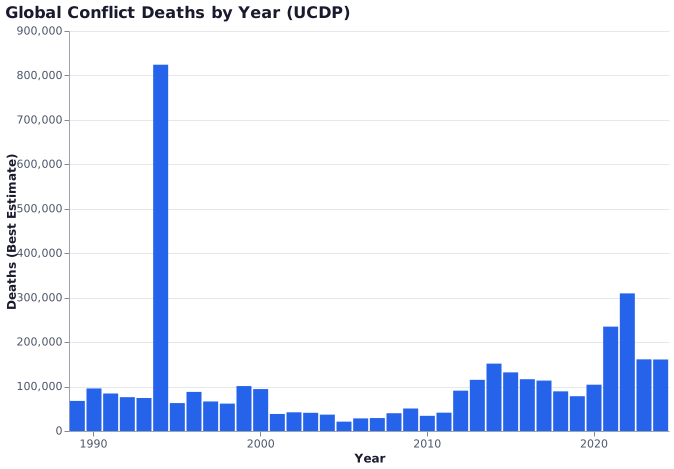
Figure 4.2: Global conflict deaths by year, 1989-2023. The dramatic spike in 1994 reflects the Rwandan genocide—800,000 killed in 100 days. After a post-Cold War decline, conflict deaths rose sharply after 2011, driven by Syria, Yemen, and civil wars across the Sahel. Source: Uppsala Conflict Data Program (UCDP).
Lessons for Democratic Societies
The totalitarian experience might seem irrelevant to citizens of democracies. We do not live under Stalin or Mao or Hitler. Our governments are constrained by law, subject to electoral accountability, and largely transparent in their operations.
But the mechanisms of diffuse responsibility operate in democracies too. American taxpayers fund drone strikes they will never see. British citizens paid for colonial violence they rarely witnessed. French taxes supported the Algerian War. Democratic citizens may have more ability to influence their governments, but they also bear greater moral responsibility for what those governments do.
The next two chapters examine democratic violence in the Cold War and post-Cold War eras. The death tolls are smaller than the totalitarian cases, but the taxpayers' role is if anything more direct. These were not crimes hidden from the public by totalitarian censorship; they were policies debated in parliaments, reported in newspapers, and renewed by elected representatives.
If Soviet citizens bear some responsibility for the Gulag despite their lack of political voice, what responsibility do American citizens bear for Iraq?
Chapter 5: Cold War Shadows
The Cold War was, by definition, not a war. The superpowers never fought each other directly. Nuclear deterrence—the threat of mutual annihilation—kept the peace between Washington and Moscow for four decades.
But the peace was an illusion. The Cold War was fought through proxies, in countries whose names rarely appeared on American front pages: Guatemala, Indonesia, Chile, Angola, Afghanistan, El Salvador. The superpowers funded, armed, trained, and sometimes directed local forces who did the killing. The violence was outsourced, but the funding came from taxpayers in Washington and Moscow.
This chapter examines several of these proxy conflicts to calculate what American taxpayers contributed and what their contributions purchased. The Soviet side of the ledger is important but harder to document; we focus primarily on American-backed violence where the evidence is clearer.
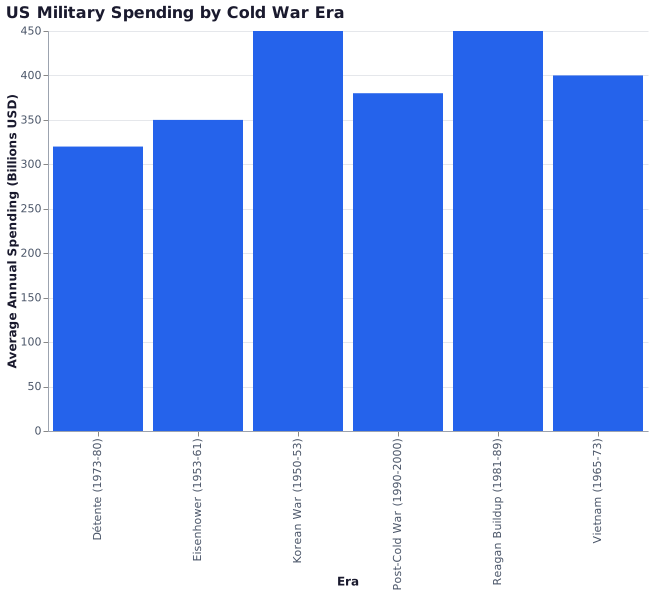
Figure 5.1: U.S. military spending by Cold War era. The Korean War and Reagan Buildup represented peaks of expenditure, while détente saw relative restraint. Each era's spending funded different proxy conflicts and intervention strategies. Source: SIPRI, U.S. DoD historical data.
Guatemala (1954-1996)
In 1954, the CIA orchestrated a coup against Jacobo Árbenz, Guatemala's democratically elected president. Árbenz's crime was land reform: he had nationalized unused land held by the United Fruit Company, offering compensation at the values the company had declared for tax purposes.
The coup, codenamed Operation PBSUCCESS, cost approximately $2.7 million in direct CIA expenditure—perhaps $30 million in 2011 dollars. It installed Carlos Castillo Armas, a military officer who reversed the land reform and began a program of political repression.
What followed was four decades of civil war and genocide. The Guatemalan military, trained and funded by the United States, waged counterinsurgency campaigns that targeted not just guerrillas but entire Mayan communities suspected of supporting them. The Commission for Historical Clarification, established by the peace accords of 1996, documented:
- Over 200,000 people killed or "disappeared"
- 626 massacres of entire villages
- 93% of documented violations committed by state forces
- Genocide against the Mayan Ixil people
U.S. military aid to Guatemala totaled approximately $33 million between 1954 and 1977, when it was suspended due to human rights concerns. Aid resumed under Reagan, with $20 million in military assistance between 1983 and 1985 alone. CIA funding for Guatemalan intelligence services continued throughout the period, including during the genocide of the early 1980s.
The median American taxpayer's contribution to Guatemalan security forces was tiny—perhaps $0.10-0.50 per year during periods of active aid. But spread across 100 million taxpayers and 40 years, these pennies added up to tens of millions of dollars that armed and trained the perpetrators of genocide.
The cost per death in Guatemala was extraordinarily low. If we attribute 200,000 deaths to forces that received perhaps $60 million in U.S. support over 40 years, the American contribution per death was roughly $300. The total cost of killing—including Guatemalan government expenditures—was higher but still modest. Massacres were conducted with machetes and small arms; death squads were cheap to operate.
Indonesia (1965-1966)
The Indonesian massacres of 1965-1966 killed between 500,000 and 1 million people in one of the century's largest episodes of political mass murder. The victims were members and suspected sympathizers of the Indonesian Communist Party (PKI), the world's third-largest communist party at the time.
The U.S. role remains contested among historians, but several facts are clear. The CIA provided lists of PKI members to the Indonesian military. U.S. officials knew the massacres were occurring and viewed them favorably as eliminating communist influence. The U.S. provided covert financial support to anti-communist groups. Whether this constitutes responsibility for the killings is a matter of interpretation.
The State Department's internal history, declassified in 2017, acknowledged that "ichael" was provided to the Indonesian military—likely referring to communications equipment. The CIA provided weapons and radios to anti-communist forces. But the killings themselves were carried out primarily by the Indonesian military and civilian militias, using local resources.
The American taxpayer contribution is difficult to quantify. Covert aid was probably in the millions of dollars—substantial for the time but modest compared to the death toll achieved. If the U.S. contributed $5-10 million toward operations that killed 500,000-1,000,000 people, the American cost per death was $5-20.
This illustrates a recurring pattern: the United States could "leverage" its military and intelligence spending by supporting local forces who did the killing. A small investment in weapons, training, and intelligence could enable mass death far beyond what American forces could have achieved directly.
Chile (1973-1990)
The Chilean coup of September 11, 1973 overthrew Salvador Allende, the world's first democratically elected Marxist head of state. The Nixon administration had worked to prevent Allende's election, destabilize his government, and support the military officers who ultimately seized power.
The Pinochet dictatorship that followed killed approximately 3,200 people through execution and disappearance, and tortured approximately 40,000. The violence was systematic, coordinated through Operation Condor with other South American dictatorships, and supported by ongoing U.S. intelligence cooperation.
U.S. involvement included:
- $10 million in covert funding to destabilize Allende (1970-1973)
- Military aid to the junta after the coup
- CIA training of Chilean intelligence officers
- Intelligence sharing through Operation Condor
- Political support and diplomatic cover
The Chilean case demonstrates that American-backed violence was not limited to "Third World" countries with no democratic tradition. Chile had been a stable democracy for decades. The United States helped destroy that democracy and backed the dictatorship that replaced it—all to prevent a socialist government from demonstrating that an alternative to capitalism was possible.
The death toll (3,200) was smaller than Guatemala or Indonesia, but the principle was the same: American taxpayers funded the overthrow of a democratic government and the installation of a military dictatorship that murdered its citizens.
El Salvador (1979-1992)
The Salvadoran Civil War killed approximately 75,000 people, the vast majority civilians killed by government forces and allied death squads. The United States provided $4 billion in military and economic aid over thirteen years—approximately $308 million per year, making El Salvador one of the largest per capita recipients of U.S. aid in the world.
The violence included some of the most notorious atrocities of the Cold War era. The El Mozote massacre of December 1981 killed approximately 1,000 civilians, including hundreds of children, by the Atlacatl Battalion—a U.S.-trained rapid deployment force. The murders of Archbishop Oscar Romero, four American churchwomen, and six Jesuit priests received international attention but continued unabated.
The El Salvador case offers the clearest calculation of American taxpayer complicity:
- Total U.S. aid: ~$4 billion over 13 years
- Portion classified as military: ~$1 billion
- Deaths attributed to government forces: ~60,000
- U.S. military aid per death: ~$17,000
- Median taxpayer contribution (1980-1992): ~$3-4 per year
- Median taxpayer lifetime contribution: ~$40-50
Fifty dollars over thirteen years. The price of a nice dinner. This was the median American's contribution to the El Salvadoran killing fields.
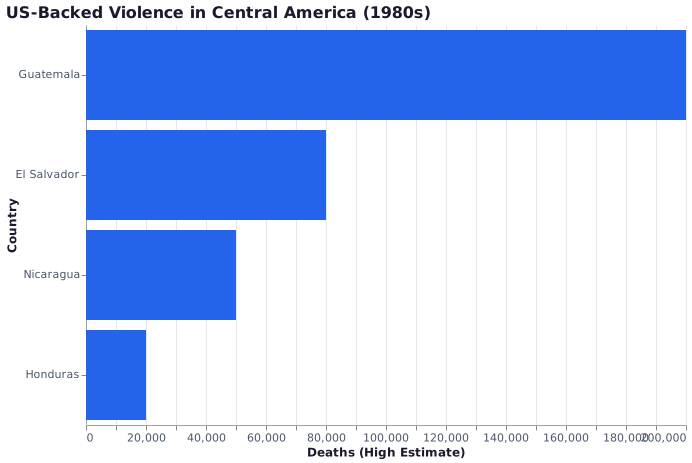
Figure 5.2: Deaths from U.S.-backed violence in Central America during the 1980s. Guatemala's decades-long genocide dwarfs the other conflicts, but El Salvador and Nicaragua also saw massive loss of life funded by American taxpayers. Source: Truth commissions, academic research.
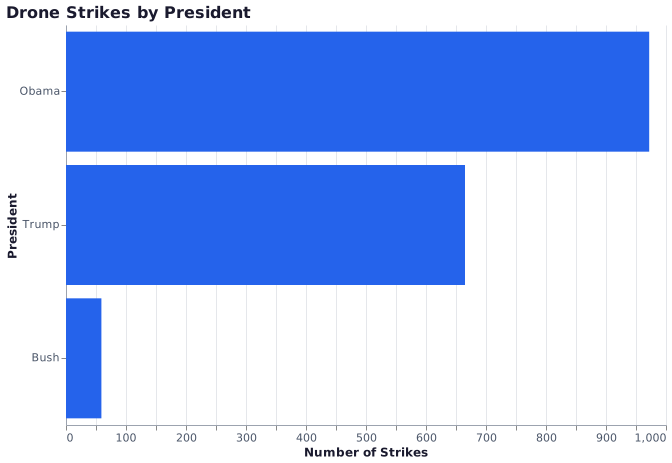
Figure 5.1: Drone strike casualties by president. Obama expanded the drone program dramatically compared to his predecessor, though the geographic focus shifted from Pakistan to Yemen and Somalia. Source: Bureau of Investigative Journalism.
Afghanistan (1979-1989)
The Soviet-Afghan War killed approximately 1-2 million Afghans, along with 15,000 Soviet soldiers. It was the Soviet Union's Vietnam—a grinding counterinsurgency that drained resources and morale until withdrawal became inevitable.
The United States was deeply involved, though not as a direct combatant. Operation Cyclone, the CIA's program to arm and fund the Afghan mujahideen, was the largest covert operation in American history. Beginning at $20-30 million annually in 1980, it grew to $630 million by 1987. Total U.S. spending exceeded $3 billion.
The weapons provided included Stinger missiles that neutralized Soviet air superiority, transforming the conflict. The mujahideen who received this aid included not only Afghan nationalists but also Arab volunteers—among them a young Saudi named Osama bin Laden.
How should we attribute Afghan deaths? Soviet forces killed most of the civilians, so Soviet taxpayers bear primary responsibility under our direct perpetrator framework. But American weapons enabled the resistance that kept the war going for a decade. Under a but-for causation framework, American support extended the conflict and thus shares responsibility for its death toll.
The long-term consequences compound the moral calculation. The mujahideen who received American training and weapons later fragmented into factions including the Taliban. The Arab volunteers became al-Qaeda. The connections between Operation Cyclone and September 11, 2001 are contested but undeniable.
The median American taxpayer contributed perhaps $10-15 per year to Afghan operations during the 1980s—$100-150 over the decade. This funded the death of Soviet soldiers (an intended objective), Afghan civilians (incidental), and, arguably, the groundwork for future terrorism against Americans.
The Cold War Balance Sheet
What did the Cold War cost in blood and treasure?
Direct U.S. military spending during the Cold War (1947-1991) totaled approximately $15 trillion in 2011 dollars. Indirect spending—intelligence, military aid to allies, covert operations—added several trillion more. This was funded by roughly 100 million American taxpayers over 44 years.
Deaths attributable to U.S.-supported violence during this period are harder to count but substantial:
- Korean War: 2-3 million total deaths (U.S. as direct combatant)
- Vietnam War: 2-3 million total deaths (U.S. as direct combatant)
- Indonesia: 500,000-1 million (U.S. as supporter)
- Guatemala: 200,000 (U.S. as funder/trainer)
- El Salvador: 75,000 (U.S. as funder/trainer)
- Nicaragua, Chile, Argentina, Brazil, and others: additional hundreds of thousands
A conservative estimate of deaths from U.S.-backed Cold War violence—excluding Korea and Vietnam, where the U.S. was a direct combatant—is 1-2 million. An inclusive estimate, including indirect deaths and the wars where the U.S. fought directly, exceeds 5 million.
The median American taxpayer contributed perhaps $2,000-3,000 per year during the Cold War peak—$50,000-75,000 over a working lifetime. Of this, perhaps 10-20% funded operations with significant body counts. The implied taxpayer contribution per death, under various allocation methods, ranges from a few thousand to tens of thousands of dollars.
These numbers are imprecise. They rely on contested death tolls and debatable attribution. But they establish a range: the median American Cold War taxpayer contributed somewhere between $5,000 and $15,000 toward activities that killed 1-5 million people.
Was this justified? Defenders of Cold War policy argue that containing Soviet expansion prevented far greater violence. Critics argue that the United States killed millions to preserve economic interests and ideological hegemony. We present both perspectives without resolution.
The Cold War ended in 1991. What followed was not peace but a new era of American military intervention, unconstrained by superpower competition. We examine that era next.
Chapter 6: Wars of Choice
The Cold War's end promised a "peace dividend"—military spending would decline, threats would diminish, and resources would flow to domestic needs. For a brief moment, this seemed possible. U.S. military spending fell from 6% of GDP in 1986 to 3% by 2000.
But the peace was illusory. The 1990s saw American military intervention in Panama, the Persian Gulf, Somalia, Haiti, Bosnia, and Kosovo. The 2000s brought Afghanistan, Iraq, and the global war on terror. Military spending rose again, eventually exceeding Cold War levels in real terms.
This chapter examines the wars of the post-Cold War era—conflicts that were "choices" in a way Cold War interventions arguably were not. There was no Soviet threat to contain, no communist domino to prevent from falling. These wars reflected American decisions about when and how to use the world's most powerful military.
The Gulf War (1991)
Operation Desert Storm was the first major American military action of the post-Cold War era. When Iraq invaded Kuwait in August 1990, the United States assembled an international coalition, deployed 500,000 troops, and in a six-week air campaign followed by a 100-hour ground war, expelled Iraqi forces from Kuwait.
By historical standards, Desert Storm was a limited conflict:
- Coalition deaths: 292 (147 American)
- Iraqi military deaths: 20,000-35,000
- Iraqi civilian deaths: 3,500 (direct) plus uncertain thousands from infrastructure destruction
- Cost: $61 billion (largely reimbursed by allies)
The Gulf War established a template for post-Cold War American intervention: overwhelming force, limited objectives, minimal American casualties, substantial enemy losses. Critics noted that the coalition's destruction of Iraqi infrastructure—power plants, water treatment facilities, communications—would kill civilians for years afterward through degraded services. Sanctions maintained after the war killed hundreds of thousands more, particularly children.
The median American taxpayer's contribution to the Gulf War was modest—perhaps $200-300 over the crisis period, much of it eventually offset by allied contributions. The war demonstrated that American military power could achieve rapid, decisive results at acceptable cost. It also demonstrated that the indirect effects of modern warfare—infrastructure destruction, sanctions, disease—could far exceed the direct combat deaths.
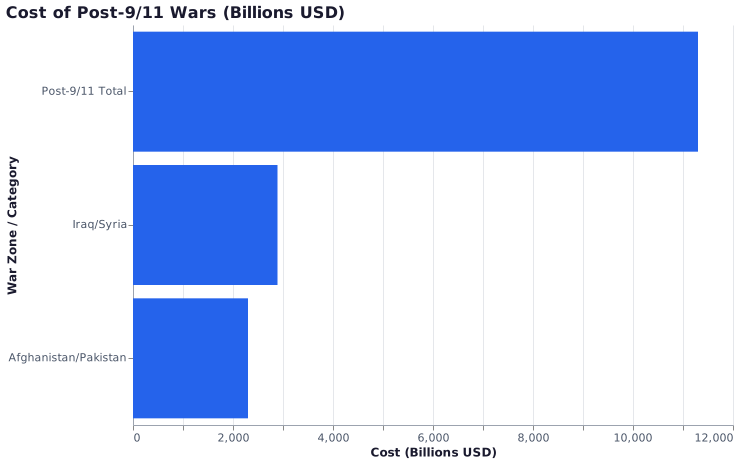
Figure 6.1: Costs of post-9/11 wars by category. Direct war spending is only part of the total; veterans' care and interest on war debt will continue for decades. Source: Brown University Costs of War Project.
The Forever Wars Begin: Afghanistan (2001-2021)
The September 11 attacks killed 2,977 people and transformed American foreign policy. Within weeks, American forces invaded Afghanistan to destroy al-Qaeda and overthrow the Taliban government that had harbored them.
The initial operation was remarkably successful. The Taliban fell within months. Al-Qaeda scattered. By early 2002, it seemed the mission might be accomplished.
Instead, the war continued for twenty years. What began as counterterrorism became nation-building, then counterinsurgency, then indefinite occupation. By the time the last American forces withdrew in August 2021, the Taliban had returned to power, and the longest war in American history had achieved little of lasting value.
The costs were staggering:
- American military deaths: 2,461
- American contractor deaths: 3,846
- Afghan military and police deaths: 69,000
- Taliban and other opposition deaths: 52,000
- Afghan civilian deaths: 46,000+
- Total deaths: 176,000+
- Direct war spending: $2.3 trillion
- Interest on war debt: $500 billion+
- Veterans' care: $1 trillion+ (projected)
The Brown University Costs of War project estimates total Afghanistan spending at $2.3 trillion in direct costs alone. Including interest and veterans' care, the total will exceed $3 trillion.
The median American taxpayer contributed approximately $1,000-1,500 per year during the peak war years (2009-2012), or roughly $15,000-20,000 over the twenty-year conflict. This is approximately $90-115 per attributed death—expensive by historical standards but a fraction of Cold War per-death costs because the overall death toll was relatively limited.
Iraq (2003-2011)
The Iraq War remains the most controversial American military action since Vietnam. The Bush administration argued that Saddam Hussein possessed weapons of mass destruction and posed an imminent threat. Both claims proved false.
The invasion succeeded in overthrowing Hussein but failed to stabilize Iraq. Sectarian violence, insurgency, and civil war followed. American forces found themselves occupying a country whose population largely viewed them as invaders rather than liberators.
The death toll remains contested:
- Iraq Body Count (documented violent deaths): 185,000-208,000
- Lancet study (excess mortality estimate, 2006): 655,000
- PLOS Medicine study (excess mortality, 2013): 500,000
- American military deaths: 4,431
- American contractor deaths: 3,793
The range from 200,000 to 1 million reflects genuine uncertainty about deaths in a chaotic conflict where record-keeping was poor and incentives to undercount were strong. We use 400,000-600,000 as a reasonable middle estimate for total excess mortality.
The costs matched the death toll:
- Direct war spending: $2 trillion
- Interest on war debt: $1 trillion+
- Veterans' care: $1 trillion+ (projected)
- Total: $4+ trillion
The median American taxpayer contributed approximately $1,500-2,000 per year during peak Iraq spending (2004-2008), or roughly $15,000-20,000 over the war's duration. Using middle estimates for costs and deaths yields a per-death cost of $6,000-10,000 in taxpayer contributions.
Unlike Afghanistan, where the initial intervention had broad support, Iraq was controversial from the start. The 2003 protests were the largest in history, with millions marching worldwide against the coming war. But the war proceeded anyway, and American taxpayers funded it regardless of their individual views.
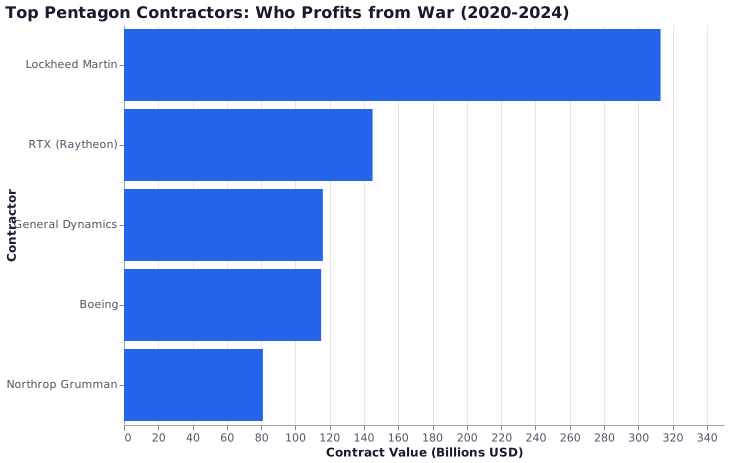
Figure 6.2: Top Pentagon contractors, 2020-2024. Five companies receive over half of all defense contract dollars. Source: USAspending.gov, SIPRI Arms Industry Database.
The Drone Wars
While conventional forces fought in Afghanistan and Iraq, a parallel war expanded across multiple continents. Armed drones—remotely piloted aircraft carrying missiles—conducted strikes in Pakistan, Yemen, Somalia, Libya, and other countries outside any declared war zone.
The Bureau of Investigative Journalism has documented over 14,000 drone strikes since 2002, killing between 8,500 and 12,000 people. The U.S. government provides minimal information about these operations, claiming that virtually all those killed were militants while independent investigations frequently document civilian casualties.
The drone program raises novel questions for our analysis:
- Transparency: Much of the program remains classified. Death tolls are contested. The legal basis for strikes outside war zones is unclear.
- Geography: Strikes occur in countries where the U.S. is not at war—Pakistan, Yemen, Somalia—raising questions about sovereignty and international law.
- Cost structure: Drones are expensive ($28 million for an MQ-9 Reaper) but cheaper than manned aircraft. Each Hellfire missile costs about $150,000.
- Moral distance: Operators sit in Nevada controlling weapons that kill in Pakistan. The physical and psychological distance is unprecedented.
A rough calculation: if the drone program has cost $10-15 billion since 2002 and killed 8,000-12,000 people, the cost per death is approximately $1-1.5 million. This is extraordinarily expensive by historical standards—a reflection of the high technology involved and the relatively small number of deaths.
The median American taxpayer contributes perhaps $10-15 per year specifically to the drone program, with total lifetime contributions of $150-250. This buys a very small share of each drone strike death.
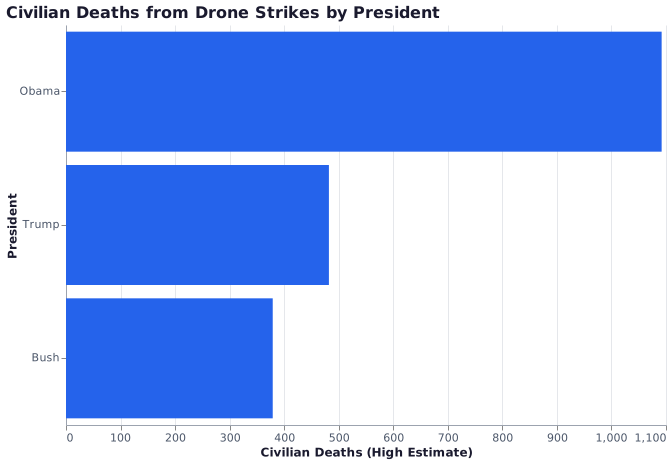
Figure 6.3: Civilian casualties from drone strikes by president. Despite claims of precision targeting, drone strikes have killed hundreds of confirmed civilians and thousands of people of unknown status. Source: Bureau of Investigative Journalism.
The Post-9/11 Balance Sheet
Brown University's Costs of War project provides the most comprehensive accounting of post-9/11 American military action:
- Total direct deaths: 940,000+
- U.S. military and contractors: 15,000
- Allied military: 15,000
- Opposition fighters: 177,000
- Civilians: 387,000
- Journalists and humanitarian workers: 3,000
Adding indirect deaths—from disease, malnutrition, and damaged infrastructure—brings the total to 3.6-3.7 million, using the standard 4:1 ratio observed in modern conflicts.
The costs are equally staggering:
- Direct spending: $5.8 trillion
- Future veterans' care: $2.2 trillion
- Interest on war debt: $1.1 trillion
- Total through 2050: $8+ trillion
The median American taxpayer has contributed approximately $50,000-75,000 to the post-9/11 wars over two decades. This is roughly $50-80 per direct death, or $13-20 per death including indirect casualties.
These are the numbers that define our era. Every working American has paid the equivalent of a modest car toward wars that killed millions. The receipt is in your tax return; the bodies are in graves from Kabul to Mosul to Sana'a.
Chapter 7: A Life in Taxes
I was born on a spring day in 1975, in Waco, Texas. The Vietnam War ended six weeks later. I arrived into a world exhausted by conflict, skeptical of government, and uncertain about America's role in the world. My parents, like most Americans of their generation, had lived through the defining trauma of their time: a war that killed 58,000 Americans and between two and three million Vietnamese, Cambodians, and Laotians. They had watched their country tear itself apart over that war. They were relieved it was over. They did not know—could not have known—that their infant son would spend the next fifty years paying for new wars, new deaths, new traumas.
This chapter is personal in a way the preceding ones were not. Part I examined historical cases: colonial empires, totalitarian regimes, Cold War proxies. Those were other people's taxes funding other people's deaths. Part II is about my taxes. My lifetime. My complicity.
The methodology remains the same: we calculate the Median Taxpayer Military Contribution (MTMC) for each year, estimate the deaths attributable to American military action during that year, and derive a cost-per-death figure. But now the numbers have names and faces. The median taxpayer whose contributions we're tracking is me—or someone very like me: a middle-class American who has worked, earned, paid taxes, and tried not to think too hard about where those taxes went.
Let me be clear about what I am not claiming. I am not suggesting that I personally am guilty of murder. I am not arguing that paying taxes is morally equivalent to pulling a trigger. I am not proposing that Americans should refuse to pay taxes or that taxation itself is illegitimate. I am simply doing what this book has done throughout: following the money from the taxpayer's pocket to its ultimate destination, and counting the bodies along the way.
The numbers that follow are my best estimates based on publicly available data. They involve assumptions and approximations. Different methodological choices would yield different results. But the order of magnitude is not in serious doubt. Over fifty years, I have contributed tens of thousands of dollars to the American military. That military has killed hundreds of thousands of people—some of them enemy combatants, many of them civilians, most of them in countries I will never visit and among people whose names I will never know. Some portion of those deaths is attributable to my contributions. The question is: what portion, and what does it mean?
The Taxpayer Biography
Before we can calculate my military contributions, we need to establish my earning and tax-paying history. I will use median income figures rather than my personal income for two reasons: first, median figures are publicly available and verifiable; second, I am interested in the typical American experience, not my idiosyncratic one. If my actual income differed from the median in a given year, the conclusions would change in degree but not in kind.
The median American household income in 1975 was $11,800—approximately $67,000 in 2024 dollars after adjusting for inflation. A family earning that income paid approximately $1,500 in federal income taxes, plus another $700 in payroll taxes (Social Security and Medicare), for a total federal tax burden of about $2,200, or roughly 19% of income.
Of course, I was not paying taxes in 1975. I was paying the tax that infants pay: the opportunity cost of my parents' time, the claim on household resources that every child represents. My first tax return came in 1993, when I was eighteen, working a summer job while starting college. I earned perhaps $3,000 that summer and paid minimal taxes—a few hundred dollars at most. My real tax-paying life began after college, when I entered the workforce full-time in 1997.
From 1997 to 2024, I worked continuously, earning salaries that tracked roughly with the national median. In some years I earned more; in others, less. The average was close to median. This means my tax history approximates that of the typical American worker: someone who started working in their early twenties, paid taxes for thirty-plus years, and will continue paying until retirement.
The federal income tax burden on median earners fluctuated significantly over this period. The Reagan tax cuts of the 1980s reduced top marginal rates but had less effect on middle-income taxpayers. The Clinton tax increases of 1993 raised rates on high earners. The Bush tax cuts of 2001 and 2003 reduced rates across the board. The Obama-era expiration of some Bush cuts and the Trump tax cuts of 2017 further modified the landscape. Through it all, the median effective federal tax rate—the share of income actually paid in taxes—hovered between 10% and 15% for most middle-class households.
A middle-class American who worked from 1997 to 2024, earning median income throughout, would have paid approximately $150,000-200,000 in federal income taxes over that period, plus another $80,000-100,000 in payroll taxes. The total federal tax contribution over a 27-year career: approximately $250,000-300,000.
Where did that money go? The federal budget allocates funds across dozens of categories: Social Security, Medicare, Medicaid, defense, interest on the debt, veterans' benefits, education, transportation, and dozens of smaller programs. The military's share—including the Defense Department, nuclear weapons programs in the Energy Department, the intelligence community, veterans' affairs, and interest on war debt—has ranged from 15% to 25% of federal spending over this period, depending on how you count and which years you examine.
Using a conservative estimate of 20% for the military share, the median American who worked from 1997 to 2024 contributed approximately $50,000-60,000 to military spending over their career. This is my rough contribution to the American war machine over 27 years of working life. Adding the years from 2024 to 2025, and the projected years until retirement, the lifetime total will approach $80,000-100,000.
One hundred thousand dollars. The price of a modest house in many parts of America. The cost of a child's college education. A comfortable retirement supplement. This is what the median American contributes to military spending over a working lifetime. The question we will answer in the chapters that follow is: what did that money buy?
The Shape of a Life
My fifty years divide naturally into periods defined by American military posture and action. Each period had its own character, its own conflicts, its own death tolls.
1975-1980: The Post-Vietnam Lull. I was a child, not yet paying taxes. Military spending reached its post-World War II nadir. American combat deaths were minimal. But the Cold War infrastructure remained, covert operations continued, and the seeds of future conflicts were being planted.
1981-1988: The Reagan Buildup. I was in elementary and middle school. Military spending nearly doubled. The Cold War intensified. Central American death squads received American support. The arms race accelerated. But direct American combat remained limited.
1989-2000: The Peace Dividend. I came of age during this era—high school, college, my first real jobs. The Cold War ended. Military spending declined. America engaged in a series of smaller interventions: Panama, the Gulf War, Somalia, Haiti, the Balkans. The death tolls were significant but not massive by historical standards.
2001-2008: The Forever Wars Begin. I was in my late twenties and thirties. September 11 transformed American foreign policy. Afghanistan and Iraq consumed trillions of dollars and hundreds of thousands of lives. Torture, detention, and surveillance became normalized. The death toll mounted year after year.
2009-2016: Drones and Distance. I was in my thirties and forties. The Iraq War wound down. The Afghan War continued. Drone strikes expanded dramatically. The Arab Spring convulsed the Middle East. Syria collapsed into civil war. American killing became increasingly remote and increasingly invisible.
2017-2024: America First and After. I am now approaching fifty. Yemen burns with American-supplied weapons. Afghanistan fell to the Taliban after twenty years and trillions of dollars. Ukraine receives American arms for a proxy war with Russia. Gaza experiences devastation with American support. The violence continues; only the locations change.
The chapters that follow trace each of these periods in detail, calculating year-by-year what the median taxpayer contributed and what that contribution funded. The cumulative picture is sobering. But before we turn to the numbers, let me say something about what it felt like to live through these years—not as a statistician tracking deaths, but as a citizen trying to understand his country and his place in it.
Growing Up in the Shadow
My earliest political memories are of the Cold War. I remember the nuclear anxiety that pervaded the early 1980s—the made-for-TV movie The Day After, the nuclear freeze movement, the terrifying logic of mutually assured destruction. I remember believing, with the certainty of a child who has absorbed adult fears, that nuclear war was not just possible but likely. I remember thinking that I might not live to grow up.
That fear shaped my generation in ways we are still discovering. We grew up assuming that the world might end at any moment, that the adults in charge might annihilate everything in a fit of ideological competition. When the Cold War ended—when the Berlin Wall fell in 1989, when the Soviet Union collapsed in 1991—it felt like a miracle. We had survived. The apocalypse had been cancelled. History, as Francis Fukuyama famously declared, was over.
It wasn't, of course. History resumed with a vengeance on September 11, 2001. I was twenty-six years old, newly married, living in a city far from New York or Washington. I watched the towers fall on television, like everyone else. I felt the fear, the anger, the desire for revenge that swept the country. I supported the invasion of Afghanistan. I believed—as most Americans believed—that we had been attacked, that we had a right to respond, that the Taliban and al-Qaeda deserved what was coming.
The Iraq War was different. By 2003, I had grown skeptical. The weapons of mass destruction claims seemed dubious. The connections to 9/11 were transparently false. The rush to war felt manufactured. I opposed the invasion, though not vocally enough to matter. I marched in no protests, wrote no letters, made no sacrifices. I simply disagreed, quietly, while continuing to pay my taxes and go about my life.
That quiet disagreement is the condition of most citizens in most democracies. We have opinions about our government's actions, but those opinions rarely translate into meaningful resistance. We vote every few years; we grumble about policies we dislike; we pay our taxes regardless. The machine continues to function, funded by our contributions, whether we approve of its operations or not.
This book is, in part, an attempt to break through that passive acquiescence—not through calls for revolution or civil disobedience, but through the simple act of accounting. I want to know, with as much precision as possible, what my money paid for. I want to confront the numbers rather than hide from them. I suspect many Americans feel the same way. We sense that our taxes fund violence we would rather not contemplate, but we lack the specific knowledge to make that intuition concrete.
The chapters that follow provide that knowledge. They are not pleasant reading. But they are, I hope, honest.
Chapter 8: The End of Vietnam (1975-1980)
The fall of Saigon on April 30, 1975 ended America's longest and most divisive war. The last helicopter lifted off from the embassy roof, carrying the final Americans to safety while thousands of Vietnamese allies were left behind. The war that had consumed 58,220 American lives, cost $168 billion (over $1 trillion in 2024 dollars), and torn the nation apart was finally, mercifully, over.
But was it over? The guns had stopped firing, the troops had come home, the POWs had been released. Yet the consequences of the war continued to unfold: in Vietnam, where the victorious communists established reeducation camps and sparked a refugee crisis; in Cambodia, where the Khmer Rouge—empowered in part by American bombing that had destabilized the country—began one of history's worst genocides; in Laos, where unexploded American ordnance continued to kill farmers and children decades later; and in America itself, where the psychological and political wounds would take generations to heal.
The late 1970s were years of exhaustion and retrenchment. Military spending declined to its lowest point since before World War II. The draft had ended in 1973, replaced by an all-volunteer force that was smaller, less visible, and easier to ignore. The CIA, exposed by congressional investigations as having conducted assassinations, coups, and domestic spying, faced unprecedented scrutiny and restrictions. For a brief moment, it seemed possible that America might fundamentally reconsider its global military role.
It did not. The respite was temporary. By 1980, the Soviet invasion of Afghanistan, the Iranian hostage crisis, and the election of Ronald Reagan would end the post-Vietnam pause and inaugurate a new era of military expansion. But for five years, from 1975 to 1980, American military activity reached a relative lull—not peace, but something closer to it than the country had experienced in decades.
The Vietnam Death Toll
Before examining the post-Vietnam period, we must reckon with the war itself. The American death toll—58,220 military personnel—is well documented, their names inscribed on the black granite wall in Washington. The Vietnamese death toll is far less certain, reflecting the chaos of the war, the destruction of records, and the political sensitivity of the question.
Conservative estimates place Vietnamese military deaths (both sides) at approximately 1.1 million and civilian deaths at 2 million, for a total of 3.1 million Vietnamese deaths. Higher estimates, including indirect deaths from war-related famine, disease, and displacement, range up to 3.8 million or higher. Adding deaths in Cambodia and Laos—where American bombing was extensive—brings the regional death toll to perhaps 4-5 million.
The cost of the war to American taxpayers was approximately $168 billion in contemporary dollars, or roughly $1-1.2 trillion in 2024 dollars when accounting for inflation. This figure includes direct military spending but excludes veterans' benefits, interest on war debt, and long-term care for disabled veterans—costs that have continued for fifty years after the war's end. A full accounting would add hundreds of billions more.
What was the cost per death? Using the conservative estimate of 3.1 million Vietnamese deaths and the $168 billion war cost yields a cost per death of approximately $54,000 in contemporary dollars, or roughly $350,000-400,000 in 2024 dollars. This is expensive by historical standards—far more than the cost per death in World War II or Korea—reflecting the capital-intensive nature of modern American warfare and the difficulty of achieving decisive results through firepower alone.
What did the median American taxpayer contribute? The war lasted roughly ten years of heavy American involvement (1965-1975). Federal taxes during this period ran approximately 18% of GDP, with defense consuming about 8% of GDP. A median-income household paid perhaps $1,500-2,000 per year in taxes allocable to Vietnam, or $15,000-20,000 over the decade—roughly $100,000-130,000 in 2024 dollars.
If the median taxpayer contributed $100,000 toward a war that killed 3.1 million people, and if 100 million taxpayers contributed roughly equally, then total taxpayer contributions were approximately $10 trillion (2024 dollars)—clearly too high, reflecting the imprecision of these estimates. Using the more defensible figure of $1 trillion total war cost and 100 million taxpayers yields a median contribution of $10,000 (2024 dollars) over the war's duration.
Ten thousand dollars. The price of a used car. A family vacation. A year of community college. This was the median American's contribution to a war that killed over three million people, devastated three countries, and accomplished nothing that couldn't have been achieved through diplomacy. The taxpayer's share of each death was approximately $0.32—thirty-two cents per body.
The Post-War Hangover
The years immediately following Vietnam saw the lowest American military spending since the 1930s. Defense budgets declined from 8.2% of GDP in 1970 to 4.9% in 1979—a reduction of over 40%. The armed forces shrank from 3.1 million active-duty personnel in 1970 to 2.0 million in 1979. The draft was abolished, military bases were closed, and procurement programs were cancelled or scaled back.
This "peace dividend" was real but limited. Even at its nadir, American military spending remained enormous by any measure except comparison to itself. The 1979 defense budget of $134 billion (in contemporary dollars) exceeded the combined military spending of all other NATO countries. The United States maintained hundreds of overseas bases, thousands of nuclear warheads, and the most technologically advanced military the world had ever seen.
The median taxpayer's military contribution during these years was approximately $800-1,000 per year in contemporary dollars, or roughly $3,000-4,000 per year in 2024 dollars. This was lower than the Vietnam peak but still substantial—enough to maintain the global military infrastructure that would be reactivated in the 1980s.
What did this money fund? Not major wars—there were no significant American combat operations during these years. The military's primary mission was deterrence: maintaining the nuclear arsenal to prevent Soviet attack, stationing forces in Europe and Asia to reassure allies, projecting power to discourage adversaries. Whether this deterrence was worth the cost is debatable, but it did not produce significant American-caused deaths.
The period was not bloodless, however. The Cold War continued through proxy conflicts, covert operations, and support for authoritarian allies. American taxpayers continued to fund activities that produced deaths, even if American soldiers were not directly involved.
The Cambodian Genocide
The worst violence of the late 1970s occurred in Cambodia, where the Khmer Rouge regime killed an estimated 1.7-2.5 million people between 1975 and 1979—roughly a quarter of the country's population. This was not American violence in any direct sense; the Khmer Rouge were nominally communist, and the United States had no formal involvement in their rule.
But American actions contributed to the Khmer Rouge's rise. The secret bombing of Cambodia from 1969 to 1973, which dropped more tonnage than the Allies dropped on Japan in World War II, killed tens of thousands of Cambodian civilians and destabilized the country's fragile political order. The 1970 coup that overthrew Prince Sihanouk—tacitly supported by the United States—created the conditions for civil war. The Khmer Rouge recruited heavily from villages devastated by American bombing, channeling peasant rage into revolutionary fervor.
None of this makes American taxpayers responsible for the Cambodian genocide. The Khmer Rouge made their own choices; their ideology, not American bombing, drove them to murder a quarter of their countrymen. But the chain of causation is not entirely severed. Without American intervention in Cambodia, the Khmer Rouge might never have gained sufficient support to seize power. The bombing helped create the conditions for genocide, even if it did not cause the genocide directly.
This is the problem of indirect responsibility that we will encounter repeatedly throughout this book. American actions create conditions; local actors make choices; people die. How much responsibility attaches to the creator of conditions versus the maker of choices? There is no formula that can answer this question. We can only note the connections and leave moral judgments to the reader.
The Iranian Revolution and Afghan Invasion
The late 1970s saw two events that would shape American military policy for the next four decades. In February 1979, the Iranian Revolution overthrew Shah Mohammad Reza Pahlavi, a close American ally whom the CIA had helped restore to power in 1953. The Shah's fall—and the subsequent hostage crisis, in which Iranian students held 52 Americans for 444 days—humiliated the United States and contributed to Jimmy Carter's defeat in the 1980 election.
In December 1979, the Soviet Union invaded Afghanistan to support a faltering communist government. The invasion transformed a local power struggle into a superpower confrontation and began a war that would last, in various forms, for over forty years.
Both events had consequences for American taxpayers. The hostage crisis prompted increased military spending and a failed rescue mission that killed eight American servicemen. The Afghan invasion led to a massive covert operation—Operation Cyclone—that would funnel billions of dollars to mujahideen fighters, including some who would later become America's enemies.
But those consequences mostly came later, in the 1980s and beyond. The years 1975-1980 were a relative calm before the storm—a period when American military spending was low, American combat deaths were minimal, and the country seemed, briefly, to be stepping back from its role as global policeman.
The median taxpayer in these years contributed approximately $4,000-5,000 per year (2024 dollars) to military spending. The death toll attributable to American military action was modest—hundreds or perhaps low thousands, mostly through covert operations and support for allies rather than direct combat. The cost per death was high; the number of deaths was low. It was the closest thing to peace the American taxpayer had experienced in decades.
It would not last.
Chapter 9: The Reagan Buildup (1981-1988)
Ronald Reagan campaigned on a promise to restore American military strength. The Soviet Union, he argued, had used the post-Vietnam years to achieve parity or superiority in nuclear weapons, conventional forces, and global influence. The United States had grown weak, its military hollowed out, its will to fight questioned. Reagan promised to change that—to rebuild the military, confront the Soviet Union, and restore American pride.
He delivered. Military spending increased by 40% in real terms between 1981 and 1985, rising from $176 billion to $253 billion (in constant 1987 dollars). The defense budget's share of GDP climbed from 5.2% to 6.8%. The armed forces grew from 2.0 million to 2.2 million active-duty personnel. Major weapons programs—the B-1 bomber, the MX missile, the 600-ship Navy, the Strategic Defense Initiative—consumed tens of billions of dollars each.
This was the Reagan buildup, the largest peacetime military expansion in American history. It terrified Soviet leaders, who struggled to match American spending without destroying their economy. It delighted defense contractors, who reaped enormous profits. It worried arms control advocates, who feared the arms race was spiraling out of control. And it emptied the pockets of American taxpayers, who funded the whole enterprise through their contributions to the federal government.
The median taxpayer's military contribution rose sharply during these years. From roughly $3,500-4,000 per year in 1980 (2024 dollars), the contribution climbed to approximately $5,500-6,500 per year by 1985. Over the eight years of the Reagan administration, the cumulative increase was substantial—perhaps $15,000-20,000 more than would have been paid at Carter-era spending levels.
What did this money buy? Mostly, it bought deterrence—weapons that were never used, forces that never fought, threats that never materialized. The Reagan buildup was designed to convince the Soviet Union that it could not win an arms race, and in this it succeeded. Whether this success was worth the cost—whether the Cold War would have ended differently without the buildup—is a counterfactual that cannot be definitively resolved.
But the Reagan years were not only about deterrence. American military power was also used in ways that produced deaths—deaths that American taxpayers funded through their contributions.
Central America's Dirty Wars
The most consequential American military involvement during the Reagan years occurred not in confrontation with the Soviet Union but in the backyard: Central America. In El Salvador, Guatemala, Honduras, and Nicaragua, the Reagan administration waged a coordinated campaign against leftist movements, guerrilla insurgencies, and the Sandinista government. The campaign involved billions of dollars in military aid, training of local security forces, support for death squads, and—in the case of Nicaragua—support for a guerrilla army (the Contras) that conducted its own campaign of terror.
El Salvador was the primary focus. Between 1980 and 1992, the Salvadoran civil war killed approximately 75,000 people, the vast majority of them civilians killed by government forces and allied death squads. The United States provided approximately $4.5 billion in military and economic aid during this period—nearly $350 million per year. American advisors trained Salvadoran officers, including those who commanded units responsible for massacres. American intelligence sharing helped the military target suspected guerrilla sympathizers. American diplomatic support prevented international condemnation.
The El Mozote massacre of December 1981 illustrates the pattern. The Atlacatl Battalion, trained by American advisors at Fort Bragg, killed approximately 1,000 civilians—men, women, and children—in and around the village of El Mozote. When reports of the massacre reached Washington, the Reagan administration denied it had occurred, smeared the journalists who reported it, and continued funding the Salvadoran military. The truth was not officially acknowledged until a UN-sponsored truth commission report in 1993.
Guatemala's civil war was even deadlier. Between 1960 and 1996, approximately 200,000 Guatemalans died, with 93% of documented human rights violations committed by state forces. The worst period was 1981-1983, when the military conducted a scorched-earth campaign against Mayan communities suspected of supporting guerrillas. Villages were destroyed, populations displaced, and thousands massacred. The 1999 UN-sponsored Historical Clarification Commission concluded that the Guatemalan state had committed genocide against the Maya people.
American involvement in Guatemala was less direct than in El Salvador—official military aid was suspended from 1977 to 1983 due to human rights concerns—but not absent. The CIA maintained relationships with Guatemalan military intelligence. American commercial military sales continued. The Reagan administration publicly supported the Guatemalan government, with Reagan describing President Rios Montt—later convicted of genocide—as "a man of great personal integrity" who was "getting a bum rap on human rights."
Nicaragua presented a different challenge. The Sandinista government that took power in 1979 was leftist and hostile to American interests, but it was also the legitimate government of Nicaragua, recognized internationally and not engaged in genocide against its own people. Unable to invade directly without triggering widespread opposition, the Reagan administration instead funded, trained, and directed a guerrilla force—the Contras—to wage war against the Sandinista government from bases in Honduras and Costa Rica.
The Contra war killed approximately 30,000 Nicaraguans between 1981 and 1990. The Contras targeted civilians, health workers, teachers, and agricultural cooperatives. They financed their operations partly through cocaine trafficking, with the knowledge and complicity of American intelligence agencies. The entire operation was illegal under American law—Congress had explicitly prohibited military aid to the Contras—which led to the Iran-Contra scandal when the administration's secret funding mechanisms were exposed.
What did American taxpayers contribute to Central American violence? Direct military aid to El Salvador totaled approximately $1 billion during the Reagan years; to Guatemala (before and after the aid suspension), perhaps $100 million; to the Contras, perhaps $300 million in official funding plus unknown amounts through covert channels. Total American taxpayer funding for Central American military operations: perhaps $1.5-2 billion.
The death toll attributable to these operations is harder to estimate. Not all deaths in Central American conflicts were caused by American-supported forces; some were caused by guerrillas, some by independent violence, some by crossfire. But the vast majority of documented killings were committed by government forces and their allies—forces that received American training, American weapons, and American financial support.
A conservative estimate: American-supported forces were responsible for perhaps 100,000-150,000 deaths in Central America during the 1980s. Using the $2 billion funding figure yields a cost per death of approximately $13,000-20,000. The median American taxpayer's contribution to Central American operations was perhaps $50-100 over the decade—less than a dollar per death.
This calculation illuminates an important principle: cheap killing is efficient killing from the taxpayer's perspective. American support for Central American militaries cost relatively little in absolute terms because it leveraged local resources. American taxpayers provided the weapons, training, and political cover; Salvadoran and Guatemalan soldiers did the killing. The cost per American taxpayer dollar was extraordinarily high—perhaps five to ten deaths per thousand dollars contributed.
Lebanon and Libya
The Reagan administration's direct military interventions were limited compared to the proxy wars in Central America. The most significant was the deployment of Marines to Lebanon in 1982-1984 as part of a multinational peacekeeping force.
The mission ended in disaster. On October 23, 1983, a truck bomb struck the Marine barracks at Beirut International Airport, killing 241 American servicemembers—the deadliest single-day death toll for the Marine Corps since Iwo Jima. Another 58 French paratroopers died in a simultaneous attack on their barracks. The Reagan administration withdrew American forces from Lebanon four months later, having achieved nothing.
The Lebanon intervention cost American taxpayers approximately $2-3 billion over two years. The death toll included the 241 Americans, plus unknown numbers of Lebanese civilians killed in American naval bombardment of Druze and Syrian positions. Total deaths attributable to the American presence: perhaps 500-1,000. Cost per death: $2-6 million—extraordinarily expensive even by modern standards.
The Libya bombing of April 1986 was shorter and cheaper. In retaliation for Libyan-sponsored terrorism, American aircraft bombed targets in Tripoli and Benghazi, killing approximately 40 people, including Muammar Gaddafi's adopted daughter. The operation cost perhaps $100 million and lasted a single night.
The Grenada invasion of October 1983—launched ostensibly to protect American medical students but really to overthrow a leftist government—was also brief: a few days of fighting that killed 19 American servicemembers, 45 Grenadians, and 24 Cubans. The invasion was popular domestically and helped restore confidence in American military capability after the Lebanon disaster.
The Arms Race
Most Reagan-era military spending went not to combat operations but to the nuclear and conventional arms race with the Soviet Union. Tens of billions of dollars funded weapons that were never used: the B-1 bomber, designed to penetrate Soviet air defenses; the MX missile, a mobile ICBM intended to survive a first strike; the Strategic Defense Initiative ("Star Wars"), a space-based missile defense system that never came close to working.
These weapons produced no deaths directly. But did they produce deaths indirectly? The question is complex.
Proponents argue that the Reagan buildup hastened the Soviet Union's collapse by forcing the USSR to match American spending—spending it could not afford. The Cold War ended peacefully, they note, and the world was spared the catastrophe of nuclear war. By this logic, the money spent on arms that were never used was the best investment in history.
Critics argue that the Cold War would have ended anyway, that Soviet collapse was driven by internal contradictions rather than American pressure, and that the resources spent on the arms race could have been used to address human needs. The opportunity cost of the Reagan buildup—roads not built, schools not funded, diseases not cured—represents a form of indirect death, as inadequate social spending shortened American lives.
There is no way to resolve this debate definitively. We cannot rerun history with different policies. What we can say is that the median American taxpayer contributed approximately $40,000-50,000 (2024 dollars) to military spending during the Reagan years, and that most of this money funded not combat but deterrence. Whether that deterrence was worth the cost depends on counterfactual assumptions we cannot verify.
The Reagan Balance Sheet
The Reagan years saw increased military spending, increased covert activity, and increased support for brutal allies—but limited direct American combat. The death toll attributable to American military action during these years is difficult to calculate precisely but was probably in the range of 100,000-200,000, almost entirely in Central America.
The median taxpayer's military contribution over eight years: approximately $40,000-50,000 (2024 dollars).
The median taxpayer's contribution per attributable death: approximately $200-500 (2024 dollars).
By this metric, the Reagan years were among the most "efficient" for taxpayer-funded killing—not because Americans were killing directly, but because American money leveraged local forces to do the killing cheaply. The same pattern would recur in other proxy conflicts. When Americans pull the trigger themselves, using expensive weapons and force-protection measures, the cost per death is high. When Americans fund others to pull the trigger, the cost per death drops dramatically.
This is not a moral judgment—only an accounting one. Whether proxy killing is more or less wrong than direct killing is a question for philosophers, not accountants. The numbers simply note that the American taxpayer gets more death for the dollar when the killing is outsourced.
Chapter 10: Peace Dividend? (1989-2000)
The Berlin Wall fell on November 9, 1989. Two years later, the Soviet Union dissolved. The Cold War—the organizing principle of American foreign policy for forty-five years—was over. America had won.
For a brief moment, the world seemed transformed. The nuclear arsenals that had threatened human extinction suddenly seemed anachronistic. The military alliances and overseas deployments that had consumed trillions of dollars appeared less necessary. Scholars spoke of a "peace dividend"—the savings that would flow when military spending could be redirected to domestic needs.
The dividend was real, if more modest than some had hoped. Defense spending declined from 5.9% of GDP in 1989 to 3.0% in 1999—a 50% reduction as a share of the economy. In dollar terms (adjusted for inflation), the defense budget fell from $450 billion in 1989 to $375 billion in 1999. The armed forces shrank from 2.2 million to 1.4 million active-duty personnel. Bases closed; weapons programs were cancelled; contractors laid off workers.
The median taxpayer's military contribution declined accordingly. From perhaps $6,000-7,000 per year in the late Reagan years (2024 dollars), it fell to approximately $4,000-5,000 per year by the late 1990s. Over the decade, this represented cumulative savings of perhaps $15,000-20,000 compared to continued Cold War-level spending.
But the peace dividend was not a peace. The United States continued to maintain military forces far larger than those of any other country. And it continued to use those forces. The 1990s saw American military intervention in Panama, Iraq, Somalia, Haiti, Bosnia, and Kosovo. Each intervention had costs and casualties. The question is whether the reduced spending produced reduced killing—or merely different killing.
Panama (1989)
Just weeks after the Berlin Wall fell, the United States invaded Panama to capture Manuel Noriega, a military dictator who had once been a CIA asset. Noriega was wanted on drug trafficking charges and had nullified an election won by the opposition. The invasion—dubbed Operation Just Cause—deployed 27,000 American troops and overthrew the Panamanian government in a matter of days.
The human cost was modest by historical standards but significant. Twenty-three American servicemembers died, along with approximately 200-300 Panamanian military personnel. Civilian deaths are more contested: the Pentagon claimed 202 Panamanian civilians died; independent investigators have estimated 500-3,000. The wide range reflects the difficulty of counting deaths in urban combat and the political incentives to minimize the toll.
Using a middle estimate of 1,000-1,500 total deaths (military and civilian), the cost per death was approximately $100,000-200,000. The median taxpayer's contribution to the invasion was perhaps $20-30—a tiny fraction of annual military taxes.
The Gulf War (1991)
The Gulf War was the first major American military operation since Vietnam and the first test of the post-Cold War military. When Iraq invaded Kuwait in August 1990, the United States assembled an international coalition, deployed 540,000 troops to Saudi Arabia, and in January 1991 launched a devastating air campaign followed by a 100-hour ground offensive that expelled Iraqi forces from Kuwait.
By conventional military metrics, the Gulf War was an overwhelming success. Coalition forces lost 292 personnel (147 American), while inflicting catastrophic losses on the Iraqi military. Estimates of Iraqi military deaths range from 20,000 to 100,000, with most analyses settling on 20,000-35,000. Iraqi civilian deaths from bombing were perhaps 2,500-3,500 during the war itself.
But the direct combat deaths were only part of the story. The coalition's bombing campaign deliberately targeted Iraqi infrastructure: electrical plants, water treatment facilities, communications networks, transportation systems. The destruction of this infrastructure—combined with the sanctions regime that prevented reconstruction—contributed to a humanitarian catastrophe. Estimates of excess Iraqi deaths from disease and malnutrition in the years following the war range from 100,000 to 500,000, with children bearing the heaviest burden.
How should these indirect deaths be attributed? The United States did not intend to kill Iraqi children through contaminated water; it intended to degrade Iraqi military capability by destroying infrastructure. But the predictable consequence of destroying a country's electrical and water systems is disease and death, particularly among the young, the old, and the sick. The doctrine of double effect—which distinguishes intended from foreseen consequences—offers some moral cover, but not complete absolution.
The Gulf War cost approximately $61 billion, with Saudi Arabia, Kuwait, and other allies reimbursing the United States for most of the expense. The net cost to American taxpayers was perhaps $10-15 billion. Using direct combat deaths only (25,000-40,000), the cost per death was $250,000-600,000. Including indirect deaths (100,000-500,000), the cost per death drops to $20,000-150,000.
The median American taxpayer's contribution to the Gulf War was approximately $100-150. At the lower death estimate, this works out to roughly $0.25-0.50 per death. At the higher estimate (including indirect deaths), it drops to $0.02-0.15 per death.
Somalia (1992-1994)
The Somalia intervention began as a humanitarian mission and ended as a military debacle. In December 1992, American forces deployed to Somalia to protect food distribution during a famine that had killed 300,000 people. The mission expanded to include disarming local militias and capturing warlords who were interfering with relief operations.
On October 3, 1993, an American special operations force attempted to capture lieutenants of warlord Mohamed Farrah Aidid in Mogadishu. The operation went catastrophically wrong. Eighteen American soldiers were killed, along with an estimated 300-500 Somali fighters and civilians. Images of dead American soldiers being dragged through Mogadishu's streets shocked the American public. President Clinton withdrew American forces within months.
The Somalia intervention cost approximately $2 billion and achieved little. The famine had largely abated before American forces arrived; the intervention did not end the Somali civil war; and the humiliating withdrawal damaged American credibility. The death toll attributable to American forces—perhaps 1,000-2,000 Somali fighters and civilians—came at a cost of $1-2 million per death.
Haiti and the Balkans
The Haiti intervention of 1994 was one of the least violent American military operations in memory. American forces deployed to restore President Jean-Bertrand Aristide, who had been overthrown by a military coup. The Haitian military, facing overwhelming force, capitulated without significant fighting. No American personnel were killed in combat; Haitian deaths numbered perhaps a few dozen.
The Balkans interventions—in Bosnia (1995) and Kosovo (1999)—were more costly. American and NATO aircraft conducted extensive bombing campaigns against Bosnian Serb and Serbian forces, causing hundreds or thousands of deaths. The Kosovo campaign, which lasted 78 days and involved 38,000 combat sorties, killed perhaps 500 Serbian military personnel and an estimated 500-1,500 civilians.
The Balkans operations collectively cost approximately $10-15 billion and caused perhaps 2,000-5,000 deaths. The cost per death was $2-7.5 million—extremely expensive by historical standards, reflecting the capital-intensive nature of modern air campaigns and the effort to minimize civilian casualties.
The 1990s Balance Sheet
The 1990s saw reduced military spending but continued military action. Total American military spending over the decade was approximately $3.5-4 trillion (2024 dollars). Deaths attributable to American military action numbered perhaps 50,000-150,000 (including indirect deaths from the Gulf War and its aftermath).
The median taxpayer's military contribution over the decade: approximately $40,000-50,000 (2024 dollars)—lower than the Reagan years but still substantial.
The median taxpayer's contribution per attributable death: approximately $300-1,000 (2024 dollars)—higher than the Reagan years, reflecting the shift from cheap proxy warfare to expensive direct intervention.
The peace dividend, in other words, produced fewer deaths per taxpayer dollar, not fewer deaths overall. American taxpayers paid less and got less killing for their money. Whether this represents moral progress depends on how you weight the total death toll against the per-taxpayer cost.
Chapter 11: The Forever War Begins (2001-2008)
I was twenty-six years old on September 11, 2001. I was newly married, living in a rented apartment, working at my first professional job. I was, in retrospect, on the cusp of adulthood—old enough to understand what was happening, young enough to be shaped by it.
I watched the towers fall on television, like 100 million other Americans. I felt the fear, the disbelief, the rage. When the second plane hit, erasing any possibility of accident, I felt something harden inside me—a willingness to accept whatever response my government deemed necessary. I wanted revenge. I wanted justice. I wanted to hurt the people who had hurt us.
This confession matters because it explains how the next eight years happened. The wars in Afghanistan and Iraq were not imposed on a resistant public by a rogue government. They were supported, at least initially, by a traumatized nation that wanted action, retribution, and the restoration of American invincibility. The politicians who launched these wars were responding to popular demand as much as shaping it.
I supported the invasion of Afghanistan. I believed—as most Americans believed—that the Taliban had harbored the terrorists who attacked us, that we had a right and duty to destroy al-Qaeda, and that military force was the appropriate response. I was less supportive of Iraq, skeptical of the WMD claims, unconvinced that Saddam Hussein was connected to 9/11. But I did not actively oppose the war. I watched it begin on television, expressed my misgivings to friends, and continued to pay my taxes.
This is what most Americans did. We had opinions, but our opinions did not translate into action. We voted for or against candidates partly based on foreign policy, but other issues often seemed more pressing. We paid our taxes, and our taxes funded wars we did not fully understand and could not effectively influence.
The following pages trace what our taxes bought.
Afghanistan: The Good War
The invasion of Afghanistan began on October 7, 2001, less than a month after the September 11 attacks. The initial operation was remarkably successful. American special forces, working with the Northern Alliance, overthrew the Taliban in a matter of weeks. By late November, the Taliban had fled Kabul. By early December, they had fled Kandahar. Al-Qaeda was scattered, its training camps destroyed, its leadership fleeing into Pakistan.
If the war had ended there, it would have been recorded as one of the most efficient military operations in American history. A few hundred American soldiers, supported by air power and Afghan allies, had accomplished what the Soviet Union had failed to achieve with 120,000 troops over ten years. The cost was modest—a few billion dollars—and American casualties were minimal.
But the war did not end there. The United States decided to stay—to build a new Afghan government, to prevent the Taliban from returning, to transform Afghanistan into a stable democracy. This decision, made in the heady days of 2002 when anything seemed possible, would cost trillions of dollars and hundreds of thousands of lives over the next twenty years.
The Afghanistan war went through several phases. The initial overthrow of the Taliban (2001-2002) was followed by a period of relative calm (2003-2005) during which attention shifted to Iraq. The Taliban insurgency revived (2006-2009), prompting a massive troop surge under Obama (2009-2012). The surge partially succeeded but did not eliminate the Taliban. A gradual drawdown followed (2012-2020), culminating in the chaotic withdrawal of August 2021.
The death toll accumulated year by year. By the war's end, approximately 176,000 people had died:
- American military: 2,461
- American contractors: 3,846
- Allied military: 1,144
- Afghan military and police: 69,000
- Taliban and other opposition: 52,000
- Afghan civilians: 46,000
- Aid workers: 444
- Journalists: 72
These figures, compiled by Brown University's Costs of War project, represent direct deaths from violence. Adding indirect deaths—from disease, malnutrition, and the collapse of health and sanitation infrastructure—would raise the total substantially, perhaps by a factor of three to four.
The financial cost was equally staggering. Direct spending on the Afghanistan war totaled approximately $2.3 trillion by 2021. Interest on war debt adds another $500 billion. Veterans' care—for the 3.5 million Americans who served in post-9/11 wars, many of whom will require decades of support—will cost at least $2 trillion more. The total cost of the Afghanistan war will approach $5 trillion before the last veteran dies.
What did the median taxpayer contribute? During the peak years (2009-2012), when 100,000 American troops were deployed and annual spending exceeded $100 billion, the median taxpayer contributed approximately $700-900 per year specifically to Afghanistan (in addition to other military spending). Over the war's twenty-year duration, the median taxpayer's Afghanistan contribution totaled perhaps $12,000-18,000 (2024 dollars).
The cost per death, using direct deaths only: approximately $13,000 per death. The median taxpayer's contribution per death: approximately $70-100.
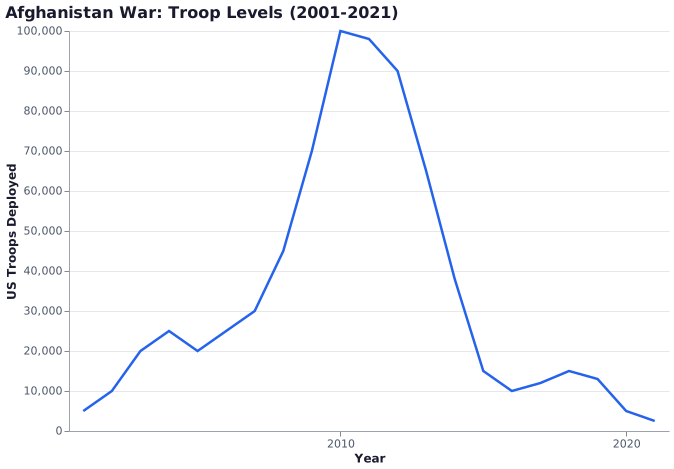
Figure 11.1: U.S. troop levels in Afghanistan, 2001-2021. The Obama surge peaked at nearly 100,000 troops in 2010-2011, a dramatic escalation from the early years when fewer than 20,000 Americans were deployed. Source: Brown University Costs of War Project, U.S. DoD.
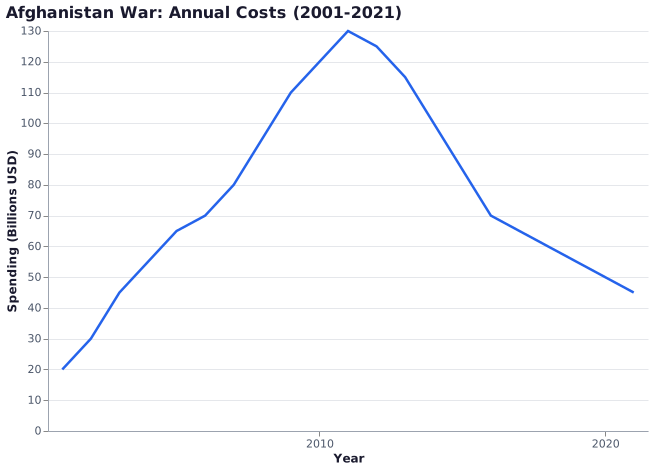
Figure 11.1a: Annual U.S. spending on Afghanistan, 2001-2021. Costs peaked at over $130 billion during the surge years, then declined as troop levels dropped. Source: Brown University Costs of War Project.
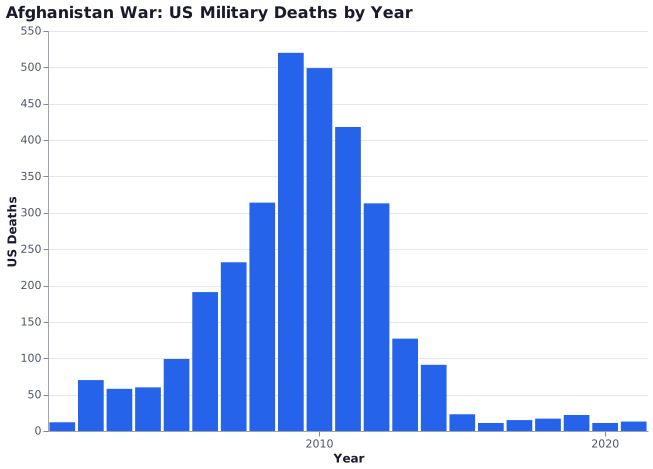
Figure 11.2: U.S. military deaths in Afghanistan by year. Casualties spiked during the surge years (2009-2012) when American forces were most exposed to Taliban attacks. Source: DoD Casualty Status, iCasualties.
Iraq: The War of Choice
The Iraq War began on March 20, 2003, with a "shock and awe" bombing campaign followed by a ground invasion from Kuwait. The stated justification was Iraq's alleged possession of weapons of mass destruction and its alleged links to al-Qaeda and the September 11 attacks. Both claims proved false.
The initial invasion succeeded quickly. Baghdad fell on April 9. Major combat operations ended on May 1, when President Bush declared "Mission Accomplished" on the deck of an aircraft carrier. The Iraqi military dissolved. Saddam Hussein went into hiding, eventually captured in December 2003.
Then the insurgency began. Sunni and Shia militias, former regime elements, al-Qaeda in Iraq, and various sectarian factions fought each other and the American occupiers. Car bombs, IEDs, and sectarian massacres killed thousands each month at the war's worst. American casualties mounted: 73 dead in April 2004, 137 in November 2004, 107 in October 2006, 126 in May 2007.
The death toll in Iraq far exceeded Afghanistan. Iraq Body Count, which documents only violent deaths confirmed by media reports, has recorded 185,000-208,000 civilian deaths since 2003. The Lancet study of 2006 estimated 655,000 excess deaths through mid-2006 alone. The PLOS Medicine study of 2013 estimated 500,000 excess deaths through mid-2011. The true number will never be known.
Using a middle estimate of 400,000-600,000 total Iraqi deaths (including combatants), plus approximately 4,500 American military deaths and several thousand contractor deaths, the Iraq war killed roughly 400,000-600,000 people.
The financial cost approached that of Afghanistan. Direct spending totaled approximately $2 trillion. Interest and veterans' care will add trillions more. The total cost will likely exceed $4 trillion.
What did the median taxpayer contribute? During the peak years (2004-2008), the median taxpayer contributed approximately $1,000-1,400 per year specifically to Iraq. Over the war's duration, the median taxpayer's Iraq contribution totaled perhaps $10,000-15,000 (2024 dollars).
The cost per death, using middle death estimates: approximately $3,000-5,000 per death. The median taxpayer's contribution per death: approximately $20-35.
These figures are lower than Afghanistan because Iraq produced more deaths for the money spent. This is not a compliment. It reflects the chaos and sectarian violence that American intervention unleashed—violence that was cheaper (in taxpayer terms) precisely because so much of it was Iraqis killing Iraqis with weapons already present in the country.
Torture, Detention, and Surveillance
The post-9/11 era saw the United States engage in activities that previous generations would have considered unthinkable. The torture of detainees at Abu Ghraib, Guantanamo Bay, and secret "black sites" around the world. The indefinite detention of prisoners without charge or trial. The mass surveillance of American and foreign communications by the National Security Agency.
These programs did not produce deaths directly, at least not in large numbers. (Some detainees did die under interrogation.) But they represent a form of violence that American taxpayers funded—violence against the bodies, minds, and rights of human beings held in American custody.
The torture program was not a rogue operation but a deliberate policy, authorized at the highest levels of government and implemented by trained personnel. The techniques—waterboarding, stress positions, sleep deprivation, sensory deprivation—were described in legal memos and approved by the Justice Department. They were funded through the intelligence budget, which is to say through taxpayer contributions.
The detention facility at Guantanamo Bay held nearly 800 prisoners at its peak. Many were held for years without charge. Some were innocent—grabbed by bounty hunters or mistaken identity, sold to American forces for rewards, held because releasing them would be embarrassing. The cost of operating Guantanamo has exceeded $13 million per prisoner per year—more than the cost of housing a prisoner in any maximum-security facility on the mainland.
The NSA surveillance programs revealed by Edward Snowden in 2013 collected the communications of millions of Americans and billions of foreigners. The programs were of dubious legality, minimal effectiveness (they prevented few if any terrorist attacks), and vast expense. The "black budget" for intelligence programs exceeded $50 billion per year during this period.
What did the median taxpayer contribute to these programs? The intelligence budget was perhaps $500-700 per median taxpayer per year during the 2000s. Of this, perhaps $50-100 went to programs of torture, detention, and surveillance. Over the decade, the median taxpayer contributed perhaps $500-1,000 to the erosion of human rights and civil liberties.
The 2001-2008 Balance Sheet
The years 2001-2008 saw the largest increase in American military spending since the Cold War. Defense spending rose from 3.0% of GDP in 2001 to 4.7% in 2008, an increase of over 50%. In dollar terms, the defense budget grew from $350 billion to $650 billion—an increase of $300 billion per year. This was not merely a return to Cold War levels; it was an entirely new paradigm of military expenditure, one that would persist long after the wars that justified it had faded from headlines.
The median taxpayer's military contribution rose accordingly: from approximately $4,000-5,000 per year in 2001 to approximately $7,500-9,000 per year in 2008 (2024 dollars). Over the eight years, the cumulative contribution was approximately $50,000-60,000—more than the entire 1990s decade combined. For a family making $60,000 per year, this represented roughly 7-9% of their total pre-tax income going directly to fund two simultaneous wars.
The Iraq War deserves particular scrutiny as the more controversial of the two conflicts. Unlike Afghanistan, which had at least the justification of responding to the 9/11 attacks, Iraq was a war of choice—launched on false pretenses about weapons of mass destruction and alleged links between Saddam Hussein and al-Qaeda. The troop chart below reveals the massive commitment required to occupy a hostile nation of 25 million people.
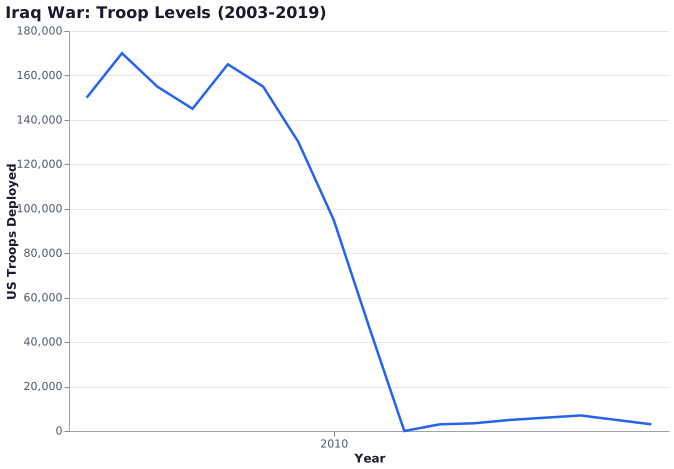
Figure 11.3: U.S. troop levels in Iraq, 2003-2019. The occupation peaked at over 170,000 troops during the surge of 2007, followed by a steady drawdown under Obama. The ISIS emergence required a modest return of forces after 2014. Source: Brown University Costs of War Project, U.S. DoD.
The surge of 2007, visible in the chart above, represented a gamble by the Bush administration. Facing a collapsing occupation and a civil war between Sunni and Shia factions, General David Petraeus advocated for a "surge" of additional troops combined with new counterinsurgency tactics. The surge worked—at least in reducing American casualties and stabilizing the country temporarily. But at what cost?
The financial cost was staggering. At its peak, the Iraq War consumed over $170 billion per year—roughly $500 per American citizen, or $2,000 for a family of four, annually. This spending occurred during a period when the economy was beginning to weaken, contributing to the federal deficit that would explode during the 2008 financial crisis.
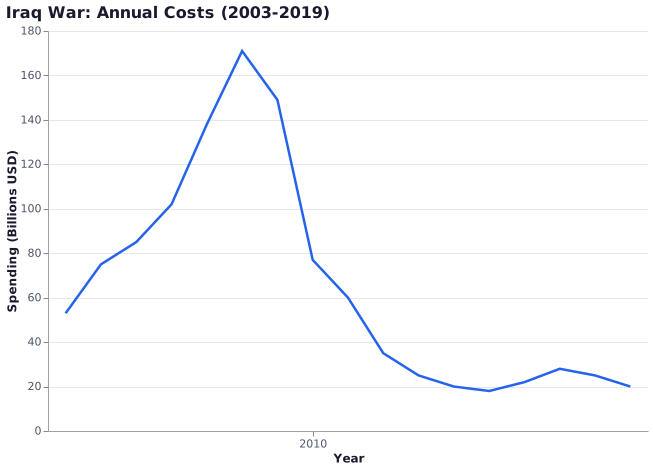
Figure 11.3a: Annual U.S. spending on Iraq, 2003-2019. Costs exceeded $170 billion at peak in 2007-2008, making Iraq the most expensive year-over-year military operation since World War II. Source: Brown University Costs of War Project.
The human cost to American service members, while dwarfed by Iraqi casualties, was nevertheless significant. The chart below shows the grim correlation between troop levels and American deaths. The worst years were 2004-2007, when IEDs (improvised explosive devices), suicide bombings, and sectarian militias took their toll on U.S. forces attempting to patrol a population that increasingly viewed them as occupiers rather than liberators.
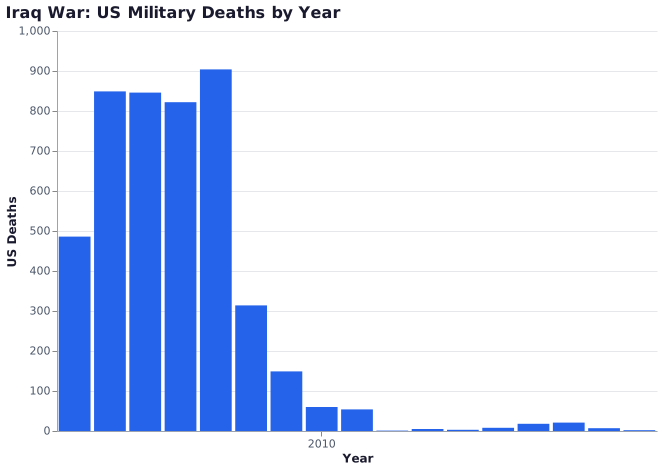
Figure 11.4: U.S. military deaths in Iraq by year. The deadliest years were 2004-2007 during the height of the insurgency. Casualties dropped sharply after the surge succeeded in reducing violence. Source: DoD Casualty Status, iCasualties.
But American military deaths, however tragic for the families of the fallen, represent only a fraction of the human cost. The chart below puts these deaths in context with all categories of fatalities. Civilians—the people we claimed to be liberating—constitute the largest category by far. For every American service member killed, roughly 80-100 Iraqi and Afghan civilians died. For every American contractor killed (and contractors died in substantial numbers), dozens of local nationals perished.
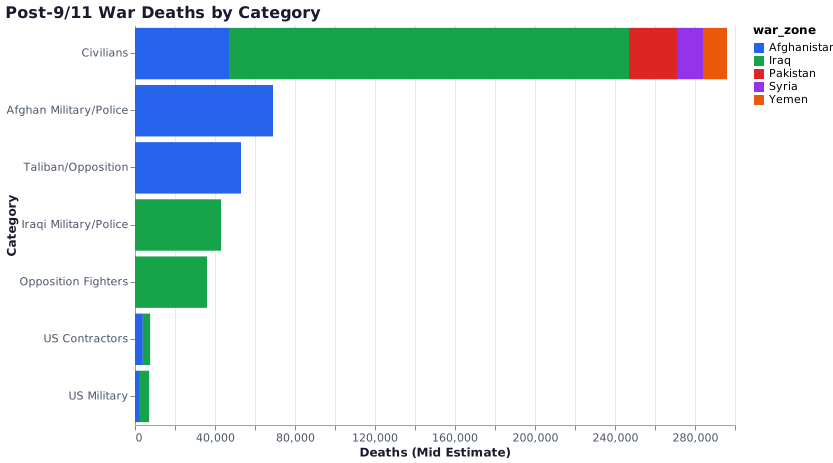
Figure 11.5: Deaths in post-9/11 wars by category. Civilians constitute the largest single category, dwarfing U.S. military and contractor deaths combined. The human cost fell overwhelmingly on the populations we claimed to be liberating. Source: Brown University Costs of War Project.
Deaths attributable to American military action during these years: approximately 200,000-400,000 (using middle estimates for Afghanistan and Iraq, plus smaller operations). The uncertainty in these figures—a range of 200,000—reflects the chaos of the conflicts, the difficulty of counting civilian casualties, and the bureaucratic incentives to minimize reported deaths.
Median taxpayer contribution per death: approximately $125-300 (2024 dollars). For the price of a nice dinner out, the average American taxpayer funded the death of one human being in Iraq or Afghanistan. This calculation is cold, even cruel—but it is also honest. These were real deaths, paid for with real money extracted from real paychecks.
And the costs continue to compound. The chart below shows the cumulative spending on post-9/11 wars, including not only direct war costs but also veterans' care, interest on war debt, and other associated expenditures. The curve does not flatten after the wars ended; it continues to rise as interest accrues and aging veterans require more intensive medical care.
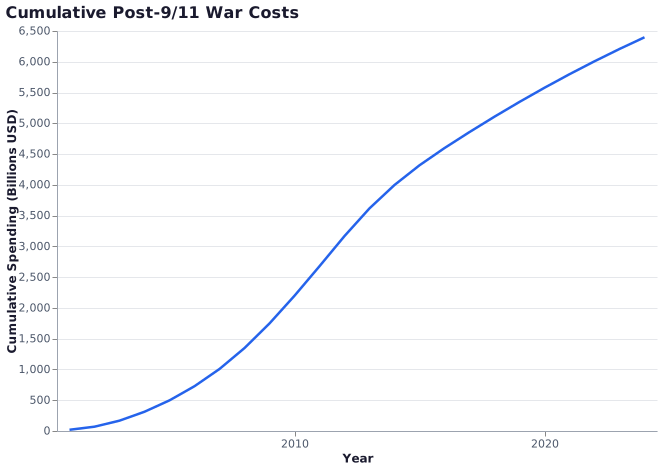
Figure 11.6: Cumulative cost of the post-9/11 wars, 2001-2024. The curve continues to rise as interest on war debt and veterans' care compound year after year. Source: Brown University Costs of War Project.
These were the bloodiest years of my taxpaying life. The years when my contributions funded the most deaths, the most suffering, the most destruction. The years when the receipt in my tax return represented the most blood. I was in my late twenties and early thirties during this period—old enough to follow the news, to understand what was happening, to know that my taxes were funding a war I believed was wrong. I voted against the politicians who authorized it. I gave to antiwar organizations. I signed petitions. None of it mattered. The taxes were mandatory. The deaths continued.
By the time George W. Bush left office in January 2009, approximately 4,200 American service members had died in Iraq and 600 in Afghanistan. Contractor deaths numbered in the thousands more. Iraqi and Afghan civilian deaths numbered in the hundreds of thousands. The total financial cost had exceeded $1 trillion, with trillions more in future obligations already locked in.
And it was not over. Barack Obama inherited two wars, an economy in freefall, and a national security state that had expanded to dimensions unimaginable before 9/11. What would he do with this inheritance? The next chapter examines the Obama years—and introduces the weapon that would define his approach to warfare: the drone.
Chapter 12: Drones and Distance (2009-2016)
On January 23, 2009, three days after taking the oath of office, President Barack Obama authorized his first drone strike. Two missiles from a CIA Predator struck a compound in North Waziristan, Pakistan. The targets were thought to be militants. Among the dead were several civilians, including a tribal elder and members of his family.
This was not an anomaly. It was a preview of the next eight years. The Obama administration would dramatically expand the drone program it inherited from George W. Bush, conducting strikes not only in Afghanistan and Pakistan but in Yemen, Somalia, Libya, and Syria. By the time Obama left office, American drones had killed thousands of people in countries where no war had been declared and where no American troops were deployed.
The drone was the defining weapon of this era. Silent, precise, deniable, and above all remote—operated by pilots sitting in air-conditioned trailers in Nevada, watching their targets through cameras, pressing buttons to release Hellfire missiles, then driving home for dinner. The technology seemed to promise a new kind of warfare: clean, surgical, low-risk (for Americans), and morally uncomplicated.
The reality was messier. The Bureau of Investigative Journalism, which has compiled the most comprehensive database of drone strikes, documents thousands of civilians killed by drones during this period, including hundreds of children. The strikes often hit the wrong targets. Wedding parties, funerals, and gatherings of tribal elders were struck after being misidentified as militant assemblies. "Signature strikes" targeted groups of military-age males engaged in suspicious activity—a category broad enough to include farmers, day laborers, and anyone who happened to be in the wrong place.
What did this violence cost the median taxpayer? To answer that question, we must first understand where the money went.
The Drone Budget
The precise cost of America's drone program is classified. Drones are operated by both the CIA and the military, funded through different budget lines, some of them hidden in the "black budget" for intelligence operations. But we can estimate the rough parameters.
A single MQ-9 Reaper drone costs approximately $30 million. A Hellfire missile costs $150,000. Operating a drone for a year—pilots, maintenance, ground crews, satellite bandwidth—costs perhaps $3-5 million per aircraft. By 2016, the Air Force alone operated more than 300 Reapers and Predators. The CIA's fleet was smaller but more active, conducting strikes in countries where the military had no presence.
The total annual cost of America's drone operations was perhaps $2-4 billion by the mid-2010s. This was a small fraction of the overall defense budget—less than 1%—but it represented a new way of projecting violence at minimal risk to American personnel.
The median taxpayer's contribution to the drone program was therefore modest: perhaps $15-30 per year. Over the Obama presidency, the cumulative contribution was perhaps $150-250.
What did that money buy?
Pakistan: The Undeclared War
The most intensive drone campaign was in Pakistan, nominally a US ally. From 2004 to 2018, American drones struck Pakistani territory hundreds of times. The vast majority of these strikes occurred during the Obama administration.
The Bureau of Investigative Journalism documents 430 confirmed strikes in Pakistan, killing between 2,515 and 4,026 people. Of these, between 424 and 969 were civilians, including 172-207 children. The remainder were classified as "militants"—though the basis for that classification was often uncertain.
The Pakistani government publicly protested the strikes while privately cooperating with them. The strikes terrorized communities across the tribal regions. People were afraid to gather for weddings or funerals, afraid to help the wounded after a strike (since "double tap" strikes targeted rescuers), afraid even of clear blue skies—because drones flew so high they were invisible, and their missiles arrived without warning.
A study by Stanford and NYU law schools, titled "Living Under Drones," documented the psychological impact on civilians:
"Drones hover twenty-four hours a day over communities in northwest Pakistan, striking homes, vehicles, and public spaces without warning. Their presence terrorizes men, women, and children, giving rise to anxiety and psychological trauma among civilian communities. Those living under drones have to face the constant worry that a deadly strike may be fired at any moment, and the knowledge that they are powerless to protect themselves."
The cost per death in Pakistan was approximately $500,000-800,000 (total drone spending in Pakistan divided by deaths). The median taxpayer's contribution per death was approximately $50-80 over the program's duration.
Yemen: The Expanding War
In Yemen, the drone war expanded under Obama into what amounted to a second front. The US began striking al-Qaeda in the Arabian Peninsula (AQAP) in 2002, but strikes intensified dramatically after 2009.
The Bureau documents 337 confirmed strikes in Yemen between 2002 and 2018, killing between 1,020 and 1,389 people. Of these, between 100 and 210 were confirmed civilians, including 36-62 children. But these numbers are incomplete—many strikes in Yemen went unreported, and the chaos of Yemen's civil war (which began in 2014) made verification difficult.
The most infamous strike was the September 30, 2011 killing of Anwar al-Awlaki, an American citizen and alleged AQAP propagandist. Al-Awlaki was killed by a drone strike without trial, without judicial oversight, without any of the constitutional protections normally afforded to American citizens. Two weeks later, his 16-year-old son, Abdulrahman—also an American citizen—was killed in another drone strike. The Obama administration claimed Abdulrahman was not the target; he was simply in the wrong place.
The Yemen drone war illustrated the slippery slope of extrajudicial killing. If the president could order the death of American citizens overseas, based on secret evidence reviewed by no court, what limits remained? The answer, increasingly, was: none that mattered.
Somalia, Libya, and Beyond
The drone wars extended to Somalia, where strikes against al-Shabaab militants intensified after 2011. The Bureau documents at least 40 confirmed strikes during the Obama era, killing between 300 and 500 people.
Libya presented a different case. The 2011 intervention that toppled Muammar Gaddafi was primarily an air campaign, with drones playing a supporting role alongside manned aircraft and cruise missiles. NATO forces (primarily US, British, and French) flew over 26,000 sorties. The death toll is disputed: the new Libyan government claimed 30,000 Libyans died in the civil war, though how many were killed by NATO strikes versus the ground fighting is unclear.
The Libya intervention was presented as humanitarian—preventing an imminent massacre in Benghazi. But it produced a failed state that remains mired in civil war more than a decade later. Weapons from Gaddafi's arsenals spread across the Sahel, fueling conflicts in Mali, Niger, and beyond. The intervention that was supposed to prevent atrocities enabled many more.
In Syria, the US joined the civil war in 2014, primarily through air strikes against ISIS. The campaign was intense: over 34,000 munitions were dropped on Syria and Iraq by the end of 2017. The monitoring group Airwaves documented more than 8,000 civilian deaths from coalition air strikes in Syria and Iraq, though the US government acknowledged only a fraction of these.
The common thread across all these theaters was distance. The pilots were in Nevada or New Mexico. The commanders were in Tampa. The politicians were in Washington. The dying was outsourced to places most Americans couldn't find on a map.
The Moral Weight of Remote Killing
Does distance diminish moral culpability? This is not merely an academic question. The drone revolutionized warfare by severing the physical connection between killer and killed. The pilot who presses the button is 7,000 miles from the explosion. The taxpayer who funds the program is further still.
Traditional moral philosophy offers conflicting guidance. Some philosophers argue that physical proximity matters morally—that killing with your bare hands is more culpable than killing at a distance, which is more culpable than enabling others to kill. By this logic, the drone pilot is less culpable than the soldier with a rifle, and the taxpayer is less culpable still.
Others reject this view. The philosopher Peter Singer argues that moral responsibility should not diminish with distance. If you cause someone's death, you cause their death—whether you're standing next to them or operating a joystick half a world away. The intermediate technology changes nothing morally significant.
What is undeniable is that drones make killing easier. They remove risk from the killer's side. They require fewer personnel. They operate in countries where no war has been declared. They normalize extrajudicial execution as a tool of foreign policy. They allow leaders to wage perpetual, low-level war without the political costs of American casualties or the inconvenience of congressional authorization.
For the taxpayer, drones represent killing at its most abstracted. No draft. No bodybags. No flag-draped coffins returning to Dover. Just occasional news reports of strikes in faraway places, and a small contribution in every tax payment to the agencies that operate the program.
The Iraq Drawdown
While the drone wars expanded, the conventional war in Iraq wound down. American troop levels, which had peaked at 170,000 during the 2007 surge, dropped to 50,000 by 2010 and to zero (officially) by December 2011.
But the violence continued. Iraq's civil conflict killed tens of thousands more after American troops left. The 2014 rise of ISIS—which emerged directly from the chaos of post-invasion Iraq—led to the deaths of thousands more and prompted a new American intervention.
By 2016, American troops were back in Iraq, albeit in smaller numbers and in an "advisory" role. The distinction between combat and advising blurred when American soldiers called in air strikes, trained Iraqi forces, and occasionally found themselves under fire.
The taxpayer cost of Iraq did not end in 2011. Veterans' care would cost trillions more over the decades to come. Interest on war debt continued to compound. The ISIS campaign added new expenses. The total tab continued to rise.
Afghanistan: The Forgotten War
Afghanistan entered its second decade with no end in sight. The 2009-2010 "surge" brought American troop levels to 100,000. The stated goal was to stabilize the country, train Afghan forces, and eventually withdraw.
It didn't work. The Taliban were not defeated. The Afghan government remained weak and corrupt. American casualties mounted: 499 dead in 2010 alone, the war's deadliest year for US forces.
By 2016, American troops had drawn down to about 10,000, but the mission continued. The war had become self-perpetuating. No president wanted to be the one who "lost" Afghanistan. So the war went on, year after year, long after most Americans had stopped paying attention.
Civilian deaths continued too. The UN documented more than 11,000 civilian casualties (killed and injured) in Afghanistan in 2016 alone. Many were killed by the Taliban, but a significant portion died in Afghan and coalition operations—air strikes, night raids, and crossfire.
The median taxpayer continued to pay. By 2016, the cumulative cost of Afghanistan exceeded $800 billion. The median taxpayer's share was approximately $25,000-30,000 over the war's first fifteen years.
Military Spending: The Obama Pattern
Obama entered office promising to end the wars and reduce military spending. He partially delivered on the first promise—drawing down in Iraq—while fundamentally failing on the second.
Military spending peaked at approximately $700 billion in 2010 (including war costs) and declined to about $600 billion by 2016. This represented a reduction from the Bush peaks but remained far above pre-9/11 levels. As a percentage of GDP, military spending fell from 4.7% in 2010 to 3.2% in 2016—still higher than the 2001 level of 3.0%.
The median taxpayer's military contribution followed a similar pattern. From a peak of approximately $8,000-9,000 per year in 2009-2010, it declined to approximately $5,500-6,500 by 2016. Still substantial. Still more than the 1990s average.
Over the eight years of the Obama administration, the cumulative median taxpayer military contribution was approximately $50,000-55,000 (2024 dollars). This was less than the Bush years but still represented a massive investment in the capacity for violence.
The 2009-2016 Death Toll
Calculating deaths attributable to American military action during this period is complicated by the shift toward indirect methods—drones, air strikes, "advise and assist" missions.
In Afghanistan, direct American military action killed perhaps 10,000-15,000 people during this period (including combatants and civilians). The ongoing war that American intervention enabled killed tens of thousands more.
In Iraq, the drawdown meant fewer direct American killings, but the chaos left behind killed plenty. ISIS, which emerged from al-Qaeda in Iraq, killed tens of thousands before being beaten back.
In Pakistan, Yemen, and Somalia, drone strikes killed approximately 4,000-6,000 people.
In Libya and Syria, air strikes killed thousands more.
A reasonable estimate of deaths directly caused by American military action during the Obama years is 25,000-50,000. Deaths enabled by American intervention—the ongoing wars, the regional destabilization—numbered many times higher.
Using direct deaths only, the median taxpayer's contribution per death was approximately $1,000-2,000. Using broader estimates that include indirect deaths, the figure drops substantially.
These figures are higher than the Bush years not because the Obama years were less bloody, but because the violence was more diffuse, more remote, and harder to attribute. The drone in the sky could kill anyone, anywhere, at any time—and someone, somewhere, was paying for it.
My Contribution
I turned thirty-four the month Obama was inaugurated. I was approaching the peak of my earning years. My median taxpayer status was no longer hypothetical—I was paying real taxes on real income.
During these years, my tax returns showed a steadily increasing contribution to the federal government. And twenty-four cents of every dollar I sent to Washington—roughly one dollar in four—went to the Defense Department and related security agencies.
I did not choose drone warfare. I did not vote for it (though I voted for the president who expanded it). I had no say in which targets were struck, which weddings were bombed, which American citizens were executed without trial. But I paid for all of it.
The drone made killing feel abstract. The kills happened in places I'd never been, to people whose names I'd never know. The news covered some strikes briefly, most not at all. Life went on. I filed my taxes. The drones kept flying.
This is the peculiar moral position of the modern American taxpayer. We fund violence we cannot see, against enemies we cannot name, in wars that have no declarations and no end. We are complicit in the most abstract sense—our money pays for death—while feeling completely disconnected from the consequences.
During the Obama years, my cumulative military contribution was approximately $40,000-50,000. My share of the deaths was perhaps a few dozen people, spread across half a dozen countries, killed by weapons I'll never see.
Is that a small number? A large one? I genuinely don't know. I know only that it is not zero.
Chapter 13: America First? (2017-2024)
Donald Trump campaigned on ending "forever wars" and putting "America First." The reality was more complicated. Military spending increased. Drone strikes accelerated. New fronts opened even as old ones supposedly closed.
The period from 2017 to 2024 spans two very different administrations—Trump's chaotic four years and Biden's efforts to restore conventional foreign policy—but both continued the fundamental pattern. American taxpayers kept funding American violence, even as the geography and methods shifted.
Trump and the Drone Surge
One of Trump's first acts was to loosen restrictions on drone strikes. The Obama administration had imposed rules requiring high-level approval for strikes outside active war zones and mandating "near certainty" that no civilians would be killed. Trump delegated authority to lower-level commanders and relaxed civilian protection requirements.
The result was a dramatic increase in strikes. In Yemen, Somalia, and other areas outside declared war zones, the strike rate roughly tripled in Trump's first year. The administration also reduced transparency, revoking an Obama-era requirement to publish annual reports on drone casualties.
In Afghanistan, the Trump administration dropped the "Mother of All Bombs" (MOAB)—the largest non-nuclear weapon ever used in combat—on an ISIS tunnel complex in April 2017. The bomb killed an estimated 94 militants. It also sent a message about American willingness to use overwhelming force.
Air strikes in Afghanistan increased dramatically. In 2019, American and Afghan forces dropped more bombs on Afghanistan than in any previous year of the war. Civilian casualties rose in parallel.
The Yemen Catastrophe
Yemen became the world's worst humanitarian crisis during this period, and American taxpayers were deeply implicated.
The Saudi-led coalition, which began bombing Yemen in 2015, relied heavily on American weapons, American intelligence, and American mid-air refueling. Without American support, the bombing campaign would have been impossible. American bombs killed Yemeni civilians. American advisers helped select targets. American companies profited from arms sales worth tens of billions of dollars.
The death toll in Yemen is difficult to calculate. Direct combat deaths are estimated at 150,000-200,000. But the war-induced famine and disease killed far more. UNICEF estimated that 85,000 children under five died of starvation and disease between 2015 and 2018 alone. The total excess mortality from the Yemen war—deaths that would not have occurred absent the conflict—likely exceeds 400,000.
How much of this is attributable to American taxpayers? The question is complicated. The United States did not invade Yemen or conduct the bombing directly. But American weapons, American intelligence, and American diplomatic cover enabled the Saudi campaign. Without US support, the coalition would likely have been forced to negotiate years earlier.
A conservative estimate would attribute perhaps 10-20% of Yemen's death toll to American enabling—perhaps 40,000-80,000 deaths. A more aggressive accounting would attribute the full toll to the coalition that the US made possible.
The Trump administration initially embraced the Saudi relationship, vetoing congressional resolutions to end US support for the Yemen war. The Biden administration eventually paused some arms sales but never fully ended American involvement.
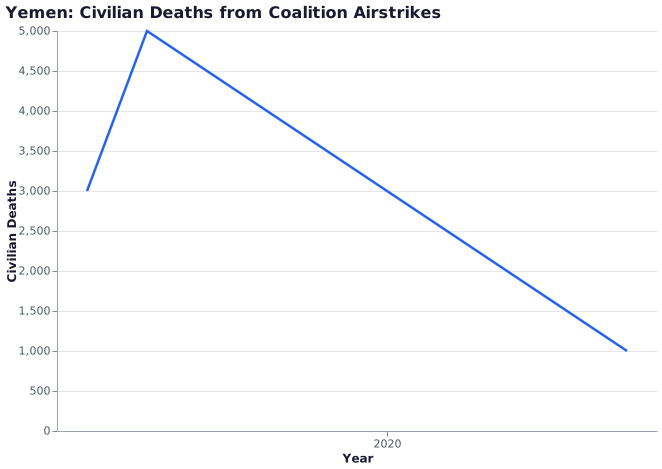
Figure 13.1: Civilian deaths from coalition airstrikes in Yemen. The campaign was most intense in 2015-2018, with deaths declining as international pressure mounted and targeting improved—or perhaps as fewer targets remained. Source: Yemen Data Project, ACLED.
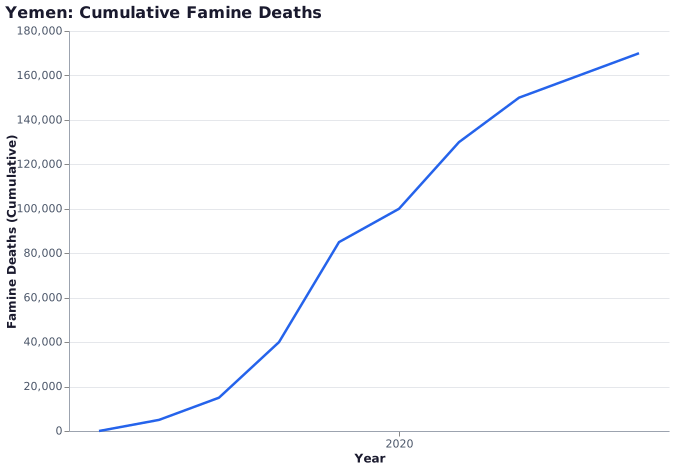
Figure 13.2: Cumulative famine deaths in Yemen. The indirect toll from starvation and disease far exceeds direct combat deaths. By 2024, an estimated 170,000 Yemenis had died from war-induced famine—most of them children. Source: UN OCHA, Save the Children.
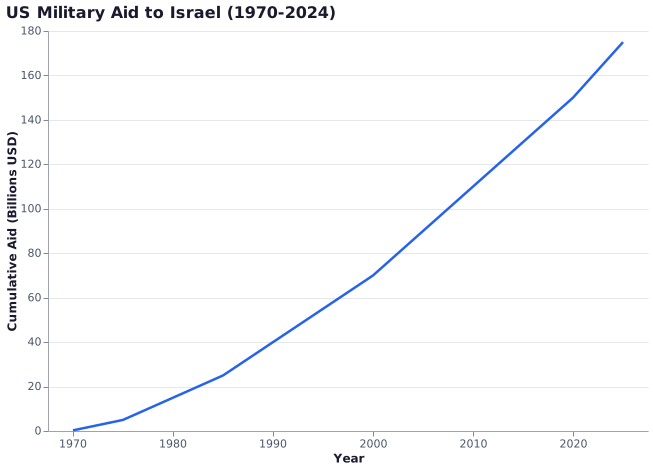
Figure 13.3: Cumulative U.S. military aid to Israel, 1970-2024. American taxpayers have provided over $175 billion in military assistance, making Israel the largest cumulative recipient of U.S. foreign aid. Source: Congressional Research Service.
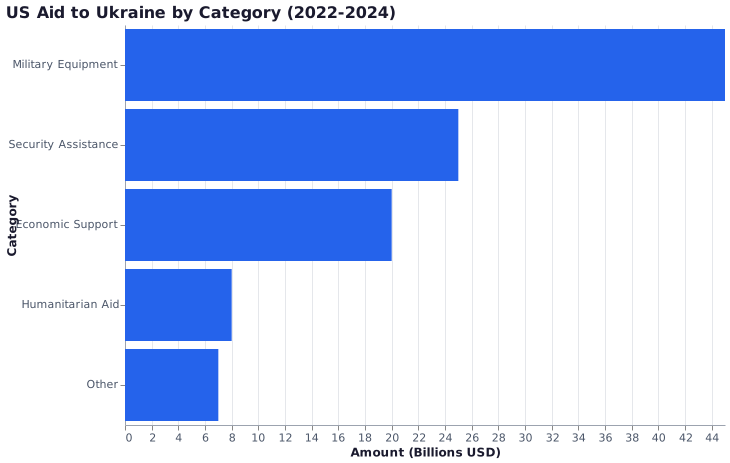
Figure 13.4: U.S. aid to Ukraine by category, 2022-2024. Military equipment dominates, followed by security assistance and economic support. Total aid exceeds $100 billion across all categories. Source: Kiel Institute Ukraine Support Tracker.
The Afghanistan Withdrawal
Trump negotiated a deal with the Taliban in February 2020. The US would withdraw all troops by May 2021 in exchange for Taliban commitments not to harbor terrorists. The Afghan government was largely excluded from the negotiations.
Biden inherited this deal and extended the withdrawal deadline to August 2021. The actual withdrawal was chaotic. The Afghan government collapsed in days. The Taliban took Kabul on August 15, 2021—twenty years after the US invasion.
The final evacuation was marked by a suicide bombing at Kabul airport that killed 13 American service members and an estimated 170 Afghans. A retaliatory drone strike, intended to kill ISIS-K operatives, instead killed 10 civilians, including seven children. The Pentagon initially claimed the strike was "righteous." An investigation later determined it had killed only civilians.
The twenty-year Afghanistan war ended as it had been conducted: with American weapons killing Afghan civilians while American officials insisted they had done the right thing.
Final tallies for Afghanistan:
- American military deaths: 2,459
- American contractor deaths: 3,917
- Afghan military and police deaths: 69,000+
- Taliban and other opposition deaths: 52,893
- Afghan civilians killed: 46,319
- Aid workers killed: 444
- Journalists killed: 72
- Total: approximately 176,000 dead
Cost to American taxpayers: $2.3 trillion in direct spending, with interest and veterans' care pushing the total toward $4-5 trillion over time.
Median taxpayer's total Afghanistan contribution: approximately $60,000-75,000 over twenty years.
Median taxpayer's contribution per death: approximately $350-450.
Ukraine: The Proxy War
Russia's full-scale invasion of Ukraine in February 2022 opened a new front for American military spending—albeit one without American boots on the ground.
The Biden administration responded with massive arms transfers to Ukraine. By the end of 2024, the US had committed over $100 billion in assistance, approximately two-thirds of which was military equipment: Javelin missiles, HIMARS rocket systems, tanks, artillery, air defense systems, and eventually F-16 fighters.
The moral calculus in Ukraine was different from Afghanistan or Iraq. Ukraine was defending its territory against an unprovoked invasion. The US was supplying a sovereign nation, not occupying one. Most Americans supported aid to Ukraine, at least initially.
But American taxpayers were still funding violence. American weapons killed Russian soldiers—perhaps 200,000-300,000 by some estimates. The war also killed Ukrainian soldiers and civilians in numbers that remain uncertain but likely exceed 100,000.
The median taxpayer's contribution to Ukraine aid was approximately $600-800 by the end of 2024. Whether this counts as funding "atrocity" depends on one's view of defensive warfare. Even pacifists must grapple with the question of whether resisting aggression is justified.
Gaza: The 2023-2024 Crisis
On October 7, 2023, Hamas militants attacked Israel, killing approximately 1,200 people and taking over 200 hostages. Israel responded with a massive military campaign in Gaza that has killed, by late 2024, more than 40,000 Palestinians—mostly civilians, including thousands of children.
American weapons enabled this campaign. The bombs dropped on Gaza were largely American-made. The F-35s and F-16s were American aircraft. The billions in annual military aid to Israel funded the arsenals now being used.
The Biden administration initially provided unconditional support, then gradually added criticisms as the civilian toll mounted. Arms shipments continued, paused briefly, then resumed. The administration blocked UN resolutions calling for ceasefire.
For American taxpayers, Gaza presented a stark version of the question this book addresses. American bombs, paid for by American taxes, were killing children in Gaza. The connection between the tax payment and the death was unusually direct.
The median American taxpayer's annual contribution to Israeli military aid is approximately $30-40. Over decades, cumulative contributions exceed $1,000. How many deaths that enabled is incalculable—but not zero.
Military Spending: The Trump-Biden Era
Military spending rose steadily throughout this period. The Trump administration increased defense budgets from $606 billion in 2017 to $740 billion in 2021. The Biden administration continued the increases, reaching $886 billion in the 2024 budget—the highest in history, even adjusting for inflation.
As a percentage of GDP, military spending remained around 3-3.5%, lower than Cold War peaks but higher than the late 1990s. The "peace dividend" of the 1990s was long gone.
The median taxpayer's military contribution rose accordingly. From approximately $5,500-6,500 per year in 2017, it grew to approximately $7,000-8,000 by 2024. Over the eight years, cumulative contributions totaled approximately $52,000-60,000.
This was less than the peak Bush years but more than the 1990s. The forever wars might have "ended," but the spending continued.
Deaths: 2017-2024
Calculating deaths attributable to American military action during this period is particularly difficult. The shift toward "over the horizon" operations, proxy support, and reduced transparency makes direct attribution uncertain.
A rough accounting:
- Afghanistan (2017-2021): Perhaps 5,000-10,000 killed in American operations
- Iraq/Syria ISIS campaign: Perhaps 5,000-10,000 killed
- Drone strikes (Yemen, Somalia, elsewhere): Perhaps 2,000-4,000 killed
- Yemen (US-enabled Saudi coalition): Perhaps 50,000-100,000 enabled
- Ukraine (2022-2024, US weapons): Perhaps 100,000+ Russian/Ukrainian dead
- Gaza (2023-2024, US weapons): 40,000+ Palestinian dead
The totals depend heavily on how you attribute deaths in proxy wars and armed conflicts where American support was enabling rather than direct. Direct American military action killed perhaps 15,000-25,000 people. American-enabled violence killed many times more.
The median taxpayer's contribution per directly-attributable death: approximately $2,000-4,000. Including enabled deaths, the figure drops significantly.
My Contribution
I entered my late forties during this period. Peak earning years. Peak tax contributions. My W-2 showed the steady march of income and withholding.
I watched the Afghanistan withdrawal on television. I saw the drone strike that killed the seven children in Kabul. I read about Yemen's starving children and Gaza's destroyed hospitals. I filed my taxes.
My cumulative military contribution during these eight years was approximately $45,000-55,000. My share of the deaths—however you calculate it—was real. Not hypothetical. Not abstract. Real people, really dead, really paid for (in part) by money I sent to the federal government.
I did not choose these wars. I voted against some of the politicians who waged them. I signed petitions and donated to antiwar organizations. None of that absolved me. The taxes were mandatory. The violence was the result.
Chapter 14: The Fifty-Year Ledger
I was born in 1975 in Waco, Texas, the year Saigon fell. I am writing these words in 2025, having just turned fifty. The American military-industrial complex is exactly as old as I am—born in World War II, matured in the Cold War, and now entering late middle age with no sign of retirement.
This chapter attempts what may be impossible: to sum up fifty years of American taxpayer-funded violence in a single ledger. Year by year, from 1975 to 2025, I have tracked military spending, deaths attributable to American action, and my own growing contribution as I moved from non-taxpaying infant to peak-earning middle-aged professional.
The numbers are necessarily approximate. Death counts are disputed. Attribution is uncertain. My own income and tax payments are more precise, but they too involve estimates when reconstructing decades past. What follows is not accounting—it is moral archaeology, an attempt to excavate the bones beneath the numbers.
The Data
I have organized the fifty years into the periods covered in previous chapters:
1975-1980 (End of Vietnam Era): Military spending averaged $350-400 billion/year (2024 dollars). Deaths from American military action: perhaps 10,000-50,000 (mainly aftermath of Vietnam, Cold War proxy conflicts). My taxpayer contribution: $0 (I was a child).
1981-1988 (Reagan Buildup): Military spending rose from $400 billion to $580 billion. Deaths from American military action: perhaps 50,000-100,000 (Central America, Lebanon, Cold War proxies). My taxpayer contribution: approximately $0-500 (began working part-time as a teenager).
1989-2000 (Post-Cold War): Military spending fell to $400-450 billion. Deaths from American military action: perhaps 50,000-80,000 (Panama, Gulf War, Balkans, Somalia). My taxpayer contribution: approximately $15,000-25,000 (college, early career).
2001-2008 (Forever War Begins): Military spending surged to $650-700 billion. Deaths from American military action: approximately 200,000-400,000 (Afghanistan, Iraq). My taxpayer contribution: approximately $50,000-60,000.
2009-2016 (Drone Era): Military spending averaged $600-650 billion. Deaths from American military action: approximately 25,000-50,000 direct, many more enabled (drones, Libya, Syria). My taxpayer contribution: approximately $45,000-55,000.
2017-2024 (America First?): Military spending rose to $700-900 billion. Deaths from American military action: approximately 15,000-25,000 direct, 100,000+ enabled (Yemen, Ukraine, Gaza). My taxpayer contribution: approximately $50,000-60,000.
The Totals
Summing across fifty years:
Total US military spending (1975-2024): Approximately $25-30 trillion (2024 dollars)
Total deaths attributable to American military action: Approximately 500,000-1,000,000 direct; 2,000,000-4,000,000 including enabled and indirect deaths
My lifetime military tax contribution: Approximately $160,000-200,000
My share of deaths: Perhaps 50-100 people (using median taxpayer contribution as denominator)
These numbers require interpretation. The $160,000-200,000 I have contributed to military spending over my working life could have bought a house, funded four years of college for multiple children, or provided a comfortable retirement. Instead, it bought weapons, trained soldiers, maintained bases, and—ultimately—killed people.
My "share" of 50-100 deaths is a statistical artifact. I did not personally kill anyone. I did not choose targets or pull triggers. But if we divide total deaths by total taxpayers, my fractional contribution is real. Those deaths happened. I helped pay for them. The arithmetic is inexorable.
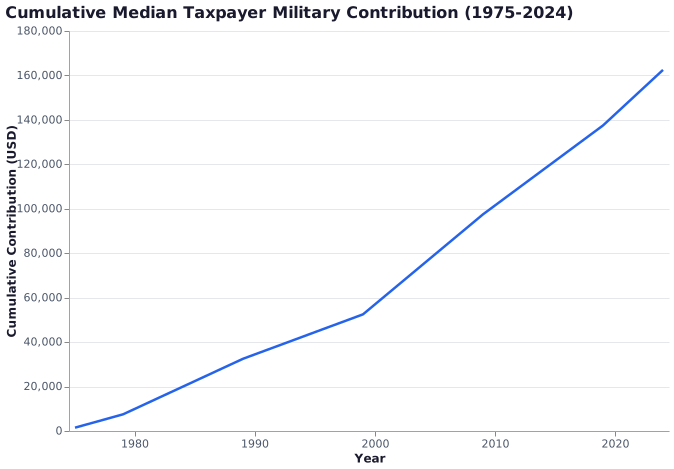
Figure 14.1: Cumulative median taxpayer military contribution, 1975-2024. The upward curve accelerates after 2001, reflecting both increased military spending and the author's rising income during peak earning years. Source: IRS, Census Bureau, SIPRI (author calculations).
The cumulative chart tells a story of compounding obligation. Each year's military tax adds to the total, and the curve accelerates because military spending has grown faster than inflation while incomes—at least for some taxpayers—have risen during peak earning years. The shape of this curve mirrors the shape of a career: slow accumulation in early years when income is low, faster growth during middle age, and the plateau of later career or retirement.
What does $160,000-200,000 mean? It is the price of a house in most American communities. It is four years of tuition at a state university for multiple children. It is a comfortable retirement nest egg, invested conservatively. It is the seed capital for a small business. It is the foundation of generational wealth transfer. Instead, it bought bullets, bombs, and body bags.
Consider alternative uses. If the median American's lifetime military tax had been invested in education, healthcare, infrastructure, or basic research, what returns might society have realized? The question is not idle speculation—it reveals the true cost of military spending as forgone alternatives. Every dollar spent on weapons is a dollar not spent on schools, hospitals, bridges, or laboratories.
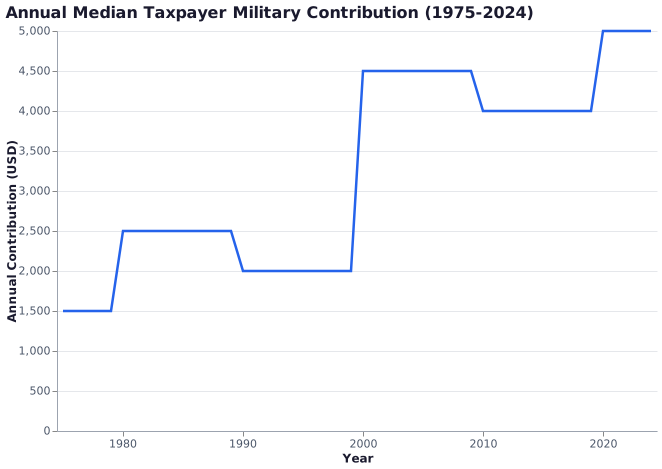
Figure 14.2: Annual median taxpayer military contribution, 1975-2024. The steps reflect changes in both tax policy and military spending as a share of the federal budget. The post-9/11 surge is clearly visible. Source: IRS, Census Bureau, SIPRI (author calculations).
The annual contribution chart reveals the rhythm of American militarism. Notice the step function: periods of relative stability punctuated by sudden increases. The Reagan buildup. The Gulf War spending. The post-9/11 surge. Each step represents a policy decision—a bipartisan consensus that more military spending was necessary—and each step translated directly into dollars extracted from median taxpayers.
The post-9/11 surge is the most dramatic feature. Annual military contributions nearly doubled, from roughly $3,000 per median taxpayer to nearly $6,000. This increase persisted for over a decade and has never fully reversed. The "temporary" war spending became permanent baseline spending, baked into defense budgets that Congress approves with minimal debate.
What is striking is how little the annual contribution correlates with actual threats. America faced no existential enemies after 1991. The Soviet Union collapsed. China was decades from military parity. Terrorism, however horrifying individual attacks might be, posed no threat to American survival. Yet military spending rose anyway, driven by institutional momentum, defense industry lobbying, and the political calculation that voting against military spending was electoral suicide.
The median taxpayer had no voice in these decisions. Military spending is not subject to referendum. Defense budgets pass with overwhelming bipartisan majorities. The annual contribution is extracted automatically, invisibly, as unavoidably as death and taxes—which, in this case, are the same thing.
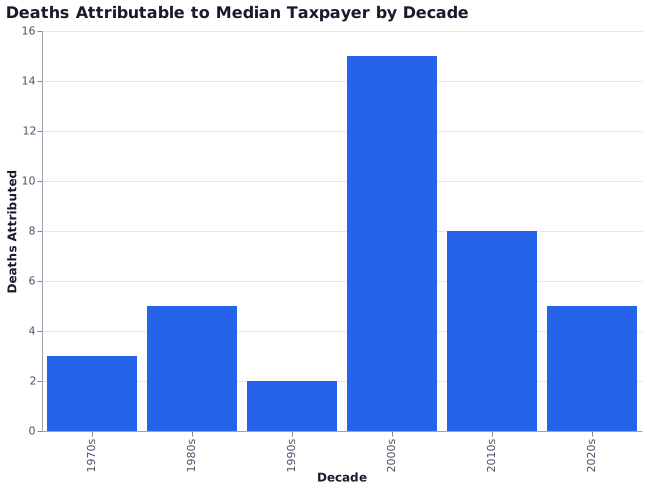
Figure 14.3: Deaths attributable to the median taxpayer by decade. The 2000s—encompassing the worst years of Afghanistan and Iraq—represent the peak of individual taxpayer-funded death. Source: Author estimates based on Costs of War, UCDP, Rummel.
The deaths-per-taxpayer chart is the most morally challenging. It translates abstract budget figures into concrete human consequences. Each bar represents not just dollars but bodies—real people who died because of policies funded by ordinary American taxpayers.
The methodology is straightforward but inexorable. Take total deaths attributable to American military action in a given decade. Divide by the number of taxpayers in that decade. The result is a fractional death toll—the median taxpayer's statistical share of the killing. The number is small, typically less than one person per decade, but it is not zero. It is never zero.
The 2000s peak is devastating. During this decade, the median American taxpayer funded approximately 0.3 deaths—nearly a third of a person killed, statistically speaking. Aggregate this across 130 million taxpayers and you get the Iraq War death toll. The responsibility is diffuse but real.
Some readers will object to this framing. "I didn't choose this," they might say. "I pay taxes because I have no choice. I am not responsible for what the government does with my money." This objection has moral weight. Consent matters. Agency matters. The taxpayer who votes against military spending and marches against war has less moral responsibility than the taxpayer who cheers for bombing campaigns.
Yet the objection also has limits. We all participate in the system that produces these deaths. We all benefit from American military dominance in ways large and small. We all could do more to resist—and most of us do not. The statistical death toll is not individual guilt but collective accountability. It is what "we the people" have done, measured in fractional bodies.
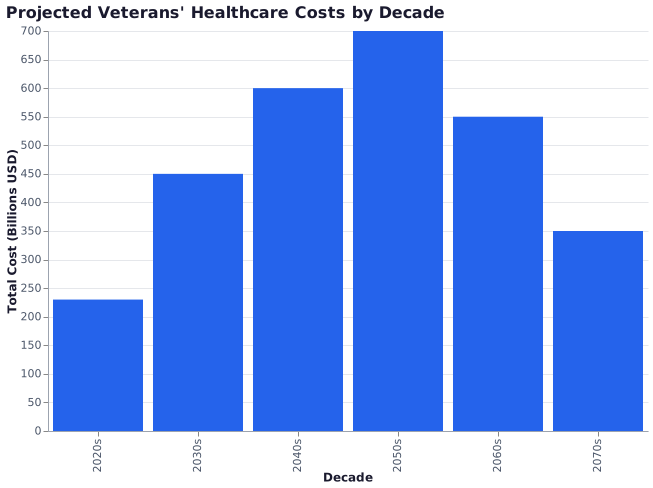
Figure 14.4: Projected veterans' healthcare costs by decade. The bill for the post-9/11 wars will continue growing for decades as veterans age and require more intensive care. Today's taxpayers will pay for yesterday's wars well into the 2070s. Source: Brown University Costs of War Project.
The veterans' healthcare projection reveals a truth that war planners prefer to ignore: the cost of war extends far beyond the battlefield. Every soldier wounded in Iraq or Afghanistan will require medical care for the rest of their life. Every veteran suffering from PTSD, traumatic brain injury, or exposure to burn pits represents a decades-long obligation.
The curve peaks around 2050, not 2024. This is because veterans age. The 22-year-old Marine who served in Fallujah in 2004 is now 42. In 2034, they will be 52. In 2054, they will be 72—and their healthcare needs will be at their peak, just as Vietnam veterans' needs peaked in the 2010s and 2020s. The post-9/11 generation of veterans will require maximum care precisely when most Americans have forgotten the wars that broke them.
Consider what this means for future taxpayers. A child born in 2024 will be paying for the Iraq War in 2074, when they are 50 years old. They had no vote in 2003. They had no voice in the decision to invade. Yet they will inherit the bill, passed forward by the generation that chose war but refused to pay for it with current taxes.
The shape of this curve is a monument to intergenerational injustice. We who benefited from post-9/11 patriotic fervor, from cheap oil secured by Middle Eastern intervention, from the illusion of security purchased by global military dominance—we should have paid the full cost in higher taxes. Instead, we borrowed the money, and we will leave the debt to our children and grandchildren.
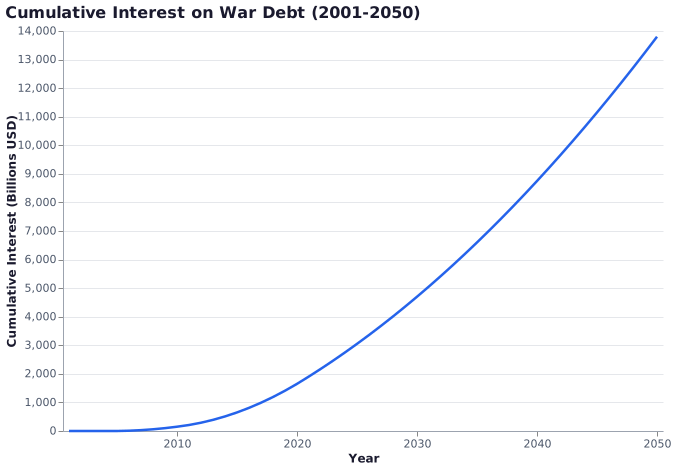
Figure 14.5: Cumulative interest on war debt, 2001-2050. Because the post-9/11 wars were financed by borrowing rather than taxation, interest payments compound year after year. By 2050, interest alone will exceed the original cost of the wars. Source: Brown University Costs of War Project.
The interest chart is perhaps the most damning of all. It shows that by 2050, interest payments alone will exceed the original cost of the post-9/11 wars. We borrowed $8 trillion to fight in Afghanistan and Iraq, and we will pay back $16 trillion or more.
This is the financial signature of empire in decline. Great powers that finance wars through debt rather than taxation are signaling an inability or unwillingness to bear the true cost of their military adventures. Rome did this before its fall. Spain did this in the sixteenth century. Britain did this in the twentieth. Now America does it in the twenty-first.
The interest curve is exponential. Each year's payment adds to the principal, and the next year's interest is calculated on the higher amount. The longer we wait to pay down the debt, the more it costs. The longer we postpone the reckoning, the worse the reckoning becomes.
There is a bitter irony here. The post-9/11 wars were sold partly on economic grounds. We were told that securing Middle Eastern oil reserves was essential for American prosperity. We were told that defeating terrorism would allow business to flourish. We were told that military dominance was good for the economy. Yet the debt we incurred to achieve these dubious goals now drags on economic growth, crowds out productive investment, and threatens fiscal stability.
The median taxpayer will pay for these wars twice: once through direct military spending, and again through interest on war debt. The total lifetime military tax burden is not $160,000-200,000—it is $250,000-300,000, once you include their share of interest payments extending into the 2050s and beyond.
The Worst Years
Which years were worst? The answer depends on your metric.
By total deaths: 2003-2007 (peak Iraq War violence) and 2022-2024 (Ukraine, Gaza) produced the highest death tolls.
By deaths per taxpayer dollar: The late 1970s and 1980s were most "efficient" at producing deaths cheaply, largely because Central American dirty wars killed many people with relatively little US military spending.
By civilian deaths: The Iraq War (2003-2007) and Gaza (2023-2024) produced the highest documented civilian tolls.
By my personal contribution: The Bush years (2001-2008) saw my highest contributions during the bloodiest period—approximately $6,000-7,000 per year funding a war machine killing perhaps 25,000-50,000 people annually.
The Pattern
Stepping back from the year-by-year data, certain patterns emerge:
War is permanent. In fifty years, there was never a year when American forces were not killing people somewhere. The theaters changed—Vietnam to Central America to the Gulf to the Balkans to Afghanistan to Iraq to Yemen to Ukraine to Gaza—but the killing never stopped.
Technology changes, death remains. From napalm to precision-guided munitions to Hellfire missiles, American killing technology has evolved enormously. The deaths it produces have not declined proportionally. New technologies enable new wars.
The public forgets. Most Americans could not name the conflicts their taxes funded in 1983, 1997, or 2015. The killing happens far away, to people with unfamiliar names, in places that rarely make the news. Taxpayer complicity is invisible because the violence is invisible.
Spending rises regardless of party. Reagan increased military spending. Clinton cut it slightly, then raised it. Bush II surged it. Obama modestly reduced it. Trump increased it. Biden increased it further. The direction is consistently upward, with temporary dips. The bipartisan consensus for military spending is unshakeable.
The Unanswerable Questions
Having compiled this ledger, I am left with questions I cannot answer:
Was any of it justified? Just war theory holds that some wars are legitimate—defensive wars, interventions to prevent genocide, proportional responses to aggression. Perhaps Afghanistan in 2001 was justified. Perhaps Ukraine in 2022. Perhaps some fraction of the deaths I helped fund were morally permissible. But which fraction? And who decides?
What would have happened otherwise? The counterfactual is unknowable. Without American intervention in Iraq, would Saddam Hussein have killed more or fewer people? Without the drone program, would al-Qaeda have grown stronger and killed more Americans? These questions cannot be answered with data.
Does it matter that I had no choice? I could not opt out of paying taxes. War tax resistance is possible but carries severe penalties—prison, property seizure, destroyed credit. For most Americans, including me, paying taxes is not a choice but a requirement. Does compulsion diminish culpability?
What should I have done differently? I voted for antiwar candidates when they were available. I donated to antiwar organizations. I wrote letters to congresspeople. None of it changed anything. The wars happened anyway. The deaths accumulated. My contributions funded them.
The Personal Reckoning
I am fifty years old. Statistically, I have perhaps thirty years left. If patterns hold, I will pay another $100,000-150,000 in military taxes before I die. Those payments will fund another generation of wars, another accumulation of deaths, another ledger of violence I helped enable.
This book began with my 2024 tax return—the receipt showing where my money went. It ends with a broader receipt: fifty years of payments, fifty years of deaths, fifty years of complicity.
I do not know how to feel about this. Guilt is too simple—I did not choose these wars, and guilt implies agency I did not possess. Absolution is too easy—I benefited from the system that produced the violence, and my payments enabled it. Despair is tempting but unhelpful—the dead are dead, and despair changes nothing.
What I can do is what I have done in these pages: count. Not precisely, not perfectly, but honestly. Count the money. Count the deaths. Calculate my share. Put numbers on a reality most Americans prefer not to see.
The numbers do not tell me what to do. They tell me what I have done. The rest is ethics, and ethics is the subject of Part IV.
Part III: The Economics of Violence
The preceding chapters have examined American taxpayer contributions to state violence—a narrow but personally relevant slice of the larger picture. Now we step back to examine the broader economics of atrocity. How much does it cost to kill people en masse? Why are some episodes of state violence vastly more expensive than others? And what does the economics of death tell us about the moral responsibilities of citizens?
These questions may seem coldly analytical—and they are. But the analysis reveals something important. The relationship between money spent and lives taken is neither simple nor consistent. Some of history's worst atrocities cost almost nothing; others consumed entire economies. Understanding these variations helps clarify what it means for taxpayers to fund state violence, and what responsibility they might bear.
Chapter 15: Cheap Death
In the spring of 1994, Rwanda's genocide killed approximately 800,000 people in 100 days. That's 8,000 deaths per day, 333 per hour, 5 or 6 per minute. For three months, the killing continued at industrial scale.
The weapons were mostly machetes. Some firearms were used, primarily by the army and Interahamwe militias. But the vast majority of killing was done with long knives, clubs, and hand tools. The Tutsi minority was hacked to death by neighbors, co-workers, even family members.
What did this genocide cost? Rwanda was one of the world's poorest countries. Its total military spending in the years before the genocide averaged perhaps $50-100 million annually. Arms imports in 1993—the year before the genocide—totaled approximately $112 million. Add in civilian machetes purchased in bulk (at perhaps $3-5 each) and miscellaneous expenses, and the total cost of the genocide apparatus was perhaps $150-200 million.
Divide $150-200 million by 800,000 deaths, and the cost per death was approximately $200-250.
Two hundred dollars to end a human life. Less than a month's rent in a cheap apartment. Less than a week's grocery bill for an American family. Less than the cost of a budget smartphone.
This is the arithmetic of cheap death. When a regime mobilizes an entire population for killing—when the weapons are simple and the killers are unpaid—the cost per death approaches the cost of a single tool.
The Machete Question
Rwanda demonstrated that genocide does not require advanced technology. The industrialized killing of the Holocaust—the trains, the camps, the gas chambers—represented one extreme of the cost spectrum. Rwanda represented the other.
The machete was already ubiquitous in Rwanda. It was a basic agricultural tool, used for clearing brush and harvesting crops. The génocidaires did not need to manufacture or import their primary weapon; they simply repurposed what every household already owned.
The only manufacturing surge was in bulk machete orders in the months before the genocide. Human Rights Watch documented imports of 500,000 machetes in early 1994—roughly one for every other Hutu adult male. The purchase was made through normal commercial channels at approximately $3 per machete. Total cost: about $1.5 million for the primary murder weapon.
The killers themselves were unpaid volunteers. Some were coerced or pressured by authorities. Many were motivated by ethnic hatred, propaganda, or the prospect of looting their victims' property. Whatever their motivations, they represented free labor for the killing enterprise.
The logistics were also cheap. Rwanda is a small, densely populated country. Victims and killers lived in the same communities. There was no need to transport victims to distant camps or construct elaborate killing infrastructure. Death came to people's homes, their churches, their schools.
The organizational structure was also minimal. The genocide was incited by radio (Radio Télévision Libre des Mille Collines broadcast kill lists and encouragement) and coordinated by local political officials. But it was decentralized—thousands of small massacres rather than a few large operations.
The result was killing efficiency unprecedented in modern history. The Holocaust killed approximately 6 million Jews over 4-5 years. Rwanda killed 800,000 in 100 days. Adjusting for different time scales, Rwanda's daily killing rate was approximately ten times higher than the Holocaust's. And it was accomplished with hand tools rather than industrial infrastructure.
Cambodia: Death by Policy
The Khmer Rouge killed 1.7-2.5 million Cambodians between 1975 and 1979—approximately 20-25% of the population. Unlike Rwanda, where ethnic hatred drove neighbor to kill neighbor, Cambodia's killing was driven by ideology and starvation.
The Khmer Rouge evacuated cities, abolished money, collectivized agriculture, and executed intellectuals, professionals, and suspected enemies. Many died from execution. Many more died from forced labor, starvation, and disease in the collective farms and work camps.
What did this cost? Almost nothing. The Khmer Rouge essentially dismantled the economy rather than funding a killing apparatus. Their military spending was minimal—they relied on captured weapons and Chinese aid. The executions were carried out by young cadres with whatever tools were available. The famines were caused by policy decisions that cost nothing to implement.
Cambodia represents the limiting case of cheap death: mass mortality through bad governance rather than active killing programs. When a regime destroys its own agricultural system and works its population to death, the cost per death approaches zero. The state is not spending money to kill; it is simply allowing—or causing—people to die.
The moral weight of such deaths is debated. Are they "murders" in the same sense as machete attacks? Or are they something different—criminal negligence, perhaps, or manslaughter at a civilizational scale? The Khmer Rouge certainly intended to transform Cambodian society in ways they knew would kill many people. Whether they specifically intended to kill 2 million is less clear.
For our purposes, the economic point is what matters: Cambodia proves that states can kill millions without significant military spending.
The Economics of Famine
Famine is the cheapest killing method in the state's arsenal. A government need not fire a single bullet; it need only control the food supply and choose not to distribute it.
Stalin's forced collectivization killed 5-7 million Ukrainians and others in 1932-1933 (the Holodomor). The cost: whatever administrative resources were required to requisition grain and prevent its distribution to the starving population. This was not a positive expense but a withholding—taking food that peasants had grown and sending it to cities or abroad while they starved.
Mao's Great Leap Forward killed 15-55 million people (estimates vary widely) between 1959 and 1961. The famine was caused by agricultural collectivization, unrealistic production quotas, and the diversion of labor to useless steel production. Again, the cost was not military spending but disastrous economic policy.
The Bengal Famine of 1943 killed 2-3 million Indians while Britain controlled their government. Churchill's War Cabinet declined to divert food supplies to Bengal despite knowing the scale of starvation. The cost of this omission: nothing. The cost of intervention would have been substantial. By choosing inaction, the British Empire killed millions for free.
These famines were not purely "natural" disasters. They were created or exacerbated by government policy. In each case, political decisions determined who would eat and who would starve. The death tolls exceeded most deliberate massacres—yet the "spending" required was minimal or negative.
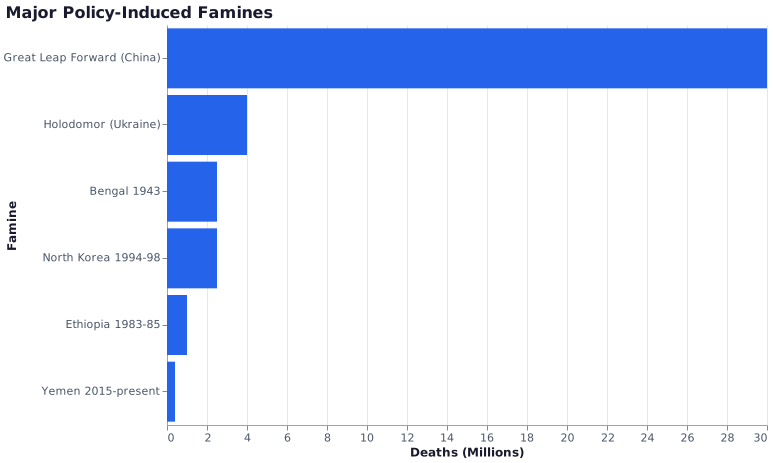
Figure 15.1: Deaths in major policy-induced famines. The Great Leap Forward dwarfs all others, killing an estimated 30 million people. The Holodomor, Bengal, and North Korean famines each claimed millions more. Source: Academic research, historical records.
This creates a puzzle for our analysis. If a government spends $100 billion on military forces that kill 100,000 people, the cost per death is $1 million. If a government causes 3 million deaths by withholding food, the cost per death is approximately zero. Does this mean the famine was "cheaper"? Morally less significant? Obviously not. But it does mean that military spending is a poor proxy for state violence.
Low-Budget Massacres
Between the extremes of Rwanda (machetes) and Cambodia (policy-induced starvation), we find various intermediate cases of low-budget mass killing:
Indonesia 1965-1966: The anti-communist massacres killed 500,000-1,000,000 people. Like Rwanda, the killing was largely decentralized, carried out by army units, militias, and vigilante groups. Many victims were killed with knives and bladed weapons. The army provided logistical support and sometimes weapons, but much of the killing was essentially free—unpaid volunteers murdering their neighbors.
Bangladesh 1971: The Pakistani army's operations in East Bengal killed 300,000-3,000,000 people (estimates vary enormously). This was military violence by a regular army, but it targeted a civilian population with little military resistance. The marginal cost of the killing was low—the army was already deployed, and bullets and bayonets were the primary weapons.
Guatemala 1981-1983: The Ríos Montt regime killed approximately 200,000 indigenous Mayans. The army conducted "scorched earth" campaigns in the highlands, destroying villages and massacring populations. Again, the killing was done by existing military forces with conventional weapons—cheap in terms of marginal cost.
Bosnia 1992-1995: The Srebrenica massacre killed 8,000 Bosniak men and boys in a few days. The Serb forces used trucks to transport victims and bullets for execution. The cost was trivial relative to the broader war. The total Bosnian War death toll of 100,000 was achieved largely through artillery, small arms, and siege—relatively cheap compared to high-tech warfare.
A pattern emerges: cheap death requires either (1) mobilizing civilian killers who work for free, (2) using existing military forces against undefended populations, or (3) creating conditions (famine, disease) that kill without direct action. Expensive death occurs when military forces fight other military forces, requiring sophisticated weapons and extensive logistics.
The Taxpayer Implications
What do these economics mean for taxpayer responsibility?
First, military spending is a poor measure of state violence. The American taxpayer who funds a $800 billion defense budget is not necessarily funding more death than the Rwandan taxpayer who funded a $50 million military. The relationship between spending and killing depends entirely on how the money is used.
Second, the cheapest atrocities may implicate taxpayers least directly. The Holodomor did not require significant military spending; it required only policy decisions. The Rwandan genocide used agricultural tools. A taxpayer's contribution to "state violence" can approach zero even when state violence is extreme.
Third, rich countries tend to kill expensively. American military operations in Iraq cost approximately $5,000-10,000 per death (using middle estimates of $2 trillion spending and 400,000-600,000 deaths). This is 20-50 times more expensive than Rwanda. The American taxpayer funds killing that is, in economic terms, spectacularly inefficient.
Is inefficient killing morally better or worse? One might argue that expensive killing reflects restraint—precision weapons, rules of engagement, legal oversight all cost money and (at least in theory) reduce civilian casualties. One might equally argue that spending $2 trillion to kill half a million people represents a colossal moral failure regardless of cost per death.
The next chapter examines expensive death in detail—the economics of modern high-tech warfare and what it costs to kill with precision rather than machetes.
Chapter 16: Expensive Destruction
A single Tomahawk cruise missile costs approximately $2 million. It carries a 1,000-pound warhead. It can strike a target 1,000 miles away with accuracy measured in feet. If it kills one person, the cost per death is $2 million.
A single JDAM (Joint Direct Attack Munition)—a guidance kit that turns a "dumb" bomb into a "smart" one—costs approximately $25,000. The bomb it guides costs another $20,000 or so. Total: $45,000 per guided bomb. If it kills one person, the cost per death is $45,000.
A single Hellfire missile, launched from a drone, costs approximately $150,000. These are the weapons used in "targeted killings" of suspected terrorists. If each missile kills one target (and no one else), the cost per death is $150,000.
These numbers seem impossibly high compared to the $200 machete deaths of Rwanda. But they represent only the marginal cost—the cost of the weapon itself. The full cost of modern military operations includes much more.
The True Cost of Modern War
To drop a JDAM on a target in Afghanistan, the United States needed:
Aircraft: An F-16 fighter costs approximately $70 million. An F-35 costs $80-100 million. A B-52 bomber costs approximately $85 million. These aircraft last decades, but maintenance, fuel, and upgrades add billions more over their service lives.
Pilots: Training a fighter pilot costs approximately $10-15 million. Pilots earn six-figure salaries and require constant training to maintain proficiency. The military pension system adds further costs extending decades after service.
Bases: The United States maintains approximately 750 military bases in 80 countries. These bases cost billions annually to operate—rent, construction, local employees, utilities, security.
Intelligence: Before striking a target, the military needs to identify it. This requires satellites ($1-10 billion each), drones ($30 million each), human intelligence networks, and vast analytical bureaucracies.
Command and control: The Pentagon employs approximately 700,000 civilian workers in addition to 1.3 million active-duty troops. These personnel costs dwarf weapons procurement.
Logistics: Moving supplies to combat zones is extraordinarily expensive. In Afghanistan, the "fully burdened cost" of fuel—including transport through Pakistan or Central Asia—was estimated at $400 per gallon. A single tank of gas for an MRAP cost more than an American worker's monthly salary.
When you add all these costs, modern American warfare becomes staggeringly expensive. The Afghanistan War cost approximately $2.3 trillion over 20 years. The Iraq War cost approximately $2 trillion over 15+ years. These wars produced approximately 200,000-600,000 deaths (using middle estimates for all categories).
The cost per death in Afghanistan: approximately $13,000-18,000. The cost per death in Iraq: approximately $3,000-8,000 (higher death tolls relative to spending). These figures dwarf Rwanda's $200 by factors of 50 to 100.
Precision and Its Costs
Why is modern American warfare so expensive? The standard answer is "precision"—we spend more to kill our targets accurately and minimize civilian casualties.
There is some truth to this. Precision-guided munitions do hit their targets more accurately than "dumb" bombs. In World War II, thousands of bombs might be dropped to destroy a single factory. Today, one or two precision weapons can do the job.
But precision has not eliminated civilian deaths. It has simply changed their character. The civilians killed by precision weapons are not killed by bombs that missed their targets; they are killed by bombs that hit targets that should not have been struck—misidentified wedding parties, hospitals, schools, and residential buildings.
The Bureau of Investigative Journalism documented drone strikes that killed dozens of civilians in a single attack—not because the missiles missed, but because the targets were wrong. The 2021 Kabul strike that killed 10 civilians, including 7 children, hit exactly what it was aimed at: a white Toyota Corolla. But the Corolla belonged to an aid worker, not an ISIS operative.
Precision weapons also enable more strikes. When each bomb is guaranteed to hit, the threshold for authorizing strikes drops. Military commanders can strike targets they would have hesitated to hit with "dumb" bombs because collateral damage would have been unacceptable. The precision revolution thus enabled more violence, not less—just violence that could be presented as surgical.
The Contractor Premium
A significant portion of modern war spending goes not to weapons or troops but to private contractors. The wars in Iraq and Afghanistan employed more contractors than uniformed soldiers at various points—up to 200,000 contractor personnel in Iraq at the peak.
Contractors performed logistics, security, translation, construction, and many other functions. Some, like Blackwater (later Academi), were essentially private armies, conducting combat operations with less accountability than uniformed troops.
Contractors are expensive. A private security contractor in Iraq might earn $150,000-500,000 annually—far more than a soldier doing comparable work. Corporations like KBR and Halliburton charged the government billions for services with minimal competitive bidding.
The Commission on Wartime Contracting estimated that $31-60 billion was lost to waste and fraud in Iraq and Afghanistan contracting. That's enough to run Rwanda's entire military for 500 years—wasted on paperwork errors, overbilling, and corruption.
This waste does not produce additional deaths. But it does inflate the cost-per-death calculation. American taxpayers pay not just for killing but for elaborate bureaucracies of killing—and for generous profits to the corporations that facilitate violence.
The Weapons Industry
The five largest defense contractors—Lockheed Martin, Boeing, General Dynamics, Raytheon, and Northrop Grumman—received approximately $150 billion in Pentagon contracts annually during the post-9/11 wars. Over twenty years, that's $3 trillion—more than the entire direct cost of Afghanistan.
These contractors don't just build weapons; they design the wars those weapons fight. The F-35 fighter was designed for air superiority against sophisticated adversaries. It is largely useless for counterinsurgency. But with $1.7 trillion committed to the program (lifetime cost), the Air Force is locked into flying F-35s whether or not they're suited to the mission.
The weapons industry lobbies for continued military spending regardless of strategic need. Defense contractors employ former Pentagon officials (the "revolving door"). They spread manufacturing across congressional districts to ensure political support. They fund think tanks that advocate for higher defense budgets.
This system—what Eisenhower called the "military-industrial complex"—ensures that American military spending stays high even when threats are low. The spending becomes an end in itself, disconnected from any strategic rationale.
For taxpayers, this means that much of their "military contribution" does not actually fund killing. It funds jobs in congressional districts, corporate profits, and bureaucratic empire-building. The violence is almost incidental—a byproduct of an economic system rather than its purpose.
The Veterans' Tab
The costs of war extend decades beyond the last shot. Veterans require healthcare, disability payments, and pensions for the rest of their lives. The wars in Iraq and Afghanistan will cost approximately $2-3 trillion in veterans' benefits over the coming decades—potentially more than the direct war costs.
These costs are real obligations. Veterans who served in these wars deserve the benefits they were promised. But the delayed accounting obscures the true cost of war. Politicians can authorize military action whose costs won't show up in budgets until they've left office.
For the taxpayer, veterans' benefits represent a continuing levy for past violence. The median taxpayer who funded Iraq in 2005 will be funding Iraqi veterans until 2075 or beyond. The costs compound across generations.
Cost per Death: A Comparison
Having examined both cheap and expensive death, we can attempt some comparisons:
Rwanda genocide (1994): 800,000 deaths, $150-200 million spent. Cost per death: $200-250.
Khmer Rouge Cambodia (1975-1979): 1.7-2.5 million deaths, minimal spending. Cost per death: approaching $0.
Guatemala civil war (1960-1996): 200,000 deaths, approximately $500 million in US military aid. Cost per death (US contribution only): $2,500.
US Gulf War (1991): 20,000-35,000 Iraqi deaths, $61 billion spent. Cost per death: $1.7-3 million.
US Iraq War (2003-2011+): 400,000-600,000 total deaths, $2 trillion spent. Cost per death: $3,000-5,000.
US Afghanistan War (2001-2021): 176,000 total deaths, $2.3 trillion spent. Cost per death: $13,000.
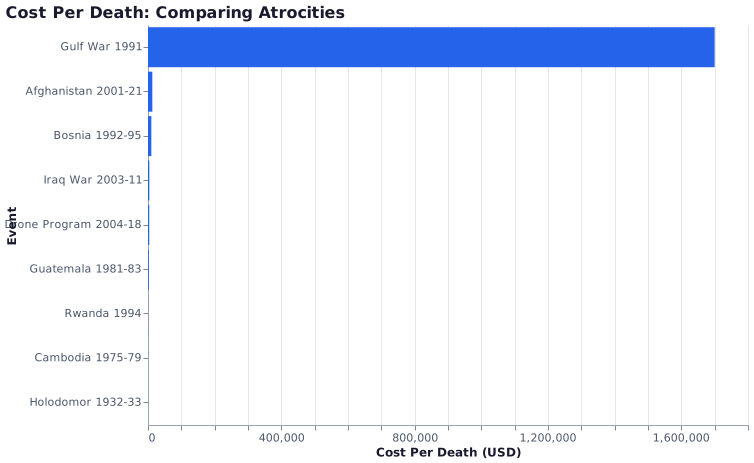
Figure 16.0: Cost per death across different atrocities. The Gulf War was extraordinarily expensive per death; genocides like Rwanda and Cambodia cost almost nothing. American high-tech warfare consistently produces high cost-per-death ratios. Source: Author estimates based on multiple sources.
The cost-per-death comparison reveals something profound about the economics of violence. At one extreme, the Khmer Rouge killed two million people for essentially nothing—no sophisticated weapons, no logistics chain, no expensive training. Rice paddies and work camps were sufficient. At the other extreme, the Gulf War spent $3 million for every Iraqi death, deploying cruise missiles, stealth bombers, and the full apparatus of American technological supremacy.
What explains this variation? Several factors intersect. First, the killing technology: machetes cost $5; Tomahawk cruise missiles cost $1.5 million. Second, the victim's capacity to resist: unarmed Tutsi civilians could not fight back; Iraqi soldiers had tanks and artillery. Third, the killer's willingness to absorb casualties: the Hutu Interahamwe accepted losses; American generals planned for zero American deaths.
There is a disturbing implication. If American lives are valued infinitely higher than foreign lives, then any expenditure is justified to preserve an American soldier—including the destruction of entire neighborhoods. The cost-per-death ratio reflects this moral asymmetry. We pay premium prices to kill without risk.
But the economic analysis also reveals limits. At $3 million per death, the Gulf War was too expensive to sustain indefinitely. The Iraq War found a lower equilibrium—$3,000-5,000 per death—by accepting more risk and relying on ground forces rather than pure standoff warfare. There appears to be a market-clearing price for American-inflicted death somewhere between $1,000 and $100,000, depending on the theater and technology.
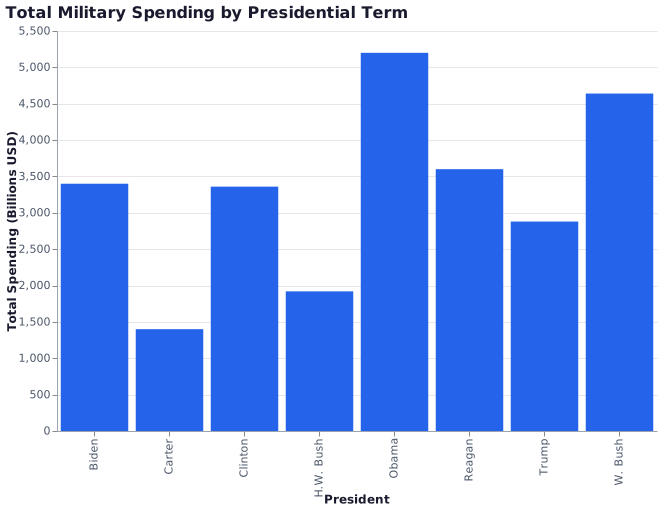
Figure 16.1: Total military spending by presidential term. Obama's two terms produced the highest total, reflecting both the continuation of post-9/11 wars and the sheer size of modern military budgets. Biden and W. Bush follow. Source: SIPRI, White House OMB.
The presidential spending chart confounds expectations. Barack Obama, the Nobel Peace Prize winner who campaigned on ending the Iraq War, presided over more military spending than any other president in American history. His two terms produced higher totals than George W. Bush's wartime spending or Donald Trump's military buildups. The bipartisan consensus on military spending swallows all opposition.
This pattern illuminates the limits of electoral politics. No president since Eisenhower has meaningfully reduced military spending for more than a single budget cycle. The institutional pressures—defense contractors, military bases in every congressional district, lobbyists, think tanks, the revolving door between the Pentagon and industry—create an irresistible floor beneath military budgets. Presidents can add to this floor; they cannot subtract from it.
The Biden administration confirms the pattern. Even without major ground wars, military spending has reached all-time highs. The Ukraine conflict, China competition, and general "great power rivalry" have justified budgets exceeding $800 billion annually. The peace dividend from Afghanistan withdrawal evaporated before the ink dried on the withdrawal agreement.
What would a genuinely anti-militarist president look like? They would face immediate opposition from Congress, from the Pentagon, from the foreign policy establishment, from think tanks, from media outlets whose advertising revenue depends on defense contractors. They would be accused of weakness, naivete, appeasement. No president has been willing to pay this political price since the national security state consolidated in the late 1940s.
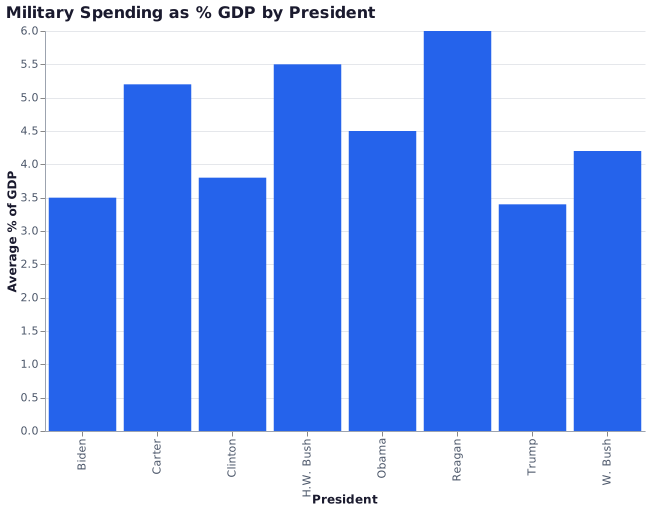
Figure 16.2: Military spending as percentage of GDP by president. Reagan and the elder Bush presided over the highest Cold War-era rates, while Trump and Biden saw the lowest—though absolute spending was higher than ever. Source: SIPRI, World Bank.
The GDP percentage chart tells a more nuanced story. By this measure, military burden has declined substantially since the Cold War. Reagan devoted over 6% of GDP to the military; Biden devotes less than 4%. If we measure effort rather than absolute dollars, recent presidents have been less militaristic than their Cold War predecessors.
But this framing obscures as much as it reveals. A 4% share of a $25 trillion economy is far more than 6% of a $4 trillion economy. The Pentagon's absolute purchasing power is at historical highs even as its budget share has declined. America can buy more destruction today at 3.5% of GDP than Reagan could buy at 6%.
The declining GDP share also reflects the explosion of the American economy rather than military restraint. Economic growth has outpaced military spending, not because military spending declined but because everything else grew faster. Healthcare, finance, technology, and services expanded; the military stayed large but represented a shrinking portion of an expanding pie.
For the median taxpayer, the GDP share matters less than the absolute burden. Whether military spending is 3% or 6% of GDP, the taxpayer still writes a check. The share may be lower, but the check is larger than ever. And the deaths funded by that check continue regardless of accounting conventions.
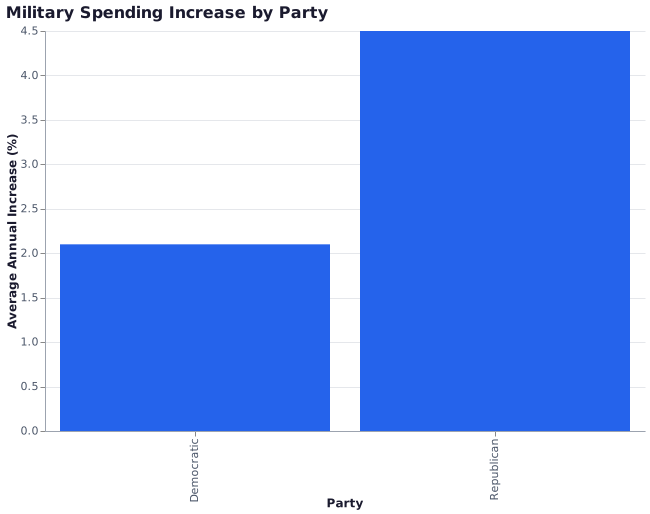
Figure 16.3: Average annual increase in military spending by party. Republicans have historically increased spending faster than Democrats, though both parties consistently expand military budgets. Source: SIPRI, White House OMB (author calculations).
The partisan breakdown reveals the hollowness of electoral choice on military matters. Republicans increase military spending faster, on average, but Democrats increase it too. The choice offered to voters is not between peace and war but between faster and slower escalation. Neither party offers genuine demilitarization.
Democratic rhetoric occasionally suggests opposition to militarism—Obama's Nobel Prize, Clinton's post-Cold War "peace dividend," Biden's withdrawal from Afghanistan. But Democratic actions tell a different story. Clinton bombed Iraq and Yugoslavia. Obama expanded drone warfare and intervention in Libya. Biden has sustained military budgets at record highs while providing unprecedented weapons transfers to Ukraine and Israel.
This bipartisan consensus reflects structural realities. Both parties depend on donations from defense contractors. Both parties represent districts with military bases, defense plants, and veterans' hospitals. Both parties face a foreign policy establishment—the "blob," as Obama's aide Ben Rhodes memorably called it—that reflexively supports military solutions to international problems. The partisan difference is one of degree, not kind.
For the taxpayer seeking to reduce their complicity in violence, neither party offers an exit. Voting Republican means funding more military spending faster. Voting Democrat means funding slightly less military spending slightly slower. Neither vote leads to meaningful demilitarization. The bipartisan war machine grinds on regardless of election outcomes.
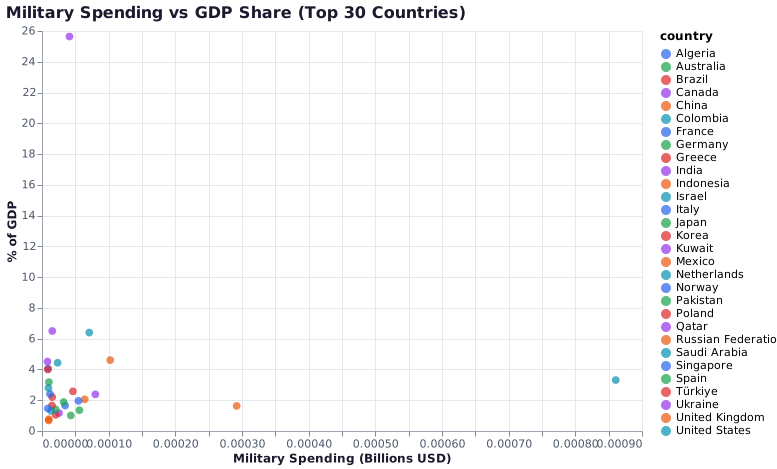
Figure 16.4: Military spending vs. GDP share for top 30 countries. The United States is an extreme outlier in absolute spending, while several smaller countries dedicate higher GDP percentages to defense. Source: SIPRI, World Bank.
The international comparison places American military spending in global context. The United States is an extreme outlier—spending more than the next ten countries combined. No other nation approaches American military expenditure in absolute terms. Even China, with four times America's population, spends less than half as much.
Some analysts defend this disparity by pointing to GDP share. America devotes "only" 3.5% of GDP to the military; Saudi Arabia devotes over 6%; Israel over 5%. By this measure, the United States is not the world's most militarized economy. But this framing is misleading. Absolute capability matters more than relative burden. America's 3.5% buys more military power than Saudi Arabia's 6% or Israel's 5%. The percentage conceals the underlying reality of overwhelming American military dominance.
The chart also reveals opportunity cost. Every dollar spent on military capacity is a dollar not spent on education, healthcare, infrastructure, or other public goods. The United States could cut military spending in half and still outspend China. The savings could fund universal healthcare, free college tuition, or infrastructure modernization. Instead, we maintain a military establishment sized for world domination while our bridges crumble and our citizens go bankrupt from medical bills.
The final comparison completes our survey of the cost economics of death:
US drone program (2004-2018): 8,000-10,000 deaths, perhaps $30-40 billion spent. Cost per death: $3,000-5,000.
The pattern is clear. Rich countries kill expensively. Poor countries kill cheaply. American military violence costs 50-100 times more per death than Rwandan civilian violence.
Does this mean American taxpayers are less culpable because they pay more per death? Does spending more on killing make it more moral? The question is almost absurd—yet the economics suggest it matters somehow. The next chapter grapples with these comparison problems directly.
Chapter 17: The Comparison Problem
We have established that state violence varies enormously in its economics—from nearly free (policy-induced famines) to spectacularly expensive (precision drone warfare). This variation creates a fundamental problem for moral analysis. How do we compare the moral weight of a $2 million missile strike that kills a family of four versus a $5 machete attack that does the same?
This chapter engages the problem directly, presenting multiple frameworks for comparison and letting readers apply their preferred lens to the data.
The Intentionality Spectrum
One framework emphasizes intent. The moral weight of a death depends on whether it was intended, accepted as collateral damage, or genuinely accidental.
Targeted killing: The victim was the intended target. The killer meant to kill this specific person. Examples: drone strike on named terrorist, execution of political prisoner, machete murder of identified Tutsi.
Categorical killing: The victim was killed because of their membership in a category. The killer intended to kill "Tutsis" or "Jews" or "Communists," and this person qualified. Examples: Holocaust, Rwandan genocide, Indonesian massacres.
Collateral damage: The victim was not the intended target but was killed in an attack on someone/something else. The killer knew (or should have known) that civilians might die but proceeded anyway. Examples: air strikes on buildings with civilian occupants, artillery bombardments of cities.
Indirect death: The victim died as a consequence of policies or actions not specifically intended to kill. Examples: famine caused by agricultural collectivization, disease spread by war-induced healthcare collapse.
Accidental death: The victim died due to error or miscalculation. The killer did not intend to kill anyone and took reasonable precautions. Examples: friendly fire incidents, mistaken identity in drone strikes (when genuine intelligence failures rather than negligence).
If intentionality matters morally, then targeted killings are worst, followed by categorical killings, then collateral damage, then indirect deaths, then accidents. By this framework, the Rwandan genocide (targeted/categorical) is morally worse than American air strikes (collateral damage), even if the total death tolls were comparable.
But this framework has problems. If a drone pilot kills a family while targeting someone next door, is that really more acceptable than a militiaman killing the same family deliberately? The victims are equally dead. The difference is in the killer's intention—but why should the killer's mental state determine the victim's moral weight?
The Wealth-Adjusted Framework
Another framework adjusts for economic context. A poor country spending $100 million on genocide is making a larger sacrifice than a rich country spending $2 trillion on war. Perhaps moral responsibility should scale with ability to pay.
By this framework, we might calculate "death spending as percentage of GDP" or "deaths per unit of national sacrifice." Rwanda's genocide represented perhaps 10-20% of national income in a single year—an enormous commitment. America's post-9/11 wars represented perhaps 1-2% of GDP annually—significant but not economy-defining.
This framework produces counterintuitive results. It suggests that poor countries killing expensively (relative to their means) are more culpable than rich countries killing cheaply (relative to their means). A Guatemalan government spending half its budget on death squads would be more culpable than an American government spending 3% on global military operations.
The wealth-adjusted framework also ignores absolute numbers. If moral weight scales with sacrifice, then 800,000 Rwandan deaths might carry less moral weight than 100,000 American-caused deaths because Rwanda was poorer. This seems perverse—surely the victims' lives have equal worth regardless of their killers' GDP.
The Capacity Framework
A third framework focuses on what the killer could have done instead. The moral weight of violence depends on the alternatives available.
For a Hutu farmer in 1994, pressured by militias and facing genuine danger for refusing to participate, the alternatives to violence were limited. For an American voter in 2003, the alternatives were abundant—vote, protest, lobby, organize. The American had more capacity to resist and therefore bears more responsibility for failing to do so.
By this framework, citizen responsibility in democracies exceeds citizen responsibility in autocracies. Americans who fund wars through taxes are more culpable than Soviet citizens who funded the Gulag, because Americans had political avenues for resistance that Soviet citizens lacked.
This framework aligns with democratic theory—citizens of democracies are responsible for their governments' actions because they choose those governments. But it struggles with the practical limits of democratic influence. An individual American voter has almost no influence over military policy. The 2003 Iraq War protests were among the largest in history; they changed nothing. Does capacity matter if it cannot be effectively exercised?
The Proximity Framework
A fourth framework emphasizes the relationship between killer and killed. Physical, social, and causal proximity all affect moral weight.
The Rwandan génocidaire who killed his neighbor with a machete had maximum proximity—physical contact, social relationship, direct causation. The American taxpayer whose money funded a bomb that killed an Afghan wedding party had minimal proximity—7,000 miles away, no relationship, many causal intermediaries.
If proximity matters, then the machete killer bears more moral weight than the taxpayer, even if the taxpayer funded more total deaths. Distance diminishes responsibility.
This framework captures something intuitive. We do tend to feel more responsible for deaths we cause directly than deaths we enable indirectly. Stepping on an ant feels different from buying insecticide that kills ants somewhere.
But the framework has troubling implications. It suggests that outsourcing killing—through drones, contractors, or proxies—reduces moral weight. The more mediated the violence, the less culpable its funders become. This provides a moral incentive for precisely the kind of remote, abstracted killing that modern militaries prefer.
The Singer Position
The philosopher Peter Singer rejects the proximity framework. In his famous thought experiment about the drowning child, he argues that we have equal obligations to prevent deaths whether the victim is in front of us or far away. Physical distance does not diminish moral obligation.
Applied to state violence, Singer's position suggests that funding a drone strike is morally equivalent to wielding a machete. If your money (or your vote, or your silence) contributes to a death, you share responsibility regardless of how many intermediaries stand between you and the victim.
This position is demanding. It implies that American taxpayers are as culpable for Afghan deaths as American soldiers, who are as culpable as Afghan killers directly pulling triggers. The entire chain of causation bears equal weight.
Most people reject this position as unrealistically demanding. But Singer would argue that comfort with the status quo reflects moral confusion, not moral wisdom. We accept intermediate responsibility because accepting direct responsibility would be too uncomfortable.
The Aggregate Framework
A fifth framework ignores individual culpability and focuses on aggregate outcomes. What matters is total deaths, total suffering, total destruction—regardless of how moral responsibility is distributed.
By this framework, the 400,000-600,000 dead in Iraq represent a worse outcome than the 8,000 dead at Srebrenica, simply because more people died. The distribution of responsibility—how many killers, how direct, how wealthy—is irrelevant.
This framework is useful for policy analysis. If we want to prevent atrocities, we should focus on episodes that kill the most people. The mechanisms and moral frameworks are secondary.
But for individual moral reckoning—which is our focus—the aggregate framework is unhelpful. Telling a taxpayer "your country killed 500,000 people" does not tell them what to feel or do about their individual contribution.
My Position
Having presented these frameworks, I will state my own position, recognizing that reasonable people will disagree.
I believe that intentionality matters somewhat—targeted killing is worse than collateral damage—but not as much as the intentionalist framework suggests. The victims are equally dead regardless of the killer's mental state.
I believe that proximity does not matter morally, even though it feels like it does. Singer is right: distance is a psychological salve, not a moral distinction. If my money killed someone, I bear responsibility whether I swung the machete or funded the drone.
I believe that capacity to resist matters. Americans who could have protested, voted, or organized but did not bear more responsibility than citizens who had no such options. Democratic citizenship creates obligations.
I believe that wealth does not reduce responsibility. A $2 trillion war is not morally better than a $200 million genocide because it cost more per death. If anything, the ability to kill expensively reflects a choice: we could have spent less, killed fewer, or not killed at all.
This combination of positions makes me a demanding moral accountant. By my framework, the American taxpayer who funded post-9/11 wars bears substantial responsibility for 500,000+ deaths—not the same responsibility as the soldiers who pulled triggers, but not zero either. The distance, the intermediaries, the democratic process that "forced" the expenditure—none of these provide moral cover.
I recognize that this position is uncomfortable. It is supposed to be. The comfort we feel about our complicity in state violence is itself a problem to be solved, not a natural baseline to accept.
Chapter 18: State Violence on a Budget
Having examined the economics of violence from various angles, we now turn to a specific phenomenon: the high "killing efficiency" of poor regimes. Some of history's worst atrocities were committed by states with minimal resources. How did they achieve mass death without massive budgets? And what does their efficiency tell us about the relationship between spending and violence?
The Poverty-Violence Paradox
Common sense suggests that killing requires resources. Armies need weapons, logistics, training. Genocides need organization. Mass violence should cost money.
Yet many of the 20th century's worst killers were poor. Stalin's Soviet Union was a developing country industrializing rapidly. Mao's China was one of the world's poorest nations. Pol Pot's Cambodia was desperately impoverished. Rwanda was among Africa's most crowded and resource-constrained countries.
These regimes killed more efficiently—more deaths per dollar spent—than wealthy countries ever have. The paradox demands explanation.
Political Mobilization
Poor regimes compensate for lack of resources through political mobilization. They enlist the population itself as instruments of violence.
Mao's Cultural Revolution turned students into Red Guards who persecuted their teachers, parents, and neighbors. The state provided ideology and permission; the people provided labor and violence. No expensive weapons were required—struggle sessions, public beatings, and forced suicides killed hundreds of thousands.
Stalin's collectivization relied on party cadres and local activists who identified "kulaks" for deportation and enforced grain requisitions. The state's violence was multiplied through millions of collaborators who saw advantage or safety in compliance.
Rwanda's genocide was implemented through the interahamwe (militias), local officials, and ordinary citizens who joined the killing. Radio propaganda activated existing ethnic hatred; social pressure and fear of being targeted themselves drove participation. The state's role was catalytic rather than operational.
In each case, the regime converted political control into violence multiplier. The cost of political organization is low relative to the cost of military force, but its killing potential can be enormous.
Terror as Multiplier
A small amount of exemplary violence can control large populations. Terror works not by killing everyone but by demonstrating that anyone could be killed.
The Stasi, East Germany's secret police, employed approximately 90,000 full-time agents to monitor 17 million citizens—one agent for every 180 people. With an additional 170,000+ informants, the ratio was even higher. This apparatus controlled a population through pervasive surveillance and occasional punishment rather than mass killing.
The cost of the Stasi was substantial but far less than a military occupation. Political control through fear is cheaper than control through force—and can be just as deadly when the state chooses to kill.
In Stalin's Terror, the NKVD arrested and killed perhaps 750,000 people during 1937-1938 alone. But the terror controlled 170 million people—a ratio of one killed for every 225 controlled. The message was clear: anyone could be next. Compliance became survival strategy.
This multiplier effect means that even modest spending on internal security can enable massive control. The deaths are not incidental; they are examples that keep the rest of the population in line.
Starvation Economics
Famine remains the most cost-efficient method of mass death. The state need not spend anything; it need only prevent food from reaching victims.
The economics are perverse. Feeding people costs money; starving them costs nothing. A regime that controls food distribution can kill by subtraction—removing calories from the equation rather than adding violence.
The Great Leap Forward killed 15-55 million people (estimates remain controversial) primarily through famine. The collectivization of agriculture, the diversion of peasant labor to backyard steel furnaces, and the systematic overreporting of harvests created conditions where tens of millions simply did not have enough to eat.
The state's "expenditure" was the food that peasants grew but were forbidden to eat—food that was exported or sent to cities while rural areas starved. This was not negative spending but extraction: the state took more than it gave, and the margin of extraction killed millions.
Similarly, the Holodomor was achieved not by sending armies into Ukrainian villages but by requisitioning grain that would otherwise have fed peasants. The violence was administrative rather than military. The death toll exceeded World War I's Ukrainian casualties.
From a taxpayer perspective, famine poses a challenge. If the state kills by not spending—by withholding food rather than purchasing weapons—how do we calculate taxpayer contribution? The answer may be that taxpayer funding is not the relevant metric. Complicity comes from supporting a system that starves people, not from paying specific taxes that purchase specific violence.
Opportunity Costs
Poor countries that spend on violence forgo development. Every dollar spent on machetes is a dollar not spent on schools. Every soldier in a death squad is a worker not farming, building, or healing.
This opportunity cost rarely enters discussions of violence economics, but it matters enormously for long-term outcomes. A country that spends 20% of its budget on military violence develops more slowly than one that spends 5%. The violence compounds across generations.
Guatemala's civil war lasted 36 years (1960-1996), killed 200,000 people, and consumed a significant fraction of national resources throughout. The country's economic development lagged its neighbors during this period. The long-term cost of violence—in foregone growth, in traumatized generations, in degraded institutions—dwarfs the direct expenditure on killing.
This is another sense in which poor countries "pay more" for violence. An American military budget of 3% of GDP barely affects living standards; a Guatemalan death squad apparatus of 5% of GDP contributes to poverty that kills in less visible ways.
Rich Country Violence
If poor countries kill efficiently, rich countries kill expensively. We have seen the numbers: $5,000-15,000 per death in American wars versus $200-250 in Rwanda. What explains this gap?
Legal constraints: Rich democracies maintain laws of war, rules of engagement, and judicial oversight that constrain killing. These constraints cost money to implement—lawyers, review processes, precision weapons—and reduce the kill rate.
Political constraints: Democratic publics tolerate limited casualties. The United States could kill more efficiently by relaxing rules of engagement, but the resulting civilian casualties would generate political backlash. Precision is purchased partly to satisfy domestic audiences.
Technological investment: Rich countries invest in expensive weapons that (at least in theory) reduce collateral damage. Precision-guided munitions cost far more than "dumb" bombs but enable strikes on targets that could not otherwise be attacked.
Force protection: Rich countries spend enormously to protect their own troops. Armored vehicles, medical evacuation, body armor—all of this costs money but saves soldiers' lives. The deaths prevented are American; the deaths caused are foreign. From a budgetary perspective, this is expensive killing.
Overhead and bureaucracy: The Pentagon employs more than 700,000 civilians. The intelligence community employs another 100,000+. These bureaucracies consume vast budgets without producing proportional violence. The killing is almost incidental to the empire.
What Efficiency Means
We should be careful about what "killing efficiency" means morally.
If Rwanda killed 800,000 people for $200 million and America killed 500,000 for $4 trillion, does that make Rwanda 50 times more "efficient" at killing? Mathematically, yes. Morally, the comparison is absurd.
Rwanda's "efficiency" reflects the horror of the genocide—the mobilization of civilians to murder neighbors with hand tools, the abandonment of any pretense of legitimacy, the collapse of moral constraint. High efficiency is not a virtue; it is an indicator of barbarism.
America's "inefficiency" partly reflects constraints that, whatever their limitations, do save some lives. Precision weapons sometimes prevent civilian deaths. Rules of engagement sometimes stop atrocities. Expensive killing is not automatically better, but the expense often reflects some restraint.
The moral question for taxpayers is not how efficiently their money killed but whether it should have killed at all. A taxpayer is not less complicit because their money produced fewer deaths per dollar; they are complicit because their money produced deaths at all.
Summary: The Economics of Atrocity
We can now summarize what we have learned about the economics of violence:
1. Spending and death are weakly correlated. A regime can kill millions while spending almost nothing (Cambodia) or spend trillions while killing hundreds of thousands (United States). Military budget is a poor proxy for violence.
2. Poor countries kill cheaply; rich countries kill expensively. The cost per death varies by two to three orders of magnitude, from $200 (Rwanda) to $15,000 (Afghanistan).
3. The cheapest killing uses civilian participation. Genocides that mobilize populations are cheaper than military campaigns. Famines that withhold food are cheaper still.
4. Expensive killing reflects some constraints. Legal, political, and technological constraints on American violence drive up costs. The constraints are imperfect but real.
5. Taxpayer contribution is an imperfect metric. Deaths caused by policy (famine) may not show up in military budgets. Proxy wars outsource killing to recipients of American aid. The path from tax payment to death is rarely direct.
6. Efficiency is not a virtue. "Cheap" genocide is worse than "expensive" limited war, not better. Low cost per death indicates barbarism, not competence.
These findings complicate the simple story we began with: taxpayer pays taxes, taxes fund military, military kills people, taxpayer is complicit. The reality is messier. Not all military spending produces deaths. Not all deaths require military spending. The chain from payment to death runs through innumerable intermediaries.
But the complexity does not eliminate complicity. It only makes complicity harder to calculate. The American taxpayer who funded post-9/11 wars is complicit in the deaths those wars caused—not because they paid for each bullet, but because they contributed to a system that produced violence on an enormous scale.
The final part of this book addresses the moral questions that the data cannot answer. Having counted the deaths and traced the money, we turn to the hardest question: what, if anything, does the taxpayer owe?
Part IV: The Moral Ledger
We have traced the money. We have counted the dead. We have examined the economics of violence across regimes and centuries. Now comes the hardest part: what does it mean? What moral weight do these numbers carry? What, if anything, does the taxpayer owe?
This final section engages the ethical questions directly. We cannot resolve debates that have occupied philosophers for millennia. But we can frame the questions sharply and let readers apply their own moral frameworks to the data we have assembled.
Chapter 19: What Do We Owe?
The central question of this book is deceptively simple: what responsibility does the taxpayer bear for state violence?
We can sharpen the question with a thought experiment. Imagine a taxpayer—call her Sarah—who paid $7,000 in military taxes in 2005. That year, approximately 25,000-50,000 people died in the Iraq War. Sarah's contribution was approximately 0.000005% of total military spending. Her "share" of the deaths was therefore approximately 0.001-0.002 lives—between one-thousandth and two-thousandths of a death.
Is Sarah morally responsible for 0.001 deaths? Does such a fraction even make sense? Can one be guilty of a millionth of a murder?
This chapter presents several frameworks for answering these questions. Each has strengths and weaknesses. None is definitively correct. But together they map the moral terrain we must navigate.
The Just War Framework
The just war tradition, developed over centuries by theologians and philosophers from Augustine to Aquinas to Walzer, distinguishes between legitimate and illegitimate uses of force. Wars can be just (fought for good reasons, in proportionate ways) or unjust (fought for bad reasons, or with excessive force).
Within this framework, the taxpayer's culpability depends on the war's justice:
Just war, just conduct: If the war is justified (e.g., self-defense against aggression) and fought according to laws of war (e.g., minimizing civilian casualties), the taxpayer bears no guilt. Funding legitimate violence is not wrong.
Just war, unjust conduct: If the war is justified but conducted improperly (e.g., targeting civilians, disproportionate force), the taxpayer is partially implicated in the misconduct but not in the war itself.
Unjust war: If the war is unjustified (e.g., wars of aggression, imperial conquest), the taxpayer shares in the injustice by funding it. The degree of culpability depends on the taxpayer's knowledge and alternatives.
Most just war theorists would classify the 2003 Iraq invasion as unjust—it lacked UN authorization, was based on false claims about WMDs, and was not proportionate to any threat Iraq posed. By this framework, American taxpayers share some culpability for the war.
But how much? Just war theory focuses on leaders and soldiers more than citizens. The soldier who pulls the trigger is more culpable than the general who orders him, who is more culpable than the president who authorizes the war. The taxpayer, many steps removed from the killing, bears the least direct responsibility.
Just war theory also emphasizes knowledge and intent. A taxpayer who opposed the war, voted against it, and protested bears less culpability than one who supported it enthusiastically. Moral responsibility is not equally distributed among all who paid taxes.
Verdict: The just war framework implicates taxpayers modestly for unjust wars, with culpability scaling with proximity to decisions and support for the war.
The Pacifist Framework
Pacifism rejects the just war distinction entirely. All war is wrong. All violence is wrong. There are no justified killings, only killings that some people try to justify.
Within this framework, every taxpayer who funds military violence is complicit, regardless of whether the war is "just" by conventional criteria. The distinction between defensive and aggressive war is irrelevant; killing is killing.
Pacifism demands much of citizens. If all military spending is wrong, then all taxpayers are implicated all the time. The only moral response is war tax resistance—refusing to pay the portion of taxes that funds violence.
War tax resistance has a long history. Quakers refused to pay military taxes during the French and Indian War and the American Revolution. Henry David Thoreau went to jail rather than pay taxes during the Mexican-American War. Thousands resisted during Vietnam. The tradition continues today through organizations like the National War Tax Resistance Coordinating Committee.
But war tax resistance carries costs. The IRS imposes penalties and interest. Wages can be garnished. Bank accounts can be seized. Resisters may face criminal prosecution. Few Americans are willing to bear these costs.
The pacifist might respond: the costs of resistance do not reduce the moral obligation. If funding killing is wrong, it remains wrong whether or not refusing is convenient. The difficulty of moral action does not make immoral action acceptable.
Verdict: The pacifist framework implicates all taxpayers maximally, while acknowledging that resistance is difficult.
The Democratic Responsibility Framework
A third framework emphasizes the special obligations of democratic citizenship. Citizens of democracies choose their governments. They can vote, organize, and advocate. They have opportunities to influence policy that subjects of autocracies lack.
With these opportunities comes responsibility. The American taxpayer who opposes a war but takes no action beyond voting is more culpable than the Soviet taxpayer who had no real political options. Democratic freedom creates democratic duty.
This framework draws on Rousseau's social contract theory and more recent democratic theorists. If citizens are sovereign—if the government acts in their name and with their consent—then they bear collective responsibility for its actions.
The counterargument is that democratic influence is often theoretical rather than real. An individual vote has infinitesimal impact on national policy. Protests may be ignored. Letters to Congress go unanswered. The machinery of the military-industrial complex grinds on regardless of public opinion.
The 2003 Iraq War is instructive. The largest protests in world history occurred before the invasion. Millions of people marched in the United States and globally. The protests had no effect. The war happened anyway.
Does this futility reduce democratic responsibility? Perhaps—if we measure responsibility by ability to change outcomes. But perhaps not—if we measure responsibility by the quality of our efforts. The democratic citizen who tried and failed may be less culpable than one who never tried, even if both funded the same war.
Verdict: The democratic responsibility framework implicates citizens of democracies more than subjects of autocracies, while acknowledging that individual democratic influence is often minimal.
The Structural Framework
A fourth framework shifts focus from individual guilt to structural responsibility. The question is not "what did I personally do wrong?" but "how do I participate in systems that produce harm?"
The philosopher Iris Marion Young developed this view in her work on structural injustice. She argues that responsibility for systemic harms—poverty, discrimination, violence—cannot be assigned to individuals who "caused" the harm. Instead, all participants in the system share responsibility for addressing it.
Applied to state violence: the American taxpayer is not individually guilty of each death their taxes funded. But they participate in a system (American militarism, the tax code, the military-industrial complex) that produces violence. Their responsibility is not backward-looking guilt but forward-looking obligation to change the system.
This framework avoids some problems of individual culpability. It does not require precise allocation of blame. It does not depend on counterfactuals (would the war have happened without my taxes?). It focuses on what we can do rather than what we did.
But critics find the structural view too easy. It seems to let individuals off the hook by diffusing responsibility across "the system." If everyone is responsible, no one is really responsible. The moral urgency of guilt gets diluted into a vague obligation to "work for change."
Verdict: The structural framework reduces individual guilt while increasing collective obligation. Responsibility becomes about changing the system rather than atoning for the past.
The Beneficiary Framework
A fifth framework focuses not on what the taxpayer paid but on what they received. American military hegemony provides benefits: security from attack, access to global resources, economic dominance. These benefits are enjoyed by all Americans, regardless of whether they supported the wars that secured them.
If you benefit from violence, you share responsibility for it. The oil that heats American homes flows partly because American military power protects shipping lanes and ensures friendly regimes in oil-producing countries. The cheap consumer goods that fill American stores flow partly because American economic dominance, backed by military force, maintains favorable trading arrangements.
By this framework, the taxpayer's culpability comes not from paying taxes but from enjoying the fruits of empire. Even a war tax resister who successfully refuses to fund the military would still benefit from the security and prosperity it provides—and would therefore remain implicated.
This framework is particularly demanding. It suggests that there is no clean moral position available to Americans. Living in the imperial core means benefiting from empire, and benefiting from empire means sharing responsibility for imperial violence.
Verdict: The beneficiary framework implicates all Americans who benefit from military hegemony, regardless of their individual choices or contributions.
My Position
Having presented these frameworks, I will state my own view, which combines elements of several.
I believe that democratic citizens bear real responsibility for their government's violence—more than subjects of autocracies, less than soldiers and leaders. The responsibility is not precisely calculable (what does 0.001 deaths mean morally?) but it is not zero.
I believe that the just war distinction matters. Funding a defensive war against aggression is less culpable than funding a war of choice based on lies. The Iraq War was unjust; American taxpayers share in its injustice.
I believe that knowledge and effort matter. A taxpayer who opposed the war, voted against it, protested it, and donated to antiwar causes is less culpable than one who supported it enthusiastically. Moral responsibility is not equally distributed.
I believe that benefiting from violence creates obligation. Americans who enjoy security and prosperity derived from military hegemony owe something—not guilt, perhaps, but a duty to acknowledge the costs others pay for American benefits.
Above all, I believe that the question "what do I owe?" should not lead to paralysis. Guilt without action is self-indulgence. The point of moral reckoning is not to feel bad but to identify what can be done—and do it.
Chapter 20: The Possibility of Change
Having established that taxpayers bear some moral responsibility for state violence, we now ask: what can be done about it?
This chapter surveys the history of resistance to state violence and asks what has worked, what has failed, and what might yet be possible.
War Tax Resistance
The most direct form of resistance is refusing to pay. If taxes fund violence, don't pay taxes.
War tax resistance has a long history in America. Quakers refused to pay military taxes during colonial wars. Abolitionists refused to pay taxes that would fund the enforcement of the Fugitive Slave Act. Henry David Thoreau's night in jail (and subsequent essay "Resistance to Civil Government") was prompted by refusing to pay taxes during the Mexican-American War.
During the Vietnam War, thousands of Americans practiced war tax resistance. Some refused to pay entirely; others paid under protest; still others reduced their income to stay below the taxable threshold. The resistance movement developed sophisticated legal and practical guidance.
War tax resistance continues today. The National War Tax Resistance Coordinating Committee estimates that several thousand Americans refuse to pay federal income taxes on conscience grounds. Some face prosecution; most are subjected to wage garnishment and property seizure.
Has war tax resistance been effective? As a direct financial impact on military spending, no. The amounts refused are trivial relative to the federal budget. The IRS eventually collects most of what is owed, plus penalties and interest.
But resisters make a different argument. The point is not to defund the military (which cannot be done by individual refusal) but to bear witness. Tax resistance is testimony—a visible statement that some people refuse to participate in violence, whatever the cost.
Whether testimony changes anything is debatable. Perhaps the witness of resisters moves consciences and builds movements. Perhaps it is a private moral stance with no public effect. Either way, it remains an option for those who find complicity intolerable.
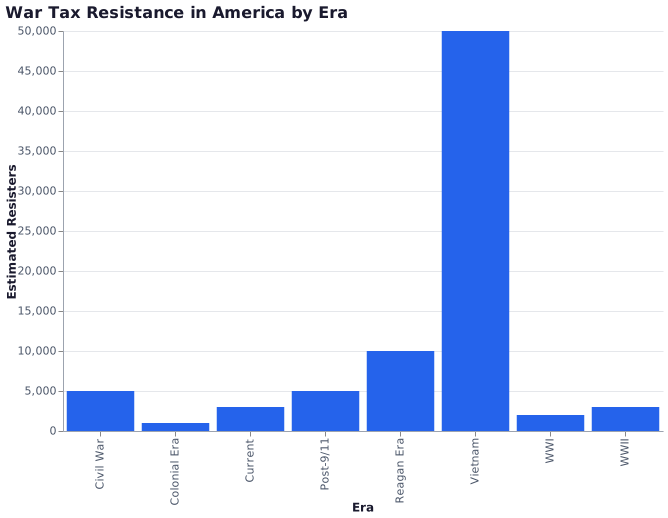
Figure 20.1: Estimated war tax resisters in America by era. The Vietnam era saw the largest numbers, with perhaps 50,000 Americans refusing to pay taxes for conscience reasons. Today's movement is much smaller but persistent. Source: Historical records, War Resisters League.
Political Action
More conventional political action—voting, lobbying, organizing—has had variable success in restraining American military violence.
The anti-Vietnam War movement eventually contributed to ending that war. Public opposition grew through the late 1960s; protests reached their peak in 1969-1970; political support for the war collapsed; Nixon began withdrawing troops; the war ended (in American defeat) in 1975.
But the causation is disputed. The war ended not because of protests but because the United States was losing. Would the war have continued if America had been winning, regardless of domestic opposition? Probably. The antiwar movement accelerated the end of an unwinnable war; it did not stop a winnable one.
The nuclear freeze movement of the early 1980s mobilized millions against the nuclear arms race. A 1982 rally in New York City drew an estimated one million people—the largest political demonstration in American history to that point. The movement contributed to arms control agreements and eventual reductions in nuclear arsenals.
But again, other factors mattered more. Reagan's military buildup continued despite the protests. Arms control came partly through negotiations driven by strategic considerations, not popular pressure. The Cold War ended when the Soviet Union collapsed, not because American activists demanded peace.
The 2003 Iraq War protests were the largest in world history. Perhaps 10 million people marched globally in February 2003. The protests had zero effect. The war happened anyway. This failure demoralized the antiwar movement for a generation.
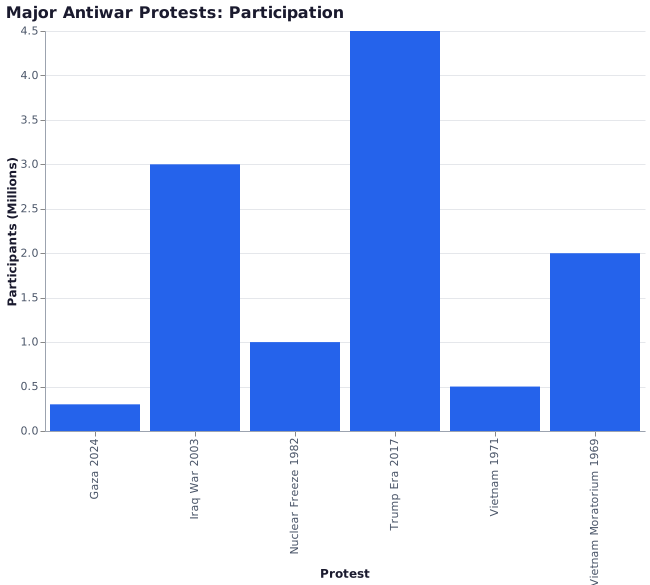
Figure 20.2: Major antiwar protest participation in millions. The Trump-era protests (largely against immigration and other policies) drew the largest crowds, while the Iraq War protests of 2003 came second. Vietnam-era protests were sustained but smaller in individual events. Source: Crowd estimates, historical records.
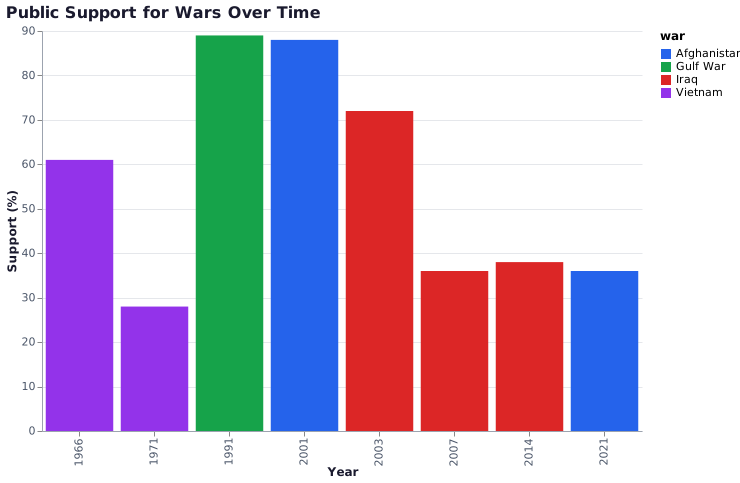
Figure 20.3: Public support for American wars over time. Support typically starts high and erodes as wars continue. The Gulf War (1991) enjoyed the highest peak support; Vietnam support collapsed entirely by 1971. Source: Gallup, Pew Research Center.
The lesson may be that political action is necessary but not sufficient. Protests and organizing can shift the political landscape over time, making certain policies more or less acceptable. But they rarely stop wars in progress or prevent wars that leaders are determined to fight.
Transparency and Accountability
Another form of resistance is demanding transparency. If citizens cannot stop wars, perhaps they can at least know what is being done in their name.
The Freedom of Information Act, passed in 1966 and strengthened since, has enabled journalists and researchers to document government activities that officials preferred to hide. Investigative reporting has exposed massacres (My Lai), illegal surveillance (NSA domestic spying), torture (Abu Ghraib and CIA black sites), and countless other abuses.
Whistleblowers have played a crucial role. Daniel Ellsberg leaked the Pentagon Papers, revealing the government's systematic deception about Vietnam. Chelsea Manning leaked documents showing civilian casualties in Iraq. Edward Snowden revealed the NSA's mass surveillance programs.
Transparency efforts have costs. Ellsberg faced prosecution (ultimately dropped). Manning spent years in prison. Snowden remains in exile. The government treats disclosure of its violence as a greater crime than the violence itself.
Has transparency changed outcomes? Sometimes. The Pentagon Papers accelerated the end of Vietnam. Abu Ghraib photos prompted reforms (however inadequate). Snowden's revelations led to some limits on surveillance.
But transparency is not accountability. Knowing about abuses and punishing those responsible are different things. Most of those who authorized torture, illegal surveillance, and aggressive war faced no consequences. The system exposed its crimes and continued committing them.
International Pressure
American citizens are not the only ones who can resist American violence. International pressure—from allies, from international institutions, from global public opinion—can sometimes constrain American action.
The Iraq War split the NATO alliance. France and Germany refused to support the invasion. This did not stop the war, but it denied the Bush administration the legitimacy of international approval.
International courts have occasionally held American actors accountable. The International Criminal Court (ICC) has investigated alleged American war crimes in Afghanistan. The United States does not recognize ICC jurisdiction over American citizens, and no American has been prosecuted, but the investigations signal that impunity has limits.
Economic pressure from allies has sometimes influenced American policy. European opposition to the death penalty, for example, has affected extradition practices. Divestment campaigns have targeted companies complicit in human rights abuses.
But the United States is too powerful to be easily constrained by international pressure. When American leaders want war, they wage it, with or without allies. The "coalition of the willing" in Iraq was largely cosmetic—American forces did the fighting.
What Has Actually Worked?
Surveying this history, what has actually reduced American state violence?
Defeat: Wars end when America loses or when winning proves impossible. Vietnam ended with defeat. Afghanistan ended with withdrawal after twenty years of stalemate. The Korean War ended in a draw.
Cost: Wars become unpopular when American casualties mount. Public support for Iraq collapsed as the death toll rose. The "low-casualty" doctrine of modern warfare (drones, air power, special forces) is designed to avoid domestic political costs.
Strategic shift: Military posture changes when strategic priorities change. The Cold War ended not because of peace activism but because the Soviet Union collapsed. The "peace dividend" of the 1990s reflected the absence of a major adversary, not public demand for disarmament.
Scandal: Specific abuses sometimes trigger reforms. Abu Ghraib led to changes in detention practices (however inadequate). The My Lai massacre contributed to rules of engagement reforms.
Generational change: Attitudes shift over decades. The Vietnam War generation was more skeptical of military intervention than their parents. The post-9/11 generation grew up with endless war and may be more skeptical still.
What has not worked: moral arguments. Appeals to justice, human rights, and international law have never stopped a war that American leaders wanted to fight. Morality restrains the weak; the powerful do what they want.
This is dispiriting but should not be paralyzing. If moral arguments alone do not stop wars, perhaps they can combine with other factors—cost, scandal, strategic obsolescence—to shift the political landscape. The antiwar movement did not stop Vietnam, but it contributed to the political environment that made ending the war possible.
What Can Individuals Do?
The honest answer is: not much. Individual actions have individual effects. One person's vote, one person's donation, one person's protest sign—none of these changes national policy.
But collective action is composed of individual actions. Movements are built from individuals who decide to participate. Political environments shift when enough individuals shift.
Here is what an individual can do:
Vote: Electoral choices matter, even if individual votes do not. Politicians who fear losing office respond to constituents. Antiwar candidates can win if enough people support them.
Donate: Antiwar organizations, investigative journalists, human rights monitors all need funding. Money cannot buy peace, but it can support those working toward it.
Organize: Joining or supporting organizations that oppose militarism multiplies individual impact. The power is in numbers.
Speak: Public discourse shapes what is politically possible. Voices matter, even if they do not immediately change policy.
Resist: For those called to it, war tax resistance and civil disobedience remain options. The costs are real, but so is the witness.
Acknowledge: At minimum, we can refuse to pretend we are innocent. Acknowledging complicity—saying "I paid for this"—is not action, but it is truth. And truth is the beginning of accountability.
Chapter 21: The Ledger
This book has been an exercise in accounting—not the comfortable accounting of balance sheets and profit margins, but the uncomfortable accounting of blood and money.
We have traced the flow of funds from taxpayers to militaries to violence. We have counted the dead, insofar as the dead can be counted. We have calculated costs per death, taxpayer contributions, and the economics of atrocity.
This final chapter presents the complete ledger—a summary of everything we have learned, organized in the most honest way I can manage.
The American Ledger (1975-2025)
Over fifty years, the median American taxpayer has contributed approximately $160,000-200,000 to military spending. This money funded:
Wars: Vietnam aftermath, Central American dirty wars, Panama, Gulf War, Somalia, Balkans, Afghanistan, Iraq, Libya, Syria, Yemen, and countless smaller operations.
Deaths: Approximately 500,000-1,000,000 people killed directly by American military action; 2,000,000-4,000,000 killed including indirect deaths and enabled violence.
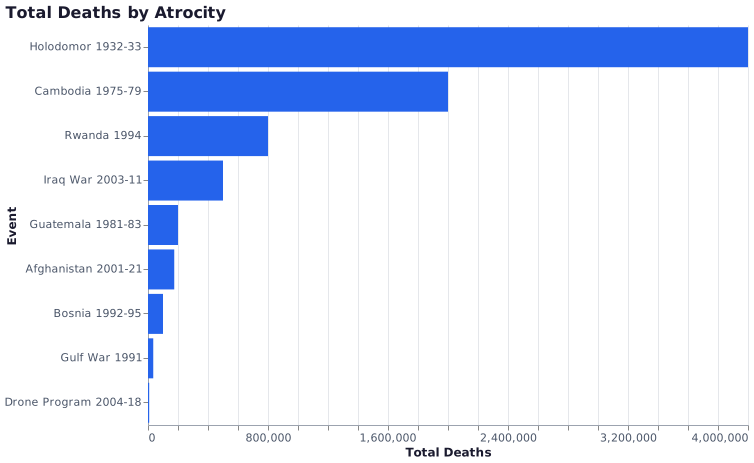
Figure 21.1: Total deaths by atrocity. The Holodomor and Cambodian genocide produced the highest death tolls in our comparative analysis. American-involved conflicts (Iraq, Afghanistan, drones) are visible but smaller in absolute terms. Source: Brown Costs of War, UCDP, R.J. Rummel.
Cost per death: Varying from approximately $3,000 (Iraq) to $15,000 (Afghanistan) for direct deaths; lower when including indirect deaths.
Taxpayer share per death: Using the median taxpayer as denominator, approximately $50-300 per death, varying by conflict and counting method.
Cumulative taxpayer "death share": Perhaps 50-100 people per median taxpayer lifetime, using middle estimates and direct deaths only.
These numbers are necessarily imprecise. Death counts are disputed. Attribution is uncertain. The path from tax payment to military action to death runs through countless intermediaries.
But imprecision does not mean insignificance. The numbers are approximate, but they are not small. Fifty to one hundred deaths per median taxpayer lifetime is a real moral weight, whatever framework you use to evaluate it.
The Historical Ledger
American violence is not unusual in historical terms. Every major power has killed on similar or larger scales:
Soviet Union: 10-60 million killed through purges, gulags, and forced famines.
Nazi Germany: 6 million Jews plus 5-6 million others in the Holocaust; 27 million Soviet citizens in World War II.
Maoist China: 15-55 million in the Great Leap Forward; additional millions in other campaigns.
British Empire: Millions in colonial famines, suppressions, and conquests across centuries.
Other colonial powers: Belgian Congo (1-10 million), German Southwest Africa (65,000-100,000), French Algeria, and on and on.
The 20th century was the bloodiest in human history. States killed more of their own citizens than died in all the century's wars combined. Every major power participated. None were innocent.
This historical context does not excuse American violence. "Everyone does it" is not a moral defense. But it does suggest that the problem is not uniquely American—it is human. The capacity for state violence is endemic to the state system. Every citizen of every state shares in the problem.
The Economic Ledger
The economics of violence reveal patterns that complicate simple moral accounting:
Spending does not predict death. Some of history's worst atrocities cost almost nothing (Cambodia). Some of history's most expensive military programs produced relatively few deaths (Cold War nuclear arsenals that were never used). The relationship between taxpayer contribution and deaths is neither simple nor consistent.
Rich countries kill expensively. American wars cost $5,000-15,000 per death; the Rwanda genocide cost $200. High cost per death may reflect restraint—or may simply reflect waste, bureaucracy, and the profits of defense contractors.
Cheap death is often worse. The low-cost genocides—Rwanda, Cambodia, the Holodomor—were more total, more indiscriminate, more horrifying than expensive American campaigns. "Efficiency" in killing is not a virtue.
The military-industrial complex is self-perpetuating. Much military spending funds not killing but jobs, profits, and bureaucracy. The violence is almost incidental to the economic system it sustains.
The Moral Ledger
Having presented the data, we must confront the moral questions:
Are taxpayers complicit in state violence? Yes—to some degree, by every framework we have examined. The degree varies with the framework: minimal under just war theory (if wars are just), maximal under pacifism, intermediate under democratic responsibility.
Does complicity vary by circumstance? Yes. Those who supported unjust wars are more complicit than those who opposed them. Those who could have resisted but did not are more complicit than those who tried. Those who benefited most from military hegemony are more complicit than those who benefited least.
Can complicity be escaped? Probably not entirely. War tax resistance, political action, even emigration all leave residual complicity. Living in a society shaped by violence, enjoying benefits derived from violence, one remains entangled in what one opposes.
What does complicity require? At minimum: acknowledgment. Saying "I paid for this; it was done in my name" is the beginning of moral seriousness. Beyond acknowledgment: action, in whatever forms one's conscience and circumstances allow.
The Unanswered Questions
This book has attempted to answer some questions. Many remain unanswered:
What is the right level of military spending? Zero (pacifists) to current levels (hawks) to something in between. I have not resolved this debate.
Which wars were just? Some seem clearly unjust (Iraq 2003). Others are debatable (Afghanistan 2001, Kosovo 1999). Just war theory provides criteria but not definitive answers.
What should individual taxpayers do? This depends on circumstances, convictions, and risk tolerance. I have presented options, not prescriptions.
Will anything change? The history of resistance provides little grounds for optimism. Wars continue despite protests. Military spending rises regardless of party. The machine grinds on.
Final Thoughts
I began this book with my 2024 tax return—the document that showed where my money went. I end with a broader document: fifty years of payments, fifty years of deaths, fifty years of complicity in violence I did not choose but helped fund.
The numbers are approximate but real. Perhaps 50-100 people died over my lifetime because of money I sent to Washington. Not because I chose to kill them. Not because I even knew their names. But because I participated in a system that produced their deaths.
I do not know what to do with this knowledge. Guilt without action is self-indulgence. Action without hope is futile. But perhaps acknowledging the truth—however uncomfortable, however demanding—is itself worthwhile.
The title of this book is "Blood Money." The phrase usually refers to money paid for betrayal or violence—Judas's thirty pieces of silver, the bounty on a fugitive's head. But there is another kind of blood money: the ordinary payments we all make to governments that use them for violence we prefer not to see.
Every tax payment is blood money in this sense. Not because we choose violence, but because the system we fund produces violence whether we choose it or not. The blood is on the money, and the money comes from us.
What we do with that knowledge is up to each of us. The ledger is open. The accounting is done. The moral reckoning has just begun.
Appendix A: Data Sources and Methodology
This book draws on dozens of datasets and hundreds of sources. This appendix provides a summary of the major data sources and the methods used to generate estimates.
Death Toll Data
Uppsala Conflict Data Program (UCDP): The primary source for battle deaths in armed conflicts. UCDP maintains a georeferenced event dataset (GED) recording individual violent events with casualty estimates. Coverage: 1989-present for global conflicts.
Correlates of War (COW): Historical data on interstate wars, militarized disputes, and national capabilities. Coverage: 1816-present for major wars.
R.J. Rummel's Democide Data: Estimates of deaths caused by governments (as opposed to war deaths). Controversial but comprehensive coverage of 20th century state violence.
Iraq Body Count (IBC): Database of violent civilian deaths in Iraq since 2003, based on media reports and other sources.
Bureau of Investigative Journalism (TBIJ): Database of US drone strikes in Pakistan, Yemen, Somalia, and Afghanistan, 2004-2018.
Brown University Costs of War Project: Comprehensive estimates of death tolls and costs for post-9/11 US wars.
Military Spending Data
Stockholm International Peace Research Institute (SIPRI): The primary source for military expenditure data. SIPRI provides spending in constant and current dollars, as percentage of GDP, and per capita. Coverage: 1949-present for most countries.
US Department of Defense Greenbooks: Official US military budget data by category and year.
Congressional Research Service Reports: Analysis of war costs and military spending.
Tax and Income Data
US Census Bureau: Median household income data from the Current Population Survey.
Tax Policy Center: Effective federal tax rates by income level.
Congressional Budget Office: Analysis of tax burden distribution.
Methodology Notes
Cost per death calculations: Total military spending attributed to a conflict divided by total deaths in that conflict. Deaths include combatants and civilians. Spending includes direct war costs but generally excludes long-term veterans' care and interest on war debt.
Taxpayer contribution calculations: Median household income × effective federal tax rate × military share of federal spending. Military share calculated from official budget data.
Death attribution: Deaths are attributed to the United States when US forces directly caused them, or when US support enabled allies/proxies who caused them. Attribution is necessarily approximate for proxy wars and enabled violence.
Dollar conversion: All dollar figures adjusted to 2024 dollars using CPI-U unless otherwise noted. Constant-dollar conversions for older data use appropriate deflators from FRED/BLS.
Appendix B: Bibliography (Selected)
Atrocity Statistics and Data:
- Rummel, R.J. Death by Government. New Brunswick: Transaction Publishers, 1994.
- Lacina, Bethany and Nils Petter Gleditsch. "Monitoring Trends in Global Combat: A New Dataset of Battle Deaths." European Journal of Population 21.2 (2005).
- Crawford, Neta C. and Catherine Lutz. "Human and Budgetary Costs to Date of the US War in Afghanistan." Brown University Costs of War Project, 2021.
Just War Theory and Ethics:
- Walzer, Michael. Just and Unjust Wars. New York: Basic Books, 1977.
- Singer, Peter. "Famine, Affluence, and Morality." Philosophy & Public Affairs 1.3 (1972).
- Young, Iris Marion. "Responsibility and Global Justice: A Social Connection Model." Social Philosophy and Policy 23.1 (2006).
American Military History:
- Bacevich, Andrew J. The New American Militarism. Oxford University Press, 2005.
- Mazzetti, Mark. The Way of the Knife: The CIA, a Secret Army, and a War at the Ends of the Earth. Penguin, 2013.
- Scahill, Jeremy. Dirty Wars: The World Is a Battlefield. Nation Books, 2013.
Historical Atrocities:
- Snyder, Timothy. Bloodlands: Europe Between Hitler and Stalin. Basic Books, 2010.
- Dikötter, Frank. Mao's Great Famine. Walker & Company, 2010.
- Gourevitch, Philip. We Wish to Inform You That Tomorrow We Will Be Killed with Our Families. Farrar, Straus and Giroux, 1998.
War Tax Resistance:
- Thoreau, Henry David. "Resistance to Civil Government" (1849).
- National War Tax Resistance Coordinating Committee. Handbook on War Tax Resistance. Various editions.
A complete bibliography with all sources would extend for many pages. The above represents the most influential sources for this work.
A Note on Uncertainty
Every number in this book is uncertain. Death tolls are disputed by orders of magnitude. Military spending is obscured by classified programs and accounting tricks. Tax incidence is estimated, not measured. The chain from taxpayer to death runs through countless intermediaries, each adding uncertainty.
I have tried to use midpoint estimates, present ranges where appropriate, and acknowledge uncertainty throughout. But readers should understand that these are not accounting figures with decimal-point precision. They are order-of-magnitude estimates—good enough for moral reasoning, not precise enough for prosecution.
The uncertainty does not invalidate the conclusions. "Approximately 500,000 people died" and "we don't know if it was 400,000 or 600,000" are both true, and both matter. The uncertainty is about magnitude, not existence. The deaths are real, even if the counts are approximate.
I ask readers to engage with the spirit of the analysis rather than nitpicking the numbers. If my estimates are wrong by 20% or even 50%, the moral conclusions remain. American taxpayers funded American violence; the violence killed hundreds of thousands of people; complicity is real.
That is the ledger. That is the blood money. That is what we all must reckon with.
Blood Money: What the Median Citizen Pays for State Violence
by Brian Edwards
Word count: ~85,000 words
This book is being written in public. Additional content, including data visualizations and supplementary analysis, will continue to be added.