Every few months, financial news leads with a familiar ritual: the release of Gross Domestic Product figures. Markets move. Politicians celebrate or deflect. Economists debate whether we are heading toward recession or recovery. Behind this ritual lies a single number that has become the primary scorecard for national economic success—a number that shapes policy decisions affecting billions of people, influences elections, and determines whether countries are considered prosperous or struggling.

Yet for all its influence, few people truly understand what this number represents. Most can recite the basic definition—the total value of goods and services produced in a country—but struggle to explain why a country with high GDP might still have widespread poverty, or why GDP growth does not always translate to improved quality of life. This article aims to change that by exploring GDP from first principles: its historical origins, the mechanics of its calculation, what it reveals about our economies, what it conceals, and how modern techniques like machine learning are opening new possibilities for economic forecasting.
Understanding GDP matters because it shapes how governments allocate resources, how investors deploy capital, and how citizens evaluate their leaders. A government chasing GDP growth at all costs may sacrifice environmental sustainability or social cohesion. An investor relying solely on GDP trends may miss structural weaknesses in an economy. A voter judging a leader by GDP performance may overlook improvements in education, health, or equality that do not show up in the headline number.
The story of GDP is also the story of how we have tried to understand economies—and the limits of that understanding. It is a story that begins in the aftermath of the Great Depression, winds through the battlefields of World War II, and continues into the algorithmic age of artificial intelligence. Along the way, we will encounter the pioneers who created this framework, the critics who have challenged it, and the innovators working to transcend its limitations.
Part I: The Birth of an Idea
Before the 1930s, governments flew blind. They collected taxes, managed budgets, and made policy decisions, but they had no systematic way to measure the overall size or health of their economies. Imagine trying to manage a business without knowing your total revenue, or trying to navigate without a map. That was the situation facing policymakers in most countries for most of human history.
The idea of measuring national economic activity has older roots, stretching back at least to William Petty in seventeenth-century England, who attempted to calculate England's national income to determine its capacity to wage war against the Dutch. Adam Smith and other classical economists discussed concepts of national wealth and income in theoretical terms. But these remained intellectual exercises, not practical tools for policy.
The Great Depression changed everything. When the American economy collapsed in 1929, plunging millions into unemployment and poverty, the government lacked even basic statistics about the scale of the catastrophe. Congress, desperate for data to guide recovery efforts, turned to a young economist named Simon Kuznets at the National Bureau of Economic Research. His task: create a comprehensive measure of the nation's economic output.
Kuznets and his team spent years gathering data, developing methodologies, and refining their approach. In 1934, he delivered to Congress a report that would reshape economic thinking: the first national income accounts for the United States. For the first time, policymakers could see the total value of what the American economy produced, broken down by industry, by type of income, and over time.
The timing could not have been more consequential. As the world lurched toward war in the late 1930s, governments needed to understand their productive capacity for military purposes. How many tanks, ships, and planes could an economy produce? How much could military spending increase before crowding out civilian production? British economist John Maynard Keynes, working for the British Treasury, adapted Kuznets's framework to help Britain plan its war economy. The measure proved so useful that by 1944, representatives from 44 countries gathered at Bretton Woods not only to design the post-war international monetary system but also to agree on standardized methods for calculating national accounts.
Kuznets himself harbored profound misgivings about how his creation would be used. In his 1934 report to Congress, he warned explicitly: "The welfare of a nation can scarcely be inferred from a measurement of national income." He understood that a single number, however carefully constructed, could not capture the complexity of human wellbeing. He worried that policymakers would confuse economic output with economic welfare, treating growth as an end in itself rather than as one means among many to human flourishing.
History has largely vindicated Kuznets's concerns. GDP became exactly what he feared—the default measure of national success, the number by which governments rise and fall, the target that shapes policy across the globe. But before we explore its limitations, we must understand what GDP actually measures and why it became so influential despite its creator's warnings.
Part II: The Core Idea—Measuring Economic Output
Gross Domestic Product is defined as the total monetary value of all final goods and services produced within a country's borders during a specific period, typically a year or a quarter. This definition, compact as it is, contains several concepts that each deserve careful unpacking.
Gross Domestic Product (GDP)
The total monetary value of all final goods and services produced within a country's borders during a specific period. Every word in this definition matters: "gross" means before accounting for depreciation; "domestic" means within geographic borders regardless of who owns the production; "product" refers to output rather than income or wealth; and "final" means only goods sold to end users, not intermediate inputs.
Consider first the word "gross." In accounting terms, gross means before deducting certain expenses—in this case, depreciation. When a factory produces goods, its machinery wears out a little. When a delivery truck makes its rounds, its engine degrades. This wear and tear represents a real cost of production, a using up of the capital stock that will eventually need to be replaced. Gross Domestic Product ignores this depreciation, counting the full value of production without subtracting the capital consumed in the process. Net Domestic Product, by contrast, subtracts depreciation to show what is left after maintaining the existing capital stock. Most countries report GDP rather than NDP because depreciation is difficult to measure accurately and because the gross figure better reflects short-term economic activity.
Next, consider "domestic." GDP measures production within a country's geographic borders, regardless of who owns the productive resources. If a Japanese automaker operates a factory in Tennessee, the cars produced there count toward American GDP, not Japanese GDP. If an American technology company licenses software to users worldwide, the licensing revenue counts toward American GDP only to the extent that the work was performed within American borders. This geographic approach contrasts with Gross National Product (GNP), which measures output produced by a country's residents regardless of location. For most large economies, the difference between GDP and GNP is relatively small, but for countries with significant foreign investment or large diaspora populations, the distinction matters considerably.
The word "product" distinguishes output from income or wealth. Although GDP and Gross Domestic Income are equal by accounting identity (every sale is simultaneously a purchase, every expenditure is simultaneously income), the conceptual focus on production shapes how we think about economic activity. We measure what is produced, not what is earned or owned. This production focus means that GDP can grow even if wealth becomes more concentrated, and it can rise even if most people see no increase in their income.
Perhaps most important is the word "final." GDP counts only goods and services sold to their ultimate consumers, not intermediate goods used in further production. This prevents double-counting. Consider a simple example: a farmer grows wheat and sells it to a miller for one dollar, the miller grinds it into flour and sells it to a baker for two dollars, and the baker bakes bread and sells it to a consumer for three dollars. If we simply added up all these transactions, we would get six dollars. But the actual value created is only three dollars—the price the consumer pays for the bread. The earlier transactions are intermediate steps, not final production. GDP captures only the final sale, or equivalently, the value added at each stage (one dollar by the farmer, one dollar by the miller, one dollar by the baker).
This focus on final goods creates some paradoxes that reveal the limitations of GDP as a welfare measure. If a company pollutes a river and another company is paid to clean it up, both activities contribute to GDP—even though the net effect on human wellbeing might be zero or negative. If parents provide childcare themselves, their labor does not appear in GDP, but if they hire a nanny for the same work, it does. If crime increases and people spend more on security systems, GDP rises, even though people are clearly worse off.
These conceptual issues are not bugs in the GDP framework but rather features of its design. GDP was created to measure market production, not welfare or wellbeing. It succeeds admirably at its intended purpose. The problems arise when we mistake this measure of production for a measure of prosperity, treating the map as if it were the territory.
Part III: Three Roads to the Same Number
One of the elegant features of national accounting is that GDP can be calculated in three different ways, each illuminating a different aspect of economic activity, and each arriving at the same total. These three approaches—expenditure, income, and production—serve as cross-checks on each other and together provide a richer picture of how an economy functions.
The Expenditure Approach
The most commonly cited approach calculates GDP by adding up all final expenditures in the economy. This is expressed in the familiar equation: GDP equals Consumption plus Investment plus Government Spending plus Net Exports, or in its abbreviated form, Y = C + I + G + (X - M). Each component reveals something important about economic structure and health.
Consumption represents spending by households on goods and services—everything from groceries and gasoline to healthcare and haircuts. In most developed economies, consumption accounts for the largest share of GDP, typically between 60 and 70 percent. This dominance of consumption explains why economists and policymakers pay such close attention to consumer confidence and retail sales: when households pull back on spending, the entire economy feels the impact.
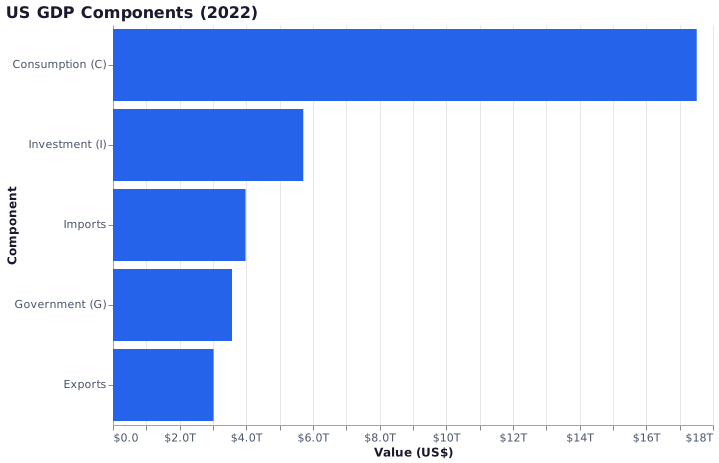
Investment includes business spending on equipment, structures, and intellectual property, as well as residential construction and changes in business inventories. Despite being smaller than consumption, investment is far more volatile and often drives business cycles. When businesses become pessimistic about future demand, they cut back on investment spending, which reduces demand further, potentially triggering a recession. Conversely, investment booms can fuel rapid expansion.
Government spending in the GDP equation includes only government consumption and investment—purchases of goods and services by federal, state, and local governments. It excludes transfer payments like Social Security or unemployment insurance because these represent redistribution rather than production. When the government writes a Social Security check, it is transferring purchasing power from taxpayers to retirees, not purchasing goods or services. When that retiree spends the check at a grocery store, the spending appears in the consumption component.
Net exports—exports minus imports—can be positive or negative depending on a country's trade balance. When a country exports more than it imports, net exports add to GDP. When imports exceed exports, as has been the case for the United States for decades, net exports subtract from GDP. This does not mean that imports are bad for the economy; rather, it reflects an accounting reality. Imports represent foreign production consumed domestically, so they must be subtracted to avoid counting production that occurred elsewhere.
The Income Approach
Every expenditure is simultaneously income for someone else. When you buy a cup of coffee, your expenditure becomes income for the coffee shop—divided among wages for the barista, rent for the landlord, profit for the owner, and so on. The income approach calculates GDP by adding up all income earned in the production process: wages and salaries, rental income, interest income, and corporate profits.
This approach reveals how the fruits of production are distributed among different factors of production. In most countries, labor income (wages, salaries, and benefits) accounts for the majority of GDP, though this share has been declining in many developed economies over recent decades. The remaining income goes to capital in the form of corporate profits, interest, and rent. Understanding this distribution matters because changes in the labor share of income have significant implications for inequality and for aggregate demand.
The Production Approach
The production approach, also called the output approach or value-added approach, calculates GDP by summing the value added by each producer in the economy. Value added is the difference between the value of a firm's output and the cost of its intermediate inputs. The farmer who turns seeds into wheat adds value. The miller who turns wheat into flour adds value. The baker who turns flour into bread adds value. The sum of all this value added equals GDP.
This approach highlights the sectoral composition of the economy—how much comes from agriculture, how much from manufacturing, how much from services. Most developed economies have seen a long-term shift from agriculture to manufacturing to services, with services now dominating. Understanding this composition helps explain employment patterns, skill requirements, and vulnerability to different types of economic shocks.
In practice, statistical agencies use all three approaches and reconcile discrepancies through a process of statistical adjustment. The fact that three independent methods produce the same number (within measurement error) provides confidence in the overall estimate. Large discrepancies between approaches often signal data quality issues that require investigation.
Part IV: Reading the Global Scoreboard
With our conceptual foundation in place, we can now examine what GDP data actually reveals about the global economy. The picture that emerges is one of extraordinary growth over the past several decades, but also stark inequality between nations and regions.
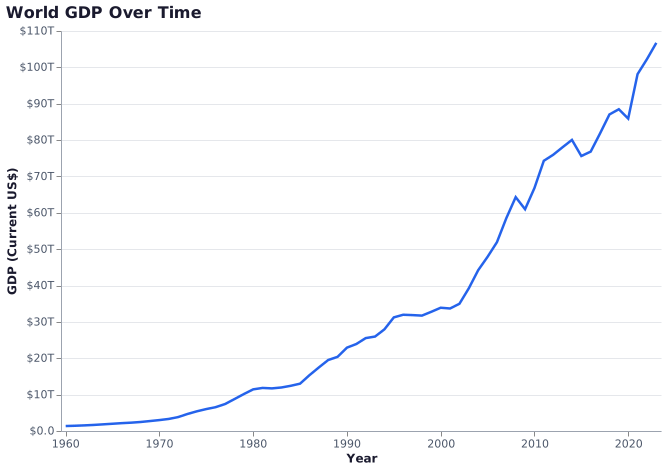
Looking at the global trend, one fact stands out immediately: the world has grown enormously wealthier over the past six decades. In 1960, total world GDP stood at roughly 1.4 trillion dollars. By 2023, it had surpassed 100 trillion dollars—a roughly 70-fold increase even adjusting for inflation. This growth has lifted billions of people out of extreme poverty, extended life expectancies, and expanded access to education and healthcare in ways that would have seemed miraculous to earlier generations.
Yet this growth has not been smooth. The chart reveals several notable interruptions: a deceleration in the early 1980s coinciding with tight monetary policy to combat inflation, a sharp dip in 2009 following the global financial crisis, and an even sharper contraction in 2020 as the COVID-19 pandemic brought much of the world economy to a halt. Each of these episodes demonstrates both the vulnerability of modern economies to shocks and their remarkable capacity for recovery.
But aggregate figures conceal as much as they reveal. Behind the headline number of world GDP lies an extraordinarily unequal distribution of economic activity. A handful of countries produce the lion's share of global output, while many others contribute only marginally despite having substantial populations. As we saw at the opening of this article, just ten countries account for more than two-thirds of global GDP.
The ranking of the world's largest economies reflects a combination of population, productivity, and historical development. The United States has led the world in total economic output for over a century, though its lead has narrowed considerably as China has grown. Japan, despite having only about a third of America's population, long held the second position thanks to its high productivity and technological sophistication. Germany, the United Kingdom, and France represent Europe's major economies, while India and Brazil represent large emerging markets with enormous populations but lower per capita output.
What this ranking obscures is the dynamic nature of economic leadership. A chart from 1980 would look quite different, with the Soviet Union still a major player and China barely registering. A chart from 2040 will likely show further shifts, with India potentially surpassing several European economies and China possibly overtaking the United States in total output if not in per capita terms.
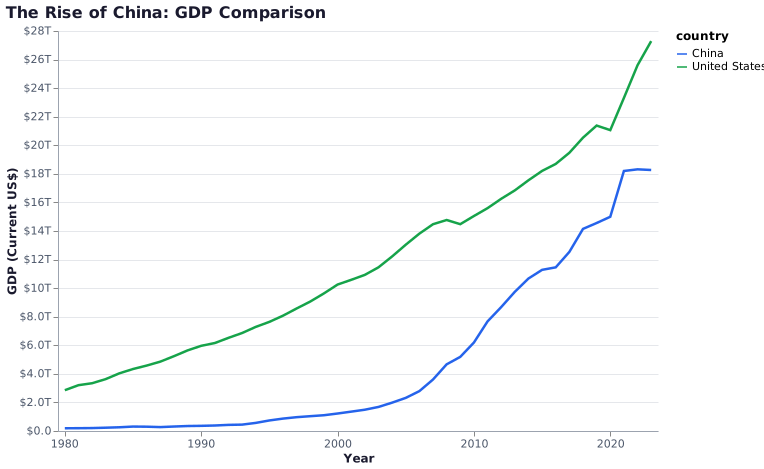
The China-USA comparison tells one of the great economic stories of our time. In 1980, China's economy was tiny by global standards—smaller than Italy's and about one-tenth the size of America's. Mao Zedong's death in 1976 and the subsequent rise of Deng Xiaoping opened the door to market reforms that would fundamentally transform the country. Agricultural decollectivization, the establishment of special economic zones, the welcoming of foreign investment, and eventual accession to the World Trade Organization (WTO) in 2001 all contributed to growth rates that averaged nearly 10 percent per year for three decades.
This 50-fold increase in 45 years is unprecedented for an economy of China's size. It has lifted hundreds of millions from poverty, created a massive middle class, and transformed China into the world's manufacturing hub. Yet significant challenges remain: an aging population, mounting debt, slowing productivity growth, and tensions with trading partners all cloud the outlook for continued rapid growth.
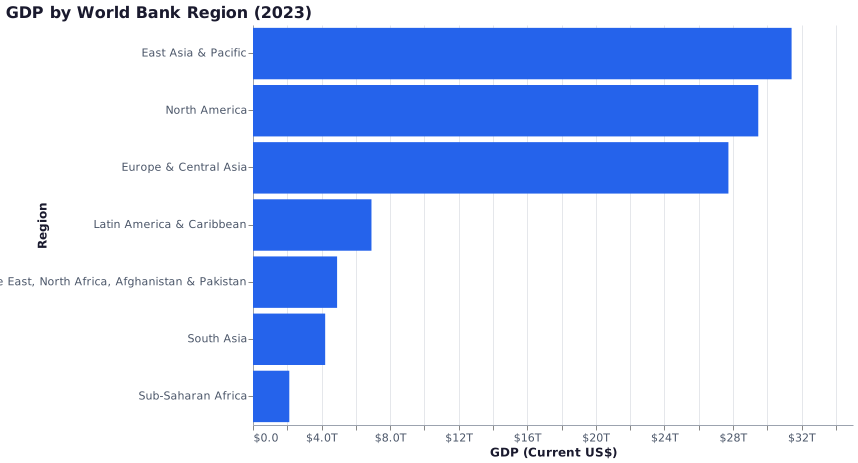
The regional breakdown reveals stark geographic inequalities. East Asia and Pacific, buoyed by the economic giants of China and Japan along with prosperous smaller economies like South Korea and Australia, leads all regions. North America benefits from having the world's largest single economy. Europe's combined output reflects its mature, high-income economies. South Asia, despite explosive population growth, remains hampered by relatively low productivity and underdeveloped institutions. Sub-Saharan Africa, despite containing over a billion people and vast natural resources, produces less than any other region.
These regional disparities matter because they shape global power dynamics, migration patterns, and the feasibility of addressing global challenges like climate change. A world in which half of GDP comes from just two countries—the United States and China—is fundamentally different from one in which production is more evenly distributed.
Part V: GDP Per Capita—A Better Measure?
Raw GDP figures tell us about the total size of an economy but nothing about how prosperous its people are. China has nearly five times the GDP of Switzerland, but few would argue that the average Chinese citizen enjoys a higher standard of living than the average Swiss. To compare living standards, we need to divide total output by population: GDP per capita.
This simple adjustment transforms the picture dramatically. Countries that rank high in total GDP may rank much lower in per capita terms, and vice versa. The United States, with its combination of large population and high productivity, ranks among the leaders on both measures. China, despite its massive total output, falls into the middle of the pack on a per capita basis. India, the world's most populous country, ranks even lower because its total output is spread among more than 1.4 billion people.
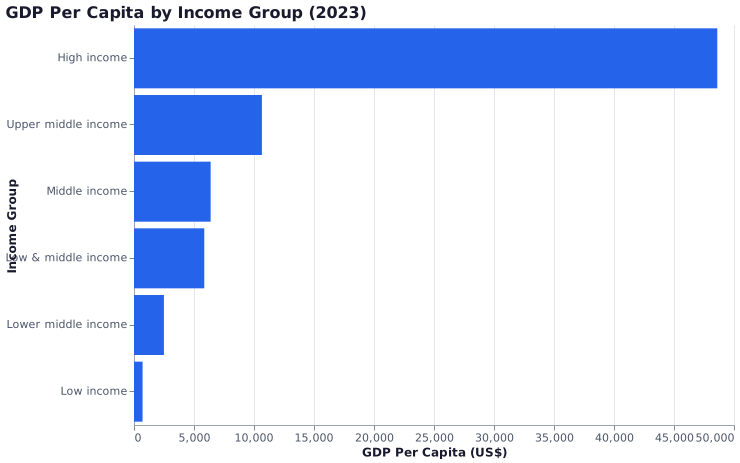
The World Bank classifies countries into four income groups based on per capita income: high-income, upper-middle-income, lower-middle-income, and low-income. The chart reveals the enormous gaps between these groups. Citizens of high-income countries produce on average about $50,000 worth of output per year, while those in low-income countries produce roughly $700—a ratio of more than 70 to 1.
This gap represents far more than abstract statistics. It translates into concrete differences in human lives: life expectancy, infant mortality, educational attainment, access to clean water and sanitation, vulnerability to disease and natural disasters. A child born in a high-income country can expect to live about 80 years on average; a child born in a low-income country, about 65. The child in the wealthy country will almost certainly learn to read; the child in the poor country has a significant chance of remaining illiterate.
Yet GDP per capita, while more informative than total GDP, still has significant limitations as a measure of living standards. It says nothing about inequality within countries. A country with high average income might still have widespread poverty if that income is concentrated among a small elite. It says nothing about non-monetary dimensions of wellbeing: health, education, environmental quality, security, freedom. And it can be distorted by factors that inflate measured output without improving actual living standards, such as very high housing costs or extensive spending on healthcare without corresponding health improvements.
Moreover, comparisons across countries are complicated by differences in price levels. A dollar goes much further in rural India than in Manhattan. Economists address this through purchasing power parity (PPP) adjustments, which account for the different costs of similar goods and services across countries. These adjustments typically narrow the gap between rich and poor countries somewhat, because services and non-traded goods tend to be cheaper in poorer countries. But even with PPP adjustments, the gaps remain enormous.
Part VI: The Economy in Motion—Growth Rates
If GDP levels show where economies stand, GDP growth rates show where they are going. A country's growth rate tells us whether it is catching up to wealthier peers, falling behind, or holding steady. Over time, even small differences in growth rates compound into enormous differences in living standards.
Consider the power of compound growth. An economy growing at 2 percent per year will double in size roughly every 35 years. At 3 percent, it doubles every 24 years. At 7 percent—the rate China achieved for decades—it doubles every 10 years. This means that a country maintaining 7 percent growth for 40 years would see its economy grow not by 280 percent (7 times 40) but by roughly 1,400 percent (approximately 2 to the fourth power, or 16-fold). Compound growth explains how countries can transform themselves within a generation or two—and why growth rate differentials matter so much for long-term development.
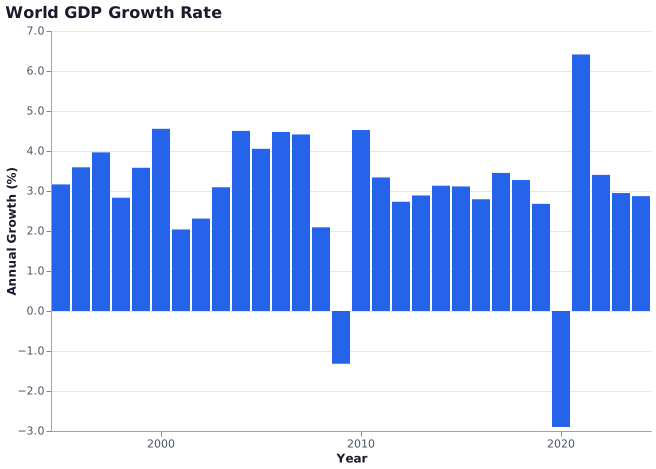
The chart of world GDP growth rates over time reveals both the general trend and the exceptional moments. For most years, the global economy grows at rates between 2 and 5 percent, reflecting the combined expansion of individual economies. But two years stand out starkly: 2009 and 2020.
The 2009 contraction resulted from the global financial crisis, triggered by the collapse of the American housing market and the subsequent failure of major financial institutions. What began as a problem in American subprime mortgages cascaded through interconnected global financial markets, freezing credit and collapsing demand around the world. Global GDP fell for the first time since World War II. The recovery, supported by unprecedented monetary and fiscal stimulus, was gradual but eventually complete.
The 2020 contraction was different in nature but even more severe in magnitude. The COVID-19 pandemic forced governments worldwide to shut down large portions of their economies to slow the spread of the virus. Restaurants, hotels, airlines, entertainment venues—entire industries effectively ceased operation for months. The resulting GDP decline was the sharpest ever recorded. But the recovery was also remarkably swift: once vaccines became available and restrictions lifted, pent-up demand and continued policy support drove a rapid rebound in 2021.
These episodes illustrate an important point about GDP growth: it measures quantity of production, not quality of life. In 2020, GDP fell precipitously, yet the temporary shutdown may have saved millions of lives. In the recovery, GDP surged, yet many people emerged from the pandemic more anxious, isolated, and precarious than before. Growth rates are important indicators, but they are not the whole story.
Part VII: Case Studies in Rise and Fall
Abstract statistics come alive through concrete examples. Three countries—China, Japan, and Argentina—illustrate different trajectories that economies can take and the factors that drive them.
China: The Growth Miracle
China's economic transformation over the past four decades is without historical parallel in terms of scale and speed. In 1980, China was one of the poorest countries in the world, with GDP per capita around $200—roughly comparable to today's least developed countries. The economy was largely agricultural, with most people living in rural areas and working on collective farms.
The reforms initiated by Deng Xiaoping beginning in 1978 gradually transformed this picture. The dissolution of agricultural collectives allowed farmers to keep surplus production, dramatically increasing food output. The establishment of special economic zones welcomed foreign investment and technology. State-owned enterprises were gradually reformed, and a private sector was allowed to emerge. Infrastructure investment—roads, ports, power plants, telecommunications—created the physical platform for industrial growth.
The results were staggering. China maintained GDP growth rates near 10 percent for three decades, a feat unmatched by any large economy in history. Hundreds of millions of people moved from farms to factories, from villages to cities, from poverty to at least modest prosperity. China became the world's manufacturing hub, producing everything from clothing to computers to solar panels. Its emergence reshaped global trade patterns, commodity markets, and geopolitical alignments.
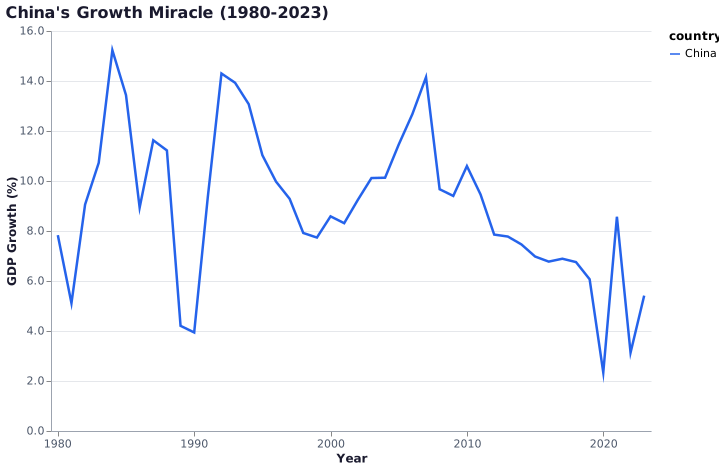
Yet China's growth model also created challenges that are now becoming more pressing. Heavy reliance on investment and exports may have reached its limits. Environmental degradation, from air pollution to water scarcity, threatens both health and economic sustainability. Demographic changes—particularly the aging of the population following decades of the one-child policy—will reduce the workforce and increase the burden on social services. Income inequality has risen sharply, and the gap between coastal cities and interior provinces remains wide. Navigating these challenges while maintaining reasonable growth rates will test Chinese policymakers in the decades ahead.
Japan: Rise, Stagnation, and Lessons
Japan's economic history offers a different lesson: even the most successful growth stories can come to an end, and recovery from stagnation can prove elusive. In the decades following World War II, Japan achieved growth rates that rivaled China's recent performance, transforming from a war-devastated nation into the world's second-largest economy.
By the late 1980s, Japan seemed poised to overtake the United States. Its companies dominated global markets for automobiles, electronics, and semiconductors. Tokyo real estate prices reached astronomical levels—at the peak, the grounds of the Imperial Palace were said to be worth more than all the real estate in California. Japanese companies bought iconic American properties, from Rockefeller Center to Columbia Pictures.
Then the bubble burst. Stock prices collapsed. Real estate values plummeted. Banks, burdened with bad loans, stopped lending. The economy that had grown at 4 to 5 percent annually in the 1980s barely grew at 1 percent in the 1990s—and even that modest growth required enormous fiscal stimulus. Japan entered what economists call a "lost decade," which eventually stretched into two lost decades, and arguably more.

The causes of Japan's stagnation remain debated. Some emphasize the banking crisis and the failure to address bad loans quickly. Others point to demographic headwinds—Japan began aging rapidly just as its growth slowed. Still others blame policy mistakes: insufficient monetary stimulus, stop-and-go fiscal policy, structural reforms that never quite materialized. Whatever the causes, Japan's experience warns against assuming that past growth will continue indefinitely and demonstrates how difficult it can be to escape from a low-growth equilibrium.
Argentina: The Perils of Instability
Argentina represents yet another trajectory: a country that was once among the world's richest but has spent a century struggling with instability and decline. At the beginning of the twentieth century, Argentina was one of the ten wealthiest countries in the world, its fertile pampas producing the beef and grain that fed a rapidly industrializing world. Buenos Aires was one of the world's great cities, its architecture and culture rivaling Paris or London.
What happened? No single factor explains Argentina's long relative decline, but several contributed. Political instability—including numerous coups, dictatorships, and abrupt policy reversals—made long-term planning difficult and deterred investment. Populist policies, particularly under Juan Peron and his successors, prioritized short-term consumption over long-term growth. Repeated currency crises and hyperinflation episodes wiped out savings and undermined confidence. Heavy external debt and messy defaults damaged access to international capital markets.
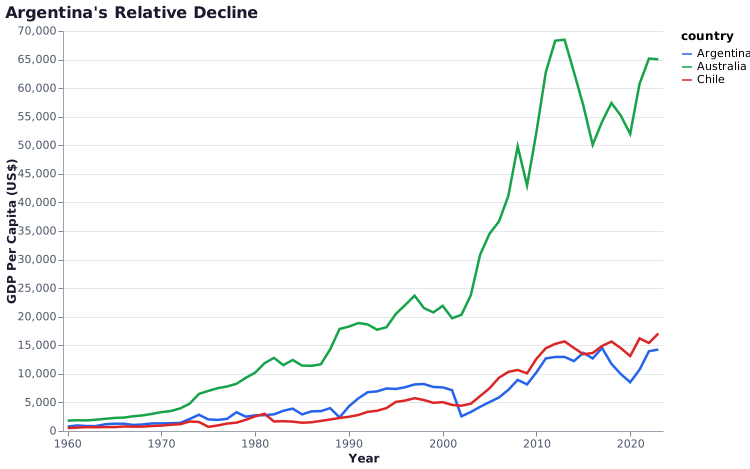
Today, Argentina remains a middle-income country with enormous potential—educated population, natural resources, diversified economy—yet it continues to struggle with inflation, debt, and macroeconomic instability. Its experience serves as a warning about the importance of sound institutions, consistent policies, and avoiding the temptation to finance current consumption at the expense of future prosperity.
Part VIII: Crises Through the GDP Lens
Economic crises test the limits of economic measurement as well as economic policy. Two recent episodes—the 2008 global financial crisis and the 2020 COVID-19 pandemic—reveal both what GDP captures and what it misses.
The 2008 Financial Crisis
The global financial crisis of 2008-2009 began in an unlikely place: the American housing market. For years, lenders had extended mortgages to borrowers with poor credit histories, packaging these risky loans into complex securities and selling them to investors worldwide. When housing prices began to fall in 2006 and 2007, many of these borrowers defaulted. The securities backed by their mortgages became nearly worthless. Financial institutions that held these securities—or had lent money to institutions that held them—faced massive losses.
The crisis reached its peak in September 2008 with the collapse of Lehman Brothers, a major investment bank. Credit markets froze. Banks stopped lending to each other, let alone to businesses or households. The resulting credit crunch pushed economies around the world into recession. Global GDP fell for the first time since World War II.
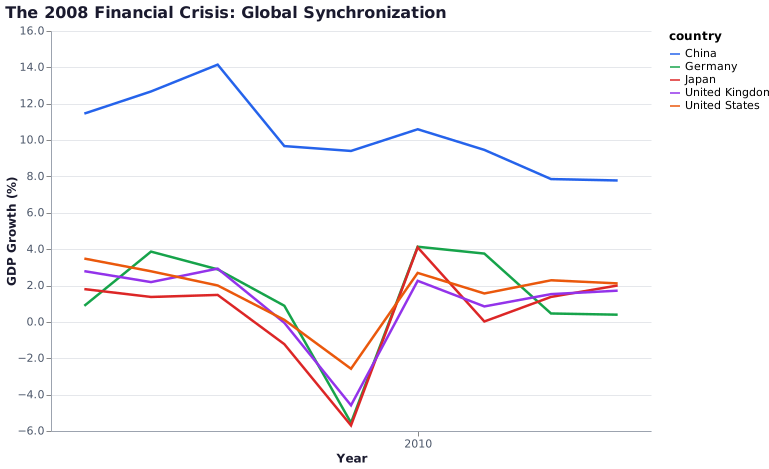
Policy responses were massive and unprecedented. Central banks slashed interest rates to near zero and began purchasing financial assets directly—quantitative easing. Governments enacted fiscal stimulus packages totaling trillions of dollars. Banks received bailouts and guarantees. These measures prevented a complete collapse and eventually restored growth, though recovery was slow and uneven.
The GDP data from this period tells part of the story: the sharp decline in 2009, followed by gradual recovery. But it misses much of the human impact: the millions who lost their jobs, their homes, their savings. It misses the lasting scars—the long-term unemployed who never returned to the workforce, the young people who graduated into a terrible job market and may never catch up, the communities hollowed out by foreclosures. And it misses the changes in policy and regulation that followed, some of which may have made the financial system safer and some of which may have constrained growth.
The COVID-19 Pandemic
The 2020 pandemic presented a crisis unlike any in living memory. Unlike financial crises, which spread through markets and institutions, this crisis spread through human contact, forcing governments to restrict the very social interactions on which economic activity depends. Restaurants closed. Schools closed. Offices emptied. Airlines grounded their fleets. Millions lost their jobs virtually overnight.
The GDP impact was immediate and severe: the steepest quarterly decline ever recorded in most countries. But the nature of this crisis meant that GDP was an even more imperfect measure than usual. Much of the decline reflected deliberate policy choice—the decision to prioritize health over economic activity. The sharp fall in GDP was, in a sense, the price paid to slow the spread of a deadly virus.
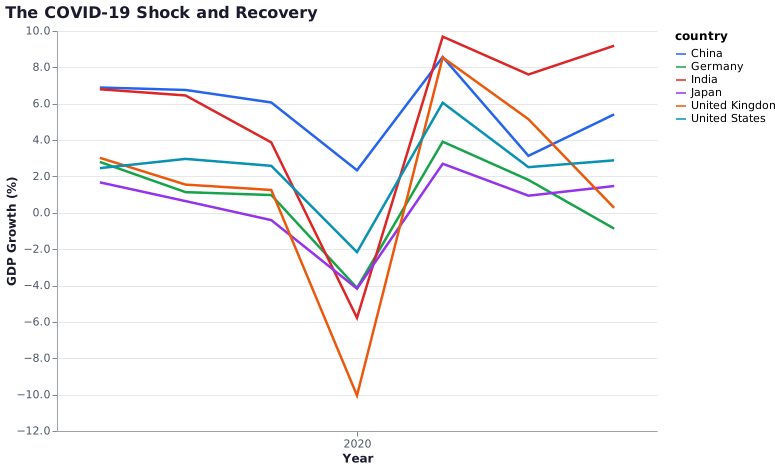
The recovery, too, was unusual. Once vaccines became available and restrictions lifted, pent-up demand surged. People who had been confined to their homes rushed to travel, dine out, attend concerts. GDP rebounded sharply in 2021. Yet the recovery was uneven across sectors and across countries. Some industries, like technology and logistics, thrived throughout. Others, like hospitality and entertainment, continued to struggle even as restrictions eased.
The pandemic also accelerated longer-term trends: the shift to remote work, the growth of e-commerce, the digitization of services. These changes may have lasting effects on productivity, urban geography, and labor markets—effects that will take years to fully manifest in GDP statistics.
Part IX: Forecasting the Future—Machine Learning Meets Economics
For as long as economists have measured GDP, they have tried to forecast it. Governments need projections to plan budgets and policies. Businesses need projections to make investment decisions. Investors need projections to allocate capital. Accurate forecasting would seem to be one of the most valuable things economics could provide.
Yet economic forecasting has a notoriously poor track record. The global financial crisis of 2008 was famously missed by most forecasters. The COVID-19 pandemic, by its nature, could not have been predicted. Even in normal times, forecasts routinely prove wrong, often by substantial margins. As the economist John Kenneth Galbraith quipped, "The only function of economic forecasting is to make astrology look respectable."
In recent years, advances in machine learning have opened new possibilities for economic forecasting. Traditional forecasting methods—econometric models based on economic theory—are being supplemented, and in some cases replaced, by data-driven approaches that can identify patterns too complex for human analysts to detect.
How Machine Learning Forecasting Works
At its core, machine learning forecasting treats prediction as a pattern recognition problem. Rather than building models based on economic theory, machine learning algorithms identify statistical relationships in historical data and use those relationships to project future values. The approach is agnostic about causation—it does not care why GDP tends to follow a certain pattern, only that it does.
For time series forecasting like GDP prediction, several techniques have proven particularly effective. Gradient boosting algorithms, such as XGBoost, LightGBM, and CatBoost, build ensembles of decision trees that progressively correct each other's errors. These methods excel at handling complex, nonlinear relationships and can incorporate many different features without suffering from the multicollinearity problems that plague traditional regression analysis.
The feature engineering process is crucial. Rather than feeding raw historical GDP values into the model, practitioners create derived features that capture different aspects of the time series: lagged values (GDP from one year ago, two years ago, and so on), rolling averages that smooth out volatility, growth rates, and trends. Research suggests that for annual economic data, somewhere between four and nine lags tend to work best—enough to capture relevant history without introducing noise.
The Challenge of Panel Data
Economic forecasting rarely involves just a single time series. Typically, we want to forecast GDP for many countries simultaneously, exploiting commonalities across countries while respecting their differences. This creates a panel data structure: observations across both time and entities.
Panel data presents unique challenges. Different countries have different data availability—the United States has GDP data going back to 1929, while some developing countries have reliable data only from the 1990s. Some countries have gaps in their series due to wars, political disruptions, or simply inadequate statistical capacity. The starting point for data collection varies: Germany's series includes reunification discontinuity, China's reflects the transition from planned to market economy.
Sophisticated preprocessing is essential to handle these issues. Missing values can be interpolated using various methods—linear interpolation, forward filling, statistical imputation—with the choice depending on the nature and extent of the gaps. Different starting dates require either restricting analysis to the common period or using techniques that can handle unbalanced panels. Outliers—like the extreme values during the COVID-19 pandemic—require careful treatment to avoid distorting the model.
Walk-Forward Validation
Evaluating time series forecasting models requires special care. The standard machine learning approach of randomly splitting data into training and test sets does not work here because it would allow the model to use future information when predicting the past. Instead, forecasters use walk-forward validation (also called time series cross-validation), which respects the temporal ordering of the data.
In walk-forward validation, the model is trained on data up to a certain point, then tested on the next period. The training window then advances, and the process repeats. This mimics the actual forecasting situation: at each point in time, we can use only information available up to that point. Models that perform well in this framework are more likely to perform well in real forecasting applications.
Model Comparison and Uncertainty
Modern machine learning practice typically involves comparing multiple models rather than selecting one a priori. For GDP forecasting, gradient boosting methods like XGBoost, LightGBM, and CatBoost often compete closely. Each has strengths: XGBoost handles missing values automatically and has strong regularization; LightGBM trains faster and uses less memory; CatBoost handles categorical features natively and often works well with default parameters.
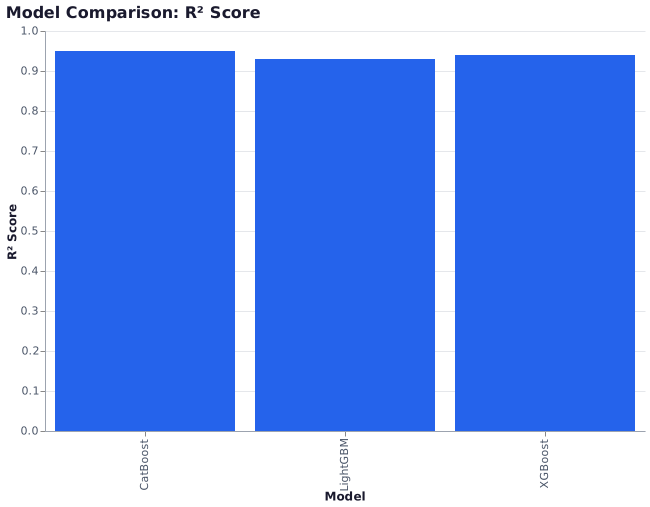
In practice, the differences between these methods are often smaller than the fundamental uncertainty inherent in economic forecasting. The economy is subject to shocks—pandemics, wars, financial crises, technological breakthroughs—that cannot be predicted from historical patterns. Even a perfect model trained on all available data would fail to anticipate the emergence of COVID-19 or the timing of the next financial crisis.
This inherent uncertainty suggests caution in how forecasts are used. Rather than treating point predictions as reliable, sophisticated users focus on forecast ranges and probabilities. They ask not "what will GDP growth be next year?" but "what is the range of plausible outcomes, and what factors might push us toward the high or low end?"
What Machine Learning Reveals
One advantage of machine learning methods is their ability to identify which features contribute most to predictions. Feature importance analysis reveals that, for GDP forecasting, the most recent values matter most—last year's GDP is the best predictor of this year's GDP. Rolling averages also contribute significantly, capturing the momentum of economic growth. More distant lags matter less, consistent with the intuition that economies change over time and distant history becomes less relevant.
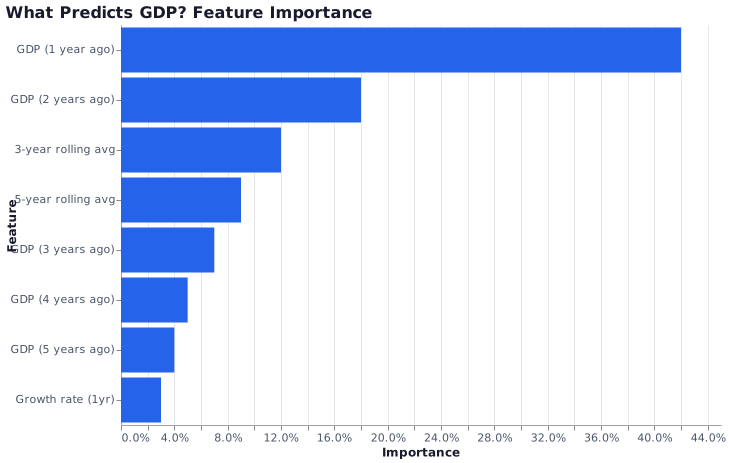
These patterns suggest that GDP, while volatile in the short run, has considerable persistence over longer horizons. Countries that are rich tend to stay rich; countries that are poor tend to stay poor. Convergence happens, but slowly. The machine learning models, in their data-driven way, are rediscovering what economists have long known: development is a gradual process, and there are no shortcuts to sustained prosperity.
Part X: What GDP Doesn't Measure
Having explored what GDP measures and how it is used, we must now confront its limitations squarely. These are not minor quibbles or technical details; they are fundamental gaps that mean GDP can paint a misleading picture of how economies are actually performing.
Distribution and Inequality
GDP measures total production, not how that production is distributed. A country where all the gains from growth flow to the richest 1 percent will show the same GDP growth as one where gains are broadly shared. Yet the lived experience in these two countries would be vastly different.
Over the past several decades, many countries have seen economic growth accompanied by rising inequality. In the United States, for example, median household income has grown much more slowly than GDP per capita, indicating that the gains from growth have been concentrated among higher earners. The average may be rising while most people tread water.
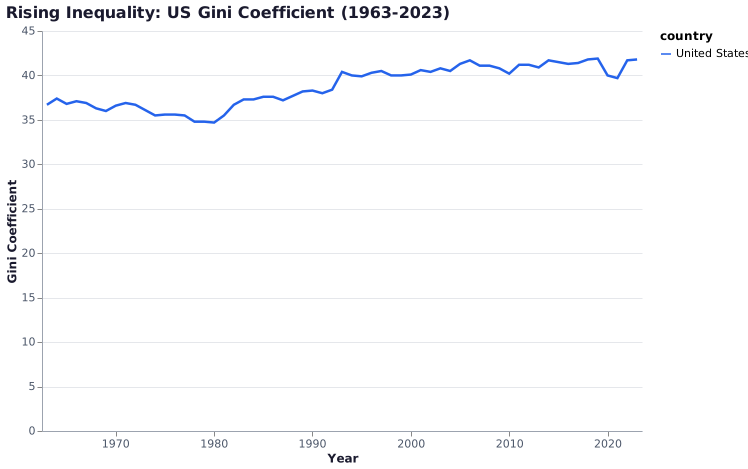
This limitation matters because it can lead to puzzlement or even anger when people are told the economy is doing well while their own circumstances stagnate. If GDP is the only measure being discussed, these experiences seem contradictory. Adding distributional measures—median income, poverty rates, income shares by quintile—provides a fuller picture.
Non-Market Production
GDP counts only production that passes through markets. The enormous amount of productive activity that occurs outside markets—household work, childcare by parents, volunteer activity, subsistence farming—does not appear in GDP statistics.
The magnitude of this omission is substantial. Studies that attempt to value unpaid household labor typically find it equivalent to 20 to 40 percent of measured GDP. This work—cooking, cleaning, caring for children and elderly relatives—is essential to human wellbeing and to the functioning of the paid economy. Without it, the market economy could not exist. Yet GDP treats it as invisible.
The omission creates perverse incentive stories. If a family hires a nanny and both parents work for pay, GDP rises because both the parents' market work and the nanny's wages are counted. If a parent stays home to care for children directly, only one salary is counted and GDP is lower—even though the children may be receiving better care. The statistic cannot tell us which arrangement is better for the family or for society.
Environmental Degradation
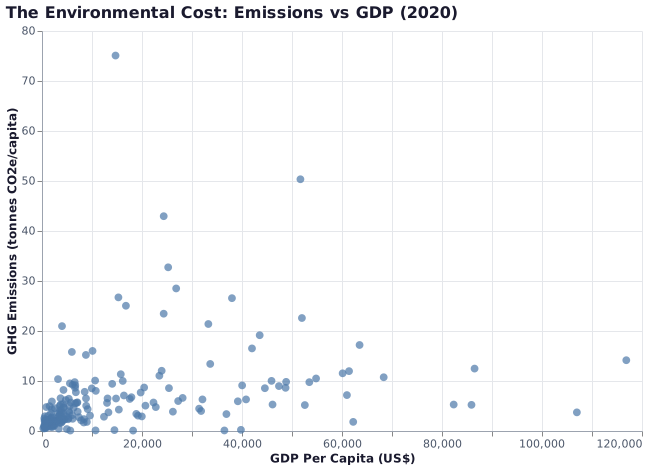
Perhaps the most serious limitation of GDP is its treatment of the environment. GDP counts the extraction and use of natural resources as pure production, ignoring the depletion of the resource base. It counts the costs of cleaning up pollution as production without subtracting the damage caused by the pollution itself. It entirely ignores environmental harms that do not yet require paid cleanup.
Consider a fishing community. If overfishing depletes fish stocks, GDP records the value of the catch without noting that the resource base is being eroded. When fish populations collapse, the loss of future production does not appear as a deduction from GDP. Only when the fishers stop fishing does GDP decline—by which point the damage may be irreversible.
This limitation becomes increasingly important as environmental constraints bind more tightly. An economy that grows by depleting its natural capital—fish stocks, forests, mineral deposits, a stable climate—may be borrowing from the future rather than genuinely prospering. GDP cannot distinguish between sustainable and unsustainable growth.
Quality Improvements
GDP measures the quantity of production but struggles with quality. When a new smartphone costs the same as the old one but has twice the processing power and a better camera, how much has production really increased? When healthcare spending rises but outcomes improve only modestly, how much of that spending represents genuine production versus waste or inefficiency?
Statisticians attempt to address this through quality adjustments—techniques like hedonic pricing that try to value the attributes of goods separately. But these adjustments are difficult, contentious, and necessarily imperfect. Some economists believe official statistics substantially understate productivity growth because they fail to capture quality improvements, particularly in technology. Others are more skeptical.
The challenge is especially acute for services, which now dominate most economies. How do you measure the quality of education, healthcare, legal services, entertainment? These services often have no clear unit of output, making it difficult to even define what productivity improvement would mean, let alone measure it.
Defensive Expenditures
GDP makes no distinction between production that increases wellbeing and production that merely defends against harms. Money spent on burglar alarms, prison construction, pollution cleanup, and healthcare to treat preventable diseases all count equally with money spent on education, art, and genuine improvements in living standards.
If crime increases and people respond by spending more on security, GDP rises—even though people are demonstrably worse off than they would be if crime were lower and they could spend that money on something they actually wanted. If environmental regulations reduce pollution but also reduce the measured output of polluting industries, GDP may fall even though human welfare increases.
These "defensive expenditures" may be substantial. Estimates suggest that a significant fraction of spending in developed economies goes to defensive purposes—protecting against harms rather than positively improving lives. A measure that counts this spending without distinguishing it from genuine progress overstates how well economies are actually serving human needs.
Leisure and Quality of Life
Finally, GDP counts work but ignores leisure. If people work fewer hours while maintaining the same productivity per hour, GDP falls—even though people may be better off with more time for family, hobbies, and rest.
This limitation helps explain why some countries with lower GDP per capita than the United States nonetheless score higher on measures of life satisfaction. Europeans work fewer hours, take longer vacations, and retire earlier than Americans. This shows up as lower GDP but may contribute to higher wellbeing.
The COVID-19 pandemic brought this trade-off into sharp focus. Lockdowns reduced GDP dramatically but also gave some people more time with family, less time commuting, and a moment to reflect on their priorities. Some found they did not miss the consumption they had given up. Others were desperate to return to normal. GDP cannot capture this complexity—the ways in which more production is not always better and less production is not always worse.
Part XI: Alternative Measures
The limitations of GDP have not gone unnoticed. Over the decades, economists, statisticians, and policymakers have developed numerous alternative measures that attempt to capture aspects of progress that GDP misses.
Human Development Index
The United Nations Development Programme introduced the Human Development Index (HDI) in 1990 as an explicit alternative to pure income measures. HDI combines three dimensions: health (measured by life expectancy), education (measured by years of schooling), and standard of living (measured by income per capita, but with diminishing returns at higher levels).
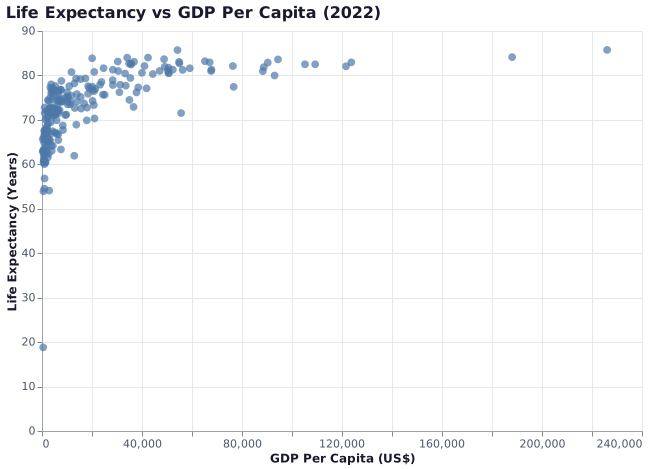
By including non-income dimensions, HDI can reveal countries that perform better or worse than their income alone would suggest. Cuba, for example, has relatively low income but high life expectancy and literacy, resulting in a higher HDI rank than income rank. Resource-rich countries with poor governance may have the opposite pattern—high income but low education and life expectancy.
HDI has its own limitations. It is still focused on objective measures rather than subjective wellbeing. It weights its three components equally without strong theoretical justification. And it remains a single index that inevitably loses information present in the underlying components. Nevertheless, it represents a significant step beyond GDP alone.
Genuine Progress Indicator
The Genuine Progress Indicator (GPI), developed in the 1990s, attempts to adjust GDP for factors that it ignores. Starting from personal consumption expenditure, GPI adds the value of household work and volunteer activity, subtracts the costs of crime, pollution, and family breakdown, and adjusts for income inequality (on the theory that a dollar of income provides more wellbeing to someone poor than to someone rich).
GPI often tells a different story than GDP. In the United States, while GDP per capita has risen steadily since the 1970s, GPI per capita has been relatively flat, suggesting that the costs and harms not captured by GDP have offset the measured gains. Other studies find similar patterns in other developed countries.
Critics argue that GPI involves many subjective judgments about what to include and how to value it. Different reasonable assumptions can produce quite different results. Nevertheless, the attempt to create a more comprehensive measure has influenced policy discussions and highlighted the limitations of GDP.
Gross National Happiness
The small Himalayan kingdom of Bhutan has taken a more radical approach, explicitly rejecting GDP in favor of Gross National Happiness (GNH) as the goal of development policy. GNH attempts to measure psychological wellbeing, health, education, governance, ecological diversity, living standards, time use, and cultural resilience.
While the GNH framework has attracted international attention and influenced development thinking, its practicality as a policy guide remains uncertain. Happiness is notoriously difficult to measure and compare across individuals and cultures. And the concept risks giving governments license to define what should make citizens happy—a power that authoritarian regimes have historically abused.
Dashboard Approaches
Rather than trying to construct a single alternative index, some argue for a dashboard approach: presenting multiple indicators side by side without combining them into a single number. GDP growth, unemployment, median income, life expectancy, carbon emissions, inequality measures—each tells part of the story, and policymakers and citizens can weigh them according to their own priorities.
The challenge with dashboards is that they do not yield a clear summary judgment. Is a country that has rising GDP but rising inequality and rising emissions doing well or poorly? Different observers will answer differently. This may be a feature rather than a bug—forcing explicit discussion of trade-offs rather than hiding them in an aggregation formula. But it does make dashboards harder to communicate and less useful for quick comparisons.
Why GDP Persists
Despite its limitations and the availability of alternatives, GDP remains the dominant measure of economic performance. Why? Several factors contribute.
First, GDP is relatively well-measured and internationally comparable. Decades of methodological development and international coordination have produced statistics that, while imperfect, are reasonably reliable and consistent across countries. Many alternative measures rely on more subjective judgments or less reliable data.
Second, GDP correlates reasonably well with many other things we care about. Richer countries tend to have longer life expectancy, better education, lower infant mortality, and more secure living conditions. GDP is not the same as wellbeing, but it is not unrelated either. As a first approximation, more production does tend to mean better lives.
Third, GDP serves important policy functions that alternatives do not easily replace. It provides a framework for national accounts, enabling analysis of how the economy is structured and how resources flow through it. It serves as the denominator for important policy ratios like debt-to-GDP. It provides a benchmark for business planning and investment decisions.
The practical path forward is probably not to replace GDP but to supplement it—to ensure that policy discussions consider GDP alongside other indicators, that the public understands what GDP does and does not measure, and that decision-makers remain aware of the trade-offs that aggregate statistics inevitably obscure.
Part XII: The Future of Economic Measurement
The twenty-first century presents new challenges and opportunities for economic measurement. Technological change, environmental crisis, and evolving values all press against the limitations of our current framework.
Real-Time Measurement
Traditional GDP measurement relies on surveys and administrative data that take months to collect and process. Official GDP figures for a quarter typically arrive two to three months after the quarter ends, with revisions continuing for years afterward. In a fast-moving economy, this lag limits the usefulness of the data for real-time decision-making.
New data sources promise to change this. Credit card transactions, satellite imagery, mobile phone location data, electricity consumption, and internet search patterns all provide near-real-time signals about economic activity. During the COVID-19 pandemic, researchers used these alternative data sources to track the economic impact of lockdowns week by week, far faster than official statistics could.
The challenge is integrating these new data sources with the traditional national accounts framework in a way that is rigorous, comparable, and free of systematic biases. Alternative data may capture some activities well while missing others. Mobile phone data may reflect youth behavior more than elderly behavior. Credit card data misses cash transactions and informal activity. Combining these sources with traditional methods requires careful statistical work.
Measuring Wellbeing
The growing field of wellbeing measurement attempts to go beyond objective indicators to capture subjective life satisfaction and happiness. National statistical agencies in several countries now routinely survey citizens about their life satisfaction, sense of purpose, and emotional experiences.
These measures reveal that income matters for wellbeing, but with diminishing returns at higher levels. Health, relationships, and job satisfaction often matter as much as income. Unemployment is particularly damaging to wellbeing, more than the income loss alone would suggest. These findings have policy implications: growth that comes at the cost of job security or community ties may not improve aggregate wellbeing.
Including wellbeing measures in policy discussions is gradually becoming more common. The UK's Office for National Statistics publishes regular wellbeing data. New Zealand has experimented with "wellbeing budgets" that consider impacts beyond GDP. Whether this represents the beginning of a fundamental shift or remains a niche alongside GDP's continued dominance remains to be seen.
Environmental Accounts
Climate change and environmental degradation have made the limitations of GDP's treatment of natural resources increasingly urgent. The System of Environmental-Economic Accounting (SEEA), developed under UN auspices, attempts to create comprehensive accounts of natural capital alongside traditional national accounts.
These environmental accounts track stocks of natural resources—forests, fisheries, mineral deposits, water—and flows of environmental services. They reveal when economic growth is being achieved at the expense of natural capital depletion. Eventually, they may enable adjusted measures of income and wealth that account for environmental degradation.
The challenge is valuation: how do you put a dollar value on a forest, a wetland, or a stable climate? Market prices exist for some environmental goods but not for many of the most important ones. Estimates of the "social cost of carbon"—the economic damage caused by each additional ton of carbon dioxide emissions—range widely depending on assumptions about discount rates, damage functions, and future economic growth. Without agreement on valuation, environmental accounting remains more qualitative than quantitative.
Distributional National Accounts
Perhaps the most promising development is the creation of distributional national accounts, which track not just aggregate income and production but how they are distributed across the population. This work, pioneered by economists like Thomas Piketty and Emmanuel Saez, links national accounts totals with tax and survey data on individual incomes.
The results are illuminating. In the United States, distributional national accounts show that since 1980, nearly all the gains from economic growth have gone to the top 10 percent of earners, with spectacular gains for the top 1 percent and 0.1 percent. The bottom 50 percent has seen virtually no increase in real income despite decades of GDP growth. Similar patterns, though often less extreme, appear in other developed countries.
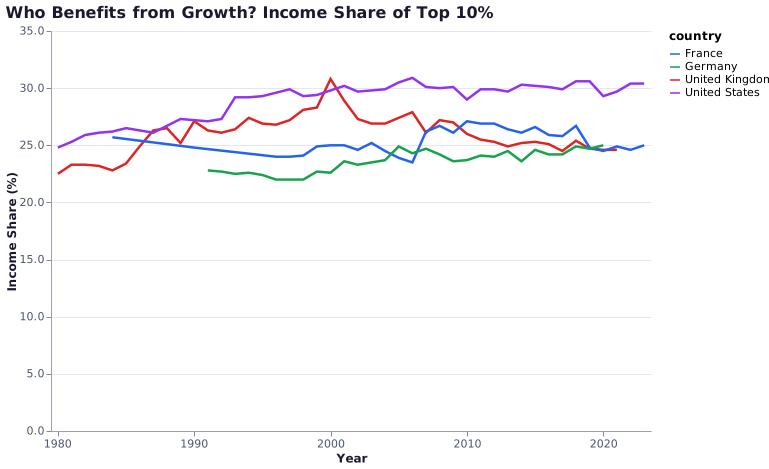
Making distributional data as routine as aggregate data would transform policy debates. Instead of arguing about whether growth is good without reference to who benefits, discussions could focus on what kinds of growth benefit whom—and what policies might make growth more broadly shared.
Conclusion: The Map and the Territory
Gross Domestic Product is a remarkable intellectual achievement: a framework for measuring the vast, complex activity of modern economies, comparable across countries and over time, grounded in rigorous accounting identities. It has served as an indispensable tool for macroeconomic policy, business planning, and international comparison. Its development marked a genuine advance in our ability to understand and manage economies.
Yet GDP is not and was never intended to be a measure of human welfare. Simon Kuznets knew this when he created it, and we should know it today. GDP can rise while inequality worsens, while the environment degrades, while people work longer hours with less security, while communities unravel. It can fall when pollution is cleaned up, when people work less and enjoy more leisure, when unsustainable growth gives way to a more balanced economy.
The goal is not to abolish GDP but to put it in its proper place: as one tool among many, valuable for what it measures but dangerous when mistaken for what it is not. Policymakers need GDP alongside measures of distribution, wellbeing, environmental sustainability, and social cohesion. Citizens evaluating their leaders need to ask not just whether the economy grew but who benefited from that growth and at what cost.
The future of economic measurement lies in plurality: multiple measures capturing different dimensions of progress, dashboards that present complexity rather than hiding it, machine learning and new data sources that enable faster and richer analysis. The single number that Kuznets reluctantly created need not remain the single scorecard by which nations are judged.
Understanding GDP—its history, its mechanics, its uses, and its limitations—is essential for informed citizenship in a world where economic numbers shape so much of our politics and policy. Armed with that understanding, we can engage more thoughtfully with the debates that will shape our collective future: debates about growth and sustainability, about efficiency and equity, about what we produce and what we value.
The economy is not GDP. GDP is just our best attempt to measure one important aspect of economic activity. The map is not the territory, and we should never mistake one for the other.