Somewhere in a school right now, a well-meaning teacher is labeling a student as a "visual learner." Maybe they'll create special flashcards. Perhaps they'll worry that their lecture-heavy style doesn't serve this child. They genuinely want to help—and they're almost certainly wasting their time.
The idea that students have distinct learning styles—visual, auditory, kinesthetic—and learn best when taught through their preferred channel is one of the most widely believed concepts in education. Ask any group of teachers, and the vast majority will nod in agreement. In international surveys, belief rates exceed 90%. Teacher preparation programs teach it. Professional development workshops reinforce it. Educational technology companies build products around it.
There's just one problem: it isn't true.
Four decades of research have failed to find evidence that matching instruction to students' preferred learning styles improves outcomes. Multiple meta-analyses—the gold standard of research synthesis—have examined this question. The average effect size across these studies is 0.04. To put that in perspective, an effect size of 0.20 is considered "small" in educational research. The learning styles effect isn't small. It's essentially zero.
The Anatomy of a Myth
Before we examine the evidence, let's be precise about what we're discussing. The learning styles hypothesis has two components. The first is that individuals have preferences for how they receive information—some prefer pictures, others prefer text, still others prefer hands-on activities. This is true. People do have preferences.
The second component is that students learn better when instruction matches their preferred style. This is the "matching hypothesis," and it's what the research has tested and rejected.
The distinction matters because proponents of learning styles often conflate the two. "Of course students have different preferences!" they'll say, as if that settles the matter. But having a preference and benefiting from that preference are different claims. I might prefer learning through videos, but that doesn't mean I'll remember more if you show me a video instead of having me read a textbook. The question isn't whether preferences exist—it's whether catering to them helps.
No fewer than 71 different learning styles models have been proposed over the years. The most famous is the VAK model (Visual, Auditory, Kinesthetic), but there are dozens of others: Kolb's Learning Styles, Gardner's Multiple Intelligences (often conflated with learning styles), Dunn and Dunn's Learning Styles Model, the Felder-Silverman model, and on and on. This proliferation should itself raise suspicions. If learning styles were a robust scientific phenomenon, wouldn't we have converged on a single model by now?
The Neuromyth Epidemic
Learning styles isn't an isolated myth. It belongs to a family of misconceptions about the brain that have infiltrated education—what researchers call "neuromyths." These are ideas that sound scientific, often invoke neuroscience terminology, but are either oversimplifications or outright falsehoods. Understanding this broader pattern helps explain why learning styles persists despite the evidence against it.
Left Brain, Right Brain
Perhaps the most famous neuromyth is the idea that people are either "left-brained" (logical, analytical, detail-oriented) or "right-brained" (creative, intuitive, big-picture). Teachers design lessons to appeal to both types. Career counselors sort students into analytical or creative paths. Entire curricula are built around this supposed dichotomy.
The scientific basis is real but vastly overstated. Yes, certain functions show some hemispheric specialization—language processing tends to involve the left hemisphere more heavily, and spatial processing the right. But this is a far cry from the popular notion that individuals have a "dominant" hemisphere that determines their personality and learning preferences.
In 2013, researchers at the University of Utah conducted perhaps the definitive study. They analyzed resting-state brain scans from over 1,000 individuals, looking for evidence of hemispheric dominance. Their conclusion was unambiguous: "Our data are not consistent with a whole-brain phenotype of greater 'left-brained' or greater 'right-brained' network strength across individuals." People don't have a dominant side. Both hemispheres work together, constantly communicating across the corpus callosum, for virtually every cognitive task.
Despite this, surveys find that 71% of UK teachers believe in left-brain/right-brain learning. The myth persists because it offers a satisfying taxonomy—a way to sort the messy complexity of human cognition into neat categories. The fact that these categories don't exist in the brain is, apparently, beside the point.
We Only Use 10% of Our Brains
This myth has remarkable staying power, despite being obviously false to anyone who has studied neuroscience. The claim is that vast regions of the brain lie dormant, unused, waiting to be activated—presumably by the right educational intervention.
The evidence against this myth is overwhelming. Brain imaging studies show activity throughout the brain, even during simple tasks. There is no "dark matter" of unused neural tissue. More compellingly, if 90% of the brain were unnecessary, why would damage to small regions cause such profound deficits? Strokes affecting less than 1% of brain volume can cause paralysis, aphasia, or blindness. Evolution would not have built and maintained a metabolically expensive organ (the brain consumes 20% of our energy despite being 2% of body mass) if 90% of it served no purpose.
The origin of the 10% myth is unclear. Some attribute it to misinterpretations of early neurological research showing that only about 10% of brain cells are neurons (the rest being glial cells, which support and protect neurons but do contribute to brain function). Others trace it to self-help gurus who found "unlock your brain's hidden potential" to be irresistible marketing.
Regardless of origin, 48% of UK teachers believe it, as do similar proportions of educators worldwide. The myth feeds into broader narratives about untapped human potential and the promise that the right technique can unlock hidden abilities. It's psychologically appealing even when neurologically absurd.
Critical Periods and Brain Plasticity
A more subtle neuromyth involves misunderstanding brain plasticity. The genuine science shows that early childhood is a period of rapid brain development, with certain skills (like language acquisition and visual processing) having "sensitive periods" when they develop most easily. From this, a distorted version emerged: the idea that if children don't learn certain things by age three (or seven, or some other magic number), the window closes forever.
This has spawned a cottage industry of "brain-based" early childhood interventions, some involving flashcards for infants, classical music for fetuses, and high-pressure academic programs for toddlers. The underlying assumption—that there's a narrow window for learning that closes permanently—is largely false.
While sensitive periods do exist for some functions, the brain remains plastic throughout life. Adults can learn new languages, though it's harder than for children. People can recover function after brain injuries, sometimes dramatically. The "use it or lose it" framing, while not entirely wrong, has been stretched far beyond what the science supports.
A survey of teachers found that 56% believe "there are critical periods in childhood after which certain things can no longer be learned." This belief may lead to premature labeling of children as deficient, or to inappropriate pressure on young children to master academic content before they're developmentally ready.
Why Neuromyths Persist
The persistence of neuromyths reveals something important about how educational ideas spread. These myths share several features that make them sticky:
- They invoke science. "Neuroscience shows..." carries authority, even when the claim that follows is unsupported. Teachers rarely have training in neuroscience sufficient to evaluate such claims.
- They simplify complexity. The brain is staggeringly complex. Myths that reduce this complexity to simple models (left/right, 10%, learning styles) make the world feel more understandable and controllable.
- They suggest interventions. Each myth implies something teachers can do: teach to both hemispheres, unlock unused potential, match instructional style to learning preference. Even when the intervention doesn't work, the myth gives teachers a sense of agency.
- They spread through trusted channels. When professional development programs, textbooks, and respected colleagues all endorse an idea, questioning it feels risky. The social cost of skepticism outweighs the cognitive benefit of accuracy.
The neuromyth epidemic suggests that education is particularly vulnerable to pseudoscience. This should concern anyone who cares about children's futures. If the profession can't distinguish evidence-based practices from appealing nonsense, what hope is there for systematic improvement?
What the Research Actually Shows
The evidence against learning styles comes from the most rigorous form of educational research: randomized controlled trials, followed by meta-analyses that synthesize findings across studies. Let's examine what researchers have found.
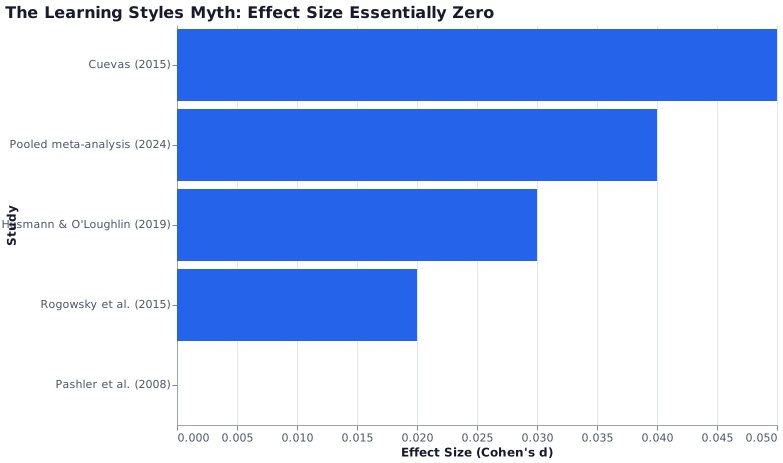
In 2008, a team led by Harold Pashler conducted a comprehensive review of learning styles research for the journal Psychological Science in the Public Interest. This wasn't a casual literature review—it was a systematic examination of whether any evidence supported the matching hypothesis. Their conclusion was damning: "Although the literature on learning styles is enormous, very few studies have even used an experimental methodology capable of testing the validity of learning styles applied to education. Moreover, of those that did use an appropriate method, several found results that flatly contradict the popular meshing hypothesis."
Subsequent studies confirmed this finding. Rogowsky and colleagues (2015) randomly assigned 121 participants to learn through either written text or audio, then tested their comprehension. Learning preference had no effect on outcomes. Husmann and O'Loughlin (2019) studied 426 anatomy students, finding that study strategies didn't correlate with self-identified learning styles—and that those who did study in accordance with their stated style performed no better than those who didn't.
A 2024 meta-analysis pooling data from nearly 5,000 participants found an overall effect size of 0.04. In statistical terms, this is noise. If learning styles worked, the effect would be visible in the data. It isn't.
The Persistence of Belief
Given this overwhelming evidence, you might expect learning styles to have been abandoned. You would be wrong. Belief in learning styles remains near-universal among educators worldwide.
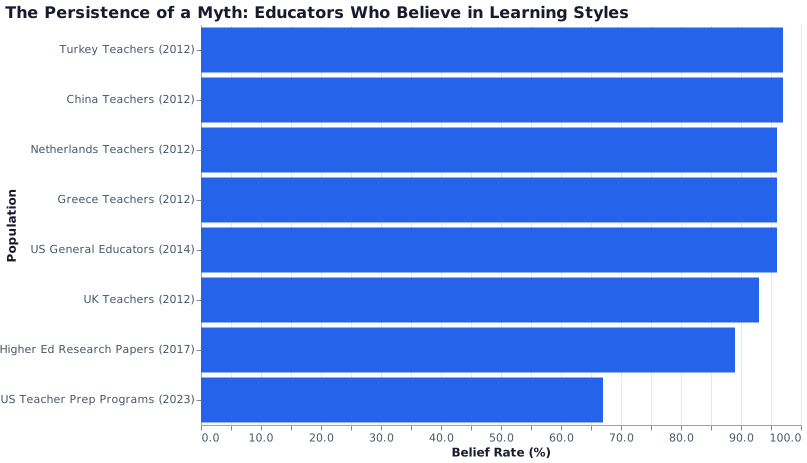
Look at those numbers. In the UK, 93% of teachers believe in learning styles. In the Netherlands, it's 96%. Turkey: 97%. China: 97%. Greece: 96%. Even among researchers publishing in higher education journals—people who should know better—89% of papers implicitly or explicitly endorse learning styles.
Why does this belief persist? Several psychological factors are at work.
Intuitive appeal. Learning styles feel true. We're all different, and it makes sense that we would learn differently. This intuition is powerful enough to override abstract statistical evidence. When a teacher observes that one student seems to benefit from diagrams while another prefers discussion, learning styles provides a ready explanation—even if the real cause is something else entirely (prior knowledge, interest, attention, or random variation).
Confirmation bias. Once you believe in learning styles, you notice evidence that confirms your belief and discount evidence that contradicts it. The student who seemed to "get it" after you used a visual aid? Proof! The student who didn't? Well, maybe you didn't quite match their style.
Investment. Teachers have invested time and energy in learning about and applying learning styles. Admitting it doesn't work means admitting they've been wasting that effort. This is psychologically painful, so the mind protects itself by holding onto the belief.
Institutional inertia. Learning styles are embedded in teacher preparation programs, professional development curricula, and educational product marketing. These institutions have their own reasons to perpetuate the myth, quite apart from whether it's true.
The Harm of a "Harmless" Myth
Some defenders of learning styles argue that even if the matching hypothesis isn't true, what's the harm? At least teachers are thinking about their students' individual needs. But this "no harm, no foul" defense doesn't hold up to scrutiny.
Wasted resources. Every hour a teacher spends creating multiple versions of a lesson to match different learning styles is an hour not spent on strategies that actually work. Every dollar a school spends on learning-styles-based professional development is a dollar not spent on evidence-based training. In a world of limited time and money, opportunity costs matter.
Stereotyping students. Learning styles labels can become limiting. A student labeled as a "kinesthetic learner" might be steered away from activities that require reading and reflection. Research suggests that labeling can affect both teacher expectations and student self-concept. The label becomes a self-fulfilling prophecy—not because the student actually learns differently, but because they've been treated as if they do.
Distraction from real differences. Students do differ in ways that matter for learning—in prior knowledge, working memory capacity, motivation, and metacognitive skills. But learning styles takes attention away from these meaningful differences and focuses it on a distinction that doesn't predict outcomes.
Erosion of educational credibility. When educators embrace ideas that scientists have debunked, it undermines public trust in education as a profession. If teachers believe in learning styles despite the evidence, what else do they believe without warrant?
What Actually Works
The good news is that we do know what improves student learning. Decades of research have identified practices with genuine effect sizes—not the 0.04 of learning styles, but 0.40, 0.50, 0.70 or higher. Here's what the evidence supports:
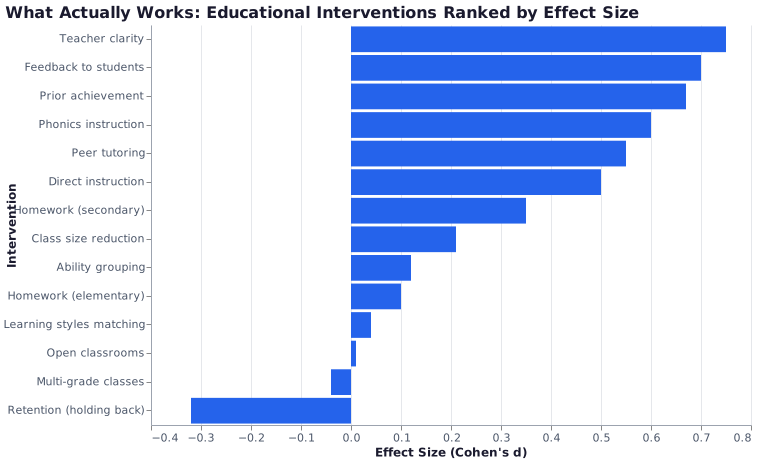
Teacher clarity (d = 0.75): When teachers clearly communicate what students should learn, why it matters, and how they'll know when they've learned it, students perform better. This isn't rocket science, but it's surprisingly rare. Many teachers dive into content without establishing clear goals.
Feedback (d = 0.70): Not all feedback is created equal. The most effective feedback is specific, timely, and focused on the task rather than the person. "Good job!" does little. "Your argument would be stronger if you addressed the counterpoint in paragraph three" does a lot.
Prior achievement (d = 0.67): What students already know is the single best predictor of what they'll learn next. This points to the importance of diagnosing student knowledge and building on it—not categorizing them by sensory preference.
Phonics instruction (d = 0.60): In reading instruction, systematic phonics—teaching the relationships between letters and sounds—has robust effects. This is the core insight of the "Science of Reading" movement, which has led 38 states to mandate evidence-based reading instruction.
Spaced practice (d = 0.60): Spreading study sessions over time produces better long-term retention than massed practice (cramming). Yet most students cram, and most curricula move on to new topics without returning to earlier material.
Retrieval practice (d = 0.50): Testing doesn't just measure learning; it enhances it. Regularly asking students to retrieve information from memory strengthens that memory. This is the "testing effect," and it's one of the most robust findings in cognitive psychology.
Notice what these effective practices have in common: they're based on how human cognition works, not on alleged individual differences. All students benefit from clarity, feedback, and retrieval practice. The learning styles myth suggests we need to customize instruction based on preferences. The evidence suggests we need to implement universal best practices more consistently.
The Cognitive Science Behind What Works
Why do certain practices work while others don't? The answer lies in understanding how human memory and learning actually function. Cognitive science has made enormous progress in the past half-century, and the findings have clear implications for education—if educators would pay attention.
How Memory Works
The dominant model of memory distinguishes between working memory (the information we're actively processing) and long-term memory (the vast store of knowledge and skills we've acquired). Working memory is severely limited—most people can hold only about four chunks of information at once. Long-term memory, by contrast, appears to have no practical limit.
Learning, in this framework, is the process of moving information from working memory into long-term memory in ways that allow later retrieval. The challenge is that working memory is a bottleneck. If instruction overloads working memory, learning fails. This is why effective teaching breaks complex material into manageable chunks, builds on prior knowledge, and provides scaffolding that reduces cognitive load.
Notice that this model says nothing about learning styles. Working memory limitations are universal. The strategies that help information move into long-term memory—practice, spacing, retrieval, elaboration—work for everyone. The science of memory gives no support to the idea that visual learners need visual instruction while auditory learners need lectures.
Why Retrieval Practice Works
The "testing effect" is one of the most robust findings in cognitive psychology. When you try to retrieve information from memory—rather than simply reviewing it—you strengthen the memory trace and improve future retrieval. The act of remembering changes the brain in ways that make the memory more durable.
This has counterintuitive implications. Students often prefer to reread their notes or textbook, feeling that they're "learning" as the material becomes familiar. But this sense of fluency is misleading. Recognition is easier than recall, and the ease of recognition creates an illusion of knowledge. When the exam comes and they must actually retrieve the information, they discover they haven't learned it at all.
Retrieval practice is harder—it requires effort, and students often get answers wrong in the process. But this "desirable difficulty" is precisely what makes it effective. The struggle to retrieve strengthens memory in ways that passive review cannot. Teachers who give frequent low-stakes quizzes aren't just assessing learning; they're causing it.
Why Spacing Works
The spacing effect was first documented in 1885 by Hermann Ebbinghaus, making it one of the oldest findings in psychology. Yet most educational practice ignores it.
The basic finding is simple: distributed practice (spreading study sessions over time) produces better long-term retention than massed practice (cramming). Study something once and wait a week, then study again; you'll remember more than if you studied twice in one session. The optimal gap between sessions varies with the desired retention interval, but the principle is universal.
Why does spacing work? The leading theory involves "forgetting as a friend." When you begin to forget something and then retrieve it again, the retrieval is harder—and therefore more effective at strengthening memory. Massed practice feels effective because the material is fresh, but this very freshness means retrieval is too easy to produce durable learning.
Most curricula are structured around massed practice. A unit on fractions covers fractions intensively for two weeks, then moves on to decimals. By the time the end-of-year exam arrives, fractions have been forgotten. Interleaved and spaced curricula—which return to previously covered material periodically—produce better retention but require more planning and feel less intuitive to teachers.
Why Interleaving Works
Related to spacing is interleaving: mixing different types of problems or topics rather than practicing one type at a time. In blocked practice, you might solve ten similar algebra problems in a row. In interleaved practice, you'd mix algebra with geometry with probability.
Interleaving feels harder, and students often prefer blocked practice. But interleaving produces better long-term learning. Why? One theory is that interleaving forces students to discriminate between problem types—to identify what kind of problem they're facing before applying a solution strategy. Blocked practice doesn't require this discrimination; you already know what type of problem you're doing.
The implications for education are significant. Most textbooks and worksheets group similar problems together. Math homework might have "Solve for x" for 20 problems of the same type. This feels efficient but produces shallow learning. Teachers who mix problem types are fighting against the structure of their materials—but they're giving students a better education.
A Success Story: The Science of Reading
Is evidence-based education actually possible? The "Science of Reading" movement suggests it is—though the path from research to practice is neither quick nor easy.
For decades, reading instruction in American schools was dominated by an approach called "whole language" or, later, "balanced literacy." These methods emphasized meaning-making, exposure to rich literature, and learning to read "naturally" through immersion in text. Phonics—explicitly teaching the relationships between letters and sounds—was deemphasized or rejected entirely as too mechanical, too boring, too focused on "skill and drill."
The problem was that whole language didn't work very well. National assessments showed stagnant reading scores. About a third of American fourth-graders couldn't read at a basic level. And the evidence from cognitive science was clear: skilled reading requires automatic decoding of words, which requires knowledge of letter-sound relationships, which must be explicitly taught. The brain didn't evolve to read; reading is a cultural invention that must be painstakingly learned.
In 2000, the National Reading Panel reviewed the research and found strong evidence for phonics instruction. Effect sizes were in the 0.4-0.6 range—far higher than learning styles. But the education establishment largely ignored the finding. Whole language had become ideological; its proponents viewed phonics as conservative, reductionist, and opposed to children's authentic engagement with text.
What changed was investigative journalism. In 2018, Emily Hanford, an education reporter, produced a documentary called "Hard Words" that brought the research to public attention. Parents who had struggled to understand why their children couldn't read suddenly had an explanation. Advocacy organizations formed. Pressure on legislators mounted.
The result has been remarkable. As of 2024, 38 states have passed laws requiring evidence-based reading instruction. Teacher preparation programs are being reformed. Curricula are being replaced. It took 20 years from the National Reading Panel's findings to widespread policy change—a frustratingly long time—but change is happening.
The Science of Reading offers several lessons for education reform. First, research alone isn't enough; it must be communicated to the public in accessible ways. Second, policy change requires political pressure, not just scientific evidence. Third, ideological resistance can delay progress for years or decades—at tremendous cost to children. And fourth, change is possible. The education establishment can be moved, even if it takes a generation.
A Cautionary Tale: The Fall of Finland
No discussion of education myths would be complete without examining Finland—once the world's education darling, now a cautionary tale about what happens when progressive ideals outpace evidence.
In the early 2000s, Finland dominated the Programme for International Student Assessment (PISA), the most respected international comparison of educational outcomes. Finnish students ranked first or second in reading, mathematics, and science. Education ministers from around the world traveled to Helsinki to discover the secret.
What they found seemed too good to be true: no standardized testing, no homework, lots of play, and radical trust in teachers. Finland became the poster child for progressive education. If only we could be more like Finland, the thinking went, our students would flourish too.
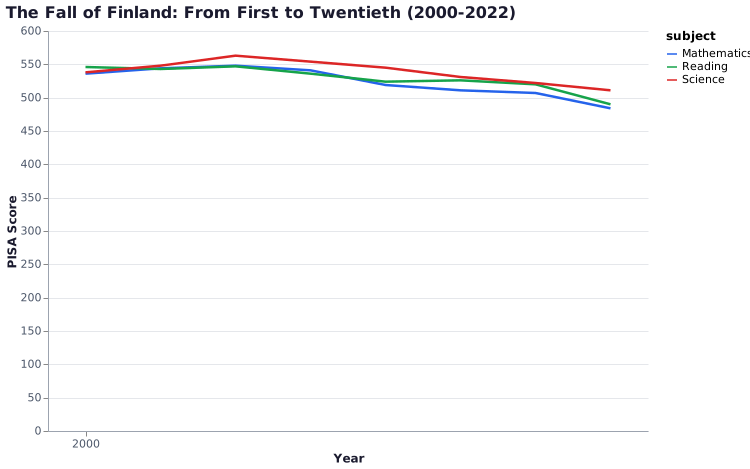
Then something unexpected happened: Finland started declining. And it didn't stop.
Between 2003 and 2022, Finland's math score dropped 64 points—from 544 to 484. This is a staggering fall. The country that once ranked second in mathematics now ranks twentieth. In reading, Finland dropped from first to twentieth. Even in science, where Finland held on longest, scores have fallen from 563 (2006) to 511 (2022).
What went wrong? Researchers point to several factors. One is the shift toward "student autonomy" and "self-directed learning"—pedagogical approaches that sound appealing but may not serve all students well. Aino Saarinen, a Finnish researcher, notes a correlation between increased emphasis on student autonomy and declining performance, particularly among younger students who need more structured guidance.
Finland also devolved authority to local schools, nominally to "trust educators," but this happened alongside budget cuts. The national inspectorates that once maintained quality were eliminated. Teacher support declined. Meanwhile, Finnish students report high levels of distraction from digital devices—41% say phones and screens disrupt their concentration.
The Finnish lesson isn't that progressive education is always wrong. It's that education is complex, and appealing ideas can have unintended consequences. The country that became famous for trusting teachers and rejecting testing may have trusted too much and measured too little.
Estonia: The Quiet Success Story
While Finland was declining, another Nordic country was quietly rising. Estonia, a small Baltic nation of 1.3 million people, has become Europe's best-performing education system—and it did so without abandoning rigor.
Estonia's 2022 PISA math score of 510 places it seventh globally, ahead of Switzerland, Canada, the Netherlands, and every other European country. In science, Estonia ranks second in the world, behind only Singapore. In reading, it ranks third. These results didn't come from nowhere; Estonia has been steadily climbing the rankings since it first participated in PISA in 2006.
What's Estonia doing right? Several factors stand out:
High-quality teachers. Estonia, like Finland, draws teachers from the top third of university graduates. Teaching is a respected profession, and teacher preparation is rigorous. But unlike Finland, Estonia has not abandoned structured curricula in favor of student-directed learning.
Strong curriculum. Estonia has a national curriculum that sets clear expectations for what students should learn at each grade level. Teachers have autonomy in how they teach, but not in what they teach. This balances professional judgment with accountability for results.
Digital integration. Estonia is one of the world's most digitized societies—it pioneered e-government, e-voting, and digital identity. Schools have integrated technology thoughtfully, using it to enhance instruction rather than replace teachers. Students learn programming and digital literacy as core subjects.
Early intervention. Estonian schools identify struggling students early and provide additional support before problems compound. This contrasts with systems that allow students to fall behind, hoping they'll catch up on their own.
Assessment culture. Unlike Finland, which minimized testing, Estonia maintains a culture of regular assessment. This isn't the high-stakes standardized testing that critics decry, but frequent, formative assessment that helps teachers identify what students have and haven't learned. When you measure, you can improve.
Estonia's success suggests that the choice between "progressive" and "traditional" education is a false dichotomy. You can have student-centered learning and clear expectations, professional autonomy and accountability, innovation and rigor. What you can't do is abandon structure entirely and expect outcomes to remain strong. Finland tried that. It didn't work. The small Baltic nation's rise from Soviet-era education system to global leader in less than two decades proves that educational improvement is possible when evidence guides policy.
The International Scoreboard
Finland's decline occurred against a backdrop of global educational disruption. The 2022 PISA results, released in December 2023, revealed historic drops worldwide. Average math scores across OECD countries fell by 15 points—a record decline. Reading dropped 10 points.
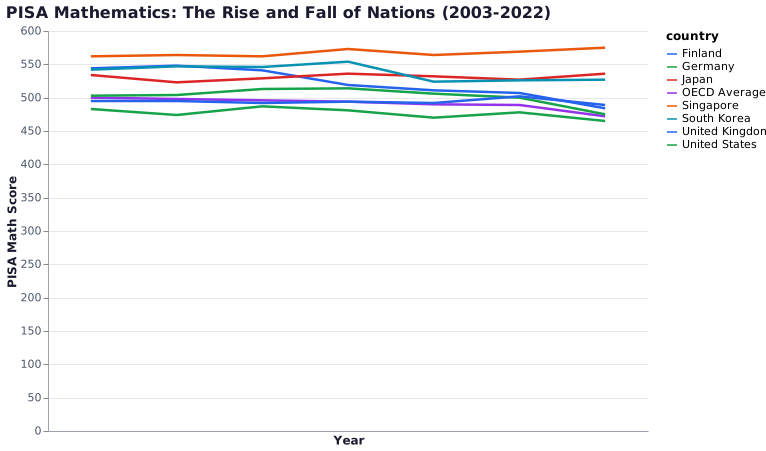
COVID-19 undoubtedly played a role—school closures disrupted learning everywhere. But the pandemic doesn't explain everything. Finland's decline began years before COVID. And some countries actually improved during this period.
Japan and South Korea maintained strong performance. Chinese Taipei gained 16 points. Estonia, a small Baltic nation, rose to become Europe's best-performing country. What do these successful systems have in common? They didn't abandon rigor in favor of unstructured learning. They didn't assume that trusting students to direct their own education would produce results.
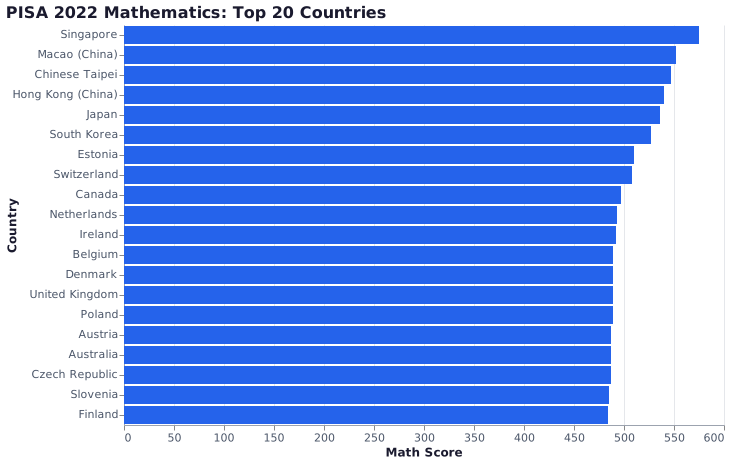
The PISA rankings reveal an uncomfortable truth for Western education reformers: the countries that emphasize traditional academic rigor—high expectations, structured instruction, substantial homework—continue to outperform those that don't. Singapore, which leads the rankings, is known for its demanding curriculum and competitive academic culture. This doesn't mean Singapore's approach is perfect, but it suggests that easy appeals to "letting children be children" and "reducing academic pressure" may come at a cost.
Money Can't Buy Test Scores
Another education myth is that student achievement is primarily a function of funding. If only we spent more money on schools, the argument goes, outcomes would improve. The United States has tested this hypothesis more thoroughly than any other country.
The U.S. spends $809.6 billion per year on K-12 education—more than any other country by a factor of five. Japan, the next biggest spender, allocates $160.5 billion. On a per-pupil basis, America spends $20,387—third highest in the developed world. Only Luxembourg and Norway spend more.
And yet American students score below the international average. In the 2022 PISA, the U.S. ranked 26th in mathematics with a score of 465—below the OECD average of 472 and far behind Singapore (575), Japan (536), and South Korea (527).
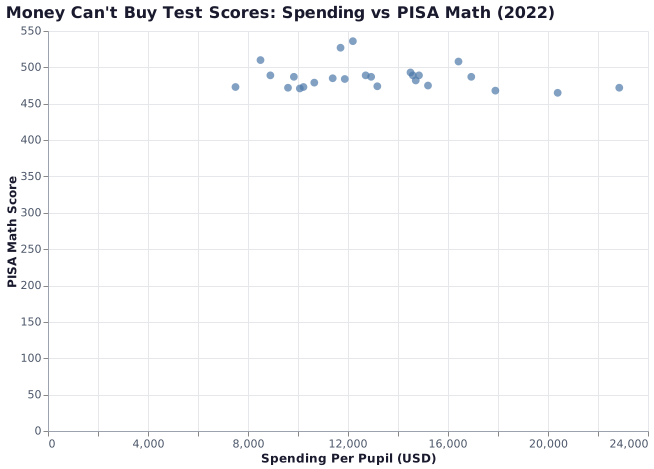
The scatter plot tells the story. There's no meaningful relationship between spending and outcomes. The United States, Luxembourg, and Norway cluster in the upper left—high spending, mediocre results. Estonia, Poland, and South Korea cluster in the lower right—moderate spending, excellent results.
Japan is particularly instructive. It spends $12,195 per pupil—40% less than the U.S.—and scores 536 in math, 71 points higher. Finland spends $11,871 and scores 484—still 19 points higher than America despite spending nearly half as much.
This pattern repeats at the state level within the United States. New York spends nearly $29,000 per pupil—more than any other state and more than most countries. Its NAEP math scores are solidly average. Utah spends less than $9,000 and achieves similar results. Massachusetts spends $22,000 and achieves the best outcomes in the country. Mississippi spends $10,000 and achieves the worst.
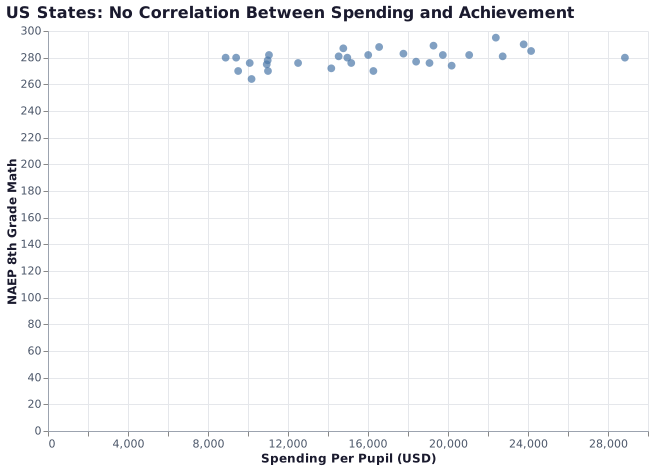
The relationship between spending and outcomes appears positive at first glance—states that spend more tend to have slightly higher scores. But this relationship largely disappears when you control for poverty. Wealthier states have both more money to spend on schools and lower child poverty rates. The spending doesn't cause the achievement; both are symptoms of underlying economic factors.
None of this means that money is irrelevant. Adequate funding is necessary for good outcomes. But beyond a certain threshold, additional spending yields diminishing returns—especially if it's not spent wisely. The evidence suggests that how money is spent matters more than how much.
The Homework Question
Few educational debates generate as much heat as homework. Parents resent it. Students hate it. Teachers disagree about it. But what does the research say?
The answer, as with many things in education, is "it depends." The effect of homework varies dramatically by age.
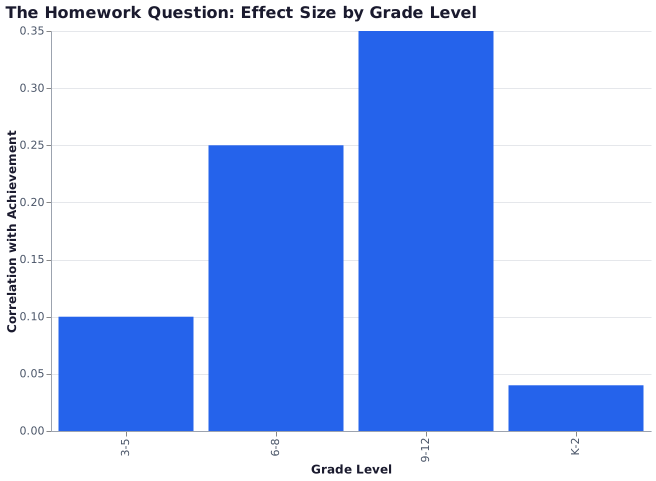
For elementary students (K-5), homework has almost no effect on achievement. The correlation is around 0.10—barely detectable. This doesn't mean homework is worthless for young children; it may build habits and responsibility. But don't expect it to boost test scores.
For middle school students (6-8), the effect strengthens (r = 0.25), but with an important caveat: returns diminish after about 90 minutes per night. Beyond that point, more homework doesn't mean more learning.
For high school students (9-12), homework has the strongest effect (r = 0.35), with diminishing returns after about 2-2.5 hours nightly. A high schooler doing 3 or 4 hours of homework per night isn't learning more than one doing 2 hours—they're just suffering more.
These findings support the "10-minute rule" that many schools have adopted: homework should increase by about 10 minutes per grade level. A fourth-grader might do 40 minutes; a high school senior might do 2 hours. This guideline isn't arbitrary—it's roughly where the research suggests returns begin to diminish.
The homework debate also reveals a class dimension rarely discussed. Students from affluent families typically have quiet spaces to study, educated parents who can help, and resources to hire tutors. Students from low-income families often have noisy, crowded homes, parents working multiple jobs, and no academic support. When homework accounts for a significant portion of grades, it advantages already-advantaged students.
The Road Forward
What would a genuinely evidence-based approach to education look like? It would start by abandoning myths—not just learning styles, but the whole constellation of appealing ideas that lack empirical support.
It would prioritize what works. Teacher clarity. Feedback. Retrieval practice. Spaced learning. Phonics instruction. These interventions have effect sizes of 0.5 or higher—an order of magnitude larger than learning styles. Schools should invest in training teachers to implement these practices well, rather than chasing the latest pedagogical fad.
It would be skeptical of intuition. Many education myths persist because they feel true. Learning styles feels true. The idea that more money automatically means better outcomes feels true. The notion that reducing academic pressure helps children flourish feels true. But feelings are not evidence. Education policy should be based on rigorous research, not on what makes adults feel good.
It would learn from high-performing systems. Singapore, Japan, South Korea, and Estonia aren't perfect, but they're achieving results that Western countries aren't. This doesn't mean importing their cultures wholesale—that's impossible. But it does mean understanding what they do differently and why it works.
It would measure outcomes honestly. Finland's decline was enabled by a culture that rejected standardized testing. When you don't measure, you don't know what's going wrong—until it's too late. Assessment isn't the enemy of good education; it's a necessary tool for improvement.
It would resist ideological capture. Education has become a battleground for culture wars. This is a mistake. The question of how children learn best is an empirical question, not a political one. Progressive and conservative educators alike should be willing to follow the evidence, even when it contradicts their priors.
Conclusion: Evidence Over Intuition
The learning styles myth is, in some ways, a microcosm of everything wrong with education discourse. It's an idea that sounds good, makes intuitive sense, has been widely adopted, and doesn't work. It has persisted for decades despite overwhelming evidence against it, sustained by institutional inertia, commercial interests, and the human tendency to believe what feels right.
But it's also a reminder that evidence-based education is possible. We know that learning styles don't work because researchers designed experiments to test the hypothesis. We know what does work because those same researchers measured the effects of alternative approaches. The knowledge exists. The challenge is implementation.
The pattern we've seen—neuromyths spreading through trusted channels, intuition overriding evidence, ideological commitments blocking reform—isn't unique to learning styles. It's endemic to education. The whole-language wars in reading, the calculator debates in mathematics, the disputes over tracking and ability grouping—these conflicts often generate more heat than light because participants are arguing from priors rather than evidence.
Breaking this pattern requires a cultural shift. Teachers need better training in research methods and statistical reasoning. Administrators need to demand evidence before adopting new programs. Parents need to ask hard questions rather than accepting claims at face value. And researchers need to communicate their findings more effectively to practitioners and the public.
The Science of Reading movement shows that such shifts are possible, even if they take decades. The falling PISA scores show that the stakes are high. And the success of Estonia demonstrates that evidence-based education isn't a theoretical ideal but a practical reality achievable in real school systems.
The next time someone tells you about visual and auditory learners, about kinesthetic and reading-writing styles, feel free to be polite—but also be skeptical. Ask for the evidence. Look at the effect sizes. Check whether the research design could actually test the claim being made.
Education is too important to be guided by myths. Our children deserve better than theories that feel good but don't work. They deserve practices that are grounded in the best available evidence about how human beings actually learn.
The data is clear. It's time we started listening to it.