In 2018, something happened that the models said was essentially impossible. UMBC, a 16-seed from a mid-major conference, defeated Virginia, the number-one overall seed and one of the best defensive teams in college basketball history. The odds of this particular upset, according to most models, were somewhere between 1-in-300 and 1-in-500. Virginia had lost only twice all season. They were favored by 20 points.
UMBC won by 20.
For the bracket-prediction industry, this was a catastrophe. Roughly 99% of brackets on ESPN, Yahoo, and CBS had Virginia advancing past the first round. Tens of millions of brackets were effectively eliminated in a single game. The models had failed.
But here's the thing: the models didn't really fail. A 1-in-300 event happening once in 136 attempts (the number of 1-vs-16 matchups from 1985 to 2018) isn't that surprising. Rare events are supposed to happen sometimes. The problem wasn't that the models were wrong—it was that people misunderstood what the models were telling them. And that misunderstanding reveals something profound about prediction, probability, and the unique structure of March Madness.
The 73% Ceiling
If you've ever tried to build a bracket prediction model, you've likely encountered a frustrating reality: no matter how sophisticated your approach, you can't seem to get much past 73-75% accuracy. This isn't because you're doing something wrong. It's a feature of the tournament itself.
Consider the baselines. If you flipped a coin for every game, you'd get about 50% right. If you simply picked the higher-seeded team in every matchup, you'd get approximately 67% correct. Using KenPom's adjusted efficiency margin—one of the most respected advanced metrics in college basketball—you'd hit around 71.5%. Add machine learning, combine multiple data sources, tune your hyperparameters obsessively, and you might scratch 74%.
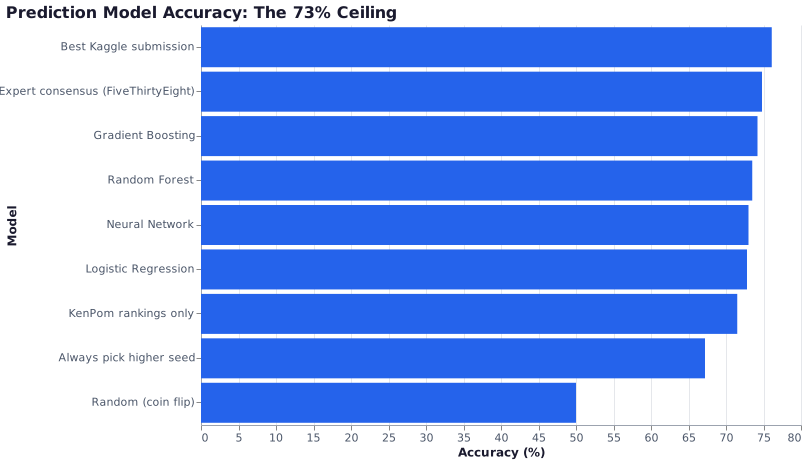
The best Kaggle submissions over multiple years of their March Madness competition have averaged around 76% accuracy. That sounds impressive until you realize it's only about 5-6 games better per tournament than just picking all the favorites. The improvement from coin flipping to favorites is worth about 11 games. The improvement from favorites to cutting-edge machine learning is worth about 5. All that sophistication buys you surprisingly little.
Why the ceiling? Three factors conspire against prediction accuracy:
Single-elimination variance. In a best-of-seven series, like the NBA playoffs, the better team wins about 80% of the time. In a single game, that number drops to roughly 65-70%. March Madness is 67 consecutive single-elimination games. Every round, variance gets a fresh chance to strike.
Limited data. College basketball teams play roughly 30-35 games per season, and many of those are against vastly inferior opponents. By the time the tournament starts, we have perhaps 10-15 games of useful signal per team. Compare this to MLB, where teams play 162 games, or even the NFL, where sample size is notoriously small but at least every game is competitive.
Intangible factors. Injuries, matchup problems, momentum, crowd effects, travel fatigue—these matter but are nearly impossible to model. A star player tweaking his ankle in warmups can flip a game's probability. A team that peaked too early might look flat in March. None of this shows up in the efficiency metrics.
The Perfect Bracket: A Mathematical Impossibility
No one has ever filled out a perfect bracket. Not in the history of the tournament. Not once.
The mathematics explain why. The NCAA tournament has 63 games (or 67 including the First Four play-in games). If you're picking randomly, the probability of getting all 63 right is 1 in 2^63, or approximately 1 in 9.2 quintillion. That's 9,223,372,036,854,775,808 possible outcomes. To put this in perspective, if every person on Earth filled out a bracket every second for a hundred years, we still wouldn't cover all the possibilities.
But surely experts do better than random? They do—but not by as much as you'd think. If you have a 73% accuracy rate (better than almost anyone achieves), your probability of a perfect bracket improves to roughly 1 in 120 billion. Better, but still effectively impossible. You'd have a better chance of winning the Powerball lottery three times in a row.
The longest verified perfect streak is 49 games. That's it. Out of 63 possible games, no one has ever publicly verified getting more than 49 right. The combination of skill and luck required is simply beyond human (or machine) capability.
This mathematical reality exposes a fundamental truth about March Madness: the tournament is designed to be unpredictable. The single-elimination format, the compressed schedule, the neutral-site games, the 68-team field—all of it maximizes variance. The NCAA isn't optimizing for the best team winning. They're optimizing for entertainment. And entertainment means upsets.
Seeds vs. Analytics: The Committee's Blind Spots
Every March, the NCAA Selection Committee meets behind closed doors to seed the 68-team tournament field. Their decisions are based on a combination of metrics, the eye test, and rules about conference representation. The resulting seedings are supposed to reflect team quality—but they consistently contain systematic biases that analytics can exploit.
The committee uses two types of metrics: "resume" metrics (like NET rankings and Strength of Record) that measure what teams have accomplished, and "quality" metrics (like KenPom and BPI) that estimate how good teams actually are. These often disagree. A team from a weak conference might compile an impressive record against inferior opponents, earning strong resume metrics but weak quality metrics. Conversely, a good team in a brutal conference might have a mediocre record despite being genuinely excellent.
When these metrics disagree, the committee consistently favors resume over quality—especially for bubble teams and lower seeds. This creates opportunities for analytics-savvy observers. If a 13-seed has a KenPom ranking suggesting they're really a 9-seed quality team, that's a potential upset waiting to happen.
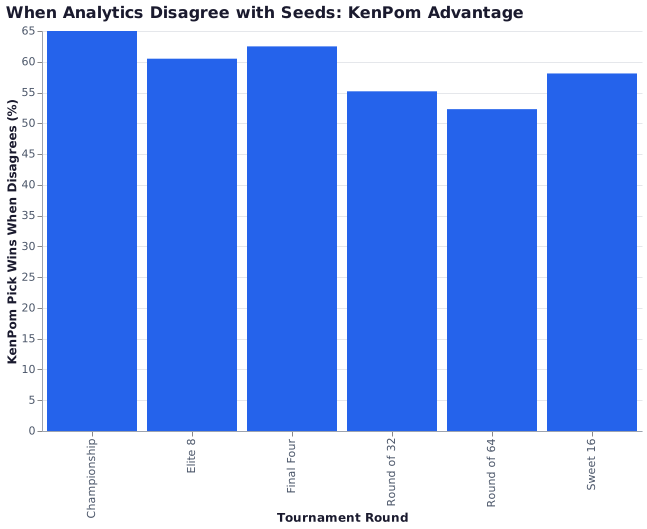
The effect intensifies in later rounds. In the Round of 64, when seeds and KenPom disagree, KenPom's pick wins about 52% of the time—barely better than a coin flip. But by the Elite Eight, that number climbs to over 60%. The further you go in the tournament, the more the committee's resume bias becomes exploitable.
Recent tournament history is littered with examples. In 2018, Loyola Chicago—a 58th-ranked KenPom team stuck with an 11-seed—rode Sister Jean's prayers (and analytics edge) all the way to the Final Four. In 2022, Saint Peter's was a 15-seed but ranked 101st in KenPom—much better than a typical 15. They became the first 15-seed ever to reach the Elite Eight. In 2024, Oakland (14-seed, 107th in KenPom) upset 3-seed Kentucky, whose analytics profile was weaker than their seed suggested.
The lesson: don't just look at seeds. Look at the underlying metrics. When they diverge, the analytics are often right.
The Anatomy of an Upset
Not all upsets are created equal. The tournament's structure creates predictable patterns of chaos—if you know where to look.
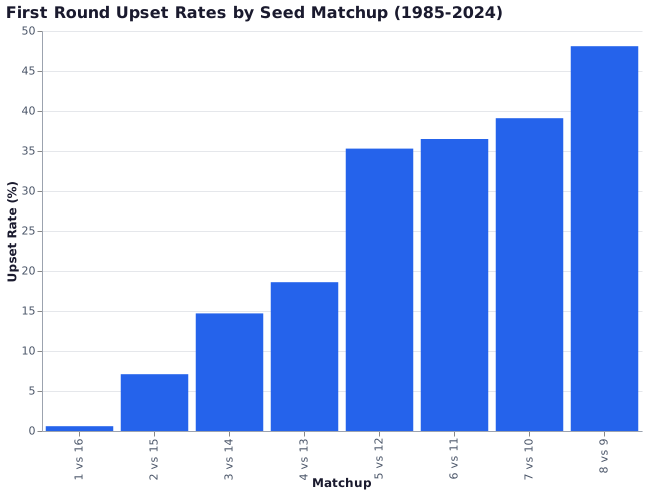
The most famous upset slot is the 5-vs-12 matchup. Since 1985, 12-seeds have won 35.3% of these games—more than one-third. This is far higher than you'd expect based on seed difference alone. Why? Several theories exist. Five-seeds often come from major conferences but aren't truly elite programs—good enough to make the tournament but not good enough to dominate it. Twelve-seeds are often conference champions from mid-major leagues—teams with momentum, chemistry, and something to prove.
The 8-9 matchup barely deserves the term "upset." Nine-seeds have won 48.1% of these games, making it essentially a coin flip. Bracket experts often ignore seeds entirely for this matchup and focus purely on which team is playing better basketball in March.
Perhaps most interesting is the 11-seed phenomenon. No seed from 9-16 has won more total tournament games than the 11-seed (104 wins and counting). The 11-seed has reached the Final Four six times—more than the 9, 10, 12, 13, 14, 15, and 16 seeds combined. Part of this is structural: many 11-seeds are "at-large" teams from major conferences that lost in their conference tournaments. They're often better than their seed suggests.
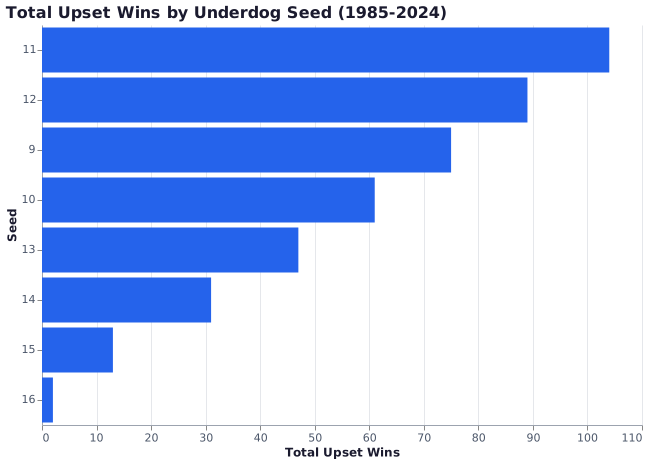
The historical data tells us something profound: seeds are useful but imperfect signals. The committee makes systematic errors. Mid-major conference champions are often underseeded. Major-conference bubble teams are often overseeded. If you want to beat the average bracket, you need to think beyond the seed lines.
What Makes Champions?
If predicting upsets is hard, can we at least identify championship contenders? Here, the data offers more guidance. Tournament champions share certain characteristics with remarkable consistency.
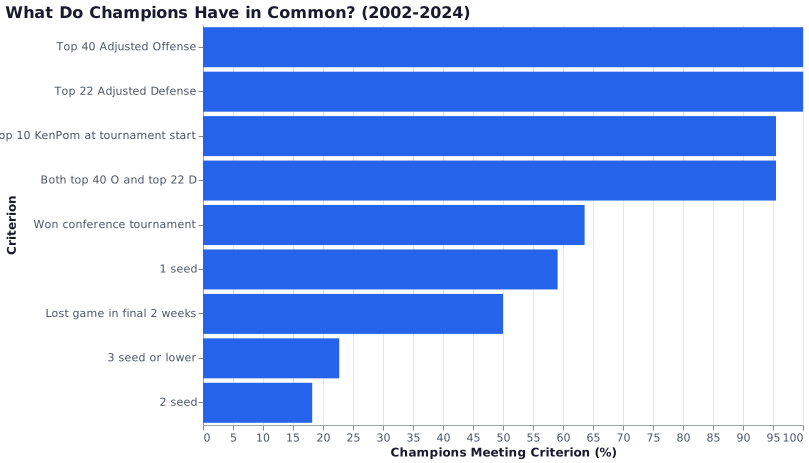
Since 2002, every single national champion has ranked in the top 40 in adjusted offensive efficiency. Every single one has also ranked in the top 22 in adjusted defensive efficiency. This dual requirement—elite offense AND elite defense—is essentially mandatory. Teams that are great on one end but mediocre on the other simply don't win championships.
The data also shows that 1-seeds win far more often than any other seed (59% of championships since 2002), but they're far from guaranteed. Two-seeds have claimed 18% of titles, and 3-seeds or lower have won 23%. The most recent examples include UConn in 2014 (7-seed) and their back-to-back titles in 2023-2024 (4-seed, then 1-seed).
What about teams that seem vulnerable despite high seeds? The data suggests red flags:
- Offense-only teams: Since 2003, nine tournament teams ranked top 10 in offensive efficiency but outside the top 100 in defensive efficiency. Almost all lost in the first round.
- Conference tournament fatigue: Teams that play extra games to win their conference tournament show a small but measurable decline in early-round performance.
- First-year coaches: New coaches face about an 8.5% higher upset rate, presumably due to system implementation challenges.
If you're filling out a bracket, the champion profile is useful: find the 1-2 seeds that rank highly in both offensive and defensive efficiency, check that they don't have obvious red flags, and weight them heavily for your championship pick. The upsets will happen along the way, but the trophy usually goes to balanced excellence.
The Rise of KenPom
No discussion of college basketball analytics is complete without Ken Pomeroy. His website, kenpom.com, has become the gold standard for team evaluation—used by coaches, media, and bettors alike.
KenPom's core insight is simple but powerful: adjust for strength of schedule and pace of play. Raw statistics like points per game or field goal percentage tell you little because they conflate team quality with opponent quality and tempo. A team that scores 80 points per game against weak opponents at a fast tempo isn't necessarily better than one that scores 65 against strong opponents at a slow tempo.
The key metric is Adjusted Efficiency Margin (AdjEM)—the difference between a team's adjusted offensive efficiency (points scored per 100 possessions against an average defense) and adjusted defensive efficiency (points allowed per 100 possessions against an average offense). A positive AdjEM means the team outscores an average opponent; a negative AdjEM means they get outscored.
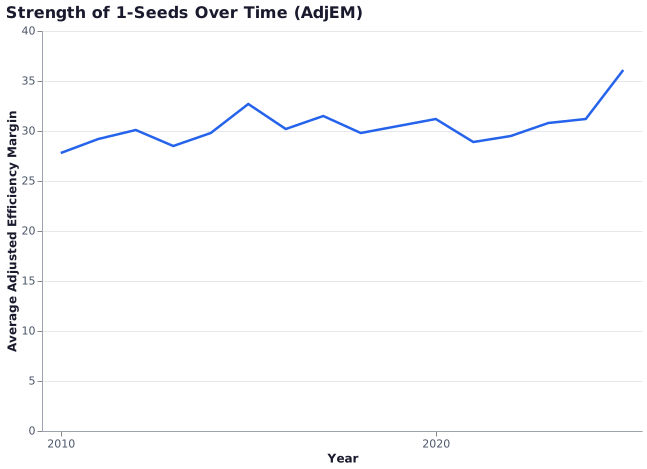
Elite teams typically have AdjEM values above +25. Tournament 1-seeds average around +30. The 2025 tournament field featured the strongest 1-seeds in history, with an average AdjEM of +36.1—demolishing the previous record of +32.7 from 2014-15.
KenPom's accuracy in predicting tournament games hovers around 70-73%—not perfect, but significantly better than seeds alone (67%). More importantly, his ratings provide a framework for understanding why teams win or lose. When a 12-seed upsets a 5-seed, KenPom often shows that the 12-seed was undervalued—their efficiency profile suggested they were really an 8 or 9 seed quality.
The limitation of KenPom (and all efficiency-based metrics) is that they measure what teams have done, not what they will do. A team that peaked in January might have weaker March numbers. A team dealing with injuries might see their metrics decline. And some factors—clutch performance, tournament experience, coaching adjustments—simply don't show up in the efficiency data.
Volatility and Variance
Some teams are more predictable than others. Understanding volatility—the tendency for performance to swing wildly from game to game—is crucial for bracket success.
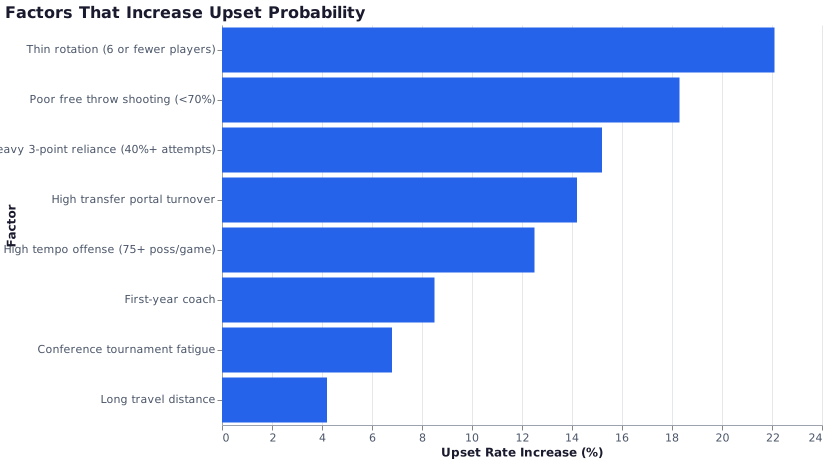
Tempo. Teams that play fast create more possessions, which means more chances for variance to strike. A team averaging 75 possessions per game has more randomness in their outcomes than one averaging 65. High-tempo teams are more likely to blow out inferior opponents—and more likely to lose games they "should" win.
Three-point reliance. The three-pointer is the most variable shot in basketball. A team that lives by the three can die by the three—one cold shooting night can end their season. Teams that generate easy baskets near the rim have more consistent scoring outputs.
Free throw shooting. Poor free throw teams introduce randomness in close games. When every trip to the line is a 65% proposition, games become coin flips in crunch time.
Rotation depth. Teams that rely heavily on 6 or fewer players face devastating foul trouble risk. One starter with three fouls before halftime can swing a game's probability by 10+ percentage points.
The strategic implication: when picking upsets, look for matchups where a volatile underdog faces a more predictable favorite. The underdog's ceiling might be high enough to steal a game; the favorite's floor might be low enough to lose one.
The Transfer Portal Era
College basketball has undergone a quiet revolution in the past five years. The transfer portal, combined with NIL (Name, Image, Likeness) money, has transformed roster construction. Players now move freely between programs, chasing playing time, money, or championship opportunities. The result is unprecedented roster volatility—and new challenges for prediction models.
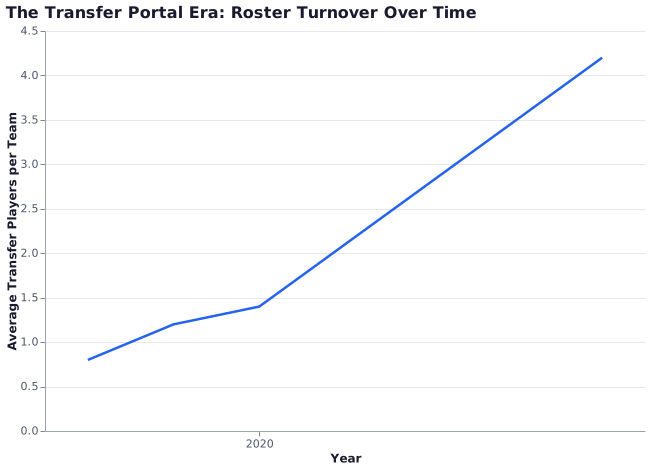
In 2018, tournament teams averaged fewer than one transfer player per roster. By 2024, that number exceeded four. Some programs have essentially rebuilt their entire roster through the portal, bringing in five or more experienced players from other schools.
This creates a prediction problem. Traditional metrics assume team chemistry and system continuity—players who have played together for years, running schemes they know intimately. Portal-heavy rosters violate this assumption. Five talented players who just met in September might look great on paper but struggle to gel on the court.
Kansas State's 2023-24 season is the cautionary tale. Jerome Tang assembled one of America's most expensive rosters through the portal—veteran talent at every position, impressive efficiency profiles for each individual player. They entered the season ranked in the top 10. They finished with a losing record and missed the tournament entirely. The talent was there. The chemistry wasn't.
On the other hand, successful portal usage can accelerate team-building dramatically. Teams that find the right fit—experienced players who fill specific needs, buy into the system, and mesh with existing personnel—can go from mediocrity to contention in a single offseason. The 2024 champion UConn built significant roster pieces through the portal.
For prediction purposes, the portal era introduces a "chemistry wildcard" that's nearly impossible to model. You can measure talent aggregation but not fit. You can see the pieces but not how they'll work together. This uncertainty should increase variance in tournament outcomes—more upsets by well-fitting underdogs, more disappointments by talent-stacked favorites who never figured it out.
The Betting Markets: Smart Money, Same Limits
If analytics can't crack March Madness, what about money? Betting markets aggregate information from thousands of bettors, including sharp gamblers with sophisticated models. In theory, market prices should reflect the best available predictions. In practice, betting on March Madness is almost as humbling as filling out brackets.
Sportsbooks set point spreads that attempt to equalize betting on both sides. If a 2-seed is favored by 8.5 points over a 15-seed, that spread represents the market's best estimate of the likely margin. Historically, these spreads are well-calibrated—favorites cover about 50% of the time, as you'd expect for efficiently set lines.
But covering the spread and winning outright are different things. Underdogs who lose by 5 when favored by 7 "cover" the spread but still lose the game (and bust your bracket). The betting market's efficiency doesn't translate into bracket predictability.
What betting markets do reveal is public bias. When the public overwhelmingly bets on favorites, sportsbooks can shade the line, giving value to contrarian bettors who take the underdog. During March Madness, this "public favorite" bias is especially pronounced. Casual bettors flood in, overvaluing name-brand programs and high seeds. Sharp bettors exploit this by taking points with undervalued underdogs.
The data suggests a mild edge for betting tournament underdogs against the spread, particularly in the first round. Mid-major conference champions receiving large amounts of public fade often outperform expectations. But even this edge is small—perhaps 52-53% win rate against the spread, before accounting for the vig (bookmaker's cut). It's not enough to get rich, just enough to confirm that favorites are slightly overvalued.
Case Studies in Madness
Abstract statistics only tell part of the story. To truly understand March Madness unpredictability, we need to examine specific cases where the impossible became real.
UMBC vs. Virginia (2018): The First 16-Over-1
For 33 years, no 16-seed had beaten a 1-seed. Zero wins in 135 attempts. The probability seemed vanishingly small—models estimated 0.3% to 0.5% per game. Virginia, the 2018 tournament's top overall seed, had won 31 games. They had the nation's most efficient defense. They were favored by 20.5 points.
UMBC wasn't just a 16-seed; they were from the America East Conference, a league that had never produced a tournament win. Their best player, Jairus Lyles, wasn't projected to be drafted. They had no business being on the same court as Virginia.
Yet something extraordinary happened. UMBC shot 54% from the field, including 12-24 from three. Virginia, the defensive juggernaut, allowed 74 points—more than they'd given up in all but one game that season. The final score was 74-54, a 20-point margin in the wrong direction. Lyles scored 28 points. UMBC's bench outscored Virginia's 29-0.
Was this predictable? Not really. UMBC's KenPom ranking was 166th—firmly in the range of typical 16-seeds. Their efficiency metrics suggested nothing special. What happened was variance: shooting variance, defensive variance, the kind of one-night explosion that single-elimination formats make possible. The sample size of one game allowed talent to be overwhelmed by circumstance.
Loyola Chicago (2018): Analytics Edge Plus Intangibles
In the same tournament that produced UMBC's miracle, Loyola Chicago demonstrated a different kind of upset—the systematically undervalued mid-major. Loyola received an 11-seed despite a KenPom ranking of 58th, suggesting they were roughly a 7-seed quality team. The selection committee had undervalued them based on their weaker conference schedule.
Loyola proceeded to prove the analytics right. They beat 6-seed Miami, 3-seed Tennessee, 7-seed Nevada (in overtime), and 9-seed Kansas State to reach the Final Four. Each game was close—three were decided by single digits, one by a last-second shot. But Loyola's efficiency profile held up against every opponent.
The run also produced March Madness's most enduring recent image: 98-year-old Sister Jean, the team's chaplain, becoming a national celebrity. The "intangible" of team chemistry and belief is impossible to model, but anyone watching Loyola that March could see they had something special. The analytics explained why they could compete; the intangibles explained why they actually did.
Saint Peter's (2022): The Peacock Miracle
Saint Peter's, a tiny Jesuit school in Jersey City, became the first 15-seed ever to reach the Elite Eight. Like Loyola, they were analytically undervalued—KenPom had them at 101st, not 15-seed territory. But unlike Loyola, Saint Peter's didn't have the efficiency numbers to suggest Final Four potential.
What they had was defense. Saint Peter's played suffocating man-to-man, extending possessions and frustrating offenses. Against 2-seed Kentucky, they held a team averaging 80 points to just 56. Against 7-seed Murray State, they allowed only 60. Against 3-seed Purdue, they held 7-footer Zach Edey to 11 points and frustrated the Boilermakers into a 67-64 loss.
The Saint Peter's run highlights how matchups matter in single-elimination. Their defensive style was particularly effective against certain offensive profiles—teams that relied on half-court efficiency rather than transition, teams that needed time to execute. When they finally lost to 8-seed North Carolina in the Elite Eight, they faced a team that could run, score in transition, and match their physical intensity. Style matters; matchups matter; and in a 67-game tournament, the wrong matchup can end any dream.
The Machine Learning Arms Race
Every year, thousands of data scientists compete in Kaggle's March Madness prediction competition. They deploy random forests, gradient boosting, neural networks, and ensemble methods. They engineer features from play-by-play data, adjusted statistics, coaching tendencies, and even sentiment analysis of sports media. The prizes are substantial; the prestige is real.
And yet, the winning accuracy barely budges from year to year. The best submissions consistently hit 74-76%—impressive, but not transformatively better than simpler approaches. Why?
The fundamental issue is signal-to-noise ratio. College basketball generates relatively little data per team per season. Each game provides maybe 70-80 possessions of information. Many early-season games are against vastly inferior opponents, providing minimal signal about a team's tournament potential. By March, even the best teams have perhaps 500-600 meaningful possessions against quality opponents—a tiny dataset by machine learning standards.
Compare this to other ML domains. Image recognition models train on millions of labeled examples. Language models see billions of tokens. A March Madness model has 68 teams, 30 games each, maybe 70 possessions per game—about 140,000 data points total, distributed across teams that may never play each other. It's like trying to learn chess from watching 10 games per player.
The machine learning community has learned several lessons from March Madness:
- Feature engineering matters more than model complexity. Simple models with good features often beat complex models with raw data.
- Ensembling helps. Combining multiple models reduces variance, even if each individual model is mediocre.
- Log loss beats accuracy. Confidence calibration—knowing when you're uncertain—is more valuable than raw prediction accuracy.
- There's a ceiling. At some point, the inherent randomness in single-game basketball outcomes limits what any model can achieve.
The honest conclusion from years of ML competition: sophisticated models provide marginal improvement over simple heuristics. If you want to beat your office pool, you don't need a neural network. You need to understand when seeds are misleading, when analytics disagree with consensus, and when to trust variance to create upsets. The rest is just noise.
The Psychology of Bracket Picking
March Madness bracket pools reveal fascinating aspects of human psychology—our biases, our overconfidence, and our relationship with uncertainty.
The availability heuristic. People overweight recent, memorable events. If last year featured a dramatic 12-over-5 upset, brackets this year will have more 12-seeds advancing than the base rate warrants. UMBC's 2018 victory over Virginia led to more 16-seed picks in 2019 than in any previous year—even though the base rate (now 1-in-68) still made such picks nearly worthless in expected value.
The narrative fallacy. We love stories. A team with a compelling narrative—a charismatic coach, a tragic backstory, a Cinderella setup—gets more bracket love than their efficiency numbers deserve. Bracket pickers consistently overvalue "story" teams and undervalue boring, methodical programs that simply execute.
Overconfidence. Studies show that bracket makers significantly overestimate their skill. In surveys, the average respondent believes they'll finish in the top 25% of their pool—a mathematical impossibility. We remember our correct predictions and forget our incorrect ones. The result is systematic overconfidence about prediction ability.
Loss aversion. People hate looking foolish more than they enjoy being right. This creates herding behavior—pickers gravitate toward chalk (favorites) because busting with the crowd is less embarrassing than busting alone. The cost is opportunity: when everyone picks the same favorites, there's little upside to correct chalk picks but massive downside to incorrect upset picks.
The illusion of control. Filling out a bracket feels like making meaningful decisions. You analyze matchups, weigh factors, and commit to choices. This feeling of control is mostly illusory—the tournament will unfold however it unfolds, regardless of your bracket—but it's psychologically satisfying. We'd rather feel in control and be wrong than feel helpless and be right.
These biases aren't character flaws; they're features of human cognition. Understanding them won't make you immune—you'll still fall prey to availability, narrative, and overconfidence. But awareness might help at the margins. When you find yourself reaching for a story pick, ask whether the efficiency numbers support the narrative. When you feel confident in an upset, check whether that confidence is calibrated to the actual probability.
The Economics of Madness
March Madness generates roughly $1 billion in television advertising revenue for CBS and Turner Broadcasting. The tournament drives significant traffic to sports betting apps, bracket contests, and sports media sites. Employers estimate productivity losses in the billions as workers track games during work hours. The economic footprint is enormous.
This economic significance creates interesting dynamics. Media coverage naturally gravitates toward compelling narratives—Cinderella stories, high-profile matchups, stars returning from injury. These narratives influence public perception, which influences bracket picks, which influences which games viewers watch. The tournament is as much a media product as an athletic competition.
The bracket contest industry has grown into a significant business. ESPN, Yahoo, CBS, and countless office pools collectively manage hundreds of millions of brackets. Some contests offer substantial prizes; Warren Buffett's famous billion-dollar challenge (since discontinued) exemplified the marketing appeal of impossible prizes. The economics work because perfect brackets are mathematically infeasible—the prize is effectively zero-cost advertising.
Sports betting adds another layer. Legal sports betting has expanded rapidly in the United States, and March Madness is one of the biggest betting events of the year. Sportsbooks offer hundreds of prop bets per game, from point spreads to over/unders to player-specific outcomes. The betting handle—total amount wagered—runs into the billions.
For bettors, the tournament presents both opportunity and danger. The influx of casual money creates potential value on unpopular sides. But the variance of single-elimination also means even well-researched bets have substantial losing risk. Professional bettors often reduce their unit sizes during March Madness, acknowledging that randomness makes standard edge calculations less reliable.
Why We Keep Trying
Given everything we've discussed—the 73% ceiling, the mathematical impossibility of perfection, the irreducible randomness of single-elimination tournaments—why do millions of people fill out brackets every year? Why do companies offer billion-dollar prizes for perfect brackets that will never be claimed?
Part of the answer is simply that it's fun. Prediction engages our pattern-recognition instincts in a low-stakes environment. We get to feel smart when our picks hit and blame bad luck when they don't. The bracket provides a narrative framework for watching games we might otherwise ignore—suddenly, a mid-afternoon matchup between schools we've never heard of becomes riveting because our bracket depends on it.
But there's something deeper going on. March Madness taps into a fundamental human desire to find order in chaos. We want to believe that with enough information, enough analysis, enough expertise, we can predict the future. The bracket is a test of that belief—and the tournament's genius is that it provides just enough predictability to keep us hooked while remaining just chaotic enough to constantly surprise us.
The 1-seeds usually advance. The 16-seeds almost never win. The patterns are real. But within those patterns, there's enough room for UMBC to beat Virginia, for Loyola Chicago to dance with Sister Jean, for Saint Peter's to become the first 15-seed in the Elite Eight. The patterns give us confidence; the exceptions keep us humble.
In a sense, March Madness is a three-week course in probability theory, delivered through the medium of basketball. It teaches us that unlikely events happen, that confidence should be calibrated, that even the best models have limits. It's a reminder that prediction is hard, expertise is overrated, and sometimes the underdogs really do win.
Practical Bracket Advice
If you've made it this far, you deserve some actionable guidance. Here's how to apply the data to your bracket:
For the championship pick: Choose a 1 or 2 seed that ranks highly in both offensive and defensive efficiency. Check that they're in the top 10 on KenPom. Avoid teams with obvious red flags (first-year coach, injury concerns, poor free-throw shooting). If multiple 1-seeds meet these criteria, differentiate on tournament experience—teams with recent Final Four appearances handle pressure better.
For the Final Four: Expect 3-4 of your picks to be 1 or 2 seeds. It's fine to pick one 3 or 4 seed if their analytics profile is strong and their path looks favorable. Don't pick any seed 5 or lower for the Final Four unless you have a specific, data-driven reason.
For first-round upsets: Focus on the 5-12 and 6-11 matchups. Look for cases where the lower seed has a KenPom ranking significantly better than their seed suggests. Prioritize upsets where the underdog's volatility factors are high (they could get hot) and the favorite's are also high (they could go cold). Pick 2-3 first-round upsets; more than that is gambling, not analysis.
For second-round upsets: This is where seeds start to matter less and analytics start to matter more. If a 10-seed's KenPom ranking suggests they're better than the 2-seed they'd face, take the upset. Historical data shows second-round upsets by 7-10 seeds happen about 30% of the time.
For differentiation: If you're in a large pool, you need to differentiate from the crowd. Check the ESPN bracket trends—if 40% of brackets have a team in the Final Four, you need a good reason to agree or disagree. Fading popular chalk (picking against consensus favorites) can provide upside, but only when supported by analytics.
Most importantly: accept that you will be wrong. A lot. The best bracket experts get about 3 out of every 4 games right—which means they're wrong about 15-20 games per tournament. If your bracket busts in the Sweet 16, you're in good company. The tournament is designed to create chaos. Embrace it.
Conclusion: The Beauty of Unpredictability
March Madness persists because it's perfectly calibrated between predictability and chaos. If favorites always won, there'd be no drama. If upsets were random, there'd be no point in analyzing. The tournament lives in the sweet spot—predictable enough to reward knowledge, chaotic enough to reward hope.
The analytics revolution has improved our understanding of college basketball immeasurably. We know more about efficiency, pace, and matchups than ever before. We can identify underseeded teams, overrated favorites, and championship contenders with increasing precision. But we still can't predict the tournament with much more than 73% accuracy—and we probably never will.
That's not a failure of analytics. It's a feature of the game.
Single-elimination tournaments are not designed to identify the best team. They're designed to create memorable moments. The buzzer-beaters, the Cinderella runs, the impossible upsets—these are features, not bugs. The format deliberately amplifies variance because variance is entertaining. We tune in not to see chalk advance but to see magic happen.
So fill out your bracket with care. Study the efficiency numbers. Look for the analytics mismatches. Pick your upsets thoughtfully. But remember that no matter how much homework you do, no matter how sophisticated your model, March Madness will surprise you. That's the point. That's why we watch.
The madness isn't a problem to be solved. It's the entire experience.
Looking Ahead: The 2025 Tournament and Beyond
As of late 2024, the 2025 tournament is shaping up to be historically significant. The current crop of 1-seed candidates boasts the highest collective efficiency margins in KenPom history. If these teams maintain their form, we could see the most dominant top seeds ever assembled—which paradoxically might lead to fewer first-round upsets but more chaos in the later rounds when elite teams collide.
The tournament format itself may eventually change. Expansion proposals have circulated for years, and the success of NIL and transfer portal rules have transformed roster composition. Some argue for a 96-team field, which would increase first-round chaos by adding more mid-major and lower-seeded teams. Others advocate for reseeding after each round, which would theoretically give the best remaining teams more favorable matchups but reduce the drama of predetermined brackets.
Technology will continue to evolve. Real-time tracking data—player movement, shot trajectories, defensive positioning—provides information that wasn't available even five years ago. Machine learning models will incorporate these new data sources. But whether these advances will break through the 73% ceiling remains to be seen. The fundamental constraint isn't data or algorithms; it's the inherent randomness of single basketball games.
The betting landscape will also evolve. As legal sports betting expands and betting markets become more efficient, edges may shrink. The "public bias" that currently provides value to sharp bettors will diminish as more sophisticated money enters the market. Eventually, March Madness betting may become as efficient as NFL betting—which is to say, very hard to beat consistently.
But the bracket experience will endure. Filling out a bracket is not primarily a betting exercise; it's a social ritual. Office pools create shared experiences. Family competitions create multi-generational bonds. The bracket gives casual fans a reason to care about games between unfamiliar teams in unfamiliar cities. This social function doesn't depend on prediction accuracy—if anything, it might be enhanced by unpredictability.
The future of March Madness prediction is probably not breakthrough accuracy. It's better uncertainty quantification. Instead of claiming 74% confidence in every pick, future models might honestly report 90% confidence in some games and 55% in others. Instead of point estimates, they might provide probability distributions. The goal isn't to eliminate uncertainty but to understand it better.
And maybe that's the right way to think about March Madness analytics. Not as a prediction problem to be solved, but as an uncertainty problem to be understood. The tournament will always be unpredictable. The best we can do is know where the unpredictability comes from, when it's likely to strike, and how to position ourselves for both favorites and upsets. The rest is beyond human control.
So fill out your bracket. Study the analytics. Make your picks with care. And then sit back and watch the chaos unfold, knowing that you did everything you could—and that it was never going to be enough. That's March Madness. That's why we love it.
The tournament endures because it offers something increasingly rare in modern sports: genuine unpredictability. In an era of super-teams, salary caps, and statistical optimization, March Madness remains wild, improbable, and essentially untameable. The data tells us the patterns; the games tell us something else entirely. Every March, we rediscover that basketball—like life—doesn't always follow the numbers. And in that discovery, we find something worth watching, something worth cheering for, and something worth filling out another bracket for—even knowing it will almost certainly bust by the Sweet Sixteen.