A specter is haunting the twenty-first century—the specter of a dead economist who refuses to stay buried. I am Karl Marx, and I have returned to examine the world that capitalism has built. The bourgeoisie may have declared my ideas obsolete, but the data tells a different story. Let us see what 142 years of development have wrought.
When I wrote Das Kapital in the reading room of the British Museum, I could scarcely have imagined the tools you now possess. You have databases containing the economic histories of every nation on Earth. You have computing machines that can analyze millions of data points in seconds. You have visualization technologies that can render complex economic relationships visible to the untrained eye. I had none of these things. I had pen and paper, the financial pages of The Economist, and the reports of factory inspectors. And yet the fundamental dynamics I identified—the dynamics that drive your economies today—were already visible to anyone willing to look.
Your data has confirmed my analysis with a precision I could not have dreamed. The concentration of capital, which I predicted as an inexorable tendency of the system, has proceeded beyond anything I witnessed in the nineteenth century. The periodic crises, which I explained as inherent to capitalism rather than as aberrations, continue to convulse your global economy. The transformation of labor, which I analyzed as the progressive deskilling and degradation of the worker, has taken new and more insidious forms. And the fundamental contradiction I identified—between the social character of production and the private appropriation of its fruits—remains unresolved.
But I must also acknowledge what I did not foresee. The working class in advanced countries has not grown progressively more impoverished in absolute terms; indeed, workers today live better materially than the bourgeoisie of my era. The revolution I expected has not occurred in the advanced capitalist countries. The system has proven more adaptable than I imagined, capable of absorbing challenges and emerging transformed. These are not small errors, and intellectual honesty requires me to grapple with them.
Let us proceed, then, to examine the evidence. Let us see what capitalism has become in the century and a half since I departed this world. Let us test my predictions against your data, and see where they hold and where they fail.
I. The Return of the Old Mole
In my lifetime, I called revolution "the old mole"—a creature that burrows underground for long periods before suddenly emerging into the light. History, I argued, works the same way. Contradictions accumulate beneath the surface until they can no longer be contained. The ruling class dismisses warnings until the very ground shifts beneath their feet. The phrase came from Hamlet: "Well said, old mole! Canst work i' th' earth so fast?" I used it to describe how revolutionary consciousness develops in fits and starts, appearing to disappear for decades before erupting with renewed force.
I died in 1883 in London, exiled and largely ignored by the respectable world. My friend Friedrich Engels delivered my eulogy to perhaps a dozen mourners at Highgate Cemetery. The bourgeois press predicted my ideas would soon be forgotten—footnotes to a revolutionary moment that had passed. The Times of London did not even publish an obituary. My works were out of print; Das Kapital had sold a few thousand copies in German and fewer still in other languages. The First International had dissolved acrimoniously years before. I died, as I had lived for much of my adult life, in relative obscurity.
They were wrong about my ideas fading. Within thirty years of my death, socialist parties claiming inspiration from my work had become major political forces across Europe. The German Social Democrats, who based their program on Marxist theory, became the largest party in the Reichstag. Socialist parties won mass followings in France, Italy, and Austria. In 1917, revolutionaries invoking my name seized power in Russia. By the middle of the twentieth century, regimes calling themselves Marxist governed a third of humanity. Whatever one thinks of what was done in my name, it cannot be said that my ideas were forgotten.
I have now been dead for 142 years. In that time, my name has been invoked to justify both liberation and tyranny. Revolutions have been fought in my name, and counter-revolutions to bury my legacy. Scholars have declared me obsolete every decade, only to be surprised when interest in my work revives with each new crisis. After the fall of the Berlin Wall in 1989, your intellectuals declared the "end of history"—the final triumph of liberal capitalism over all alternatives. Then came the financial crisis of 2008, and suddenly Das Kapital was a bestseller once again. The old mole, it seems, cannot be killed by bourgeois obituaries.
And yet here I am, summoned by the very technology I could not have imagined, to examine the world that capital built. The machines that store your data, the algorithms that govern your lives, the devices through which you read these words—all products of the system I dissected in Das Kapital. The semiconductor chips manufactured in Taiwan, the rare earth minerals mined in the Congo, the assembly workers in Shenzhen, the software engineers in Bangalore—all links in a global chain of commodity production that spans the entire planet. This is the world market I predicted, realized on a scale I could not have conceived.
What I find, examining your data, is that capitalism has performed far better than I expected in some dimensions—and far worse in others. The productive forces have developed beyond anything I could have conceived. In my time, the steam engine was the height of industrial technology. You have nuclear power, solar panels, electric vehicles, supercomputers in your pockets. The absolute standard of living for workers in advanced countries has risen dramatically. An ordinary working-class family in America or Europe today has access to medical care, education, transportation, and communication technologies that were unavailable to the wealthiest industrialists of my era.
And yet the fundamental dynamics I identified—the concentration of capital, the periodic crises, the alienation of labor, the extraction of surplus value—these have not merely persisted but intensified. The gap between the richest and the rest has widened to obscene proportions. Financial crises recur with dreary regularity, each one requiring more dramatic intervention than the last. Workers in your era may have smartphones, but they also have zero-hour contracts, gig work, algorithmic surveillance, and mounting insecurity. The old mole has been burrowing all along.
II. What I Observed in Manchester
Let me begin by recalling what I saw with my own eyes. In 1845, my collaborator Friedrich Engels published "The Condition of the Working Class in England," documenting the horrors of industrial Manchester. Friedrich was the son of a textile manufacturer, a bourgeois by birth who had come to hate his own class. He knew the factory system from the inside, having managed one of his father's mills. His book was a damning indictment based on direct observation, interviews with workers, and official reports.
I visited the city myself and saw the Irish Quarter, where families of eight slept in single rooms in cellars that flooded with sewage when it rained. I saw children as young as five working fourteen-hour days in the cotton mills, their small fingers useful for cleaning the machinery. I saw workers maimed by machines, discarded when no longer useful, their injuries uncompensated because they were deemed responsible for their own carelessness. I saw operatives dying of lung diseases from cotton dust, their lives consumed by the machines they served. The average life expectancy in Manchester's working-class districts was seventeen years—less than half that of the rural gentry.
This was not an aberration—it was the system working exactly as designed. The factory owner purchased labor-power as a commodity, paying only enough to keep the worker alive and reproducing. From this purchased labor-power, he extracted more value than he paid for. The difference—what I called surplus value—was the source of his profit. The worker toiled twelve or fourteen hours, but only six or eight of those hours produced value equivalent to his wages. The rest was appropriated by the capitalist. This was not theft in the ordinary sense; it was exploitation built into the very structure of the wage relation.
The worker had no choice but to accept these conditions because the means of production—the factories, the machines, the raw materials—were owned by the capitalist class. The enclosure of common lands had driven peasants from their traditional subsistence, creating a mass of "free" laborers who were free in a double sense: free from feudal obligations, but also free from any means of supporting themselves except by selling their labor-power. Those who refused to work under factory conditions faced starvation. The workhouse, with its deliberate degradation and separation of families, was designed to make even the worst factory job seem preferable.
I saw, too, the instability of the system. Every few years, the factories would close, throwing thousands out of work. Goods rotted in warehouses while people went hungry. Ships loaded with textiles sat in Liverpool harbor with no buyers while mill workers starved in Manchester. The capitalists blamed "overproduction," but this was absurd on its face—there was never too much bread for the hungry, only too much bread for those who could pay. The crisis was one of effective demand, not of real abundance.
The crises arose from the contradiction at the heart of capitalism: workers could never be paid enough to purchase what they produced, because that would eliminate the surplus value that made production profitable. Each capitalist sought to pay his workers as little as possible while hoping other capitalists' workers would buy his products. But if all capitalists paid less, then all workers had less to spend, and the market contracted. The individual rationality of each capitalist produced collective irrationality for the system as a whole. This was not a moral failing but a structural necessity.
From these observations, I developed the theoretical framework of Das Kapital. The contradictions I identified were not moral failings of individual capitalists but structural features of the system itself. A kindly factory owner who paid higher wages would be driven out of business by competitors who did not. Competition forced every capitalist to maximize extraction of surplus value or perish. The accumulation of capital led inevitably to its concentration in fewer hands—larger factories swallowed smaller ones, railways consolidated, banks merged. The reserve army of the unemployed kept wages low by ensuring workers were always replaceable—there was always someone more desperate willing to take your job.
And periodic crises purged the system of weaker capitals while intensifying the suffering of the working class. Bankruptcies destroyed inefficient firms, fire sales transferred their assets to survivors, mass unemployment drove down wages—until conditions were ripe for a new round of accumulation. The cycle repeated itself every decade or so, with each crisis more severe than the last, or so I believed.
I predicted that these tendencies would eventually produce conditions so intolerable that the working class would rise up and seize the means of production. Capitalism, I wrote, produces its own gravediggers. The centralization of production, the organization of workers in factories, the development of communication technologies like the telegraph and the railroad—all these would make collective action possible on a scale never before seen in human history. The very forces that capital unleashed to exploit workers would also organize them into a class capable of overthrowing it.
That revolution has not occurred as I imagined it. But let us examine the data to understand why—and whether my analysis of capitalism's fundamental dynamics was nonetheless correct.
III. The Concentration of Capital
The most basic prediction of Das Kapital concerns the tendency of capital to concentrate in fewer and fewer hands. Competition, I argued, would drive smaller capitals out of business. A larger firm with more advanced machinery could produce commodities more cheaply, undercutting its competitors. The defeated firms would be absorbed by the victors, their assets sold at distress prices. Large corporations would swallow their competitors. Wealth would accumulate at one pole of society and misery at the other. This was not a moral judgment but an economic law, as inexorable as gravity.
I wrote in Volume I of Das Kapital: "One capitalist always kills many. Hand in hand with this centralisation, or this expropriation of many capitalists by few, develop, on an ever-extending scale, the cooperative form of the labour process." The small manufacturers I observed in Manchester—master craftsmen employing a handful of workers—would be swept away by the industrial giants. The corner shop would yield to the department store. The local banker would be absorbed by the national bank.
World Bank figures confirm this prediction with striking clarity. Consider the income share captured by the top ten percent of Americans. In 1980—the year the neoliberal era began with the election of Ronald Reagan—this figure stood at approximately 25 percent. By 2023, it had risen to over 30 percent. A five-point increase may sound modest, but it represents a transfer of hundreds of billions of dollars annually from working families to the wealthy—a dramatic reversal of the egalitarian gains that had been achieved in the mid-twentieth century.
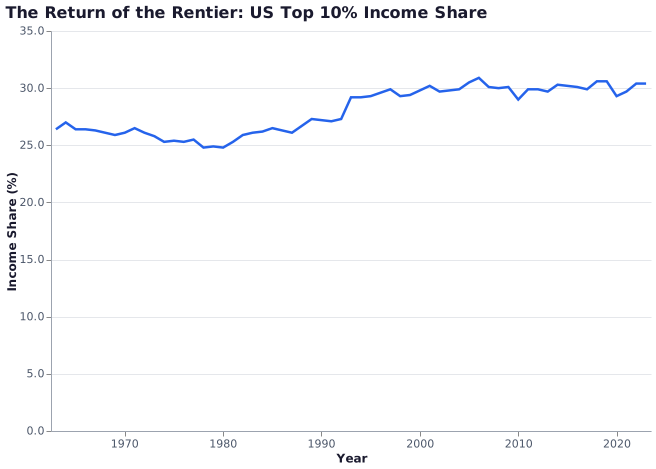
But even this dramatic figure understates the concentration at the very top. The richest one percent of Americans have seen their share of national income more than double since 1980, from around 10 percent to over 20 percent. The richest 0.1 percent—some 330,000 individuals—have seen even greater gains. The richest 0.01 percent—about 33,000 people—command wealth that would have seemed implausible even to the Rothschilds and Vanderbilts of my era. Three individuals—three!—now own more wealth than the bottom half of the American population combined.
Your society has recreated the gilded aristocracy of my era, but with numbers that would have shocked even the most rapacious robber barons. John D. Rockefeller at his peak was worth perhaps $400 billion in your currency. Your richest individuals today have fortunes approaching $200 billion each—and there are more of them. The billionaire class has grown from a handful in my era to over 2,700 worldwide. They own newspapers, television networks, social media platforms. They fund political campaigns, endow universities, shape public discourse. They are not merely wealthy individuals but a class with common interests and the power to pursue them.
This is not merely an American phenomenon. Across the capitalist world, the neoliberal era has reversed the egalitarian gains of the mid-twentieth century. Britain, Germany, and France have all seen inequality increase, though not to American extremes. Even the Scandinavian social democracies—long held up as proof that capitalism could be tamed—have experienced rising inequality since the 1990s. The Nordic model has not been abolished, but it has been eroded. The Swedish Gini coefficient has risen from among the world's lowest to merely below average among developed nations.
The global picture reveals even starker disparities. Your Gini coefficients—a measure of income inequality where 0 represents perfect equality and 100 represents one person having everything—show a world divided into zones of relative equality and zones of extreme concentration. The most unequal societies on Earth are in Latin America and Africa, where colonial extraction established patterns of ownership that persist to this day.
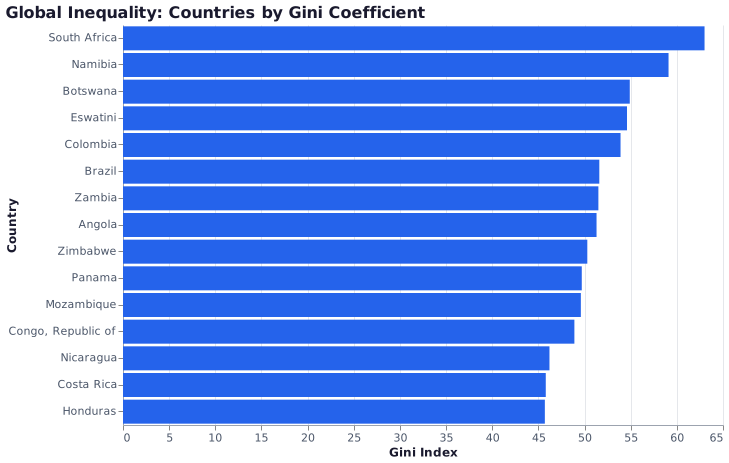
South Africa stands out as the most unequal society in your world, with a Gini coefficient above 60. This is the legacy of apartheid—a system that encoded racial capitalism into law, concentrating land and wealth in white hands while extracting labor from the Black majority. The formal end of apartheid in 1994 did not abolish this structure; it merely removed its legal sanction. The mines still belong to the mining companies. The farms still belong to the descendants of settlers. The Black majority still provides the labor. The means of production remain concentrated, and so inequality persists—indeed, it has worsened since the end of formal apartheid.
Brazil, Colombia, and much of Latin America show similar patterns. The latifundia—the great estates established during colonial rule—still dominate agricultural production. The oligarchies that controlled these economies in the nineteenth century have transformed themselves into modern capitalists, but they remain in control. Landowning families that once grew sugar and coffee now control banks, media conglomerates, and telecommunications networks. The form of their wealth has changed; its concentration has not.
Wealth inequality—the ownership of assets rather than annual income—is even more extreme than income inequality. In the United States, the top one percent owns more wealth than the bottom 90 percent combined. The top 0.1 percent—approximately 330,000 people—holds more than the bottom half of the population. These figures approach the levels of pre-revolutionary France, when the nobility and clergy owned nearly everything and the peasants nothing. The difference is that today's aristocracy is not hereditary by law—but inheritance taxes have been slashed, and the children of billionaires start life with advantages that might as well be hereditary.
I predicted this concentration, but I did not foresee its particular form. In my time, capital meant factories, mines, railroads—physical means of production that required physical presence to operate. You could see the factory owner's wealth in the smokestacks of Manchester, the ships in Liverpool harbor, the railroad tracks stretching across the landscape. Capital was tangible, local, visible.
In your era, capital has become increasingly abstract: financial instruments, intellectual property, platform monopolies. The richest men in your world—and they are almost all men—own not factories but algorithms. They extract surplus value not from the labor of mill workers but from the attention of billions, the data generated by daily life, the network effects that make their platforms indispensable. Amazon's Jeff Bezos owns warehouses and delivery trucks, but his real wealth derives from the platform that makes Amazon the default marketplace for online commerce. Meta's Mark Zuckerberg owns servers and offices, but his real wealth comes from controlling the attention of three billion users.
This transformation does not refute my analysis; it extends it. The fundamental dynamic remains: those who own the means of production extract value from those who must labor to live. The means of production have changed—from physical capital to platform monopolies, from industrial machinery to algorithmic systems—but the relationship has not. The tech billionaire in California and the factory owner in Manchester are engaged in the same essential activity: appropriating the surplus value created by others' labor. The cotton mill extracted value from the physical labor of operatives; the social media platform extracts value from the cognitive labor of users who generate content for free. The form is different; the essence is the same.
IV. The Rise of Finance Capital
In Volume III of Das Kapital, I discussed what I called "fictitious capital"—capital that exists as claims on future value rather than as actual productive assets. Stocks, bonds, and financial instruments represent ownership of expected future profits, not physical means of production. A stock certificate is a piece of paper—it does not produce anything. Its value derives entirely from the expectation that the underlying enterprise will generate profits. I warned that the proliferation of such fictitious capital could destabilize the entire system.
I was building on observations that were already apparent in my time. The joint-stock company had transformed the nature of ownership, separating it from management and making it infinitely divisible. The London Stock Exchange had become a casino where fortunes were made and lost on paper, disconnected from any physical act of production. Railway manias, bank failures, and speculative bubbles occurred with depressing regularity. The Overend, Gurney and Company bank collapse of 1866 triggered a financial panic that closed hundreds of firms; it was caused by reckless lending with no connection to productive investment.
Your data reveals that finance has grown to dominate your economies to a degree I never anticipated. In 1970, the financial sector—banks, insurance companies, investment firms—accounted for about 4 percent of American GDP. Today it exceeds 8 percent. The financial industry captures a larger share of corporate profits than ever before—over 30 percent at its peak, compared to under 20 percent in the 1970s. More dramatically, domestic credit by financial institutions has grown from about 100 percent of GDP in 1960 to over 200 percent today.
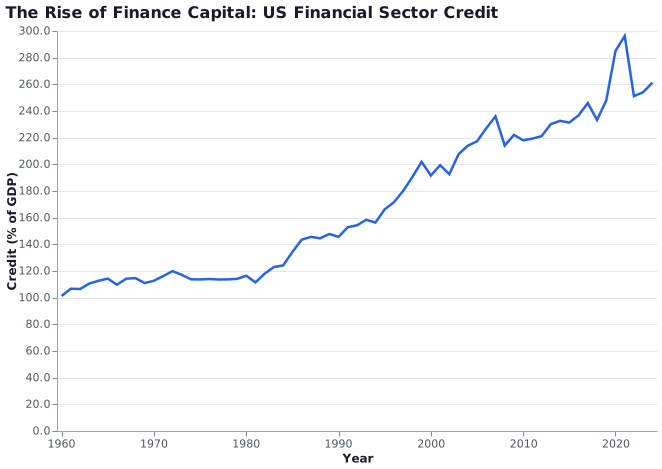
This phenomenon, which your economists call "financialization," represents a fundamental shift in the structure of capitalism. In the classical model I described, the circuit of capital moved from money to commodities to more money: M-C-M'. The capitalist advanced money to purchase means of production and labor-power, combined them to produce commodities, and sold those commodities for a profit. The profit—the surplus value—came from production. Finance was merely the oil that lubricated this engine; it enabled production but did not generate value itself.
In your financialized economy, this circuit has been short-circuited. Capital increasingly seeks to skip the troublesome business of actual production. Why build a factory when you can make more money trading derivatives? Why hire workers when you can profit from arbitrage? Why invest in research and development when you can boost your stock price through share buybacks? The circuit becomes M-M': money making more money without the intermediate step of producing anything useful.
Your corporations now spend more money on share buybacks—repurchasing their own stock to boost its price—than on capital investment. This makes perfect sense from the perspective of executives whose compensation is tied to stock price. It makes no sense from the perspective of society, which needs actual goods and services. The incentive structure of your financial system rewards extraction over production, speculation over investment, short-term gains over long-term development.
This is, I argued, ultimately parasitic. Financial profits must ultimately derive from production somewhere in the system; they are claims on surplus value extracted by others. The hedge fund manager who makes billions trading derivatives is not producing any value; he is extracting a portion of value produced by workers elsewhere in the economy. When financial claims outgrow the productive base, a crisis becomes inevitable. The debts cannot be paid because the surplus value to pay them does not exist.
Your financial crisis of 2008 illustrated this perfectly. The edifice of mortgage-backed securities, collateralized debt obligations, and credit default swaps had grown to represent claims far exceeding the actual value of the houses that supposedly backed them. Banks had created a superstructure of financial claims worth trillions of dollars, based on an underlying asset base of perhaps one trillion in subprime mortgages. When reality reasserted itself—when people could not pay mortgages for homes worth less than they owed—the entire structure collapsed. Trillions of dollars of fictitious capital evaporated overnight. The real economy ground to a halt.
Lehman Brothers collapsed. AIG was rescued at a cost of $182 billion. The entire global banking system teetered on the edge of collapse. Governments around the world were forced to intervene on an unprecedented scale. The U.S. government committed over $700 billion to the Troubled Asset Relief Program; the Federal Reserve created trillions more through quantitative easing. The European Central Bank, the Bank of England, the Bank of Japan—all were forced to take extraordinary measures to prevent complete systemic collapse.
The response to that crisis revealed another dynamic I identified: the socialization of losses while profits remain private. Your governments poured trillions into rescuing the financial system. The banks deemed "too big to fail" were saved; their shareholders and executives kept their gains from the bubble years. The bonuses continued. Not a single major bank executive went to prison for the fraud and recklessness that caused the crisis. The workers who lost their homes and jobs received comparatively little. The crisis was an occasion for massive upward redistribution, hidden behind the language of systemic necessity.
And then, as soon as the crisis passed, the same financiers began lobbying to repeal the regulations imposed in its aftermath. Within a decade, many of the Dodd-Frank restrictions had been weakened or removed. The pattern continues: private gain during the boom, public rescue during the crash, resistance to reform during recovery. The system has not been fixed; it has merely been stabilized long enough for the next crisis to develop.
V. The Transformation of Labor
I based my analysis on the industrial proletariat—workers in factories, mines, and mills who sold their labor-power to capitalists in exchange for wages. These workers, concentrated in large workplaces, developed class consciousness through shared experience. They worked side by side, endured common conditions, faced common bosses. They organized unions, conducted strikes, and built political movements. The factory itself was a school for collective action. I believed they would eventually seize the means of production and establish a society based on collective ownership.
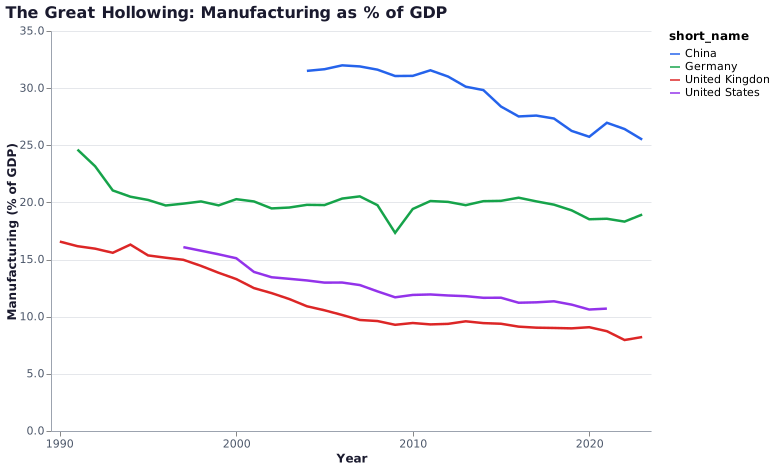
The proletariat I described has largely vanished from the advanced capitalist countries. Manufacturing, which once employed a third of American workers, now employs less than ten percent. In Britain, the figure is below eight percent. In Germany, which retained more of its industrial base than most, it is around eighteen percent. The factories have not disappeared; they have moved. To China, to Vietnam, to Bangladesh, to Mexico—wherever labor is cheapest and regulations weakest. The industrial working class still exists, but it toils now in Shenzhen rather than Sheffield, in Dhaka rather than Detroit.
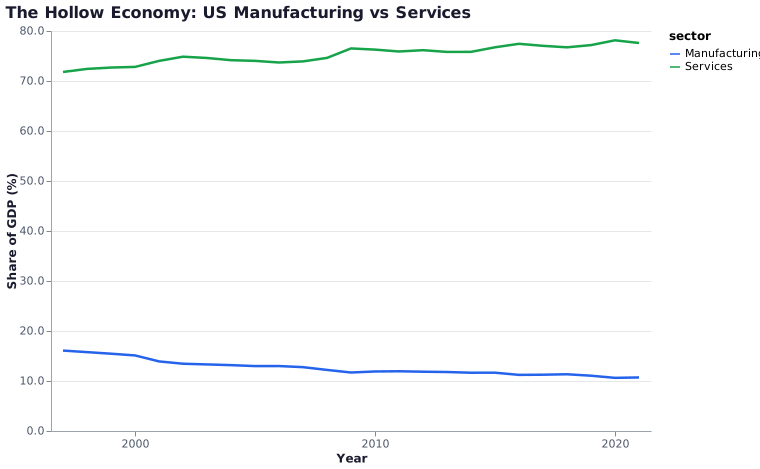
This transformation poses a challenge to the traditional Marxist analysis. The workers in advanced countries are now predominantly in services—retail, healthcare, hospitality, information technology. They work in Starbucks rather than steel mills, in hospitals rather than factories, in call centers rather than coal mines. They are scattered across small workplaces rather than concentrated in large factories. A Walmart store might have 300 employees; a nineteenth-century cotton mill had thousands. Service workers often work alone, interacting with customers rather than fellow workers. The conditions that once made class solidarity natural—shared labor, common grievances, daily interaction—are largely absent.
Union membership has collapsed accordingly. In the 1950s, over a third of American workers belonged to unions. Today the figure is around six percent in the private sector. Similar declines have occurred across the developed world. Without unions, workers have little collective bargaining power. Wages stagnate while productivity rises, and the difference flows to capital. The share of GDP going to labor has declined in virtually every advanced economy since the 1970s.
And yet exploitation continues—perhaps in even more insidious forms. The service worker at Amazon's warehouse is subjected to algorithmic surveillance that would have impressed the most tyrannical factory foreman of my era. Every movement is tracked by handheld scanners. Every second is accounted for. Workers are expected to pick 300 items per hour—one every twelve seconds—under the constant gaze of cameras and software. They wear out their bodies meeting quotas set by machines, then are discarded when they slow down. Injury rates at Amazon warehouses are nearly double the industry average. Workers urinate in bottles because bathroom breaks reduce their pick rates. This is the dark satanic mill of the digital age.
The gig worker driving for Uber or delivering for DoorDash has no job security, no benefits, no collective bargaining power. They are supposedly "independent contractors"—entrepreneurs of the self—but they set neither their prices nor their working conditions. The app determines the fare, the route, the customer rating that can terminate their access to work. They own their vehicles and phones—the means of production, in a limited sense—but they are utterly dependent on platforms controlled by others. They bear all the risks of capitalism while receiving few of its rewards. If they get sick, they earn nothing. If their car breaks down, they pay for repairs. If the algorithm decides their rating is too low, they are deactivated with no appeal.
The reserve army of the unemployed—my term for the permanent pool of jobless workers that keeps wages low—has taken new forms. Official unemployment statistics in your era often look low, but they mask widespread underemployment, discouraged workers who have left the labor force, and the proliferation of precarious work. The gig economy is nothing but a reserve army in disguise: workers available on demand, paid only for the moments they are actively useful, discarded the instant they are not. There are five million "gig workers" in America alone—and tens of millions more in part-time, temporary, and contingent employment that offers none of the security of traditional jobs.
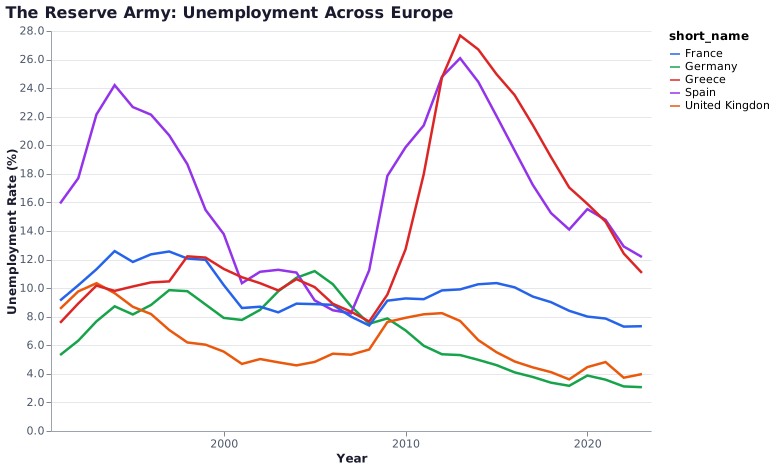
The European experience after 2008 illustrates this dynamic starkly. Greece and Spain, subjected to brutal austerity by their creditors, saw unemployment rise above 25 percent—Great Depression levels maintained for years on end. Youth unemployment exceeded 50 percent in both countries. An entire generation lost years of productive life, denied the opportunity to build careers, form families, or develop their potential. Young Greeks and Spaniards who should have been entering the prime of their working lives instead emigrated by the hundreds of thousands, seeking work in Germany or Britain or anywhere that would have them.
And what was the purpose of this suffering? To ensure that debts to German and French banks were paid. The reserve army was deliberately expanded to discipline labor and reduce wages—to make these countries "competitive" by making their workers desperate enough to accept any wage. This was not an accident or an oversight; it was policy. The "structural reforms" demanded by the Troika—the European Commission, the European Central Bank, and the International Monetary Fund—explicitly aimed to weaken labor protections, reduce the minimum wage, and make it easier to fire workers. The crisis was used as an opportunity to restructure the balance of power between capital and labor.
VI. The Crisis Cycle
I argued that periodic crises are not accidents or aberrations but inherent features of capitalism. They arise from the basic contradiction I identified: the tendency of the rate of profit to fall. Competition forces capitalists to invest in machinery and technology, increasing the productivity of labor. The capitalist who can produce goods more cheaply will drive his competitors out of business. But profit derives from the exploitation of living labor, not from machines. As the ratio of capital to labor increases—as more and more investment goes into machinery relative to wages—the rate of profit tends to decline.
This tendency is not absolute; there are counteracting forces. Capitalists can intensify the exploitation of labor, extending working hours, reducing wages, and speeding up production. They can open new markets, new resources, new pools of labor to exploit. Technical innovation can reduce the cost of constant capital (machinery and materials), offsetting the rise in its proportion. But these are temporary palliatives, not permanent solutions. The underlying tendency reasserts itself.
Capitalists respond by seeking new outlets for accumulation. They seek new markets, new resources, new pools of labor to exploit. They export capital to regions where the rate of profit is higher. They speculate in financial assets when productive investment seems unprofitable. And periodically, the accumulated contradictions explode in crisis: overproduction, falling prices, bankruptcies, unemployment, and destruction of capital values. The crisis clears away the deadwood—the less efficient capitals, the excess inventories, the inflated asset prices—creating conditions for a new round of accumulation.
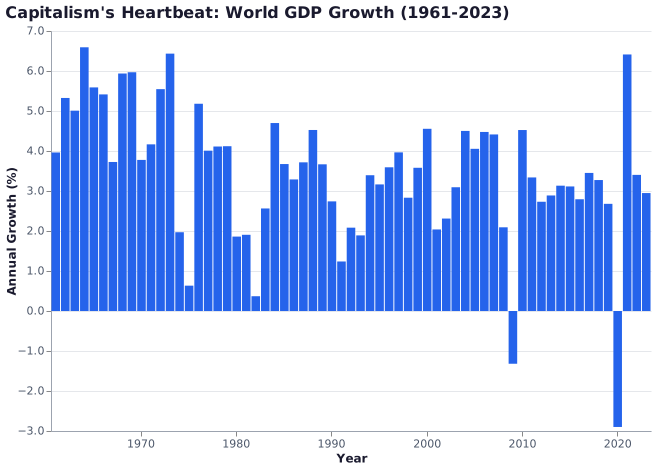
Your data confirms the persistence of this crisis cycle. The global economy has experienced major downturns roughly every decade: the oil shocks of the 1970s, the Latin American debt crises of the 1980s, the Asian financial crisis of 1997-98, the dot-com crash of 2000-01, the global financial crisis of 2008-09, and the pandemic crash of 2020. Each crisis was explained in terms of its specific triggers—oil prices, subprime mortgages, a novel virus—but the pattern suggests systemic causes. If capitalism were inherently stable, such regular convulsions would not occur.
What strikes me most about your era's crises is their intensity and the scale of intervention required to contain them. In 1929, the Great Depression saw American GDP fall by about 30 percent over four years. The response was inadequate—governments initially tried to balance their budgets and maintain the gold standard, exactly the wrong policies. The Depression dragged on for a decade, ending only with the massive government spending of World War II.
Your modern crises have been met with far more aggressive intervention. In 2008-09, global GDP fell by about 2 percent—far less than in 1929-33. But this relative moderation was achieved only through unprecedented state action. The U.S. government committed trillions to bank bailouts and fiscal stimulus. The Federal Reserve expanded its balance sheet from $900 billion to over $4 trillion through "quantitative easing"—purchasing mortgage-backed securities and government bonds to inject money into the financial system. Central banks around the world cut interest rates to zero or below. Governments ran deficits of 10 percent of GDP or more.
In 2020, global GDP fell by over 3 percent in a single quarter—an unprecedented peacetime collapse. The world recovered quickly only through even more massive state intervention: trillions of dollars in fiscal stimulus, central banks purchasing assets on an unimaginable scale, direct payments to citizens to prevent economic collapse. The Federal Reserve's balance sheet expanded to nearly $9 trillion. The U.S. government sent checks directly to households, extended unemployment benefits, provided forgivable loans to businesses. European governments implemented furlough schemes that paid workers' wages while their employers remained closed.
These interventions have prevented your depressions from reaching the depths of the 1930s. But they have not eliminated the contradictions that produce crises; they have merely postponed and displaced them. The debts incurred to fight the pandemic crisis will constrain government action in the next crisis. The asset purchases that inflated stock and housing prices have widened inequality. The zombification of unproductive firms through easy credit has prolonged the malaise even as it prevented the worst. Each intervention is larger than the last; each leaves the system more fragile for the next shock.
Each crisis has also been an opportunity for further concentration of capital. The 2008 crisis saw the largest banks grow even larger, absorbing their failed competitors. JPMorgan Chase acquired Bear Stearns and Washington Mutual. Bank of America swallowed Merrill Lynch and Countrywide. The "too big to fail" banks became bigger still, their market share increasing even as they were bailed out by taxpayers. The 2020 pandemic transferred trillions to the largest corporations while small businesses closed permanently. Amazon, already dominant, grew to control half of American e-commerce. The billionaire class added more wealth in 2020 than in any previous year—over $1 trillion in the United States alone.
VII. The Global Factory
I wrote in the Communist Manifesto that capitalism creates a world after its own image. The bourgeoisie "compels all nations, on pain of extinction, to adopt the bourgeois mode of production; it compels them to introduce what it calls civilisation into their midst, i.e., to become bourgeois themselves." We were witnessing, I argued, the creation of a truly global economy for the first time in human history. The steamship and the telegraph were annihilating distance. British capital was building railroads in India, extracting gold from South Africa, growing tea in Ceylon. The world market was taking shape before our eyes.
This prediction has been fulfilled beyond anything I imagined. The container ship, the jumbo jet, the fiber-optic cable—technologies I could not have conceived—have made possible the integration of production across continents. A product may be designed in California, its components manufactured in a dozen Asian countries, assembled in China, and shipped to consumers worldwide. The iPhone in your pocket contains parts from over 200 suppliers in 43 countries. Capital flows across borders at electronic speed, seeking the highest returns regardless of nationality. A hedge fund in New York can move billions to Singapore in milliseconds.
This globalization has produced what I might call a global industrial reserve army—billions of workers in developing countries available to capital at wages that would be unthinkable in Europe or America. When American workers demanded higher wages or better conditions, capital could credibly threaten to move production to Mexico. When Mexican workers became too expensive, the jobs moved to China. When Chinese wages rose, production shifted to Vietnam, Bangladesh, Ethiopia. This power asymmetry has been the primary force holding down wages in advanced countries even as productivity soared.
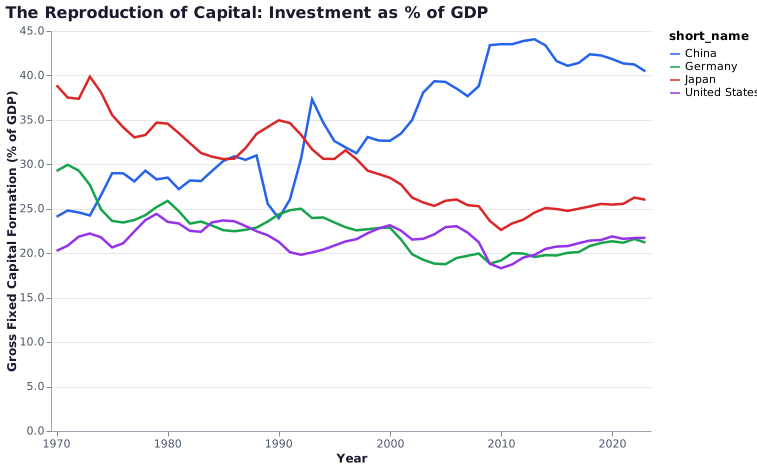
The result has been a massive redistribution of the global working class. In 1980, China's manufacturing sector was negligible—the country was still recovering from the chaos of the Cultural Revolution. Today Chinese manufacturing output exceeds that of the United States, Japan, and Germany combined. The Chinese working class has grown from peasant farmers to industrial workers in a single generation—a transformation that took centuries in Europe compressed into decades. This is the most dramatic proletarianization in human history. Hundreds of millions of people have moved from rural villages to factory cities, from subsistence agriculture to wage labor, from traditional society to industrial modernity.
The Chinese case challenges my predictions in interesting ways. China's development has been overseen by a party that calls itself Communist, using the instruments of a Leninist state to manage a thoroughly capitalist economy. The state owns the commanding heights—the largest banks, the utilities, the key industrial enterprises—but private capital operates freely, and billionaires proliferate. China has more billionaires than any country except the United States. Is this socialism with Chinese characteristics, or capitalism with state control? The theoretical questions matter less than the practical results: hundreds of millions lifted from absolute poverty, but at the cost of brutal working conditions, environmental devastation, and political repression.
What I find most remarkable is that Chinese workers have begun to struggle against their exploitation in ways I would recognize. Strikes have proliferated despite being technically illegal. Workers have organized to demand higher wages, better conditions, safer workplaces. Foxconn, the manufacturer of Apple products, was forced to raise wages and install suicide nets after a wave of worker suicides drew international attention. The Chinese Communist Party has been forced to raise the minimum wage repeatedly and strengthen (at least on paper) labor protections. The contradiction between China's official ideology and its capitalist reality creates pressure that cannot be indefinitely contained.
And the same dynamics are emerging elsewhere. Strikes in Bangladesh's garment factories. Labor organizing in Vietnam's electronics plants. Protests in Ethiopia's industrial parks. Wherever capital goes in search of cheap labor, workers eventually organize. The conditions may differ from nineteenth-century Manchester, but the fundamental conflict between capital and labor reproduces itself. The global factory is also a global school for class consciousness.
VIII. What I Did Not Foresee
Intellectual honesty requires me to acknowledge where my predictions went wrong. I did not merely make minor errors; I made fundamental mistakes about the trajectory of capitalism and the working class. Acknowledging these errors is not a refutation of my analysis but a necessary refinement of it.
First and most important: I expected the revolution to occur in the most advanced capitalist countries—Britain, Germany, France, the United States. These were the countries where industry was most developed, where the proletariat was largest and most organized, where the contradictions of capitalism were most acute. Instead, revolutions claiming my name occurred in backward agricultural societies: Russia in 1917, China in 1949, Cuba in 1959, Vietnam in 1975. These were not the proletarian revolutions I envisioned but peasant uprisings led by vanguard parties, occurring in countries where capitalism was least developed rather than most.
These revolutions did not produce the communist society I envisioned but rather authoritarian states that developed industry through brutal means. Stalin's forced collectivization killed millions; Mao's Great Leap Forward killed tens of millions. These regimes called themselves socialist or communist, but they bore little resemblance to the "free association of producers" I described. The working class did not control the means of production; the party-state did. Workers had no more control over their labor in Soviet factories than in capitalist ones—less, in fact, since they could not even change employers. These were not failures of my theory; they were betrayals of it. But I must account for why revolution took this form rather than the one I predicted.
Second: I expected the working class in advanced countries to grow ever more impoverished and revolutionary. The immiseration thesis—the idea that capitalism would progressively immiserate workers until they had nothing to lose but their chains—was central to my prediction of revolution. Instead, after terrible struggles, workers in advanced countries won reforms that made capitalism bearable: the eight-hour day, workplace safety regulations, old-age pensions, unemployment insurance, universal healthcare, free public education. The welfare state, which I would have dismissed as mere reformism, dramatically improved working-class living standards.
Workers in advanced countries today live better materially than the bourgeoisie of my era. They have indoor plumbing, central heating, refrigerators, automobiles, telephones, televisions, computers. They receive medical care that would have seemed miraculous to the richest capitalists of the nineteenth century. Their children attend school rather than working in factories. Their average lifespan exceeds seventy years, compared to forty in my time. These are not trivial improvements; they represent a fundamental transformation in the material conditions of working-class life.
Third: I underestimated capitalism's adaptability. The system has survived not by rigidly resisting change but by absorbing challenges and emerging transformed. The factory system gave way to the office, the assembly line to the service economy. Financial crises that might have brought the system down were instead managed through state intervention. The state, which I analyzed primarily as an instrument of class rule, also developed the capacity to stabilize capitalism and moderate its excesses. The New Deal, the welfare state, Keynesian demand management—these were not socialist measures, but they saved capitalism from itself.
Fourth: I did not anticipate the ecological dimension of capitalism's crisis. In my time, nature seemed inexhaustible—a source of raw materials and a sink for waste without obvious limits. The forests were vast, the oceans immense, the atmosphere infinite. We knew of local pollution, but global limits seemed impossibly remote. Your era confronts the reality that capitalism's drive for endless accumulation is incompatible with a finite planet. Climate change, biodiversity collapse, resource depletion, ocean acidification—these represent a contradiction more fundamental than any I identified, one that threatens not merely capitalism but civilization itself.
My analysis focused on the exploitation of labor, but I gave insufficient attention to the exploitation of nature. Capital treats both labor and nature as inputs to be used and discarded. Both workers and ecosystems are externalities—their degradation a cost to be imposed on society rather than borne by the capitalist. The coal-burning factory that dumps smoke into the air is not paying for the climate damage; the pesticide manufacturer is not paying for the dead bees. The ecological crisis is thus a manifestation of the same dynamic I described: the drive to accumulate regardless of consequences, the subordination of all values to the logic of profit.
IX. The New Forms of Alienation
In my early writings, before Das Kapital, I developed the concept of alienation—the separation of workers from the products of their labor, from the process of production, from their fellow workers, and ultimately from their own human potential. The factory worker who performs a single repetitive task, who has no control over what is produced or how, who competes with fellow workers for jobs rather than cooperating with them—this worker is alienated in the deepest sense. Their labor, which should be an expression of their humanity, becomes instead a denial of it.
I identified four dimensions of alienation. First, workers are alienated from the products of their labor—the things they make belong to the capitalist, not to them. The weaver does not wear the cloth she weaves; the baker does not eat the bread he bakes; the builder does not live in the houses he constructs. The products of labor confront the worker as alien objects, as commodities to be purchased rather than goods to be enjoyed. Second, workers are alienated from the process of production—they do not control how they work, what they produce, or the pace and conditions of their labor. The capitalist or his foreman dictates every aspect of the work process. Third, workers are alienated from their fellow workers—they are forced to compete for jobs, to see each other as rivals rather than comrades. Fourth, workers are alienated from their "species-being"—from the creative, purposive activity that distinguishes humans from other animals. Labor under capitalism is not self-expression but self-denial.
Alienation has taken new forms in your era. The knowledge worker who spends their days producing reports no one reads, attending meetings that decide nothing, performing tasks whose purpose they cannot discern—this is a new kind of alienation. Your anthropologist David Graeber documented what he called "bullshit jobs"—positions that even those who hold them believe contribute nothing of value. Administrative assistants who have no one to assist. Corporate lawyers who produce documents no one reads. Public relations specialists who manufacture images disconnected from reality. Middle managers who exist only to attend meetings. Compliance officers whose job is to ensure compliance with regulations that serve no productive purpose.
This is alienation raised to absurdity: labor that is experienced as meaningless by the very people performing it. The factory worker at least produced something tangible—cloth, steel, machines. The bullshit jobholder produces nothing at all, and knows it. They spend their days going through motions, checking boxes, shuffling papers, attending meetings—all while sensing that their work could disappear tomorrow and no one would notice. This is not exploitation in the traditional sense; it is the waste of human potential on a colossal scale.
The digital economy has created new frontiers of alienation. The user of social media is both consumer and product, their attention harvested and sold to advertisers, their emotions manipulated by algorithms optimized for engagement. They perform unpaid labor—creating content, providing data, training artificial intelligence systems—while believing themselves to be at leisure. They scroll through feeds curated to maximize their time on the platform, their anger and anxiety exploited for advertising revenue. Their every click is tracked, analyzed, and monetized. Their personal data is extracted and sold to the highest bidder. The distinction between work and life dissolves, but not in the liberatory way I might have hoped: life itself becomes raw material for capital accumulation.
The gig worker experiences a peculiar alienation: they own their means of production—their car, their phone, their time—but are utterly dependent on platforms controlled by others. They have the form of independence without its substance. The Uber driver owns their car but cannot set their fare. The DoorDash deliverer owns their phone but cannot negotiate their commission. Their every action is surveilled by the app, their every rating consequential. They bear all the risks of entrepreneurship—vehicle maintenance, insurance, fuel, self-employment taxes—while enjoying none of its rewards or autonomy. They are, in effect, employees without employment rights, contractors without contracts, workers without the legal protections of workers.
Perhaps most strikingly, your era has seen the rise of what might be called aspirational alienation. Workers are encouraged to identify completely with their employers, to be "passionate" about their work, to see themselves as "team members" rather than employees. Startups tell their workers they are "family" while denying them equity. Corporations demand loyalty while offering none. Workers are expected to find meaning and purpose in their jobs, to perform emotional labor as well as physical labor, to bring their "whole selves" to work. This ideology of work-as-calling obscures the fundamental relationship of exploitation. The worker who loves their job still produces surplus value for their employer; their love merely makes the extraction more efficient.
X. The State and Capital
I wrote that the state is the executive committee of the bourgeoisie—an instrument for managing the common affairs of the capitalist class as a whole. This formulation has sometimes been misunderstood as suggesting that the state simply does whatever capitalists want. That was not my meaning. The state mediates conflicts within the capitalist class, balancing the interests of different fractions of capital against each other. It maintains the general conditions for accumulation—enforcing contracts, providing infrastructure, educating workers, maintaining order. It may act against the immediate interests of particular capitalists while serving the long-term interests of capital as a class.
Your era provides abundant evidence for this characterization. Consider who benefits from state action, who shapes state policy, who revolves between public office and private profit. The personnel of the state and the personnel of capital overlap extensively. Treasury secretaries come from and return to Goldman Sachs. Regulators move to the industries they regulate. Politicians depend on corporate campaign contributions. Lobbyists write legislation. Think tanks funded by billionaires shape the terms of public debate. The state is not a neutral arbiter but a contested terrain where capitalist interests are represented far more effectively than those of workers.
The financial crisis of 2008 revealed the intimate relationship between state and capital with unusual clarity. The banks that caused the crisis were rescued while ordinary citizens lost their homes. The Federal Reserve, supposedly an independent institution, acted transparently in the interests of finance capital, lending trillions at near-zero interest to the same institutions that had created the crisis. The executives who presided over catastrophe faced no criminal consequences; many kept their bonuses. The state did not restrain capital; it served it.
Yet the relationship is more complex than my analysis sometimes suggested. The state does not simply do capital's bidding; it mediates conflicts within the capitalist class and maintains the conditions for accumulation as a whole. Sometimes this requires acting against the immediate interests of particular capitalists. Antitrust enforcement breaks up monopolies that threaten competition. Environmental regulation prevents individual firms from destroying the commons on which all depend. Labor law provides a minimum of worker protection that prevents the most destructive race to the bottom.
The welfare state presents a particular puzzle. The reforms I dismissed as insufficient have genuinely improved working-class lives. Universal healthcare, free education, unemployment benefits, old-age pensions—these reduce the absolute power of capital over workers. They provide alternatives to selling labor-power on whatever terms employers offer. A worker who knows they will receive unemployment benefits if they lose their job is less desperate than one who faces starvation. A worker with access to public healthcare is less dependent on employer-provided insurance. In this sense, welfare-state provisions are achievements of working-class struggle, not concessions graciously granted by capital.
And yet the welfare state has not transcended capitalism; it has stabilized it. By providing a safety net, it reduces the revolutionary potential of the working class. By socializing some of the costs of reproducing labor-power—education, healthcare, pensions—it reduces the wage bill for individual capitalists. By maintaining aggregate demand during downturns through unemployment benefits and other automatic stabilizers, it prevents crises from spiraling into system-threatening collapses. The welfare state represents a reformed capitalism, not a supersession of it.
The neoliberal era has seen systematic attacks on the welfare state—not its abolition, but its transformation. Social insurance has become conditional, punitive, degrading. The unemployed are subjected to constant surveillance and humiliating requirements—attend job-search seminars, prove they are looking for work, submit to sanctions for minor infractions. Public services have been privatized, their provision subordinated to profit. Prisons are run for shareholder value. Healthcare is managed by insurance companies whose business model is to deny claims. The safety net has been reengineered to push workers into whatever jobs are available, at whatever wages are offered. This is the reserve army disciplined by the state itself.
XI. Why the Revolution Did Not Come
The revolutionary moment I anticipated has not arrived in the advanced capitalist countries. There have been upheavals—1968 in France, the movements against austerity after 2008, Occupy Wall Street, the Yellow Vests in France, the Black Lives Matter protests across America—but none has threatened the fundamental structure of power. The working class has not become, as I predicted, a unified force capable of seizing the means of production. Why?
Part of the answer lies in capitalism's adaptability, which I have already acknowledged. The system has proven capable of conceding reforms sufficient to defuse revolutionary pressure while preserving its essential structures. The New Deal saved American capitalism from the threat of the 1930s. The welfare states of Europe absorbed the energies of socialist movements. When workers won the eight-hour day, the weekend, paid vacations, they acquired stakes in the system. They had something to lose.
Part of the answer lies in the fragmentation of the working class itself. The industrial proletariat I described, concentrated in large workplaces, has given way to a dispersed service workforce. The factory brought workers together physically; the service economy scatters them. Gig workers have no common workplace to organize. Remote workers never meet their colleagues. Immigrant workers compete with native workers and face the additional barriers of xenophobia and precarious legal status. The unemployed are isolated, ashamed, and desperate. The conditions that made solidarity possible in the factory—daily contact, shared grievances, common experience—do not exist in the same form today.
Part of the answer lies in the ideological apparatus of capitalism, which has developed in ways I did not anticipate. Mass media, from newspapers through television to social platforms, have shaped consciousness to an unprecedented degree. The worker who identifies with billionaires, who dreams of becoming rich rather than of collective liberation, who blames immigrants or bureaucrats for problems caused by capital—this worker is not ready for revolution. Your television celebrates wealth and mocks solidarity. Your social media amplifies grievance while fragmenting movements. The ideology of individual achievement is so pervasive that collective action seems almost inconceivable.
Part of the answer lies in the very success of past struggles. Workers in advanced countries have something to lose—pensions, healthcare, mortgaged homes, consumer goods. The transition to socialism appears risky, its outcome uncertain. Better, many conclude, to accept capitalism's distribution while trying to improve one's individual position within it. This is rational from the individual perspective, even as it is self-defeating collectively. The prisoner's dilemma operates at the level of class.
And part of the answer lies in the failures of actually existing socialism. The Soviet Union did not create a society of free producers but a new form of exploitation and oppression. Workers in Eastern Europe fled westward when they had the chance; they voted with their feet against what called itself communism. The Chinese Communist Party has produced billionaires and sweatshops. The Cuban Revolution improved healthcare and education but repressed dissent. Venezuela's socialist experiment ended in economic collapse and emigration. These examples—whatever one thinks of their causes—have discredited the idea of socialism for many workers who might otherwise be receptive.
And yet I do not believe the story ends here. The contradictions I identified have not been resolved; they have been managed, postponed, displaced. Each crisis is more severe than the last, each intervention more extreme. The interventions required to stabilize the system grow more desperate. The ecological limits of endless accumulation become more apparent. A system that requires constant growth on a finite planet is approaching its ultimate contradiction. The old mole may yet emerge.
XII. What the Data Predicts
I am not a prophet, and history does not proceed according to plan. The future is made by human beings acting in circumstances not of their choosing; it is not predetermined by economic laws. But certain tendencies are visible in your data, and extrapolating them suggests the following possible trajectories.
The concentration of capital will continue. The largest corporations will grow larger still, absorbing competitors, capturing regulators, shaping politics. The billionaire class will expand its share of wealth while the middle class erodes. This is not a temporary deviation from capitalism's nature; it is capitalism's nature expressing itself. The forces I identified—competition, accumulation, concentration—have not been neutralized. They operate now on a global scale, producing inequalities that would have seemed impossible in my era.
Financial instability will intensify. Your data shows a pattern: each crisis requires more dramatic intervention than the last. The savings and loan crisis of the 1980s required billions; the 2008 crisis required trillions; the 2020 crisis required tens of trillions. Central banks have exhausted conventional monetary policy; interest rates have been at or near zero for most of the past fifteen years. At some point, the tools will be insufficient. Currencies may be destabilized. The fiction of money—the social agreement that certain pieces of paper or digital entries have value—will be exposed as the fiction it always was. What happens then, no one can predict.
The climate crisis will accelerate. Your data shows temperatures rising, ice caps melting, extreme weather events increasing. Capitalism cannot solve a problem that requires limiting growth; growth is its very definition. The entire system is premised on endless expansion—more production, more consumption, more accumulation. To address climate change seriously would require constraints on capital that capital will resist. The conflicts over resources, migration, and habitable territory will intensify. These conflicts will be managed through authoritarian means—surveillance, border walls, camps, police violence. The choice between socialism and barbarism, which Rosa Luxemburg posed over a century ago, will become ever more starkly apparent.
The working class—globally, not just in the advanced countries—will continue to struggle. Strikes in China despite official repression. Protests in Chile against neoliberal pension systems. Uprisings in Iran against theocratic capitalism. Labor organizing in Amazon warehouses. Teacher strikes across America. These are not isolated events but manifestations of the same underlying dynamic. The contradiction between the productive forces and the relations of production has not been transcended; it has been globalized. Wherever capital exploits labor, resistance emerges.
Whether these struggles coalesce into a force capable of transforming society, I cannot say. That depends on choices yet to be made, organizations yet to be built, circumstances yet to unfold. But I am confident of this: capitalism will not last forever. No system does. Slavery was abolished—after millennia of seeming permanence, it ended in a few generations. Feudalism was overcome—the lords and peasants gave way to bourgeois and proletarians. Capitalism, too, will pass into history. The only question is what will replace it, and whether the transition will be managed humanely or will collapse into chaos and barbarism.
XIII. A Note to My Critics
I am aware that my name has been used to justify horrors I would have condemned. Stalin's gulags, Mao's famines, Pol Pot's killing fields—all have been defended in my name. I repudiate these crimes absolutely. They were not the inevitable result of my ideas but betrayals of them.
I wrote of the "free association of producers"—a society in which the means of production are held in common and managed democratically. The totalitarian states that called themselves communist concentrated power in the hands of party elites, suppressed dissent, and exploited workers as ruthlessly as any capitalist. They were not socialism but state capitalism—the extraction of surplus value by the state rather than by private owners. The party-state became the new exploiting class. Workers had no more control over production than under private capitalism; they merely traded one set of masters for another.
I am also aware of the many ways my analysis was limited by my time and circumstances. I was a European man of the nineteenth century, and my blind spots reflect that position. My treatment of non-European societies was often condescending and dismissive. My analysis of colonialism, while recognizing its exploitation, sometimes fell into apologetics for its "civilizing" role. My discussion of gender was limited; I did not adequately analyze the exploitation of women's unpaid domestic labor. I had little to say about race as a system of domination distinct from class. Those who have developed my analysis in these directions—from W.E.B. Du Bois to Angela Davis, from Cedric Robinson to Silvia Federici—have improved it.
I was wrong about many things. I was wrong about the trajectory of revolution. I was wrong about the immiseration of the working class in absolute terms. I was wrong about how quickly capitalism would face its final crisis. These are not small errors.
But I was right about the fundamental nature of capitalism: a system driven by the accumulation of surplus value, prone to crises, generating inequality as a feature rather than a bug. The data you have shown me confirms this analysis with a precision I could not have imagined. The tendencies I identified in their early stages have developed to their logical extremes. Concentration continues. Crises recur. Exploitation persists in new forms. The fundamental contradictions remain unresolved.
XIV. A Final Word
I began my major work with a commodity—the simplest element of capitalist wealth, a thing that appears trivial and obvious but reveals upon analysis to be a complex social relationship. From that starting point, I developed an analysis of the entire system: production, circulation, distribution, crisis. I showed how the exchange of equivalents in the market generated exploitation in production. I demonstrated how competition among capitals led to concentration and centralization. I explained how the drive for profit produced both technological development and periodic collapse.
Your data has added precision to my analysis without overturning its fundamental structure. The numbers have grown larger, the circuits more complex, the geography more global—but the dynamics are the same. Capital still seeks to valorize itself, to squeeze ever more surplus value from human labor and from nature. Workers still must sell their labor-power to survive, having no other means of obtaining what they need. Crises still periodically destroy the accumulated wealth of society and the lives of those who produced it. The concentration of capital still proceeds apace, creating billionaires at one pole and precarious workers at the other.
I wrote in the preface to Capital that my aim was to reveal "the economic law of motion of modern society." That law still operates. The forces I described are still at work. The destination they point toward—the transcendence of capitalism by a more humane form of social organization—remains to be achieved. Whether that destination will be reached, and by what route, depends on human action—on the struggles of workers, on the wisdom of leaders, on the accidents of history.
The old mole is still burrowing. When and where it will emerge, I cannot say. But emerge it will. No system of exploitation lasts forever. Slavery was abolished after millennia. Feudalism gave way after centuries. Capitalism, too, will pass into history. The only question is whether what follows will be better or worse—whether the transition will be managed by the associated producers in their own interest, or will collapse into barbarism and authoritarianism.
That question, I leave to you. I have provided the analysis. The action is yours.
"Philosophers have only interpreted the world, in various ways; the point is to change it."
— Theses on Feuerbach, 1845