A New Book on Marxism for Our Time
Deep Dives
Explore related topics with these Wikipedia articles, rewritten for enjoyable reading:
-
Young Hegelians
14 min read
The article extensively discusses Marx's break from 'left-Hegelian thought' and his relationship to Feuerbach. Understanding the Young Hegelians movement provides essential context for Marx's intellectual development and the 'epistemological break' Althusser describes.
-
The German Ideology
11 min read
Directly referenced as a pivotal 1845 text marking Marx's rupture with humanism and Feuerbach. This work is central to the article's discussion of the humanist vs. science debate in Marxism.
-
Rheinische Zeitung
1 min read
The article discusses Marx's role as editor of this newspaper and how state censorship radicalized him. Understanding this publication's history illuminates Marx's early political development and his critique of liberal institutions.
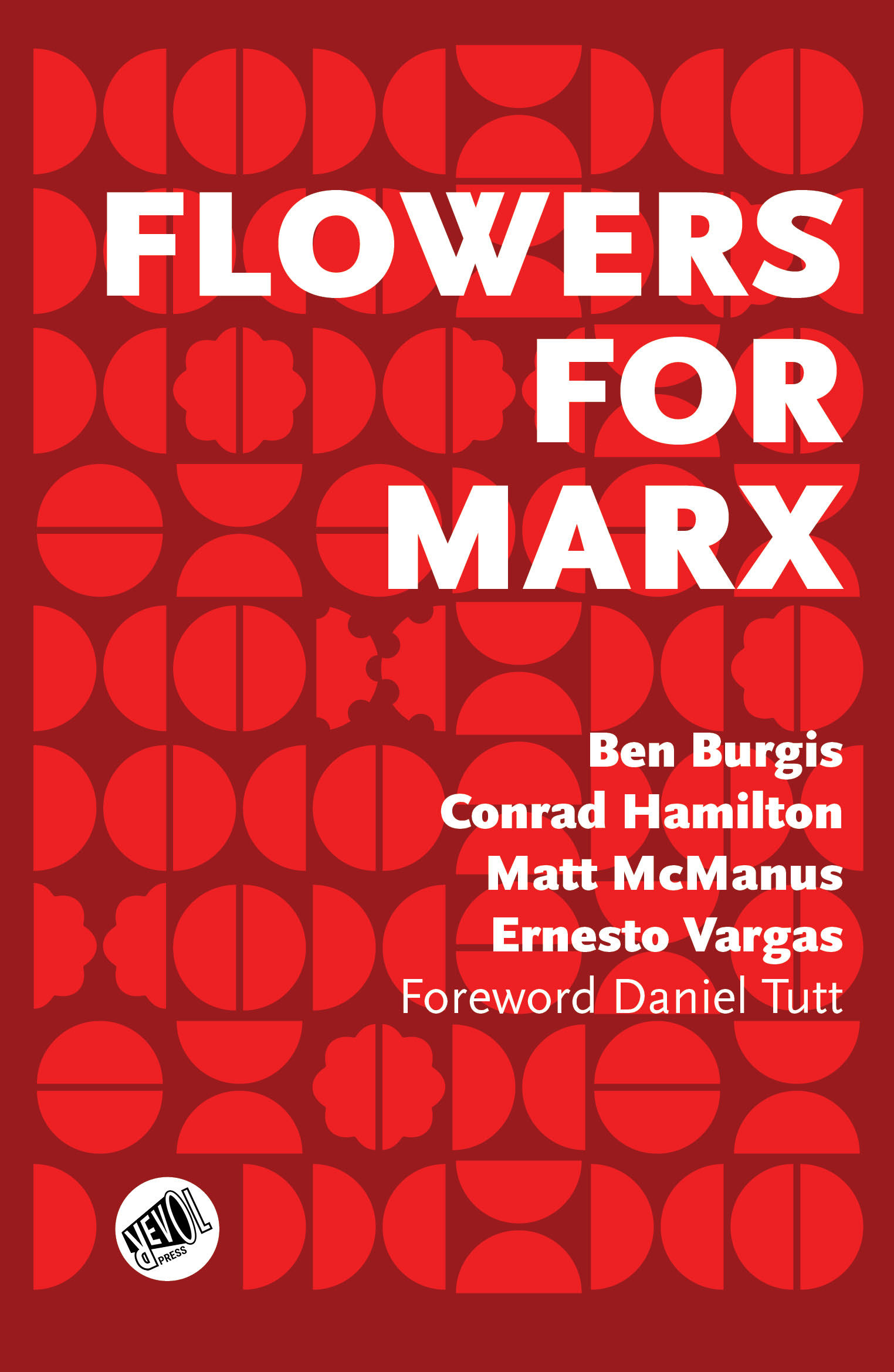
Since the collapse of Sanders and Corbyn, the Western left has been thrown into a state of uncertainty. Should it continue to pursue a democratic socialist agenda, attempting to transform liberal capitalism from within? Or should it break with this, calling for revolt against a capitalist class unbowed by the movements of the past decade? In the new book Flowers for Marx four authors address this question by returning to Marx—or rather, by asking which Marx we should return to. Is Marx an inveterate democrat, whose work privileges the dignity of man above all? Or is he—as Louis Althusser once argued—the founder of a new science, incompatible with the shibboleths of liberal-capitalist society?
The book is edited by my comrade and colleague Conrad Hamilton, co-host of the new show on my Emancipations podcast called “The Archimedean Point” and he establishes an interesting polemic with Matt McManus on democratic socialism throughout the book, looking at Althusser and the humanism debate. Conrad has co-lead two study seminars with me on Althusser’s For Marx and Jameson’s The Political Unconscious. Ben Burgis weighs in with a strong defense of the historical materialism of analytic Marxist thinker G.A. Cohen, and MattMcManus defends liberal socialism and Rawls as an essential figure for socialism. Ernesto Vargas brings an international dimension to the book with an essay on Mexico and the class composition of the bourgeoisie and dynamics involved with development.
In my Foreword to Flowers for Marx I revisit the debates over humanism in the young Marx, looking specifically at the debates Marx had with liberals in his time and how the censorship complex of the state radicalized Marx towards very particular views on free speech and liberalism more generally. I then look at how censorship works on the left in today’s time given that the book Flowers for Marx was itself censored by a prior publisher.
In his seminar “The Other Side of Psychoanalysis” delivered in the wake of the May 1968 uprising in France, Jacques Lacan remarked that Hegel’s theory of history reveals that the position of mastery becomes the “cuckold of history.” This is an insight that Nietzsche had already intimated in his warning: “Whoever fights monsters
...This excerpt is provided for preview purposes. Full article content is available on the original publication.