A Conversation with Alenka Zupančič
I should begin by apologising for my absence. I had to take some urgent time off for reasons that will likely be very boring to you all. I nevertheless hope that today’s long-awaited post makes up for it.
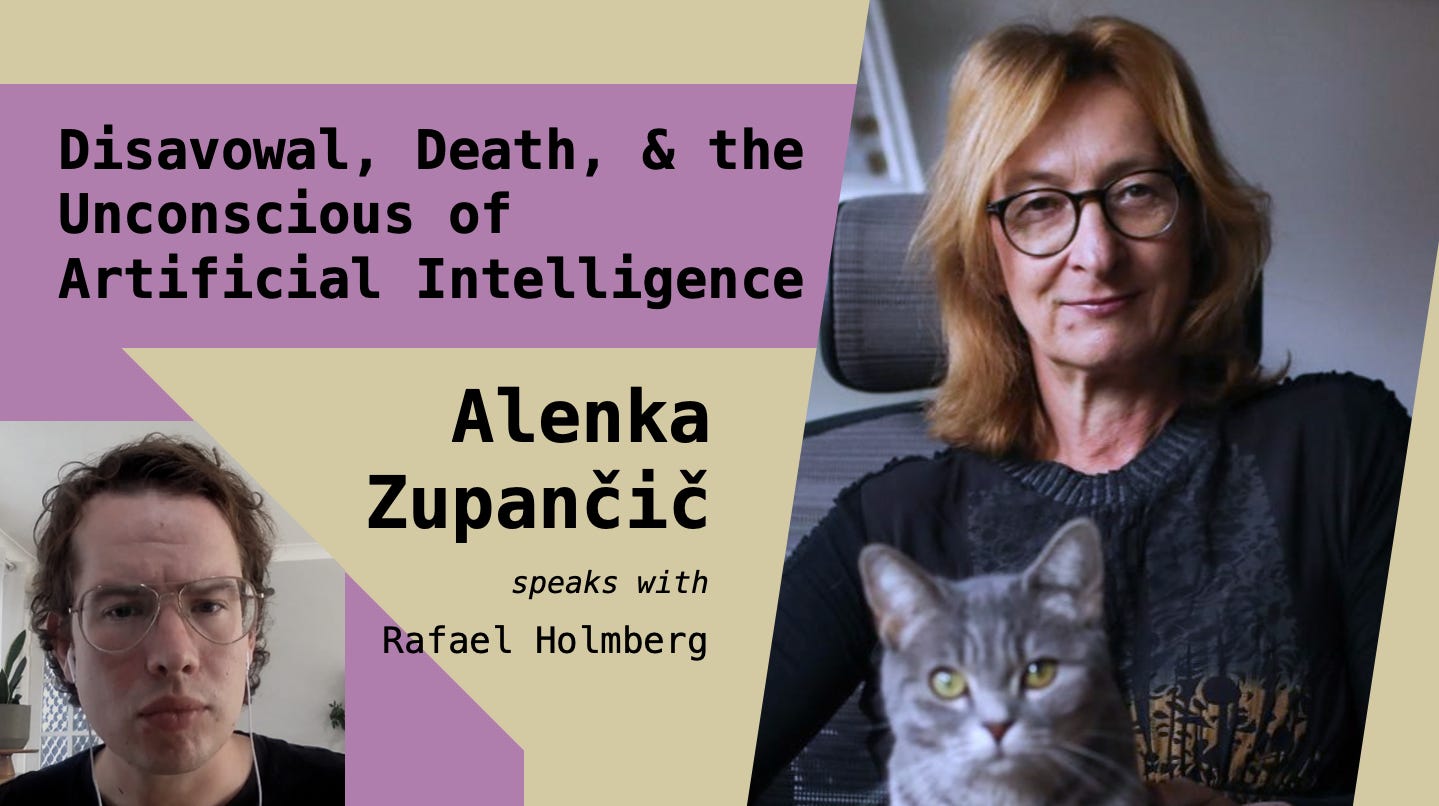
Last week, I was amazed to have the chance to speak with the philosopher Alenka Zupančič. For any of my readers, and for anyone somewhat familiar with psychoanalytic theory and contemporary continental philosophy, Zupančič does not need an introduction. She is one of the three central figures of the pioneering work of the Ljubljana School (alongside Slavoj Žižek and Mladen Dolar) and has published fantastic books and articles on politics, film, literature, Lacan, Nietzsche, Kant, Marx, and much more.
I asked Zupančič about topics including the political implications of the death drive, the limits of her use of ‘disavowal’ (Verleugnung), fetishised representations of the end of the world, and the subjectivity or ‘unconscious’ of artificial intelligence. Watch the full recording here:
Below are just a few samples of what was talked about.
Disavowal or Death Drive?
I began by suggesting that there might be an opposition between disavowal (I know very well but nevertheless…) and the death drive. The formula for psychoanalytic disavowal, which was rigorously explored in Zupančič’s latest book, is that the very act of knowing something permits us to invert this knowledge, to behave as if it were not true. This formula, I argue, allows us to extract a type of inverted enjoyment out of what is otherwise an impasse in our political situation. Where the death drive is concerned, however, it is precisely this ‘enjoyment’ which becomes problematised. The death drive is a point where repetition persists through an abandonment of enjoyment: for example where we remain in a terrifying fantasy far more brutal than reality itself, or where apocalyptic ‘visions of the end’ are continuously rendered more violent than any realistic scientific scenario. The death drive is where enjoyment rejects itself, where we act so that we may no longer enjoy. This, I suggest, opposes disavowal, which deploys a paradoxical logic in order to continue enjoying. Zupančič’s response was, as expected, very good, showing the conjunction between disavowal and the death drive.
AI, Unconscious, Disavowal
Zupančič asks a very interesting question regarding artificial intelligence and large language models: the crucial subjective dimension of language is not what is said, but what is
...This excerpt is provided for preview purposes. Full article content is available on the original publication.