Blue States, High Rates
Deep Dives
Explore related topics with these Wikipedia articles, rewritten for enjoyable reading:
-
Renewable portfolio standard
9 min read
The article repeatedly references RPS mandates as a key driver of electricity price differences between states. This Wikipedia article explains how these standards work, their history, and implementation across different jurisdictions.
-
Indian Point Energy Center
14 min read
The article mentions the 'premature closure of the Indian Point nuclear power plant' as contributing to New York's high electricity prices. This specific facility's controversial shutdown in 2021 illustrates the tension between environmental concerns and grid reliability.
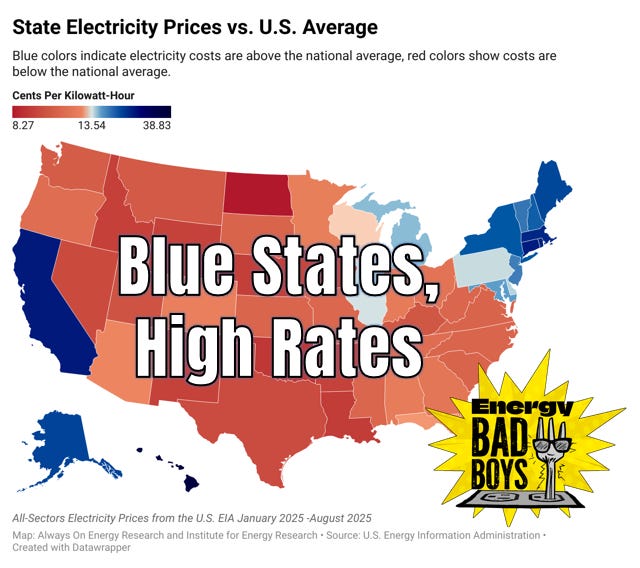
As we noted in our piece “States with Clean Energy Mandates Have Higher Rate Increases,” electricity prices stem from a variety of factors, including resource mix and public policies.
For instance, the bluest states in the country—based on the percentage of votes going to Democrats in the last two presidential elections—have much higher rates than red states. While only one red state (Alaska) has average electricity prices above 15 cents per kWh, more than half of all blue states exceed the same figure.
In fact, twelve out of the top fifteen states with the highest electricity prices in the country are blue states, and only one is red. The exact opposite is true for the lowest fifteen electricity rates—twelve are red states, and two are blue.
To address this trend, we released a report this week entitled Blue States, High Rates that Always On Energy Research coauthored with the Institute for Energy Research. You can access the entire report here, or read it below.
Introduction
Energy affordability has become a top concern for American families and businesses. A recent poll conducted by Ipsos found that 73% of U.S. residents were concerned about their electricity and gas bills rising this year, and 80% of Americans admitted they feel powerless over how much they are charged for these utilities.
These affordability concerns are well-founded. Federal data show U.S. electricity prices increased by 27% from January 2021 through January 2025 and by an additional 11% from January through September 2025, placing additional strain on Americans’ finances.
Electricity prices are especially high in traditionally liberal areas of the country. In total, 86% of states with electricity prices above the national average in the continental U.S. are reliably blue, having voted for the Democratic nominee for president in the 2020 and 2024 elections. In contrast, 80% of the ten states with the lowest electricity prices are reliably red, defined as having voted for the Republican candidate in these contests.
This report explains how state-level energy policies primarily shape electricity and highlights five states (California, Florida, Louisiana, Kentucky, and New York) to illustrate how these policies affect affordability.
Expensive Electricity is a Choice: How States Shape Electricity Policy
The data is clear: bluer states tend to have much higher electricity prices than red states.
More than almost any other product, electricity prices are a direct result of state energy policies because states have
...This excerpt is provided for preview purposes. Full article content is available on the original publication.