How Cursor Shipped its Coding Agent to Production
New report: 96% of devs don’t fully trust AI code (Sponsored)

AI is accelerating code generation, but it’s creating a bottleneck in the verification phase. Based on a survey of 1,100+ developers, Sonar’s newest State of Code report analyzes the impact of generative AI on software engineering workflows and how developers are adapting to address it.
Survey findings include:
96% of developers don’t fully trust that AI-generated code is functionally correct yet only 48% always check it before committing
61% agree that AI often produces code that looks correct but isn’t reliable
24% of a developer’s work week is spent on toil work
On October 29, 2025, Cursor shipped Cursor 2.0 and introduced Composer, its first agentic coding model. Cursor claims Composer is 4x faster than similarly intelligent models, with most turns completing in under 30 seconds. For more clarity and detail, we worked with Lee Robinson at Cursor on this article.
Shipping a reliable coding agent requires a lot of systems engineering. Cursor’s engineering team has shared technical details and challenges from building Composer and shipping their coding agent into production. This article breaks down those engineering challenges and how they solved them.
What is a Coding Agent?
To understand coding agents, we first need to look at how AI coding has evolved.
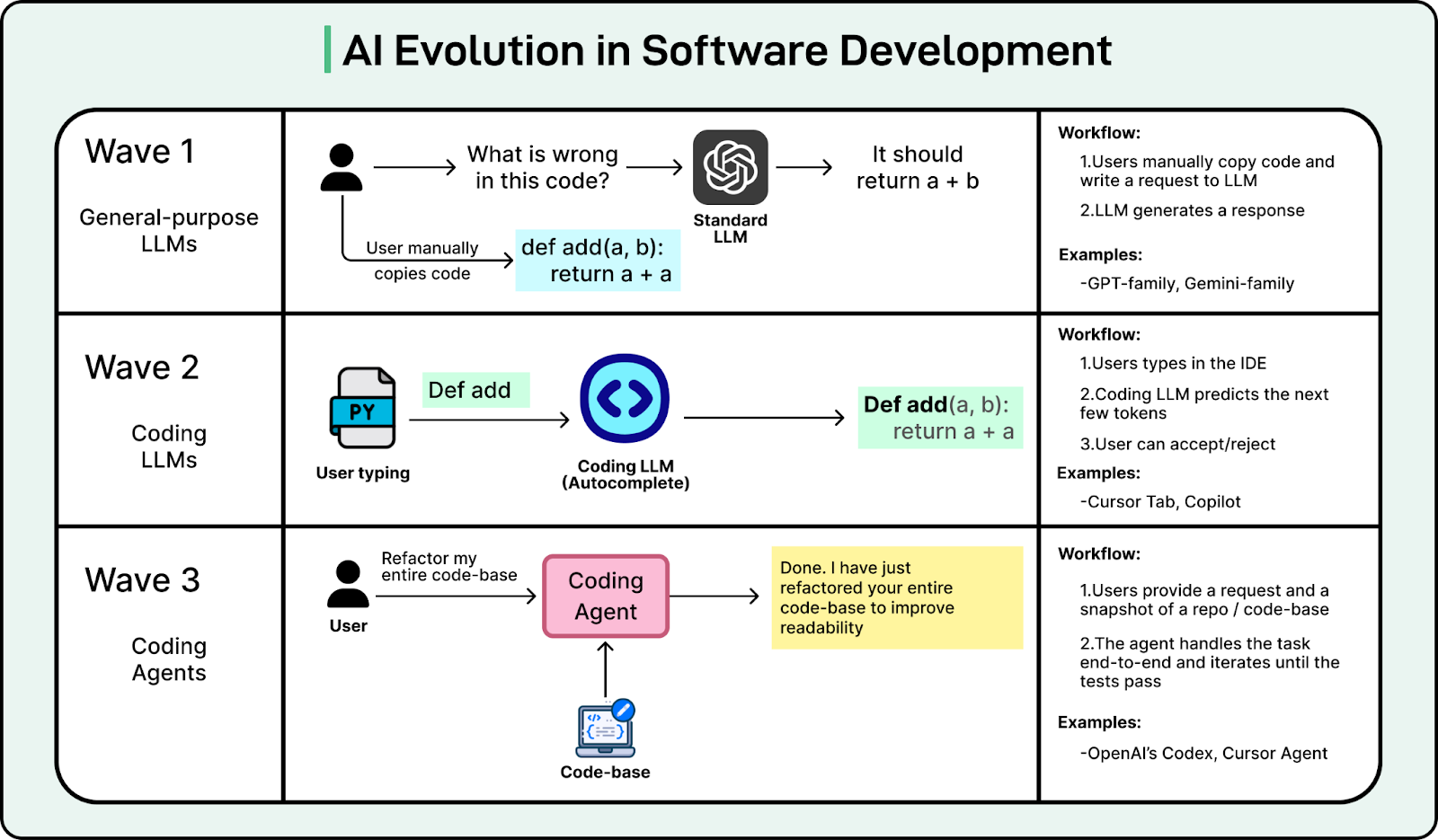
AI in software development has evolved in three waves. First, we treated general-purpose LLMs like a coding partner. You copied code, pasted it into ChatGPT, asked for a fix, and manually applied the changes. It was helpful, but disconnected.
In the second wave, tools like Copilot and Cursor Tab brought AI directly into the editor. To power these tools, specialized models were developed for fast, inline autocomplete. They helped developers type faster, but they were limited to the specific file being edited.
More recently, the focus has shifted to coding agents that handle tasks end-to-end. They don’t just suggest code; they handle coding requests end-to-end. They can search your repo, edit multiple files, run terminal commands, and iterate on errors until the build and tests pass. We are currently living through this third wave.
A coding agent is not a single model. It is a system built around a model with tool access, an iterative execution loop, and mechanisms to retrieve relevant code. The model, often referred to as an agentic coding model, is a specialized LLM trained to reason over codebases, use tools,
...This excerpt is provided for preview purposes. Full article content is available on the original publication.