The art of industrial leapfrogging
Deep Dives
Explore related topics with these Wikipedia articles, rewritten for enjoyable reading:
-
Deferent and epicycle
13 min read
Linked in the article (18 min read)
-
Learning curve
13 min read
Linked in the article (17 min read)
-
American system of manufacturing
15 min read
The article discusses interchangeable parts as a major manufacturing paradigm shift, mentioning guns and sewing machines. The American system of manufacturing is the historical system that pioneered interchangeable parts in the 19th century US, providing rich context on how this paradigm emerged and transformed industry.
This essay is an extended version of the talk I gave at Progress Conference 2025. I will add a link to the recording as soon as it’s published.
Note: if you already agree with all the arguments and want to skip to the description of the new paradigm, jump to the section Building a new system.
Manufacturing is like a sewer. We all know it’s important, but we don’t really want to think about it until something goes wrong.
Well, something is going wrong.
If you’re reading this, it means you’re not living under a rock (or at least that your rock-covered home has internet) and therefore you’ve heard some noise about manufacturing. “Reindustrialization”, “onshoring”, “advanced manufacturing”, and other terms are everywhere. Considering that materials and manufacturing underpin civilization, it’s great that such an important and often ignored area is getting the air time it deserves!
But the way that most people are thinking about manufacturing — particularly how to manufacture more things in the US, why that is important, and more generally how centers of manufacturing gravity shift — is incomplete or just plain wrong.
I’m going to unpack a different way to think about manufacturing and how it changes over time: the idea of a manufacturing paradigm.
We’ll dig into the history of manufacturing paradigms, how they shift centers of manufacturing, and explore the fuzzy contours of the new paradigm we might be able to create. Creating this new paradigm is important not just for those of you focused on the US; it’s critical for unlocking human progress both on earth and across the stars.
Manufacturing matters
First, I want to establish some table stakes: Techno-industrial civilization is downstream of manufacturing technology. Regardless of what kind of progress you want to see in the world, you should care about manufacturing.
Do you want to fight disease, improve health, and extend lifespans? You need manufacturing advances. A manufacturing innovation turned penicillin into the life-saving juggernaut that has saved hundreds of millions of lives and arguably helped win WWII: before researchers figured out how to grow huge batches of penicillium rubens in a bioreactor it was a miraculous scientific breakthrough with a worldwide supply of a few hand-made doses. Today, many drugs and medical devices are secretly bottlenecked by their manufacturability.
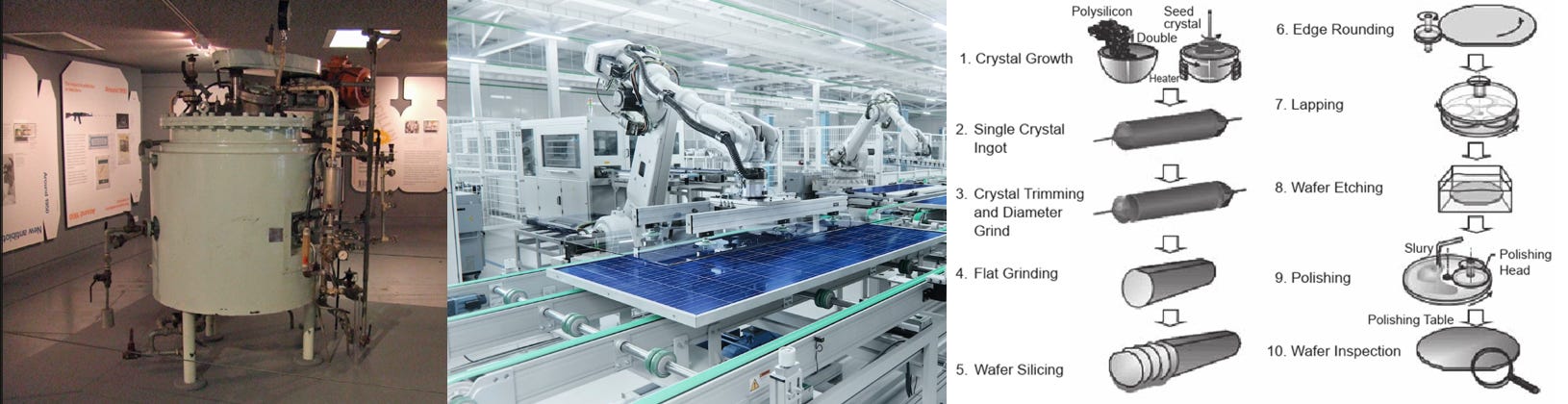
Do you want to prevent climate change, save the environment, and make energy too
...This excerpt is provided for preview purposes. Full article content is available on the original publication.