TODAY WE NEED PHILOSOPHY TO SURVIVE AS HUMANS
Deep Dives
Explore related topics with these Wikipedia articles, rewritten for enjoyable reading:
-
Alain Badiou
16 min read
The article directly references Badiou's 'True Life' and his claim about philosophy corrupting the youth. Understanding Badiou's broader philosophical project—his ontology based on set theory, his theory of the Event, and his radical leftist politics—would deeply enrich the reader's understanding of the argument being made.
-
Socratic method
13 min read
The article centers on the 'Socratic revolution' and the technique of endless questioning ('What, exactly, do you mean by...?'). A deeper understanding of the elenctic method, its historical context in Athens, and its role in Western philosophy would provide essential background for the article's core argument about thinking.
-
Air India Flight 171
14 min read
The article uses this specific aviation disaster as its central illustrative example of the limits of digital systems versus human thinking. Understanding the full technical investigation and the fly-by-wire system failures would illuminate the philosophical point about machine cognition versus human judgment.
Welcome to the desert of the real!
If you desire the comfort of neat conclusions, you are lost in this space. Here, we indulge in the unsettling, the excessive, the paradoxes that define our existence.
So, if you have the means and value writing that both enriches and disturbs, please consider becoming a paid subscriber.
Below, a text containing some old and new material
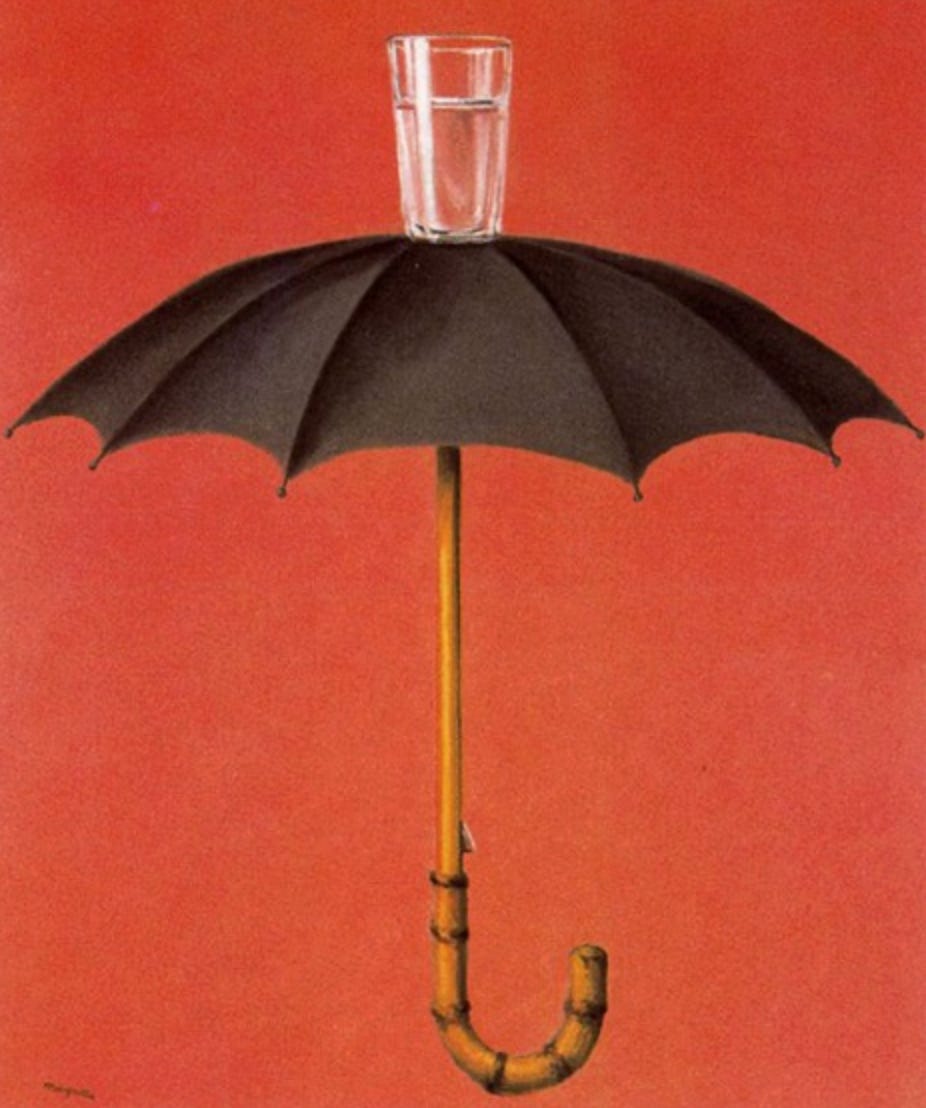
(Picture: Les Vacances de Hegel – René Magritte)
We celebrate World Philosophy Day every third Thursday in November—this year it falls on November 20. So let’s use this opportunity to recall what philosophy is at its most basic.
Alain Badiou opens his True Life with the provocative claim that, from Socrates onward, the function of philosophy is to corrupt the youth—to estrange them from the predominant ideologico-political order. Such “corruption” is needed especially today, in our liberal-permissive West, where most people are not even aware of the ways the establishment controls them, precisely when they appear to be free. The most dangerous unfreedom is the unfreedom that we experience as freedom. Or, as Goethe put it two centuries ago: “None are more hopelessly enslaved than those who falsely believe they are free.” Is a libertarian, who works on destroying the thick social network of customs in which he can only thrive, really free?
The Socratic revolution is characterized by two features. First, it is a reaction to the general crisis of Greek social life, which, for Socrates, is embodied in the widespread popularity of sophists—performers of empty rhetorical tricks who enacted a decay of the tradition of the polis. Second, what Socrates opposes to this decay is not a simple return to the glorious past but a radical self-questioning. The basic procedure of Socrates is the endless repetition of the formula: “What, exactly, do you mean by …?”—by virtue, truth, the Good, and similar basic notions. Today, we need the same questioning: what do we mean by equality, freedom, human rights, the people, solidarity, emancipation, and all other similar words which we use to legitimize our decisions? Thinking means that, when we are confronted with the ecological crisis, we don’t just focus on saving nature, we also ask ourselves what nature means today. With the rise of AI, it is not enough just to ask whether machines are able to think—we should also ask what human thinking really means. We should follow Descartes here: when he
...This excerpt is provided for preview purposes. Full article content is available on the original publication.