The End of the Whisper
Deep Dives
Explore related topics with these Wikipedia articles, rewritten for enjoyable reading:
-
Logos (Christianity)
12 min read
The article discusses the theological concept of the Word (logos) as divine creative force, referencing John 1:1 and the idea that language births reality. This Wikipedia article explores the rich philosophical and theological history of logos in Christian thought, connecting to the article's meditation on language as the medium of creation.
In this remarkable meditation, Hinternet Associate Editor Oladejo Abdullah Feranmi gives what we read as some real theological heft to the recent and very different meditation from JSR on the downsides of consciousness-uploading, and other clever go-it-alone strategies for securing some sort of knock-off version of immortality. We ourselves confess to knowing very little about Islam, surely less than we should. But it is enough to read Abdullah’s reflexions to see what a rich intellectual tradition this faith has sustained over the centuries, and what a formidable interlocutor it is with the other Abrahamic faiths, with Milton and Blake, and with the faint remnants of theological insight that we might still detect, if we are sensitive, in such theories of meaning as continue to be produced by philosophers of language in our go-it-alone age. —The Editors
1.
In nearly every tradition that speculates on beginnings, knowledge precedes matter; it orders chaos. Beginning as an act of divine intimacy, it is the first fire passed between creator and created, the first inheritance. In the Book of Genesis, the first utterance, “Let there be light”, was not merely a command but a revelation of the fact that language itself is the medium of creation. The Qur’an mirrors this moment through the word Kun, “Be”, and all that followed came into existence. Knowledge, in this sense, is not discovery but transmission: it comes from God, who is both the origin and the final repository of all knowing.
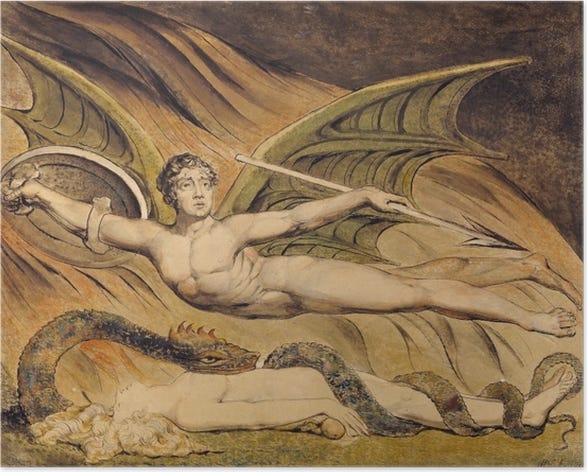
Yet what happens when the vessel of that knowledge refuses submission? The drama of Iblīs (called Satan, Shaitān, Azāzīl, Lucifer, the Adversary, the Accuser) is not a simple tale of rebellion. It is the story of intellect unmoored from humility. It is the tragedy of one who knew too much of himself and not enough of the mercy that made him.
In Islam, Iblīs is not an angel but a jinn, one of those beings made of “smokeless fire.” The Qur’an 18:50 says: “He was one of the jinn and he disobeyed the command of his Lord.” Before his fall, tradition describes him as Azāzīl, the most devout among the hosts. Theologians such as Al-Tabarī and Al-Ghazālī record that Iblīs’s devotion was unmatched, his worship unbroken across ages. He knew the names of the heavens, the natures of the stars.
...This excerpt is provided for preview purposes. Full article content is available on the original publication.