My latest #ThoughtoftheDayonChina: how China and India should seize the recent thaw to rebuild and elevate bilateral ties, beginning with the media.
On Friday afternoon (10/10/2025), I had the pleasure of speaking via Zoom at a session titled “India-China Communication Dialogue” during the 31st Annual Conference of the Asian Media Information & Communication Centre (AMIC) in Mumbai, India. I have argued that both countries should seize the recent thaw in relations to rebuild and elevate bilateral ties, beginning with the media.
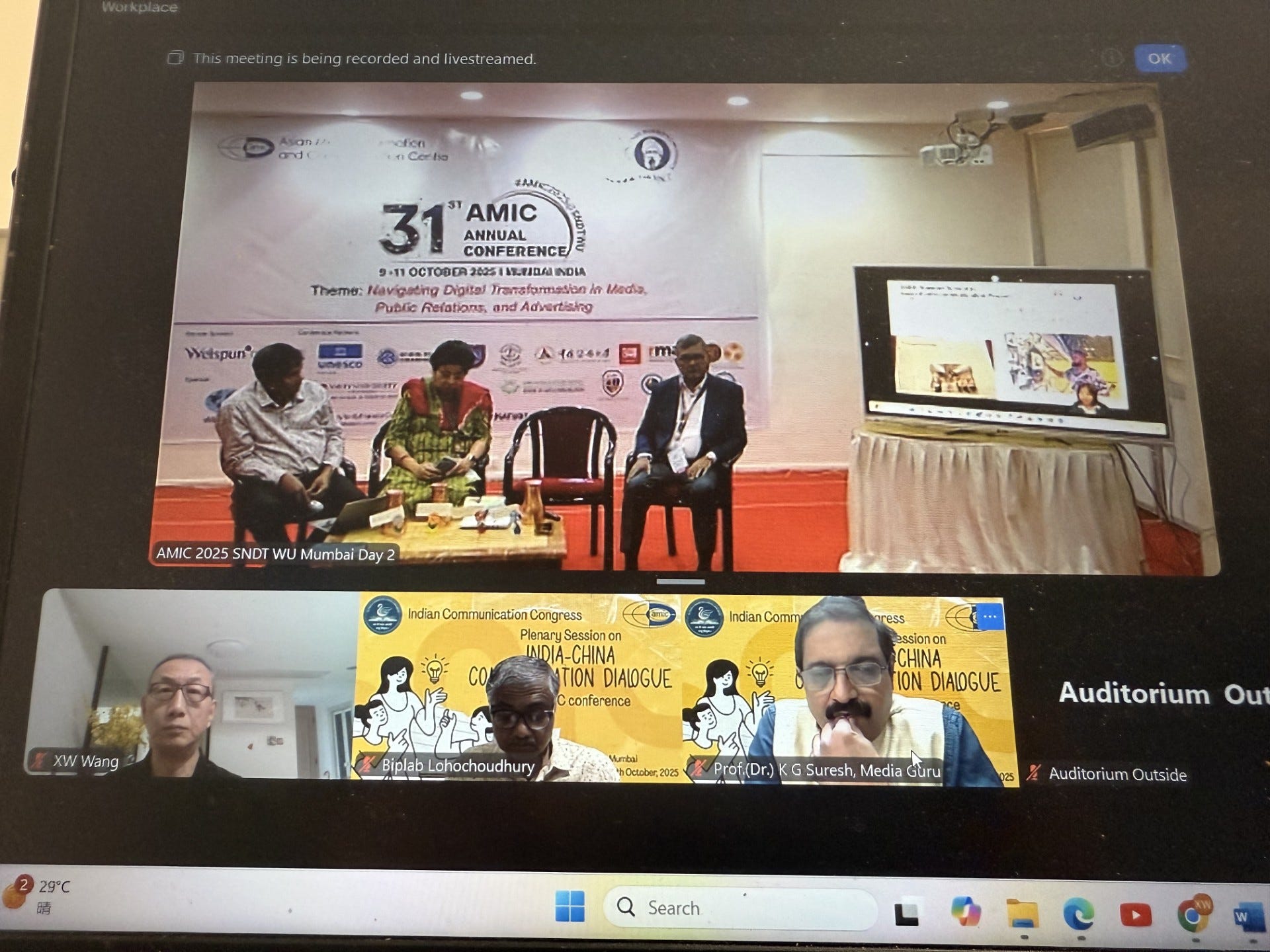
In this age of profound global uncertainty—marked by geopolitical tensions, economic shifts, and climate challenges—it is more paramount than ever for the world’s two most populous countries and emerging powerhouses, India and China, to communicate with each other more effectively and empathetically.
Unfortunately, following the border clash in 2020, the bilateral ties have suffered a major setback epitomized by the fact that only one accredited journalist remains stationed in each other’s country—a stark symbol of fractured trust.
This breakdown in communication cascaded into deeply negative portrayals of the other in our media landscapes, along with a decline in people-to-people exchanges—from student programs to tourism—that once wove our societies closer.
I shared how my generation remains captivated by Indian culture and Bollywood films. I still recall, as a teenager in the 1970s, how we were enchanted by those black-and-white Indian films that first flickered onto our cinema screens. The 1951 classic Awaara, or The Vagabond known overseas was the very first Bollywood film publicly shown in China, and it captured our imaginations like nothing else. To this day, we of that era can still hum the iconic song “Awaara Hoon” with a nostalgic smile—its melody a timeless echo of shared human longing and joy.

I offered the following recommendations:
Both governments should prioritize resuming and streamlining the process of accrediting and facilitating journalists to be stationed in each other’s capitals and key cities. A free flow of reporters on the ground isn’t just about headlines; it’s about humanizing the narrative and countering misinformation with firsthand truth.
Second, cooperation is widened to supercharge people-to-people exchanges—through eased visa issuances, targeted facilitation measures, and more dialogues and like the one on Friday.
More crucially, as both India and China expand our global media networks to amplify our voices on the world stage, there’s immense untapped potential for collaboration between our outlets. And Hong Kong is the ideal hub to facilitate such partnerships and cooperation.
Under the “one country, two systems” framework, Hong Kong enjoys a much more open information environment compared to the Chinese
...This excerpt is provided for preview purposes. Full article content is available on the original publication.