Query to Self: Is It, This Semester Worth Incorporating in My Classes My Introductory Digression on: "The Liberal Arts, Education, & 'AI'"?
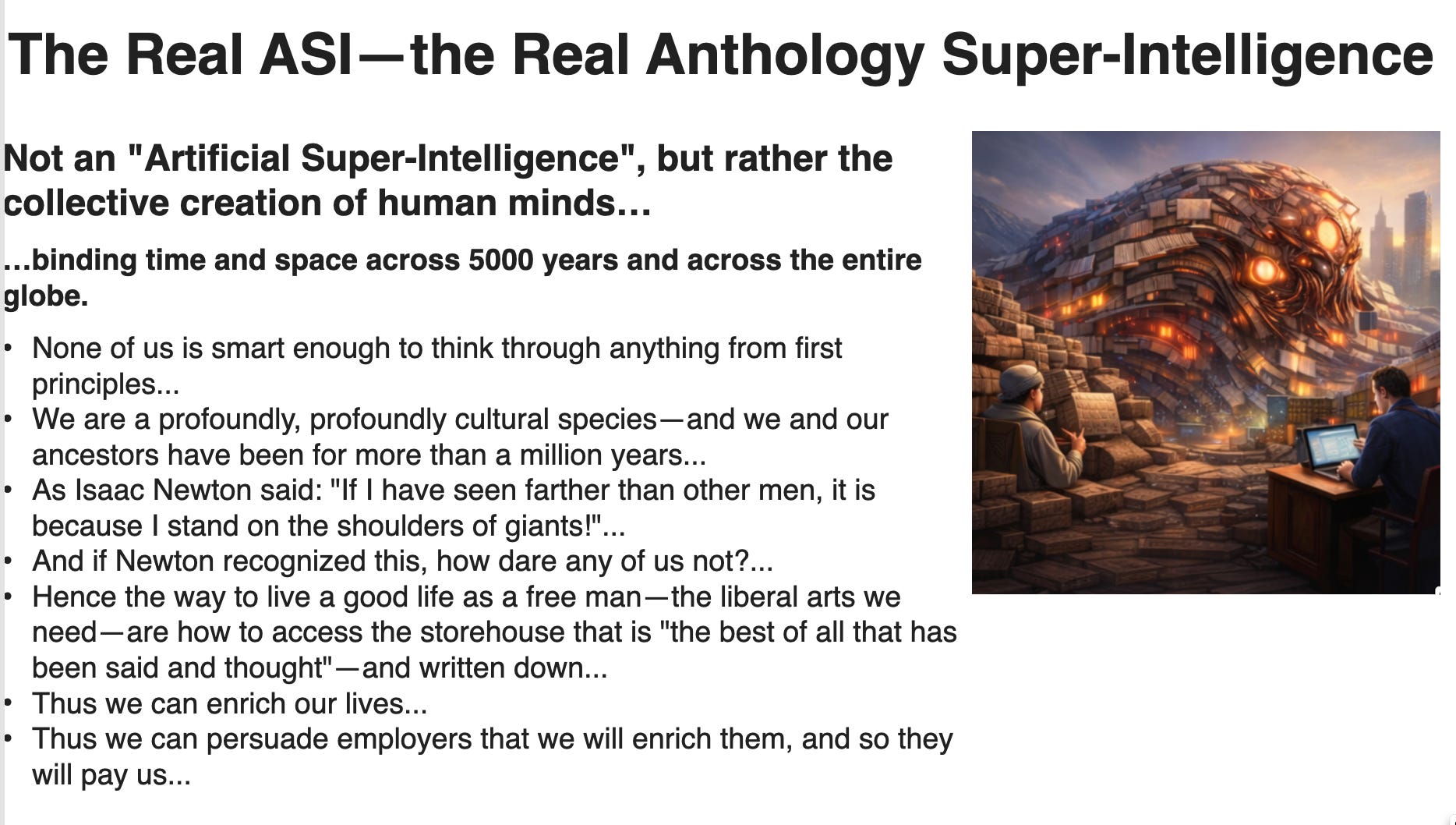
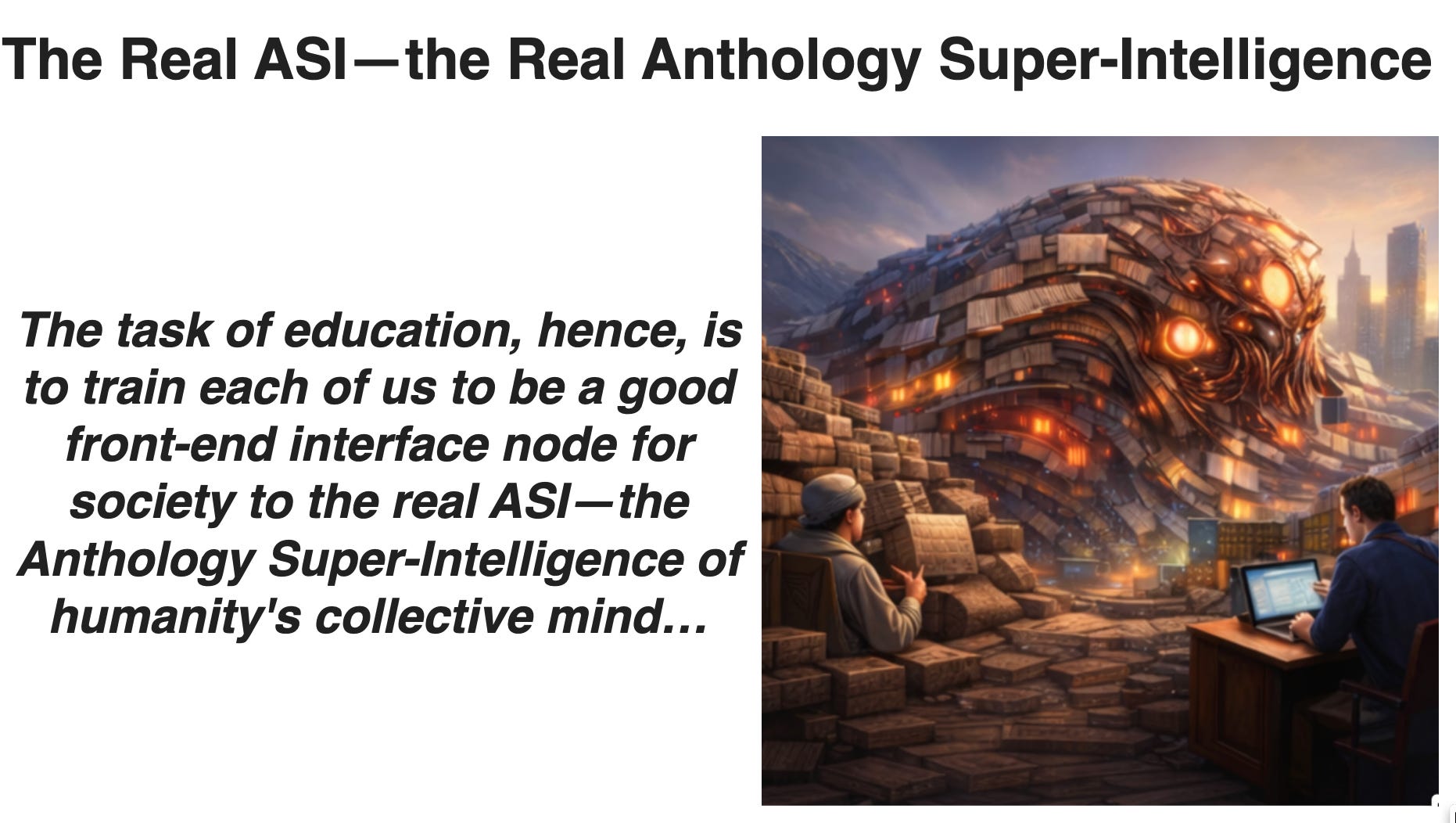
Masters of the Liberal Arts, or servants of the machine? Education as learning how to jack in to the real ASI—the Anthology Super-Intelligence of the collective human mind. The skills needed by free people living by their wits just got more, not less, important with the coming of “AI”: use “AI” to deepen our connection to humanity’s knowledge stack—or let it quietly hollow us out…
I have a new set of slides for this perennial topic I sometimes include and sometimes don’t—short, very short:

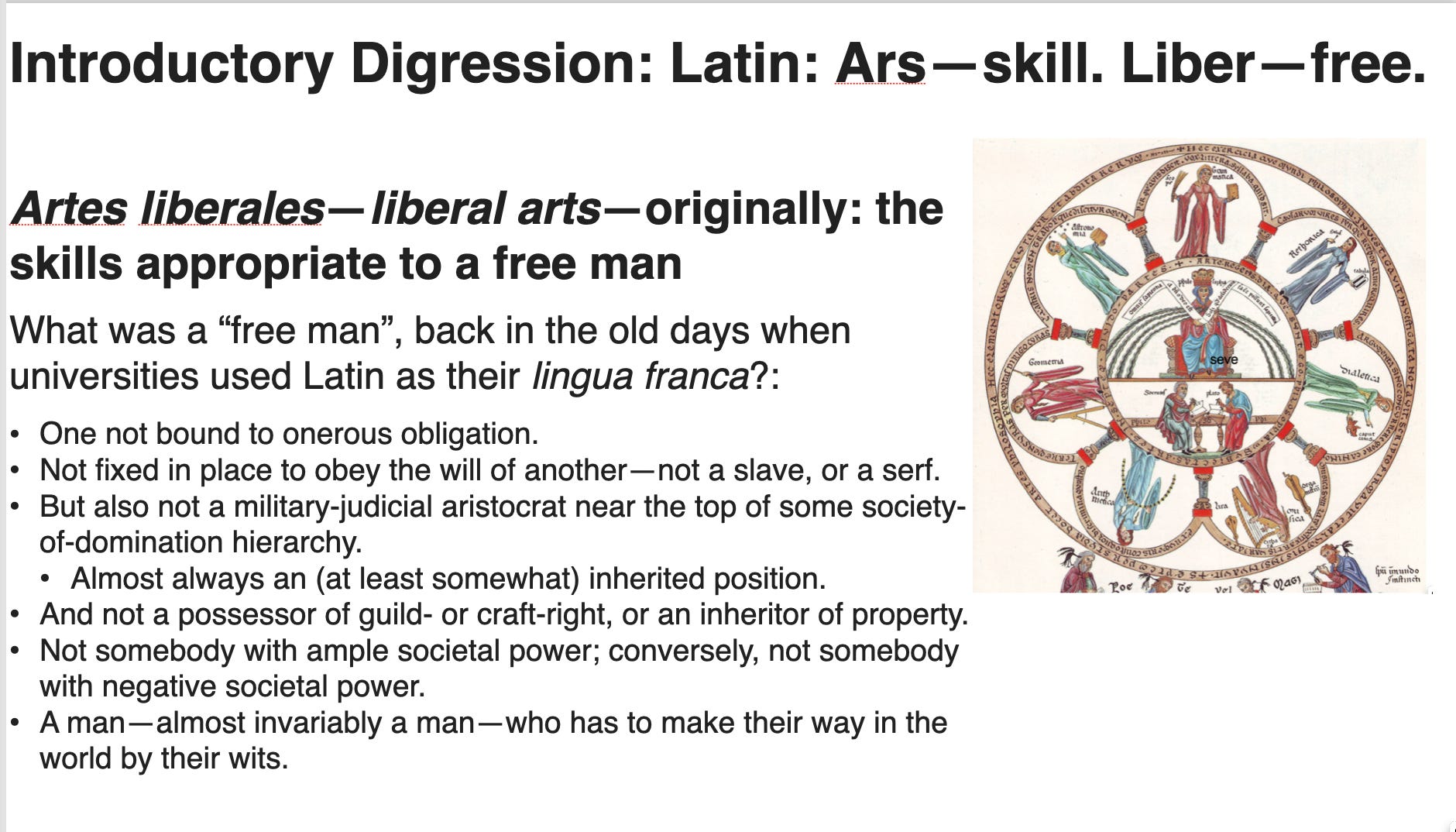
Latin is, for once a useful starting point. Ars is skill. Liber is free. The artes liberales—the liberal arts—were, at their origins, not high-minded exercises in self-expression or vague “critical thinking,” but rather the skills appropriate to a free man. That phrase, “free man,” is already doing a lot of work. In context, it meant someone:
Not bound to onerous obligation;
Not fixed in place to obey the will of another—not a slave or a serf;
But also not a military-judicial aristocrat near the top of a society-of-domination hierarchy;
Not a guild master and not a large property owner;
Not somebody with ample societal power, and conversely not somebody with strongly negative power either.
The liberal arts the toolkit that allowed one who had no land, no inherited office, no fixed corporate-body privilege, to navigate the world. They were about surviving and thriving in a complex, literate, institutional society in which your only capital was what you knew and how you could use it. Thus away the Latin and the robes from the medieval university and you find something remarkably contemporary: a curriculum for people whose main asset is their brain.
To wit:
THE BASIC THREE Logic: how to construct and assess arguments. Grammar: how language works, and thus how to read and write with precision. Rhetoric: how to persuade other human beings face-to-face.
Plus: being able to write a fine chancery hand and thus create authoritative-looking and readable documents by yourself.
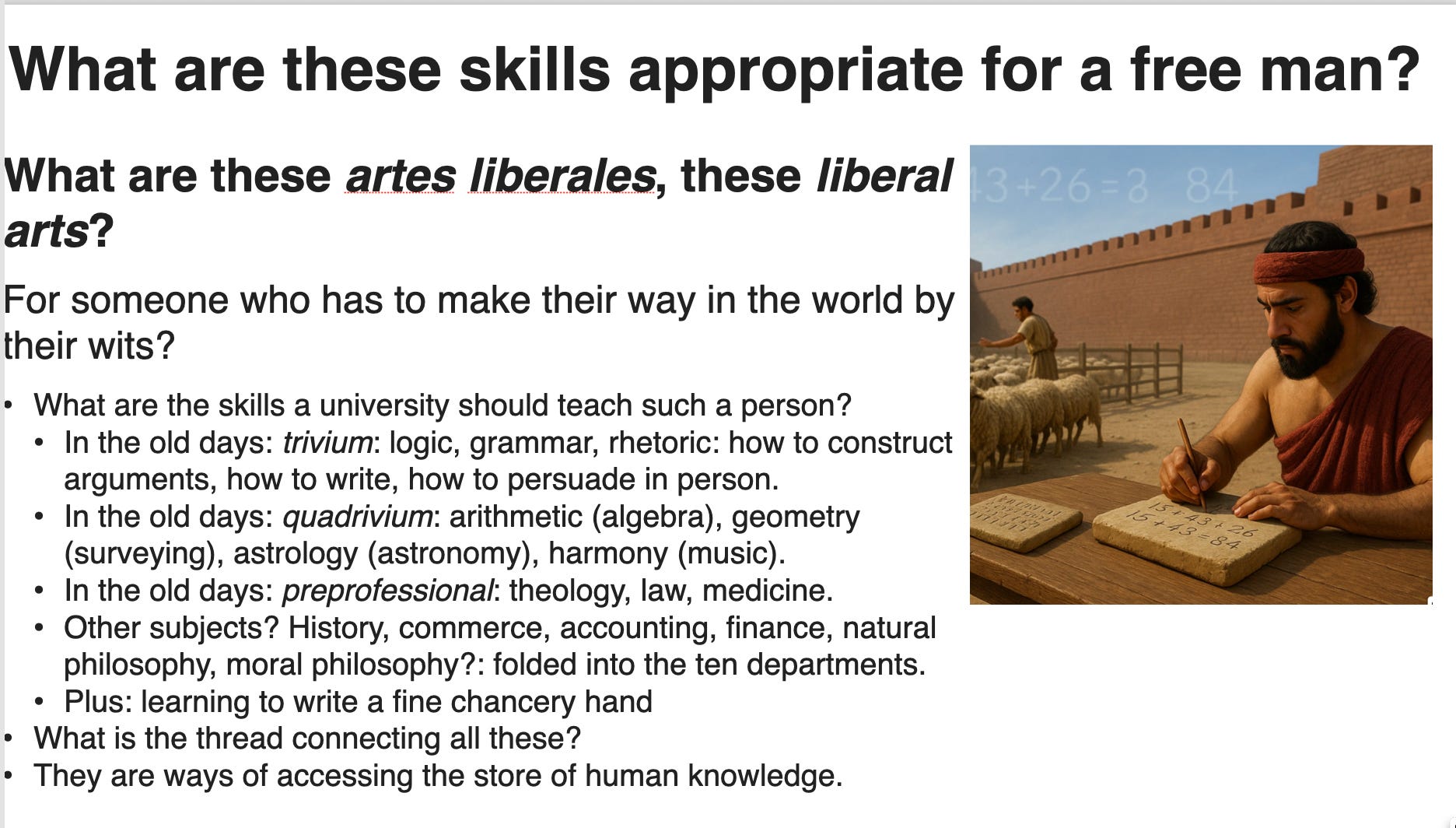
THE NEXT FOUR: Quantitative mastery of number (arithmetic, algebra). Quantitative mastery of space (geometry: surveying, spatial reasoning). Forecasting (astrology—with a little astronomy thrown in; and, more generally, the habit of quantifying and modeling the world). Harmony (music: ratios, patterns, and aesthetic form as numerical relationships have psychological and social resonance).
PRE-PROFESSIONAL: Theology, law, medicine—the three
This excerpt is provided for preview purposes. Full article content is available on the original publication.