Robotics Levels of Autonomy
Robots have powered manufacturing for decades, yet they stayed single-purpose and thrived only in perfect settings. Previous attempts at intelligent machines overpromised and underdelivered. But they were too early. Today, modern AI paradigms convert most robot roadblocks into data problems and push machines toward capabilities once thought impossible. As these models absorb real-world experience, robots will sharpen current skills, gain new ones, and deploy faster, absorbing ever-increasing shares of labor.
General-purpose robots that can accurately perform any task in any domain is now an inevitability, and mass labor replacement is on the horizon. However, these robots will arrive in levels, slowly adding more capabilities until all tasks are feasible. To provide a barometer for this progress, we introduce our industry-first “Robotics Levels of Autonomy,” which classifies robotics into 5 distinct Levels.
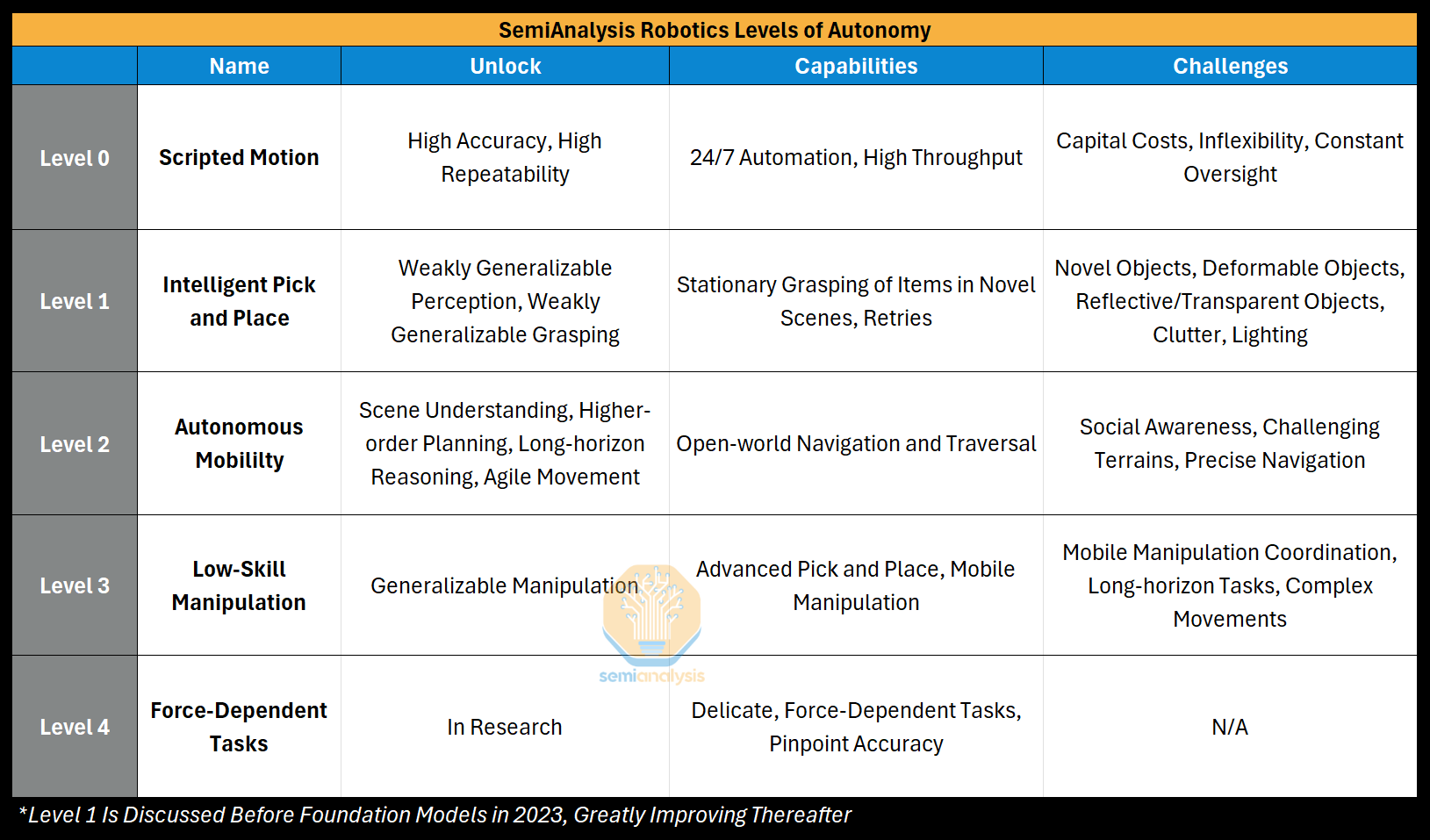
Each Level of Autonomy is defined by the capability unlocked, and each builds sequentially on those before it to enable new applications. To ground these Levels, we provide data-driven analysis of current deployments, use cases and economics, current challenges, and active areas of progress. The Levels provide a type of task segmentation in which progress is additive -- robots may target one Level of tasks and still benefit from capabilities developed in other Levels.
Our Levels of Autonomy are demarcated around commercial viability -- not merely what is possible. Robot autonomy is inherently linked to applications: creating value only through actions often irrecoverable. Therefore, capabilities are derived from reliability and capability. Once reliability is proven, the robot must deliver sufficient throughput to justify its cost as well.
Thank You
We’ve talked extensively to top scientists, surveyed numerous companies, traveled to top industry conferences, and dug into research surrounding contemporary robotics to develop this taxonomy.
We deeply appreciate the invaluable contribution of our coauthors: industry practitioners Niko Ciminelli, Joe Ryu, and Robert Ghilduta. We take inspiration from coauthor Joe Ryu’s framework to flesh out this classification. This project couldn’t be done without the help of outside experts.
We welcome feedback: Please reach out to discuss anything regarding our new Levels of Autonomy classification. You can meet us in person at most of the top industry events, such as Humanoids Summit SF, CoRL, Humanoids 2025 Seoul, and more.
Describing Autonomy
The path to full autonomy begins with accurate, single-purpose systems. But general-purpose robots must start anew, learning to see, plan, interact, and achieve exceptional
...This excerpt is provided for preview purposes. Full article content is available on the original publication.