The survival of Swiss watches
Deep Dives
Explore related topics with these Wikipedia articles, rewritten for enjoyable reading:
-
Quartz crisis
12 min read
The article centers on how Swiss watchmaking nearly collapsed due to Japanese quartz technology in the 1970s-80s. This Wikipedia article provides the full historical context of this pivotal industry disruption.
-
Piezoelectricity
13 min read
The article explains how quartz crystals vibrate when electrically charged (the Curie brothers' discovery), but readers would benefit from deeper understanding of this phenomenon that revolutionized timekeeping.
-
Railway time
20 min read
The article mentions the 1847 standardization of British railway time as a key driver of watch demand. This topic explores how railroads fundamentally changed humanity's relationship with precise timekeeping.
This article originally appeared in the first print issue of Works in Progress, which subscribers received last week. Subscribe to get six full-color editions sent bimonthly, plus invitations to our subscriber-only events.
It’s April 1984. Two men are sleeping in a car park in Basel. Each morning they wake, leave their borrowed Volkswagen Westfalia, and wash in the train station toilets. Then they go to their new stand at the Basel fair: the high point of the watch industry’s annual calendar. Their stand is arresting: every case is empty. With only two models to show, probably better not to show them at all. Instead, the pair focus on pitching the great and the good of the Swiss watch industry. If anyone asks them where they’re staying, they’ll say the Hilton.
The two men are Jacques Piguet, born into a family of watchmakers; and Jean-Claude Biver, a disgruntled ex-exec from Omega. The plan is to relaunch Blancpain, a brand they’d acquired in 1981 but had yet to bring back to life. The move is somewhat audacious: the Swiss watch industry is in a tailspin, disrupted by a new technology, the quartz wristwatch, that has left Switzerland’s traditional watchmakers obsolete.
Japanese factories are churning out watches that are faster, cheaper, and more precise than the Swiss mechanicals could ever hope to be. Over half of Switzerland’s watch companies collapse. Two thirds of its watchmaking jobs disappear. But Swiss watchmaking isn’t dead yet, and a handful of people are about to snatch it from obsolescence.
From the city to the mountains
The story of Swiss watchmaking began in Geneva in the 1540s. At the behest of John Calvin, the city imposed a ban on jewelry, the craft that had sustained Geneva’s artisans. The law, however, left one deliberate loophole: timepieces, those most practical and Protestant of devices, were still permitted to be worn. Denied their old market, the city’s artisans, joined by religious refugees from France and Italy, retooled and got to work.
At that point, despite Calvin’s strictures, watches remained more a curiosity than a necessity. When mathematician and astrologer Thomas Allen visited his friend, Sir John Scudamore, at the turn of the seventeenth century, and decided to bring his watch with him, a maid presumed its ticking to be the noise of the devil, and promptly threw it out of the window.
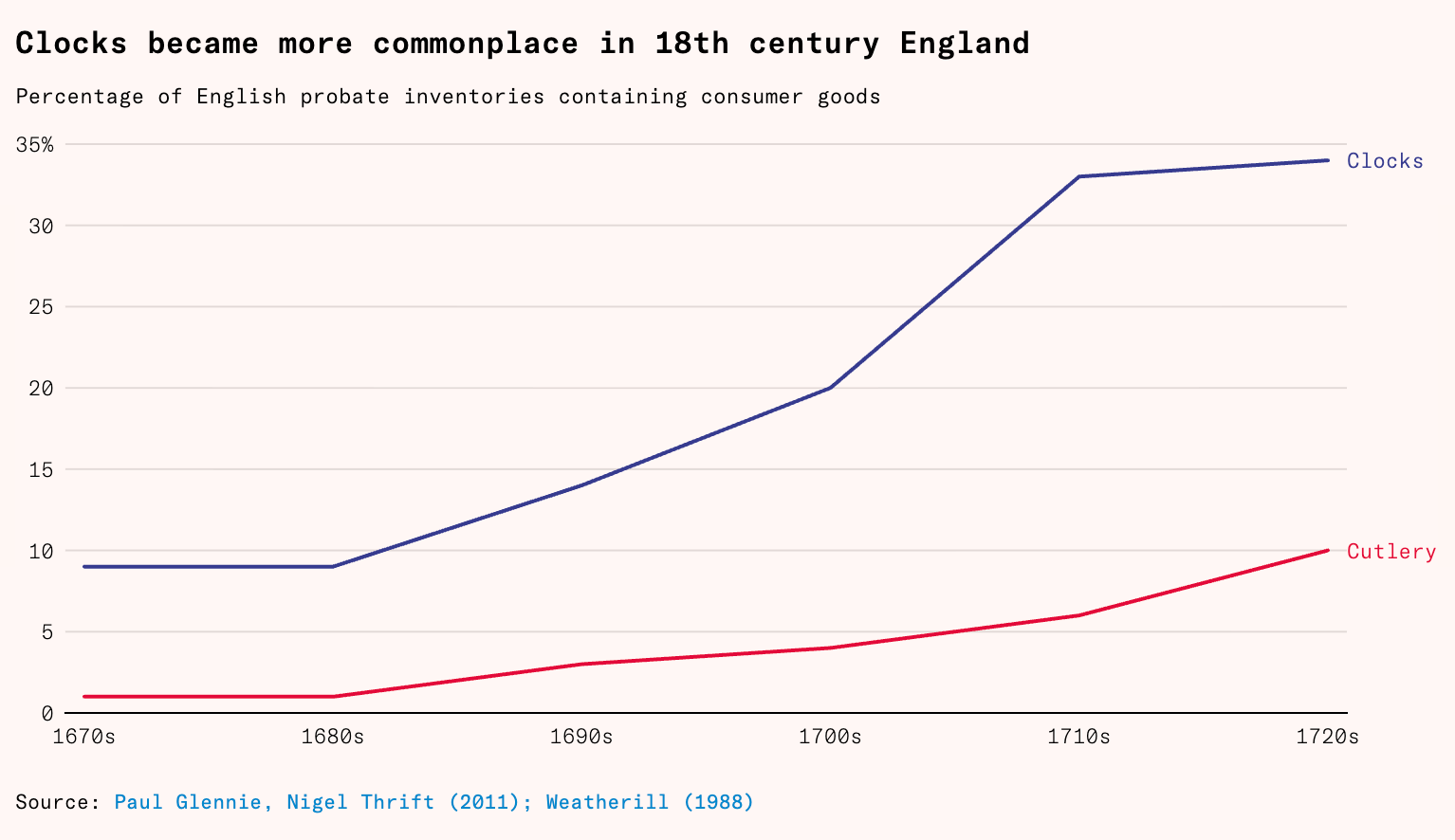
Time was measured in a mongrel fashion: references
...This excerpt is provided for preview purposes. Full article content is available on the original publication.