America is Flying Blind on Immigration
Thanks for reading! If you haven’t subscribed, please click the button below:
By subscribing, you’ll join over 75,000 people who read Apricitas!

Today, roughly one-in-five American workers are immigrants. They contribute massively to the US economy in sectors as wide-ranging as healthcare, construction, education, agriculture, finance, manufacturing, and tech. That means the question “How many people have immigrated to the US this year?” is increasingly important to the American economy, making it all the worse that we currently have no good answer.
In a country like Canada, the vast majority of immigrants come via airports or the few land border crossings with the United States, making it comparatively easy to produce quarterly inflow statistics. The national census is done every five years, ensuring immigration counts are benchmarked to comprehensive data more frequently. Plus, the Canadian government maintains a series of specialized surveys dedicated explicitly to tracking immigrants’ education, labor market, housing, and other outcomes. US immigration statistics are comparatively sparse, with aggregate population estimates only produced once per year and comprehensive censuses only done once a decade.
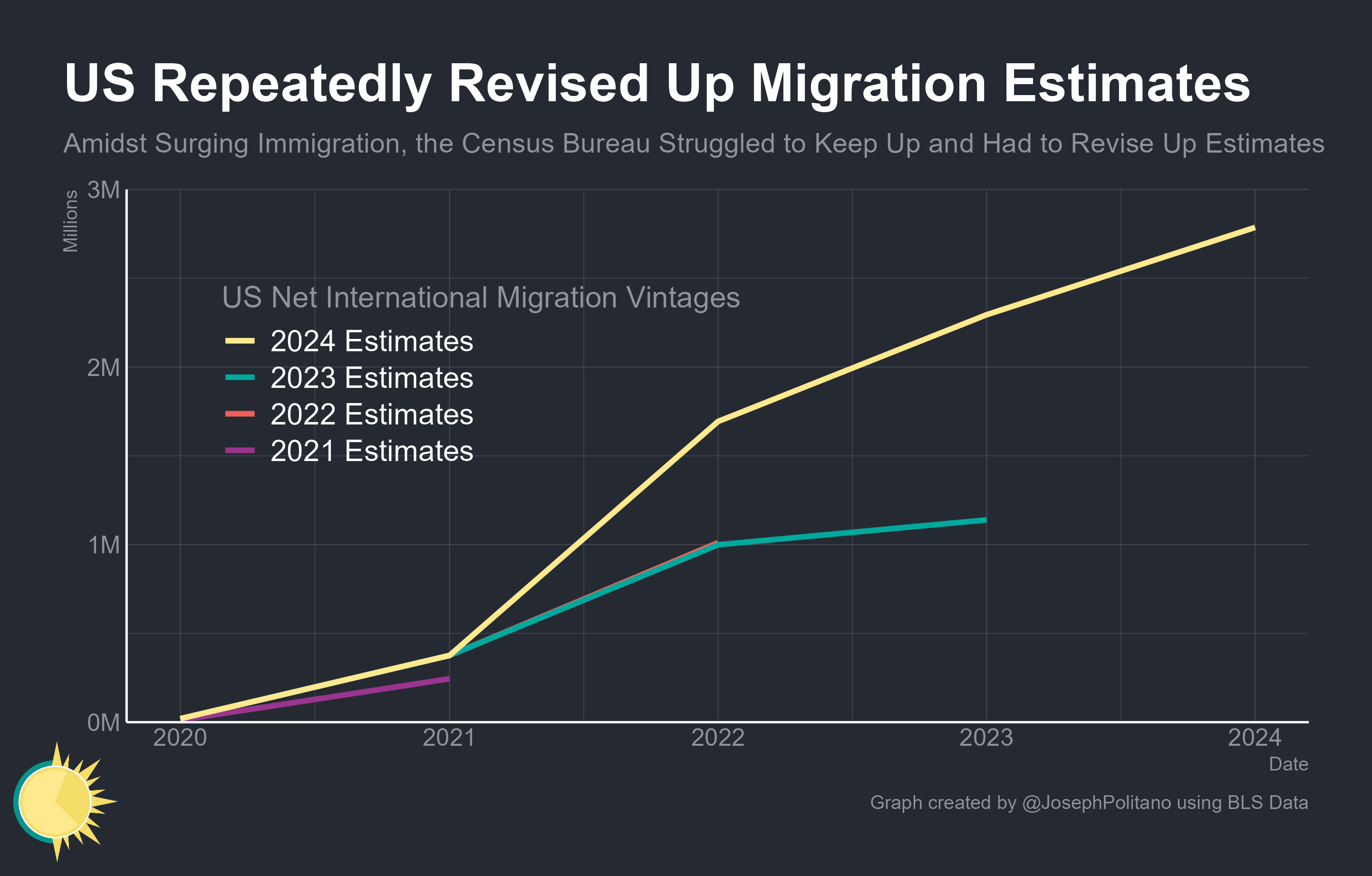
Previously, this wasn’t much of a problem—America is a much larger country with a much lower immigration rate than Canada, and population flows tended to be stable enough that shifts in immigration policy were not macroeconomically significant. That changed during the pandemic, as COVID-related travel restrictions caused an unprecedented slowdown in immigration flows at a time when regular data collection was extremely difficult. Immigration subsequently rebounded to the highest level in decades, but that 2021-2023 immigration surge did not show up in official data for years because so many of the immigrants went through asylum or refugee systems that were not well-tracked by population statistics.

Now, the same problem is happening in the opposite direction—the Trump administration’s crackdown on immigration is not well-tracked by public statistics, so it is totally unknown how many fewer immigrants have moved to the US this year or how many residents have actually been deported. The last official population estimate was released before the Trump administration began stripping many immigrants of legal status, deliberately shrinking legal immigration flows, and implementing mass deportations of undocumented immigrants. Answering simple questions like “what is a normal amount of job growth, given the immigration downturn” is now so difficult that forecasters and think-tanks are coming up with wildly different answers.

Even answering how many immigrants have left the United
...This excerpt is provided for preview purposes. Full article content is available on the original publication.