Uncrewed Combat Aerial Vehicles - An Option for Deep Precision Strike?
Deep Dives
Explore related topics with these Wikipedia articles, rewritten for enjoyable reading:
-
Suppression of enemy air defenses
2 min read
The article extensively discusses UCAV survivability against air defenses, with detailed probability models for attrition on inbound and outbound legs. Understanding SEAD doctrine and tactics provides crucial context for why outbound attrition is higher and how militaries actually approach the air defense problem that makes UCAV economics so challenging.
-
Lanchester's laws
12 min read
The article presents a detailed mathematical attrition model comparing UCAVs to missiles, calculating expected kills and costs. Lanchester's laws are the foundational mathematical framework for combat attrition modeling that underlies this type of analysis, giving readers the theoretical basis for understanding why these probability calculations matter.
-
General Atomics MQ-20 Avenger
1 min read
The article discusses the CA-1 Europa as a new European UCAV for deep strike missions. The MQ-20 Avenger is the leading American equivalent—a jet-powered, stealthy UCAV designed for similar strike and ISR missions—providing concrete context for what these systems look like in practice and the technological baseline Helsing is competing against.
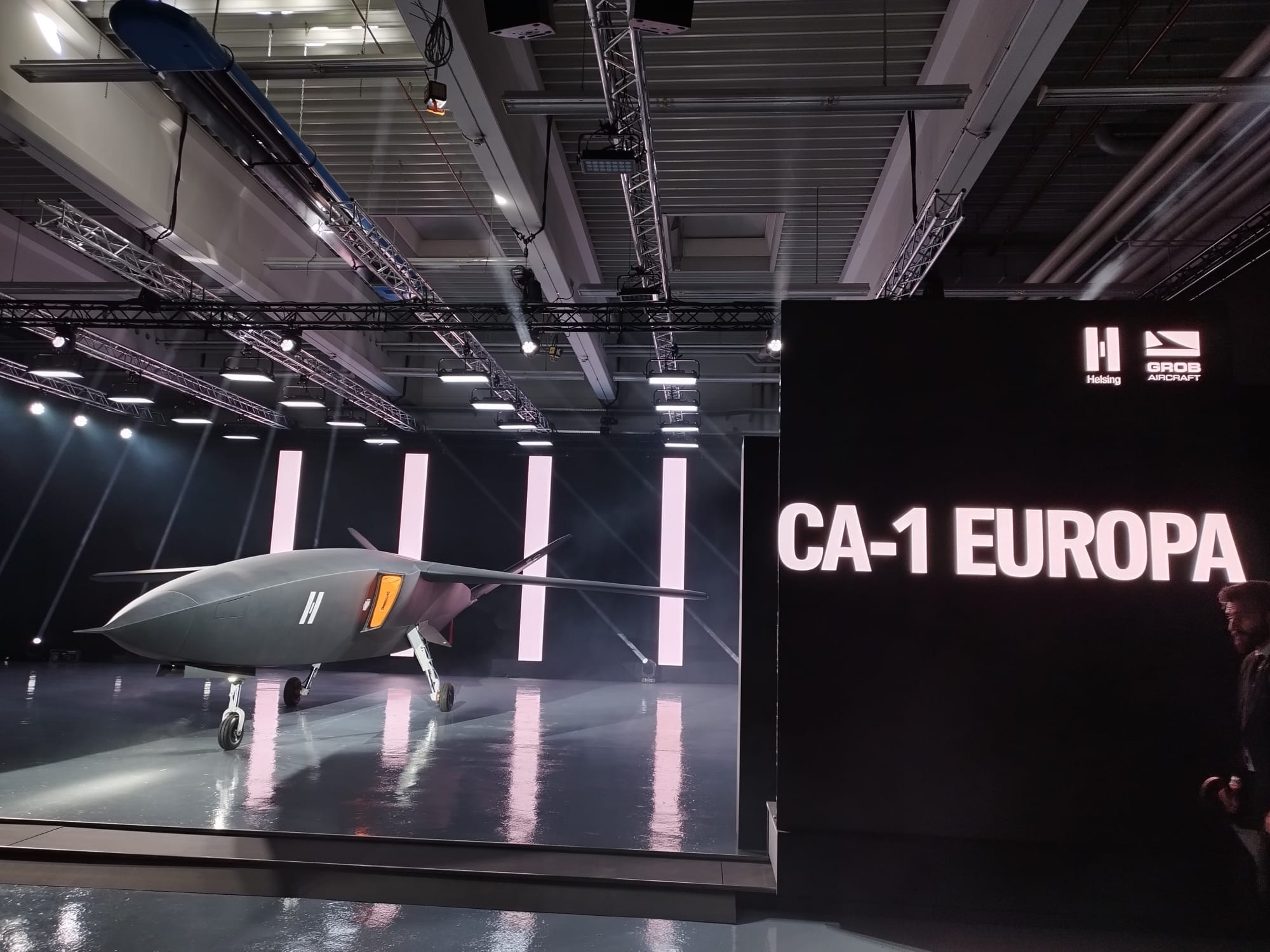
Picture: Fabian Hoffmann / Missile Matters
Earlier this fall, Helsing, Europe’s prime AI defense startup, showcased a new unmanned combat aerial vehicle (UCAV) at a launch event in Tussenhausen, near Munich, Germany — the CA-1 Europa.
What sets Helsing apart from its competitors, at least in the announcement accompanying the product launch, is its emphasis on the CA-1 Europa fulfilling a deep strike requirement for its operators. This suggests a role for the UCAV that goes beyond the collaborative and supporting functions with manned aircraft emphasized by other industry actors in the field, pointing instead to a strike mission intended to generate independent effects.
This coincides, likely not by accident, with the Bundeswehr recently issuing a requirement for a “Jagbomberdrohne” (fighter bomber drone), which, as the name implies, refers to a system capable not only of supporting airborne assets as a loyal wing man but also of independently executing strike missions.
This raises important questions: What is the future role of UCAVs in deep strike missions, and under what circumstances might they prove superior to traditional one-way deep strike systems? Can these types of UCAVs fill Europe’s deep strike requirement and perhaps compensate for its inferiority in traditional missile systems?
Factors affecting performance
Whether reusable UCAVs or one-way effectors, such as cruise missiles, ballistic missiles, or long range drones, are preferable for deep strike missions depends on several factors. The most important are unit cost, the likelihood of loss, the likelihood of destroying the target if the system arrives, and, for UCAVs, recurring operating costs for maintenance, refueling, and sortie generation.
Expected attrition is arguably the decisive variable for UCAVs. A reusable aircraft only makes economic sense if it can survive more than a single mission. UCAV attrition is also more structured than for missiles: there are losses on the way to the target and losses on the way out. In many scenarios the return leg is likely more dangerous, because the defender has been alerted, has a rough idea of the aircraft’s location following the strike, and may have had time to mobilize air defenses.
The second key variable is lethality once the platform arrives. Here a UCAV has a potential advantage. It can carry several payloads (for example, several guided or unguided bombs), and, if it survives over the target, it can engage multiple aimpoints in a single sortie. In principle, a single UCAV that reaches its target
...This excerpt is provided for preview purposes. Full article content is available on the original publication.