AI Slopaganda in the KMT Election
Deep Dives
Explore related topics with these Wikipedia articles, rewritten for enjoyable reading:
-
Kuomintang
17 min read
The article centers on the KMT chairmanship election but assumes reader familiarity with the party's complex history, its role in Chinese civil war, retreat to Taiwan, and evolution from authoritarian ruler to opposition party struggling with cross-strait identity politics
-
Deepfake
15 min read
The article discusses AI-generated deepfake videos as a key disinformation tool but readers would benefit from understanding the underlying technology, its history, detection methods, and broader implications for democracy beyond this specific Taiwan case
-
Taiwan independence movement
13 min read
The article references the shifting Taiwanese identity conception and the KMT's struggle with being 'the party that regards Taiwan as Chinese' - understanding the historical context of Taiwan independence sentiment provides crucial background for the political dynamics described
Mandarin Peel is an International Relations graduate student based in Taiwan. His work focuses on U.S.–China tech competition, Indo-Pacific geopolitics, and Taiwan. You can find more of his writing on X and on Substack, where he also publishes work from fellow researchers.
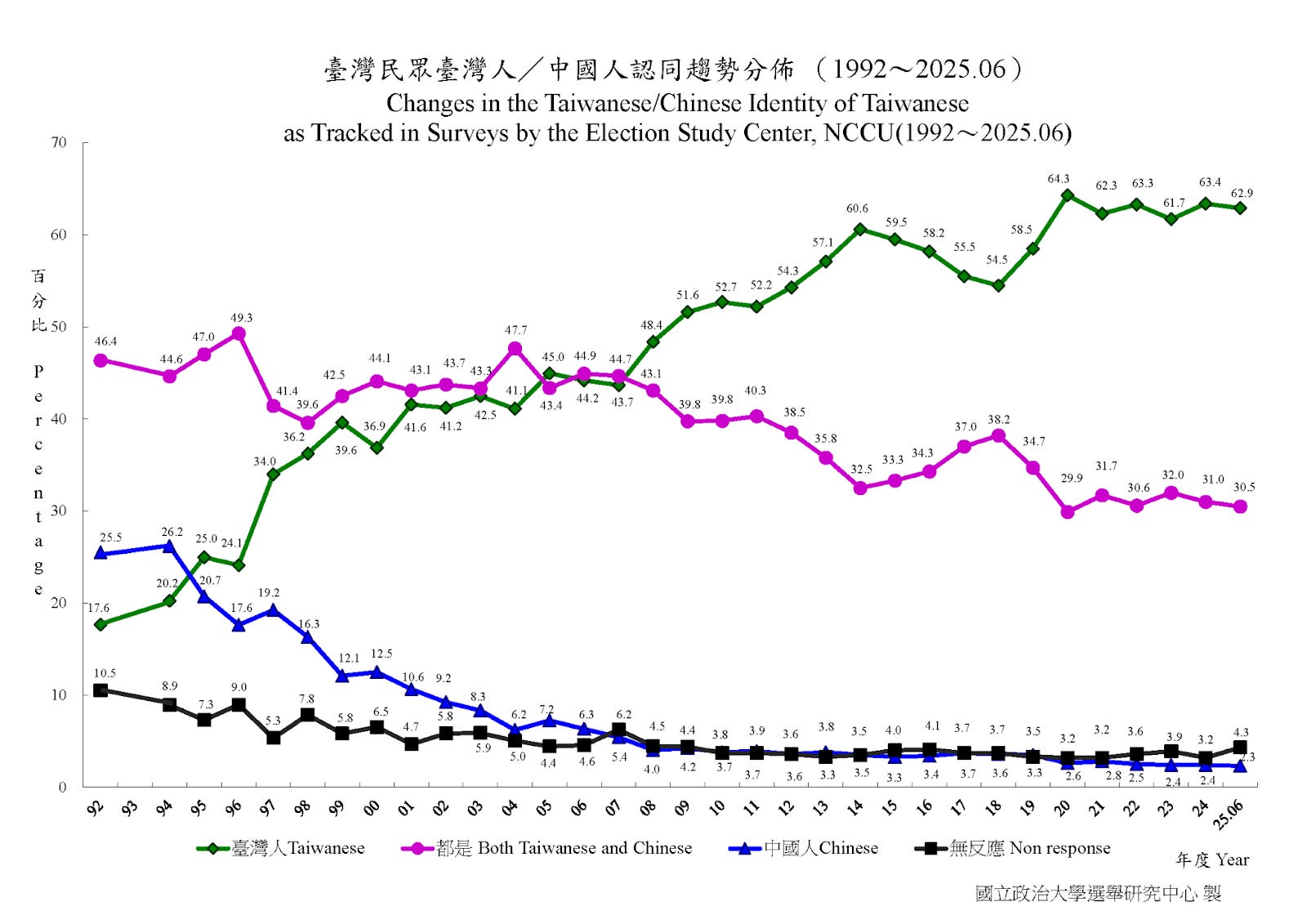
The October 2025 KMT chairmanship election came at a time of reckoning for the party. The KMT faces a difficult challenge — being the party that regards Taiwan as Chinese — trying to get elected by a public whose own identity conceptions trend the opposite way.
At first, 73-year-old Hau Lung-pin 郝龍斌, a central figure of the deep blue wing of the KMT’s old guard, was the favored candidate for the position, having built a strong network within the party over his long career. Though he has historically leaned pro-China even for the KMT, he was running to help the KMT win elections. Toward that end, his vision for the party’s new core message would step more in line with the current trends in Taiwanese identity conception: “Pro-America, not kneeling to America; Peaceful with China, not sucking up to the CCP” “親美不跪美,和中不添共.”
His main competition, and the eventual victor, was Cheng Li-wun 鄭麗文, a 55-year-old candidate with fewer connections but not without charm or vision. A brash and charismatic campaigner, she instead sought to use growing mistrust of America, brewing since the beginning of Trump’s second term, and convince voters to be unapologetically pro-China and Chinese while refusing to be a “piece in the chess game of two great powers” — a favorite metaphor of Taiwanese America-skeptics (疑美論). “This is my promise, and it’s not just elected as party chair: in the future, all Taiwanese will proudly and confidently say ‘I am Chinese.’ This is what the KMT needs to do!”
Perhaps as controversial as Cheng’s remarks was a deepfake video that emerged of Hau Lung-pin and city councilmember Liu Caiwei 柳采葳 kissing at a press conference. Hau said that posts like this were coming from “overseas” accounts seeking to influence the election. His close ally Jaw Shaw-kong 趙少康 even directly accused China of election interference. This marked a turning point as officials of the party that had previously disputed such claims are now making them too. Hau cited a National Security Bureau report that found over 1,000 videos about the election on Chinese TikTok over
...This excerpt is provided for preview purposes. Full article content is available on the original publication.