Ma Ying-jeou on Sanae Takaichi's recent remarks on Taiwan
Deep Dives
Explore related topics with these Wikipedia articles, rewritten for enjoyable reading:
-
Treaty of Mutual Cooperation and Security between the United States and Japan
12 min read
The article discusses Japan's 'collective self-defense' and the U.S.-Japan security framework. Understanding this treaty is essential context for why Takaichi's remarks about military involvement in Taiwan are so significant and why U.S. consultation would be required.
-
Senkaku Islands dispute
11 min read
Ma Ying-jeou directly references the 'Diaoyutai Islands' (Japanese: Senkaku) and his 2012 East China Sea Peace Initiative. This territorial dispute between Japan, China, and Taiwan provides crucial context for understanding the historical tensions underlying current cross-strait dynamics.
-
Article 9 of the Constitution of Japan
14 min read
The article mentions Japan's 'war-renouncing Constitution' and debates about collective self-defense. Article 9 is the specific constitutional provision that makes Takaichi's statements about potential military action so controversial and legally contested within Japan itself.
The bilateral relations between China and Japan have rapidly dived into a severe crisis after Sanae Takaichi, the new Japanese Prime Minister, said at a Parliamentary session last Friday (November 7), according to Kyodo, the Japanese news agency
TOKYO - Prime Minister Sanae Takaichi said Friday that a Taiwan emergency involving the use of military force could constitute a “survival-threatening situation” for Japan under the country’s security legislation.
Her remarks suggested Japan could exercise the right of collective self-defense if such a situation is recognized as “survival-threatening,” even under the nation’s war-renouncing Constitution, in a move that would provoke China, which claims the self-ruled island as its territory.
She apparently acknowledged her government could, depending on the circumstances, authorize the Self-Defense Forces to take action if China were to impose a maritime blockade on Taiwan or engage in other coercive measures, even if Japan is not directly attacked.
Takaichi, who took office on Oct. 21, is known as a pro-Taiwan lawmaker. She is also viewed as a successor in her outlook to assassinated former Prime Minister Shinzo Abe, whose hawkish views on national security have shaped her nationalistic stance.
She has since refused to withdraw her remarks.
In response, Sun Weidong, China’s vice foreign minister in charge of Asia, has, apparently under the instruction of the Chinese President Xi Jinping, summoned the Japanese ambassador, Kanasugi Kenji, in Beijing late at night on Thursday to lodge a strong protest.
China’s foreign ministry also issued a travel alert for Chinese citizens, urging them not to travel to Japan.
A social media account operated by China’s state broadcaster, often used in recent years to convey yet-to-be announced official plans, today threatened to impose sanctions on Japanese politicians individually and suspend government-to-government exchanges in military, diplomatic, and economic areas between the two countries if Tokyo didn’t meet Beijing’s demand to withdraw the remarks.
That’s just the background of the following social media post today by Ma Ying-jeou, former leader of Taiwan - officially President of the Republic of China - from 2008 to 2016
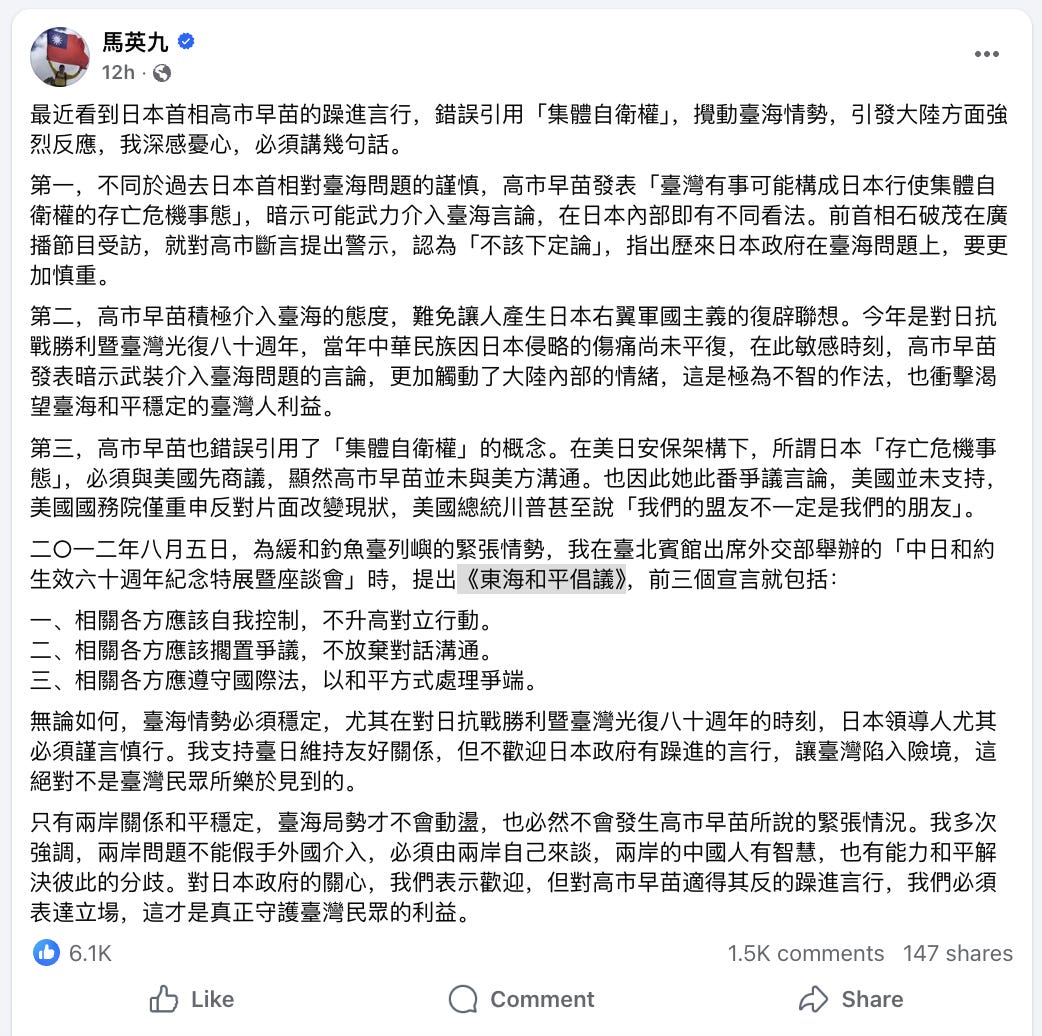
Recently, after witnessing Japanese Prime Minister Sanae Takaichi’s rash and escalatory remarks—misusing the concept of “collective self-defense” and stirring tensions in the Taiwan Strait, which provoked a strong reaction from the mainland—I felt deeply concerned and compelled to speak out.
To begin with, unlike previous Japanese prime ministers who exercised caution on cross-Strait issues, Takaichi declared that “a contingency
...This excerpt is provided for preview purposes. Full article content is available on the original publication.