The Gay Black American Who Stared Down Nazis in the Name of Love
Every day is a good day to share a story about an American facing down fascists. Today we’re sending out this Narratively Classic because tomorrow over at Narratively Academy we’ll be chatting with the author, Ethelene Whitmire, about how she expanded this story into a book set to be published by Penguin Random House next week. Enjoy the story—we’re making it free to all this week—and hope you can join us tomorrow.
In Italy at the end of 1944, the Negro 92nd Infantry Division of the United States Army discovered two gaunt men who claimed they had escaped from a Nazi concentration camp. One man was thin and blonde with a “scholarly appearance.” The other had brown skin, a slight build and an erect carriage. After two years behind barbed wire, they said, they had fled the camp and gone on an incredible journey to reach the American lines: swimming in lakes, hiking through the snow-covered Apennines, and taking shelter in barns, caves, woods and the homes of friendly partisan supporters. They claimed they dodged bullets and ate leaves to survive; they said they bore witness to the slaughter of women and babies. Their names were Reed Peggram, an African-American, and Gerdh Hauptmann, his Danish friend, and they were “ragged and near collapse from hunger and fatigue.”
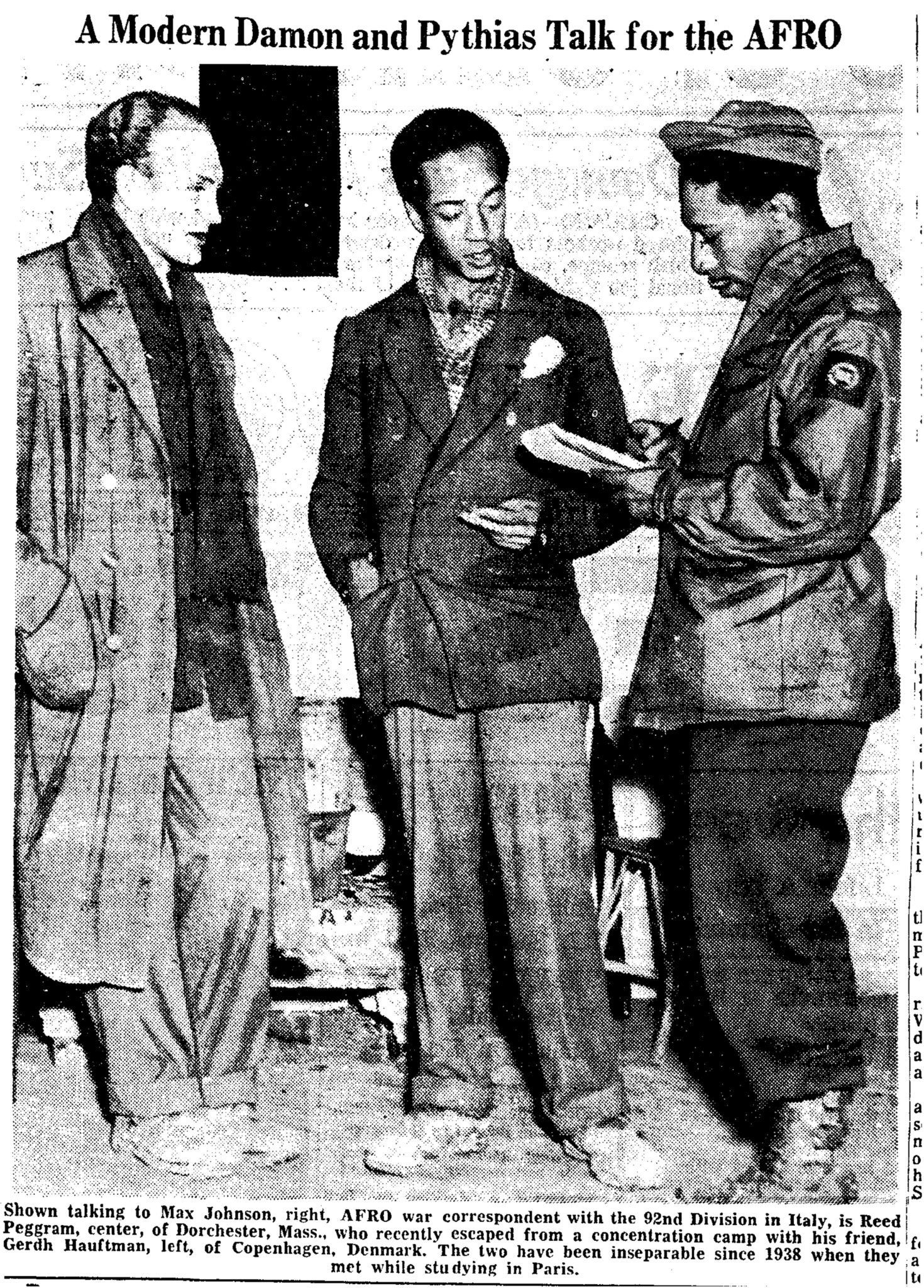
Freelance war correspondent Max Johnson, writing for the Negro newspapers Call and Post, New York Amsterdam News and Baltimore Afro-American, reported this curious find. The headlines that accompanied his stories were purposefully provocative: “Negro Escapes German Camp in Italy,” “Two Scholars Flee Concentration Camp,” “How Boston Lad Studying in Denmark Escaped Nazis” and “Boy Friends Scorn Bombs, Come Out OK.” Although he reported their claims, Johnson was skeptical of Peggram’s tale, not even believing that he was an American citizen, since his “accent was decidedly British.” Another correspondent noted that Peggram claimed to have a bachelor’s and master’s from Harvard, that he spoke English flawlessly, along with four other languages, and that despite his ordeal, it was not his physical suffering that upset him most. “One of my greatest losses was my diploma from Harvard,” Peggram said. “They don’t issue duplicates. But I still have my Phi Beta Kappa key.” The two
...This excerpt is provided for preview purposes. Full article content is available on the original publication.