The Week Observed: December 5, 2025
Deep Dives
Explore related topics with these Wikipedia articles, rewritten for enjoyable reading:
-
Induced demand
13 min read
The article discusses both induced travel (adding road capacity elicits more travel) and traffic evaporation (the opposite effect when capacity is reduced). This economic concept is central to understanding why freeway widening projects fail to reduce congestion and why the Hammersmith Bridge closure didn't cause predicted traffic chaos.
-
YIMBY
13 min read
The article extensively discusses the YIMBY vs NIMBY debate in California housing policy, including specific legislation like SB 79 and the tension between pro-housing reformers and progressive groups opposing density. Understanding the YIMBY movement's origins, philosophy, and political strategies provides essential context.
-
Hammersmith Bridge
12 min read
The article uses the 2019 closure of this Victorian suspension bridge as a case study in traffic evaporation and urban resilience. The bridge's history, engineering challenges with its cast iron structure, and the ongoing debate about its future repair provide rich context for the transportation policy discussion.
What City Observatory Did This Week
Oregon’s Climate Failure: Transportation Emissions Keep Rising Despite Pledges
Oregon loves to talk climate action, but when it comes to actually reducing transportation emissions—the state’s largest source of greenhouse gases—it’s failing spectacularly. Portland metro area transportation emissions have increased 0.8 percent annually over five years, even as the state’s official goal calls for cutting them by more than five percent per year.
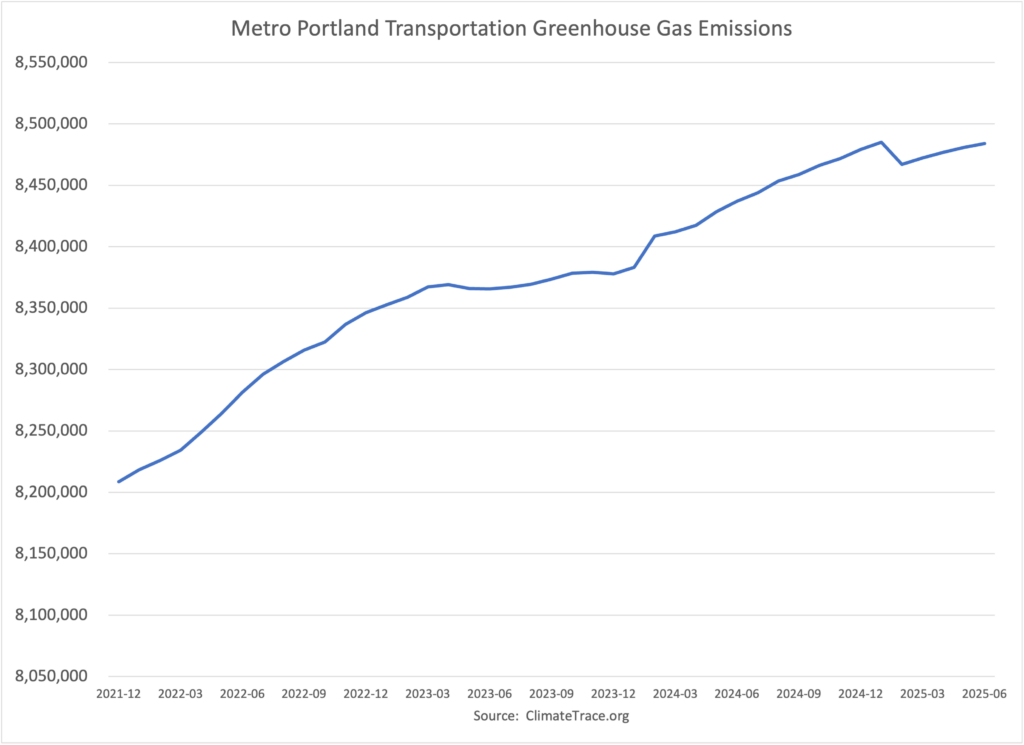
The culprit? A decade of wildly optimistic assumptions. When Oregon’s Land Conservation and Development Commission set targets in 2009, planners bet heavily on technology: cleaner cars, rapid electrification, consumers ditching SUVs for efficient vehicles. Every single assumption proved wrong. Americans are keeping their gas-guzzlers longer, buying bigger trucks and SUVs, and adopting electric vehicles at a crawl.
The 2009 rules wisely required a reality check every four years. That moment arrived December 5, when LCDC was supposed to reckon with these failures and adjust course. Instead? Staff recommended essentially no changes to targets that are already being missed by miles.
This is policy malpractice dressed up as climate leadership—making ambitious long-term pledges while ignoring present-day failure. With each passing year of inaction, the remaining window to address climate change shrinks. Oregon needs honest accounting and aggressive course correction, not more aspirational targets destined to be ignored.
Must Read
Time for foundations to hold grantees accountable for NIMBY lobbying. In many ways, one of the biggest problems confronting the US--and a key cause of homelessness--is growing housing unaffordability, which is closely associated with local land use restrictions. A wave of reformers have tried to push back against the “Not in My Backyard (NIMBY) opposition, to make it easier to build more housing, to increase supply, lower rents, and improve affordability. But along the way, they’ve run into widespread opposition from ostensibly “progressive” groups, that have taken the side of anti-housing groups. Nate Resnikoff, writing in Inside Philanthropy argues that these groups have benefited significantly from foundation funding, from many of the foundations that purport to care about poverty and affordability. Resnikoff reports that
. . . at least $260 million in funding by 15 major foundations since 2018 to nonprofits across California that have actively opposed pro-housing legislation in recent years.
Resnikoff offers the example of Oakland’s PolicyLink, which has gotten tens of millions in grants from the Ford Foundation, the California Endowment and other donors. PolicyLink has produced NIMBY-themed communications materials
...This excerpt is provided for preview purposes. Full article content is available on the original publication.