Bretton Woods III
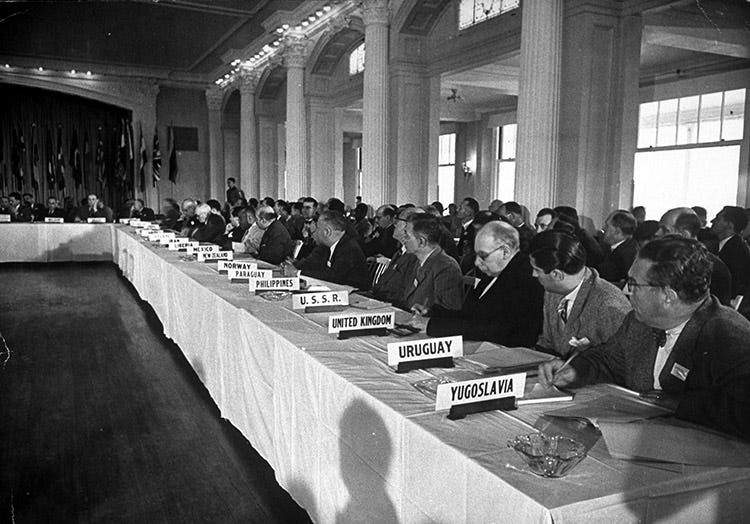
Delegates to the Bretton Woods Conference, 1944. Source: History Today.
Zoltan Poszar’s recent research note on the emergence of “Bretton Woods III” has attracted a considerbale amount of attention for a short, technical research note, but the fuss is understandable: Poszar, Credit Suisse’s head of short-term interest rate strategy, is an authority, and his argument, which he makes succinctly, is eye-catching – and particularly appealing to anyone with a commitment to cryptocurrency, for which Poszar predicts a potentially bright future. Poszar suggests that out of 2022 monetary shock - the sanctions imposed on Russia - the semi-stable “Bretton Woods II” regime that balanced on the monetary relationship between the US’ massive deficit and China’s massive surpluses, is now appearing a “Bretton Woods III”, based (in part) on a new commodity money system, with the renminbi at its centre, opposing the old credit money system of the US dollar.
The original Bretton Woods agreement
The periodisation is quite satisfying, not least because it cues up an understanding of each of these global monetary orders as subject to its defining contradiction. For Bretton Woods I, the actual Bretton Woods arrangements as put in place after the conference there of 1944, this was the inherent instability of making one currency – the dollar - the lynch-pin of a global system of fixed exchange rates, and then attempting to tie that currency to a gold “anchor” – the requirement that the Federal Reserve would always exchange dollars for gold, to anyone, US based or otherwise, at the fixed rate of $35/ounce.
The theory was that the (semi-)fixed exchange rates would remove the monetary instability of the interwar years, in combination with strict controls on capital, whilst the gold link to the dollar would stabilise its own value. In the immediate postwar years, this worked well: the US was a major exporter to the rest of the world – the foundation, in fact, of the entire industrialised system, having suffered less material destruction than Europe and Asia – and the overvaluation of the dollar relative to gold was not apparent.
The problem, as economist Robert Triffin first pointed out to a Congressional Committee in 1959, was that the status of the dollar as the reserve currency peg for the rest of the world was creating a persistent excess demand for dollars outside of the US. To supply this as the source of dollars,
...This excerpt is provided for preview purposes. Full article content is available on the original publication.