Is the Ukraine War an RMA?
Deep Dives
Explore related topics with these Wikipedia articles, rewritten for enjoyable reading:
-
Revolution in military affairs
13 min read
The article's central question is whether Ukraine represents an RMA. Understanding the historical concept of RMAs - from the introduction of gunpowder to nuclear weapons to precision-guided munitions - provides essential context for evaluating whether drone warfare constitutes a similar paradigm shift.
-
First-person view (radio control)
15 min read
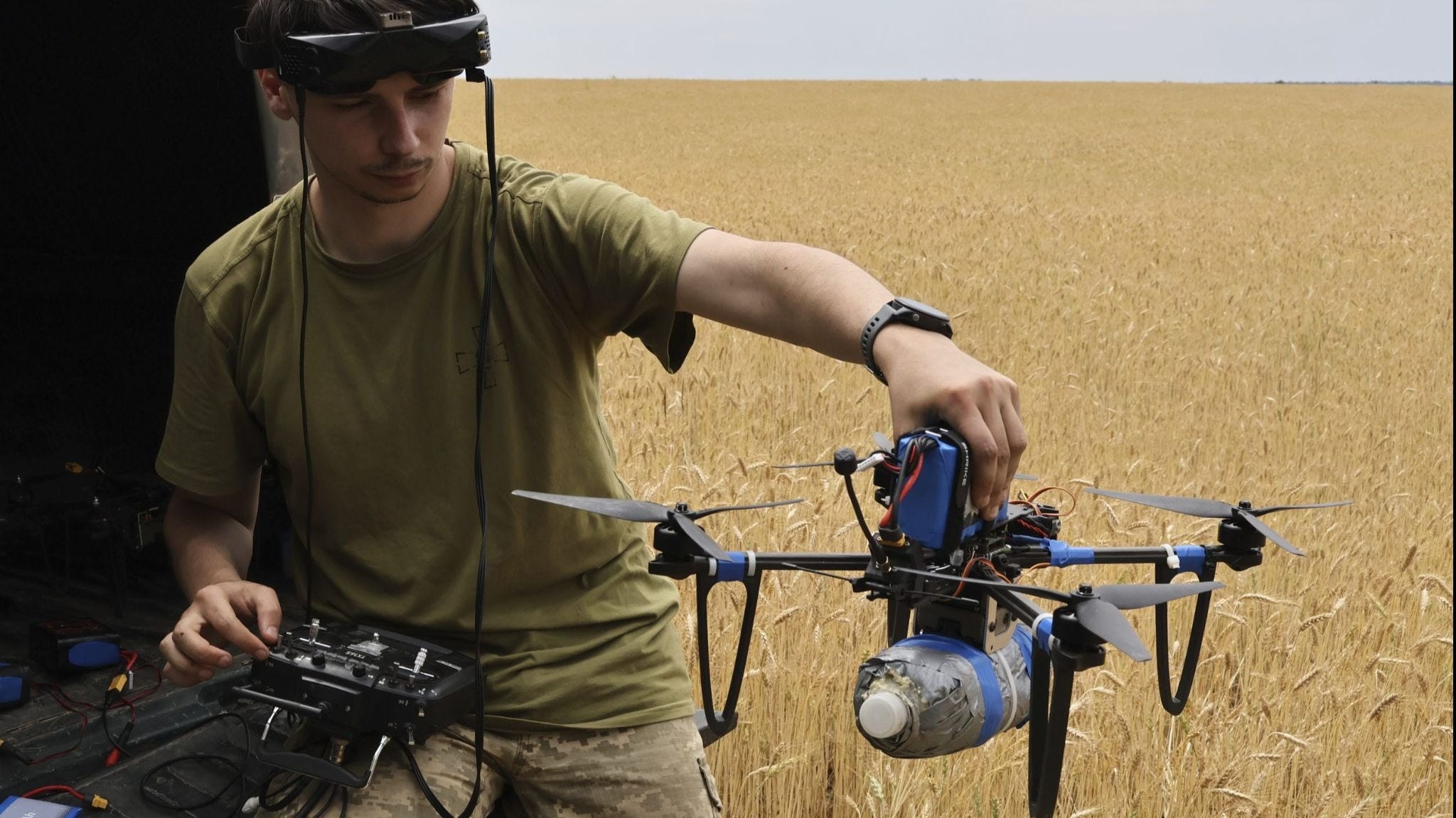
FPV drones are discussed extensively as the primary casualty-causing weapon in Ukraine. The technical details of how FPV systems work, their origins in hobbyist drone racing, and how they've been weaponized would help readers understand the technological transformation described in the article.
-
Kursk Oblast
16 min read
The article references Ukrainian operations in Kursk and fighting involving North Korean troops there. Understanding Kursk's geography, its historical significance (including the famous WWII tank battle), and its current role as a cross-border combat zone provides important context for the tactical discussions.
Rob Lee, a former Marine and Russia expert at FPRI, has spent significant time on the frontline in Ukraine. He joins Shashank Joshi, defense editor of The Economist and of Breaking Beijing and our newly minted Second Breakfast podcast to discuss the war in Ukraine, technology on the battlefield, and the future of warfare.
Today, our conversation covers:
Whether Ukraine represents a revolution in military affairs and what lessons the war holds for other theaters
Why 80% of casualties in Ukraine are caused by UAVs,
The limits of FPVs and UAVs, tactics to counter UAV attacks, and the role of unmanned ground vehicles,
Institutional friction within the Ukrainian forces,
How Chinese components and commercial drones from DJI are shaping the battlefield.
Drone incidents over Europe, burden sharing, and what NATO is learning from the war,
Plus: what music Ukrainian soldiers are listening to on the battlefield.
Thanks to the Hudson Institute Center for Defense Concepts and Technology for sponsoring this show.
Listen now on iTunes, Spotify, or your favorite podcast app.
A Transparent Battlefield
Jordan Schneider: A defense-tech talking point is that 70% of casualties on the battlefield today are caused by drones. Rob, what should we make of that?
Rob Lee: We should question statistics when they don’t have a clear source, because they anchor our views of modern warfare. Are the percentages authoritative? Are they replicable in other conflicts?
I visited the front line in Ukraine last summer and spoke with more than 15 battalion and brigade commanders, or their intelligence officers (S-2s). I asked each the same question, “What percentage of current casualties are from Unmanned Aerial Systems (UAS)?” 80% was the most common answer, with a range of 75-95%. This is the number cited by senior Ukrainian officials, like Pavlo Palisa.
Artillery and UAS are complementary, so it’s hard to distinguish between them. In many cases, artillery is important for destroying tree lines, which allows UAS to drop grenades on exposed troops. Artillery also helps to canalize Russian units — Russian infantry avoids open fields, sticking to tree lines. UAS can then drop mines to funnel them in a specific direction — there’s a profound psychological effect of having a 155mm or 152mm shell land near you. Artillery isn’t obsolete. Commanders of elite UAS units said that although UAS cause more than 50% of casualties, they do not operate
...This excerpt is provided for preview purposes. Full article content is available on the original publication.