The 'Toy Story' You Remember
Deep Dives
Explore related topics with these Wikipedia articles, rewritten for enjoyable reading:
-
Film grain
1 min read
Central to the article's thesis about how Toy Story's original 35mm release looked fundamentally different from modern digital transfers. Understanding film grain explains why the analog-to-digital transition changed the visual character of these films.
-
Digital intermediate
1 min read
The article describes the technical process of transferring digital animation to film and back. Digital intermediate is the professional term for this workflow and explains the broader industry transition from analog to digital mastering.
-
Cathode ray tube
17 min read
The article specifically mentions that Toy Story frames were exposed using CRT screens displaying red, green, and blue separations. Understanding CRT technology illuminates why this painstaking nine-hours-per-30-seconds process was necessary before digital projection existed.
Welcome! Glad you could join us for another Sunday edition of the Animation Obsessive newsletter. This is our slate:
1) Digital animation on film stock.
2) Animation newsbits.
With that, let’s go!
1 – The hybrid
Toy Story used to look different. It’s a little tricky to explain.
Back in 1995, CG animation was the topic in the industry, and Pixar was central to the hype. The studio had already shifted Disney to computers and won the first Oscar for a CG short (Tin Toy). Giant movies like Jurassic Park incorporated Pixar’s software.
The next step was Toy Story, billed as the first animated feature to go all-CG.1 Even after Pixar’s successes, that was a risk. Would a fully digital movie sell tickets?
It clearly worked out. Toy Story appeared 30 years ago this month — and its popularity created the animation world that exists now. A new process took over the business.
But not entirely new — not at first. There was something old about Toy Story’s tech, too, back in 1995. Pixar made the thing with computers, but it still needed to screen in theaters. And computers couldn’t really do that yet. From its early years, Pixar had relied on physical film stock. According to authors Bill Kinder and Bobbie O’Steen:
[Pixar’s Ed] Catmull recognized that his studio’s pixels needed to merge with that world-standard distribution freeway, 35 mm film. Computer chips were not fast enough, nor disks large enough, nor compression sophisticated enough to display even 30 minutes of standard-definition motion pictures. It was axiomatic that for a filmgoing audience to be going to a film, it would be a... film.2
Toy Story was a transitional project. Since Pixar couldn’t send digital data to theaters, every one of the movie’s frames was printed on analog film. When Toy Story originally hit home video, that 35 mm version was its source. Only years later, after technology advanced, did Pixar start doing digital transfers — cutting out the middleman. And Toy Story’s look changed with the era.3
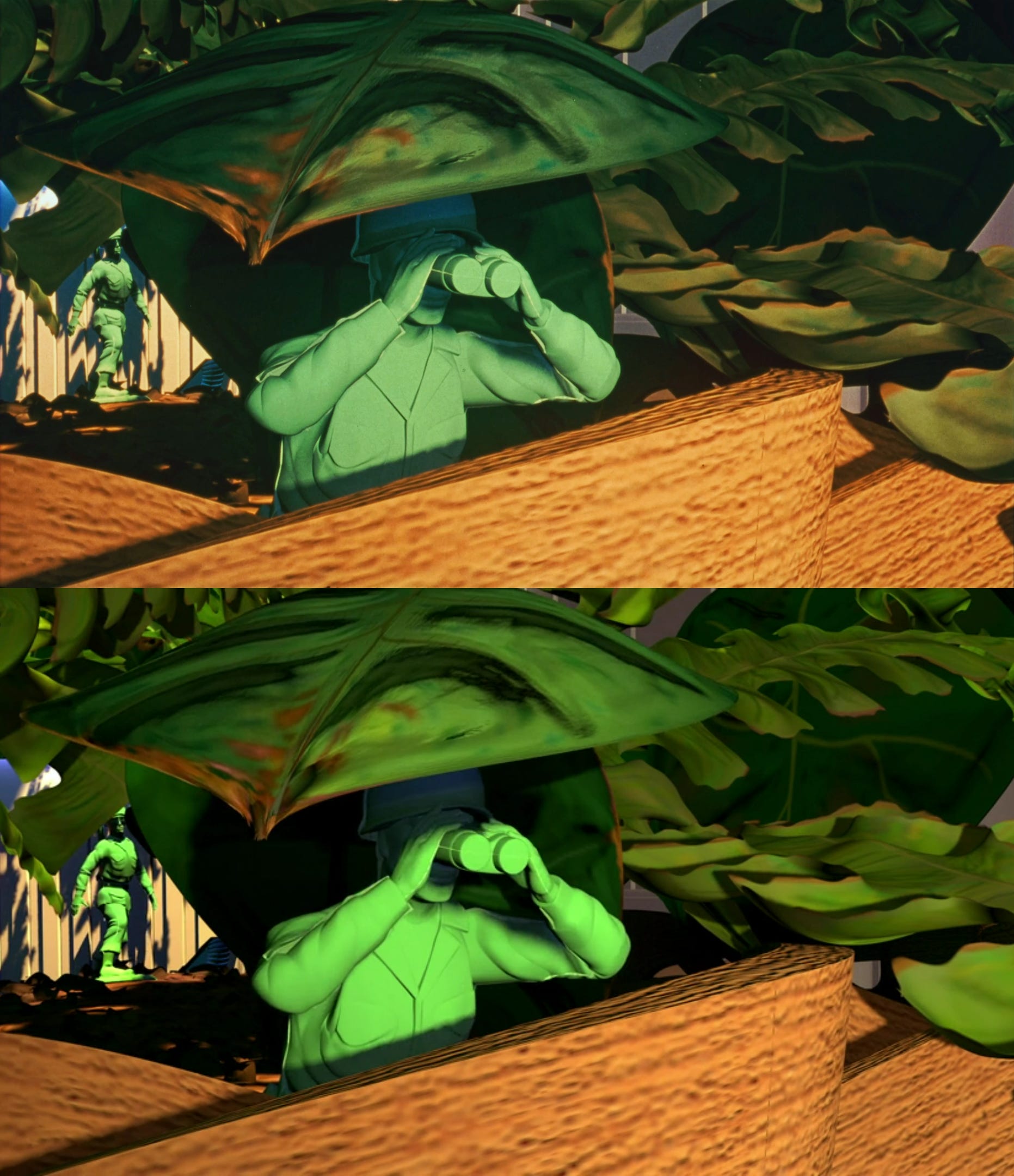
While making Toy Story, Pixar’s team knew that the grain, softness, colors and contrasts of analog film weren’t
...This excerpt is provided for preview purposes. Full article content is available on the original publication.