The article centers on RCP8.5 and its validity as a climate scenario. Understanding what Representative Concentration Pathways are, how they were developed, and their role in IPCC assessments provides essential context for the debate about whether RCP8.5 represents a plausible future or an implausible worst case.
The article discusses SSP5-RCP8.5 and SSP1-Sustainability extensively. Shared Socioeconomic Pathways are the framework that replaced earlier SRES scenarios and combine with RCPs to create the scenarios used in modern climate research. Understanding SSPs is crucial to grasping the scenario debate.
The article concludes with discussion of how individual integrated assessment models have outsized influence on climate projections. Understanding what these models are, how they combine economic, energy, and climate systems, and their limitations illuminates the methodological critiques raised in the article.
“Who controls the past controls the future: who controls the present controls the past” — George Orwell, 1984
Last week in Belém, Brazil the 30th Conference of Parties to the U.N Framework Convention on Climate Change (UNFCCC) concluded with little accomplished, according to most observers.
Perhaps the most significant accomplishment was formalizing a fully Orwellian characterization of the recent history of climate policy — See my post last week for why the UNFCCC characterization of moderating trends in climate projections is straight up misinformation.
Below is an excerpt from the COP30 agreement that turns flawed scenarios into policy success:
Acknowledges that significant collective progress towards the Paris Agreement temperature goal has been made, from an expected global temperature increase of more than 4 °C according to some projections prior to the adoption of the Agreement to an increase in the range of 2.3–2.5 °C and a bending of the emission curve based on the full implementation of the latest nationally determined contributions, while noting that this is not sufficient to achieve the temperature goal;
Today, I ask and answer — When should the climate community have first recognized that its projections of future climate change were based on flawed scenarios and taken action to correct course?
The answer, in short, is 2017.
That’s when Justin Ritchie and Hadi Dowlatabadi published their seminal paper:1
Ritchie, J., & Dowlatabadi, H. (2017). Why do climate change scenarios return to coal? Energy, 140:1276-1291.2
That paper altered the trajectory of my own work on climate. It found that the scenarios underpinning essentially all of projective climate research and the basis for the IPCC assessments were fundamentally flawed.3
They argued:
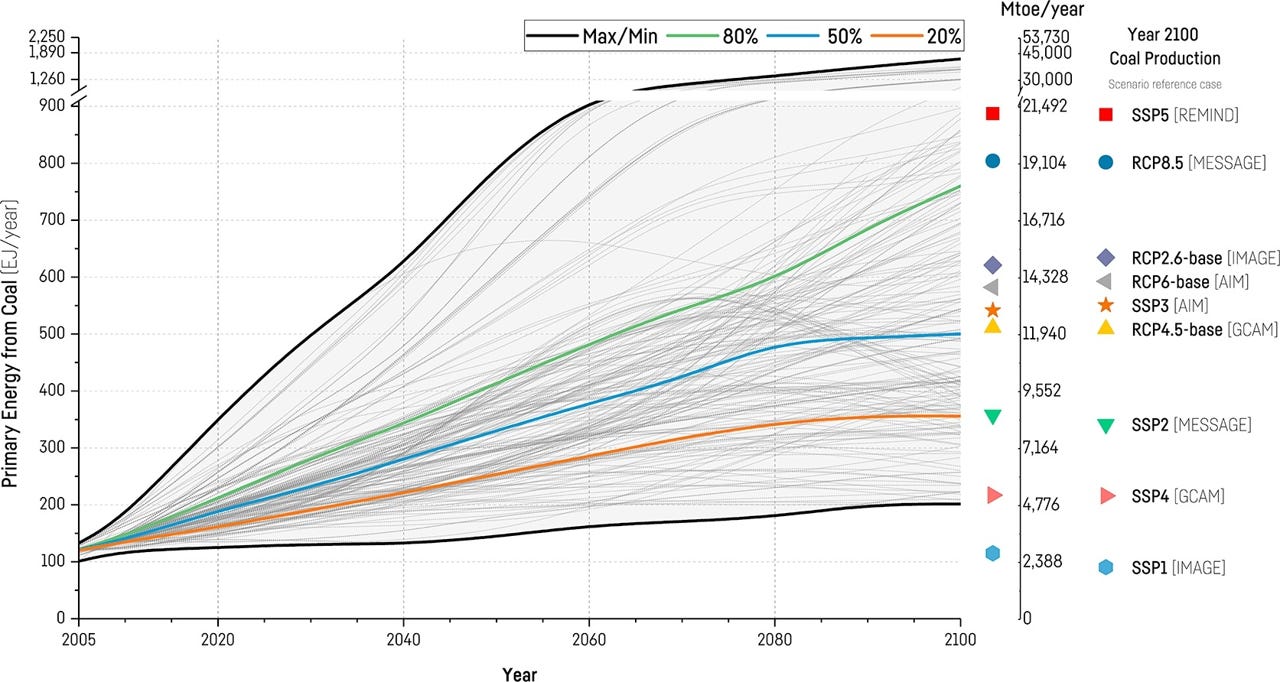
Thousands of scenarios, one common assumption — Coal consumption goes up, up, up. Source: Ritchie and Dowlatabadi 2017.
This paper finds climate change scenarios anticipate a transition toward coal because of systematic errors in fossil production outlooks based on total geologic assessments like the LBE model. Such blind spots have distorted uncertainty ranges for long-run primary energy since the 1970s and continue to influence the levels of future climate change selected for the SSP-RCP scenario framework. Accounting for this bias indicates RCP8.5 and other ‘business-as-usual scenarios’ consistent with high CO2 forcing from vast future coal combustion are exceptionally unlikely. Therefore, SSP5-RCP8.5 should not be a priority for future scientific research or a benchmark for policy studies.