I think India can do it
Deep Dives
Explore related topics with these Wikipedia articles, rewritten for enjoyable reading:
-
List of countries by GDP (PPP) per capita
10 min read
Linked in the article (5 min read)
-
Economic liberalisation in India
15 min read
The article references India's 'big economic reforms happened in 1991' as a pivotal moment comparable to China's 1979 reforms. This Wikipedia article details those specific liberalization policies that transformed India from a socialist planned economy to a market-oriented one, providing essential context for understanding India's growth trajectory.
-
Four Asian Tigers
13 min read
The article discusses India's potential to replicate the rapid industrialization seen in South Korea and references 'manufacturing miracles' driven by women's labor migration. The Four Asian Tigers (Hong Kong, Singapore, South Korea, Taiwan) represent the specific economic development model India is attempting to follow, with detailed historical context on how these economies achieved rapid growth.
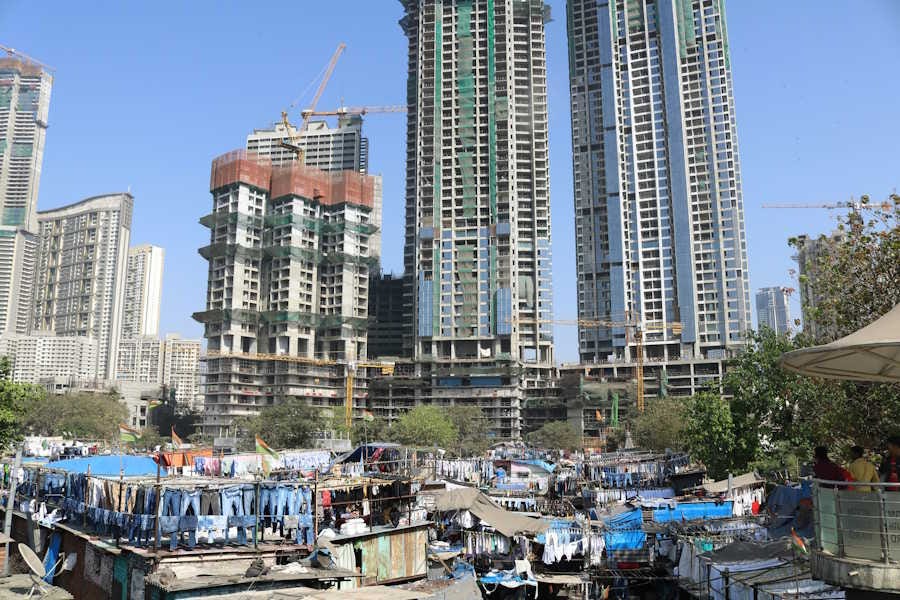
In 2004, The Economist predicted that India’s economic growth rate would overtake China’s in two decades. In 2010, in an article called “India’s surprising growth miracle”, they shortened that timeline dramatically, declaring that India might overtake China in terms of GDP growth as early as “2013, if not before”.
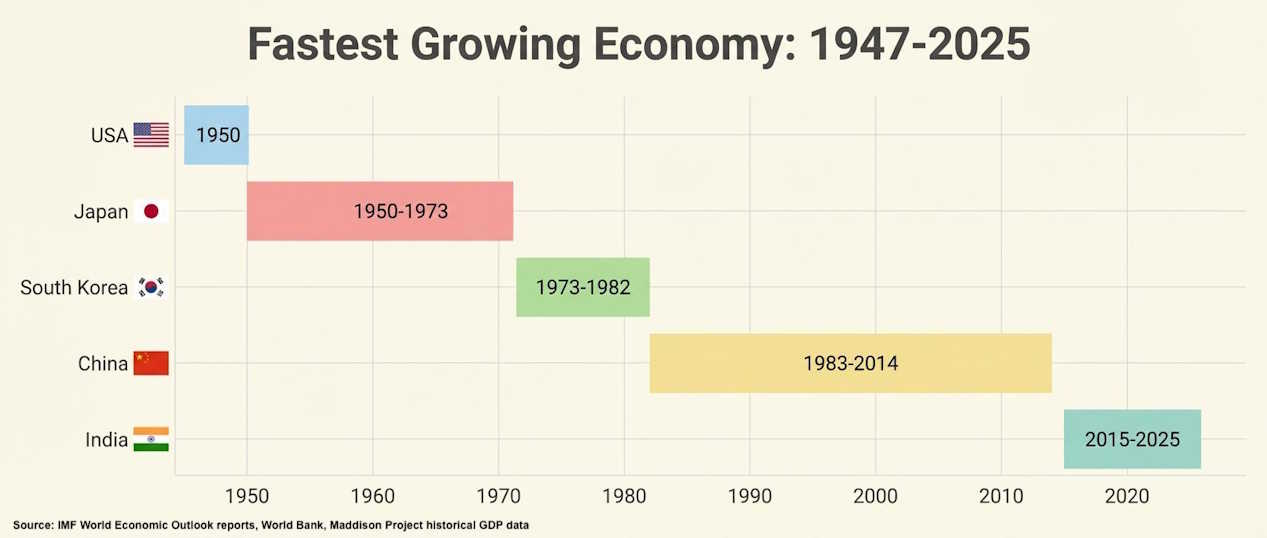
In the end, it took two years longer. Since 2015, India has been the world’s fastest-growing major economy, taking the crown from China:
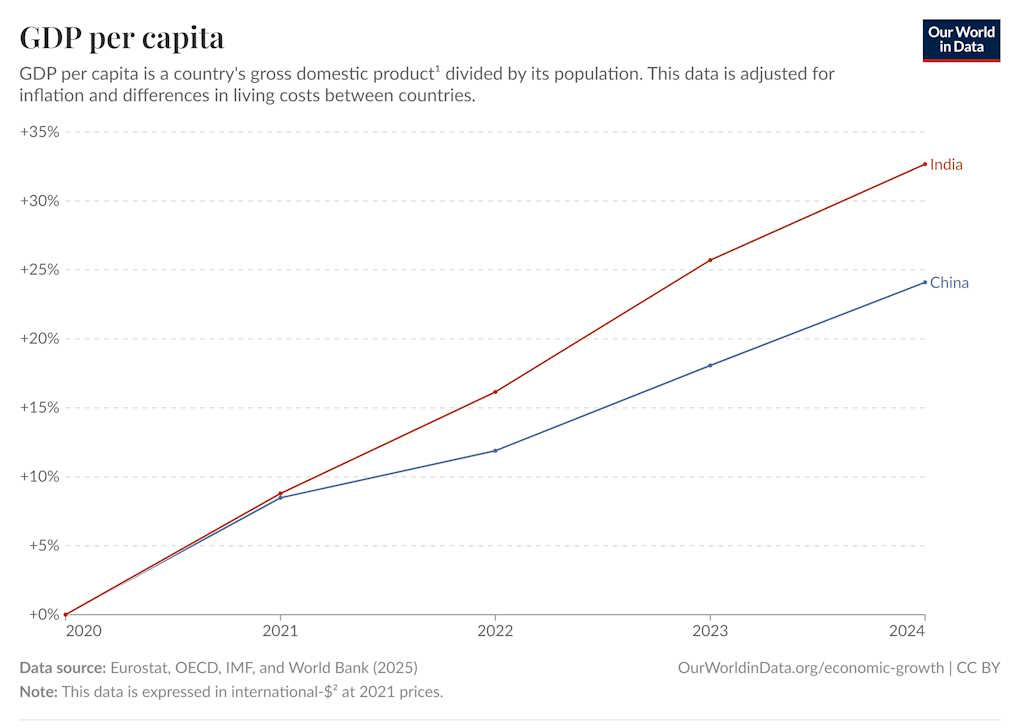
As The Economist noted, this is partly due to India’s more rapid population growth. If we want to look at living standards, we should look at per capita GDP (PPP). Here, India didn’t overtake China until after the pandemic:
India continues to turn in strong growth performances. In the third quarter of this year, it grew at 8.2%, up from 7.8% the previous quarter:
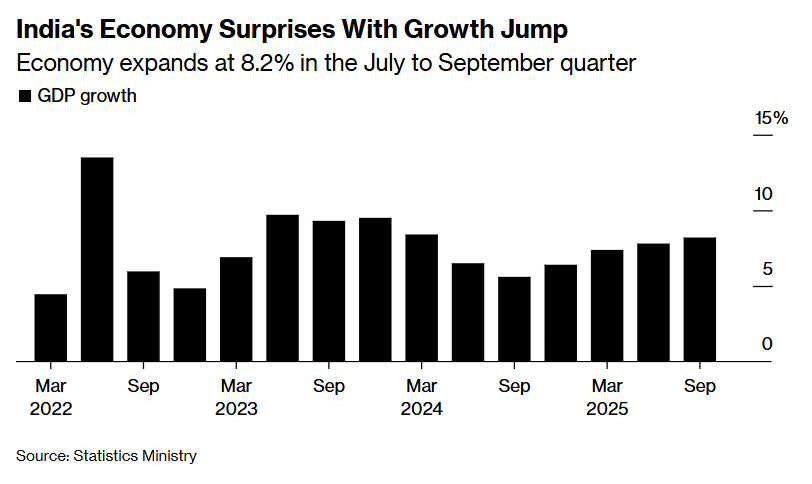
India’s population is growing at a little less than 1% a year, so this roughly corresponds to a per capita growth rate of around 7.2% or 7.3%.
That sort of growth rate is less than South Korea or China managed during their heydays of industrialization. From 1991 to 2013, China’s per capita GDP (PPP) grew at an annualized rate of 9.4%. But 7.2% would still be enough to utterly transform India in just a short space of time.
According to the IMF, India has a per capita GDP (PPP) of $12,101 as of 2025. Thirteen years of growth at 7.2% would bring that to $29,878 — a little higher than where China is today. That’s interesting, because India’s big economic reforms happened in 1991 — twelve years after China’s. Two decades of 7.2% growth would bring India to $48,609 — about as rich as Hungary or Portugal today.
In other words, if India keeps growing as fast as it’s growing right now, it will be a developed country before kids born today are out of college.
Consider even the more modest scenario in which India grows at the same rate it’s been growing over the past decade — about 5.4% in real per capita PPP terms. Fifteen more years of that growth rate would bring India to $26,633 — about where China and Thailand are today. Twenty years, and it would be $34,644 — about the same as Chile.
This is all a big “if”, of course. When I threw out some optimistic
...This excerpt is provided for preview purposes. Full article content is available on the original publication.