The Divine Enfant Terrible
Deep Dives
Explore related topics with these Wikipedia articles, rewritten for enjoyable reading:
-
Infancy Gospel of Thomas
11 min read
The article extensively discusses this second-century apocryphal text as the source material for the film, comparing how the original depicts a young Jesus who curses people versus the film's more subdued portrayal
-
The Last Temptation of Christ (film)
15 min read
The article draws significant parallels between this Scorsese film and The Carpenter's Son, discussing how both depict a humanized Christ tempted by Satan. The controversy and theological implications of this 1988 film inform the article's analysis.
-
The Passion of the Christ
16 min read
The article explicitly compares The Carpenter's Son's visual style, lighting, and score to Mel Gibson's film, particularly the Garden of Gethsemane sequence. Understanding Gibson's approach to depicting Christ helps contextualize the newer film's aesthetic choices.
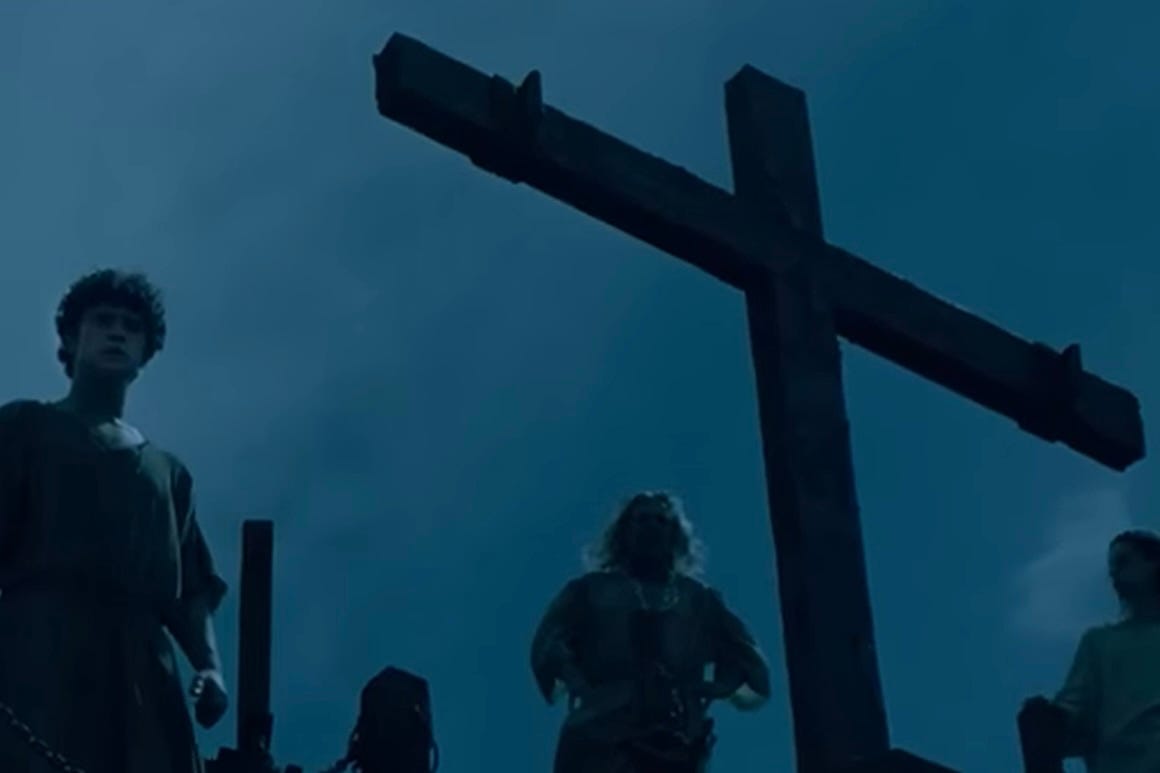
A long lineage of Jesus films depicts Christ as almost otherworldly, serene, and calmly removed from the people around him. Movies like Cecil B. DeMille’s The King of Kings (1927) depict Jesus as bathed in a soft glow of light, and as he moves through Jerusalem he seems to barely touch the ground. While Christian doctrine professes that Jesus is both fully divine and fully human, depictions of him in film almost always place a heavy thumb on the scale of divinity. There have been a few notable exceptions — and it’s within this counter-stream of Jesus films that Lotfy Nathan’s The Carpenter’s Son fits most squarely. It depicts a world filtered through horror and a deeply human Christ, both of which are uncommon but not unique within the canon of Jesus films. Despite its connection to this interesting lineage, The Carpenter’s Son remains a rather surface-level exploration, shying away from some of the more disturbing issues it hints at.
The film narrates the lost years of Jesus’ childhood, telling the story of a 15-year-old boy (Noah Jupe) who knows he’s not like the other children but isn’t quite sure what he is. He’s called the Boy in the credits, and not referred to as Jesus until the film’s climax. His father, the Carpenter (Nicolas Cage), is in equally turmoil, unsure whether his child is “of the angels” or a spawn of the devil. Regardless, the Carpenter recognizes the power and danger of the Boy, and does everything he can to protect the world until his son gains enough maturity to understand his powers. The Boy finds himself drawn to a peer (The Stranger, Isla Johnston) who refuses to go to school and entices him to commit violations of ritual law, such as touching a sleeping leper. While the identity of this Stranger is treated as a major reveal, it’s pretty obvious from the beginning who the Boy is palling around with. This becomes the overriding question of the story: Will the Boy follow his father’s advice and grow into a pious believer, or follow the Stranger down a different path?
At the start of the film, a Blair Witch-style title card informs us that a number of other Gospels filled in the narrative gaps that the four canonical Gospels left behind. We then learn that what we are about to witness
...This excerpt is provided for preview purposes. Full article content is available on the original publication.