Can Germany Become Europe's Missile Superpower
Deep Dives
Explore related topics with these Wikipedia articles, rewritten for enjoyable reading:
-
Mark 41 vertical launching system
1 min read
The article references German frigates equipped with MK41 VLS cells as the delivery platform for naval Tomahawks. Understanding this modular launch system explains why certain ships can carry cruise missiles and how NATO standardization enables weapons interoperability.
-
German Navy
13 min read
The article discusses F123 and F124 class frigates and Germany's naval strike capabilities. Understanding the modern German Navy's structure, current fleet composition, and post-Cold War evolution provides important context for assessing Germany's maritime power projection ambitions.
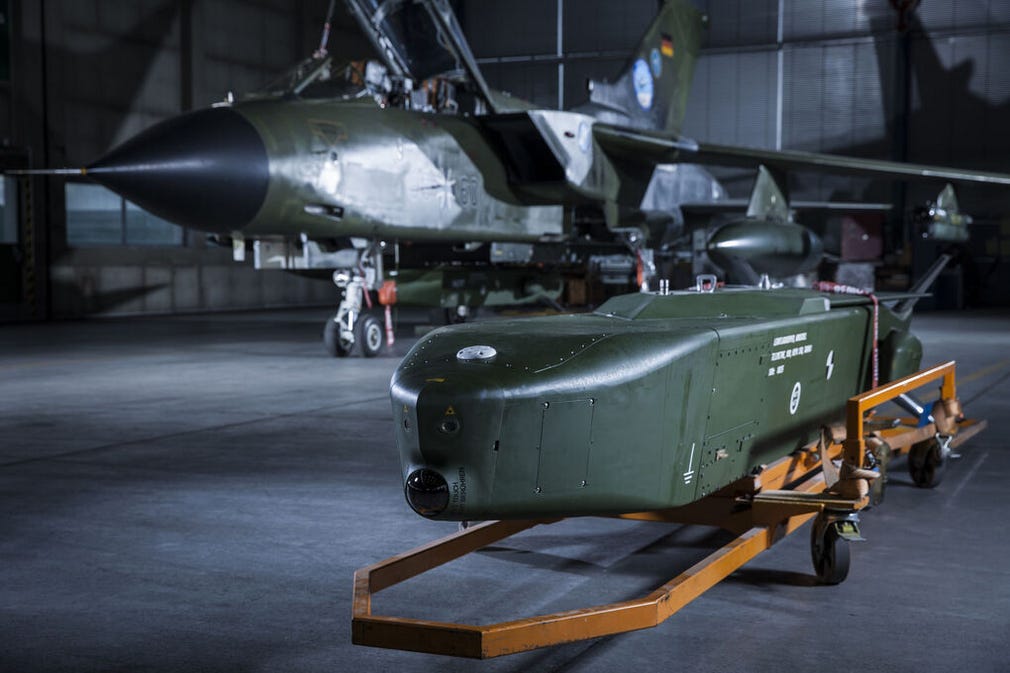
Picture: MBDA Germany
Earlier this year, German Chancellor Friedrich Merz announced his ambition to make the Bundeswehr the strongest conventional military in Europe, pledging “all the financial resources it needs.” With the debt brake reformed and the floodgates of military spending opened, this ambition now appears within reach.
One area long neglected in German defense spending is conventional long-range strike weapons. That, however, finally seems to be changing. This post reviews Germany’s announced and ongoing procurement projects in the conventional long-range strike domain.
Tomahawks for the Bundeswehr?
According to a list obtained by Politico, Germany plans to procure 400 Tomahawk Block Vb cruise missiles for roughly €1.15 billion. These Tomahawks would be divided between land- and sea-based components.
For the German Navy, Tomahawk would serve as an interim capability to meet its deep-strike requirement in the near to medium term, until the 3SM “Tyrfing”, a land-attack cruise missile currently in joint development with Norway, enters service in the mid-2030s. Tomahawk missiles would presumably be deployed aboard F123 and F124 class frigates, which are equipped with 16 and 32 MK41 vertical launch system (VLS) cells, respectively.
In total, the German Navy operates four F123 and three F124 class frigates, providing up to 160 VLS cells at sea if all vessels are deployed simultaneously. Assuming a Tomahawk loadout share of 20 to 30 percent, which is typical for U.S. Navy ships, the German Navy might have between 30 and 50 missiles at sea at any given time. That said, it is unlikely that the entire fleet would be deployed for strike missions simultaneously.
The Politico article also indicates that Germany is interested in acquiring three ground-based Typhon launchers for €220 million. Given the price tag, it is likely that the list refers to three Typhon batteries, each consisting of four launchers, one Battery Operations Center, and associated support vehicles. With each launcher capable of carrying up to four Tomahawks, this would theoretically allow for up to 144 ground-based launches at a time, though salvos of this size would be unlikely in practice.
The Block Vb Tomahawk, which the Bundeswehr appears to be interested in, is one of three Block V variants and comes equipped with the Joint Multiple Effects Warhead System (JMEWS), which combines a primary shaped charge with a secondary penetrator warhead, providing the missile with hard-target kill capability.
This is a somewhat peculiar choice, as the Bundeswehr’s hard-target kill
...This excerpt is provided for preview purposes. Full article content is available on the original publication.