Why open networks win
What if the greatest breakthroughs in human history weren’t new inventions, but the simple removal of friction? We are trained to look for the next revolutionary product. We almost always overlook the invisible, boring standards that allow thousands of new products to exist.
This is a story about that hidden architecture. It’s about why the battle for the future isn’t about building a better thing — it’s about agreeing on the rules that let everything connect.
It’s a battle that repeats in every era, and today it’s being waged over the operating system for human ambition itself: money.
The most dangerous move isn’t falling behind on technology. The most dangerous move is to accept a “modern” solution that’s just a prettier cage.
The beginning
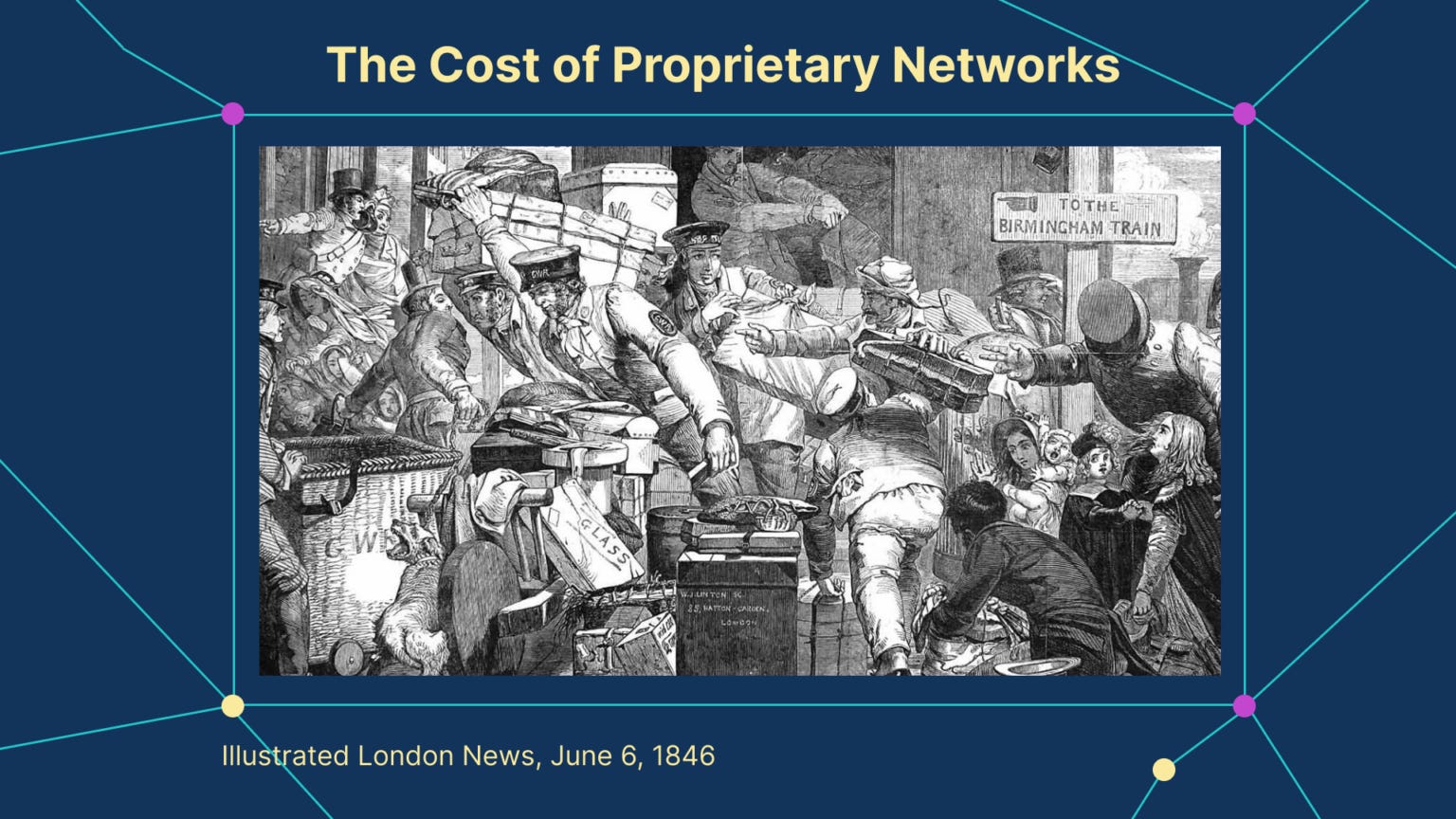
Our story begins not with an invention, but with a maddening, costly, and completely unnecessary stop.
In 1885, a passenger traveling across England — say, from London to Wales — would arrive at the station in Gloucester, disembark, and find herself stranded. Her journey was not over, but her train’s was. To continue, she would have to navigate a chaotic platform, haul her luggage to a separate station, and buy a new ticket for a different company’s train, one that ran on tracks just a few inches wider.
Nearby, a merchant might watch in despair as his cargo of fragile pottery was unloaded from one car and manually reloaded onto another, the cost of breakage and delay eating into any potential profit.
This was the daily, maddening reality of a closed system. In 19th-century Britain and America, railways were a fragmented patchwork of private lines, each with its own incompatible track gauge. It was a failure of coordination that held entire economies captive, levying a hidden tax on every person and every piece of cargo.
Then, over a single, frantic weekend in 1886, thousands of workers across the American South set out to fix the impossible. In a near-miraculous feat of coordination, they manually adjusted 13,000 miles of track to a national standard. By Monday morning, trains rolled uninterrupted from the Atlantic to the Mississippi. The result was immediate: Traffic rose 20% almost overnight. They chose a two-day sprint of relentless work to build a century of frictionless progress.
This chaotic, costly, and ultimately necessary act of standardization is not a historical curiosity. It is the central, repeating drama of human progress. In every era, we
...This excerpt is provided for preview purposes. Full article content is available on the original publication.