The Private Governments Who Will Resist Zohran Mamdani and Populism
Deep Dives
Explore related topics with these Wikipedia articles, rewritten for enjoyable reading:
-
Lina Khan
15 min read
Khan is mentioned as one of Mamdani's transition co-chairs and is described as an 'anti-monopoly leader.' Understanding her background, her landmark paper on Amazon's antitrust implications, and her tenure as FTC Chair provides essential context for the article's central thesis about fighting private monopoly power.
-
Axon Enterprise
13 min read
The article extensively discusses Axon's monopolistic practices in body cameras and police equipment, including specific lawsuits from Baltimore, Augusta, and Howell. Understanding the company's history, acquisition strategy, and market dominance illuminates the 'private government' concept central to the article.
-
Natural monopoly
13 min read
The article describes multiple markets (fire trucks, emergency radios, transit buses, court software) where consolidation has led to monopoly pricing power over government purchasers. Understanding the economic theory of natural monopolies and how they differ from artificial monopolies helps readers evaluate when government intervention is warranted.
A few days ago, Zohran Mamdani got elected to be the mayor of New York City. Along with new governors-elect Mikie Sherrill in New Jersey and Abigail Spanberger in Virginia, as well as elected officials across smatterings of other states, and new Georgia public services commissioners Peter Hubbard and Alicia Johnson, this crop is the latest group with a mandate to do something about the anger Americans feel towards their society. And whether moderate, left-wing, or in-between, most, led by Mamdani, are saying they will do something about it.
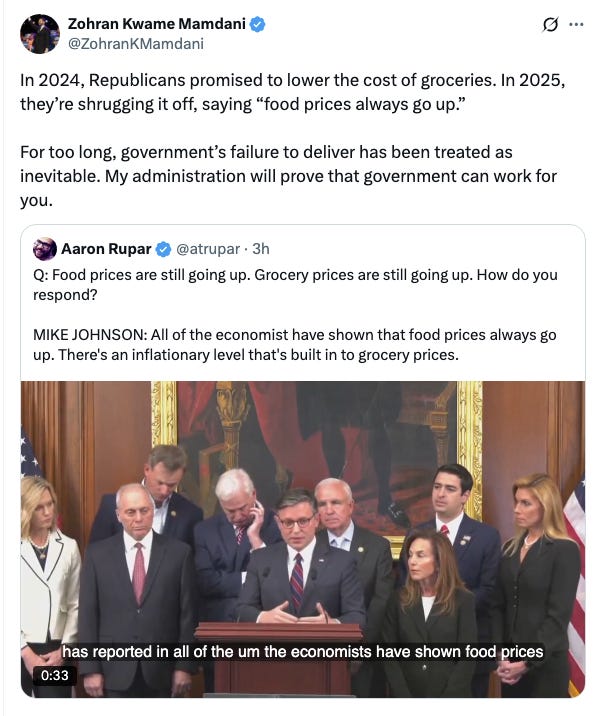
The challenges facing these leaders are profound, and they are not unique to this moment. In 2006, 2008, 2010, 2014, 2016, 2018, 2020, 2022, and 2024, voters threw the bums out, as the famous statement goes. They are likely to do so again in 2026, this time repudiating Donald Trump. And I think the reason is because most of our leaders are only looking at the public governments, not the private governments - aka commercial monopolies - that undergird them. To take a simple but powerful example, during Covid, it was Apple and Google, not governments, who set public health policy around contact tracing through their control of mobile privacy settings.
This shadow private governance model, controlled by financiers, is what Americans dislike. Obama and Trump saw this dynamic, and yet despite their anti-establishment political messaging, neither broke with the status quo on its alignment with Wall Street. Similarly, Nancy Pelosi in 2006 ran on Drain the Swamp, a message Trump re-used so effectively few remember Pelosi was there first. In fact, no one in the last 20 years has channeled the rage of voters with sufficient policy courage.
That’s why one of the more interesting dynamics at work in New York City is that Mamdani brought on anti-monopoly leader Lina Khan as one of his transition co-chairs. There are other signs. Mamdani is apparently going to maintain his political organizing machine, and has even launched a high-profile resume-gathering operation. (If you’re in NYC and are looking to do something interesting, you should consider applying…)
These dynamics lead to a question. Is there now a nascent unification of political populism with governing expertise? I don’t want to overstate the argument, since New York City governance is not something I know particularly well, and Mamdani has a whole lot of people giving him advice. We’ll know more when he starts hiring and
...This excerpt is provided for preview purposes. Full article content is available on the original publication.