What the special election in Tennessee says about the 2026 midterms
Deep Dives
Explore related topics with these Wikipedia articles, rewritten for enjoyable reading:
-
2018 United States House of Representatives elections
12 min read
The article repeatedly uses the 2018 'blue wave' midterms as the key benchmark for understanding current special election swings, making detailed knowledge of that election essential context
-
Gerrymandering in the United States
13 min read
The article discusses GOP 'ultra-gerrymanders' in Texas and Indiana pending Supreme Court decisions, and how Republicans may reconsider drawing partisan maps - understanding gerrymandering mechanics illuminates these strategic calculations
Voters in Tennessee’s 7th Congressional District voted on Tuesday, Dec. 2, to fill a vacancy left by Republican representative Mark Green, who resigned from Congress in July 2025. The election for this rural seat went for Republican candidate Matt Van Epps over Democratic candidate Aftyn Behn, with Van Epps having a 9-point margin in the vote as of 10:30 PM ET on Dec. 2. Some ballots are still being counted.
While Republicans held the seat, Van Epps’ 9-point margin is a significant shift to the left since 2024. Green won the seat by 21 points in 2024, and Donald Trump carried it by 22 points over Kamala Harris. Behn’s 9-point loss is a 13-point shift toward Democrats in a little under a year. The fact that a rural Tennessee district ended up just a high-single-digits win for Republicans should be a five-alarm fire for the party ahead of the 2026 midterms.
Specials keep pointing to a big Dem. win in 2026
Zooming out, the election on Tuesday confirms a broader trend in recent special elections to vacant congressional seats. Democratic candidates in special elections have been dramatically outperforming benchmarks based on the 2024 election. The result in TN-7 is 13 points less Republican than in 2024, in line with other congressional specials that have an average 17-point swing. And it is higher than other down-ballot special elections: Specials for state legislative seats have moved to the left at more like an 11-point clip in 2025.
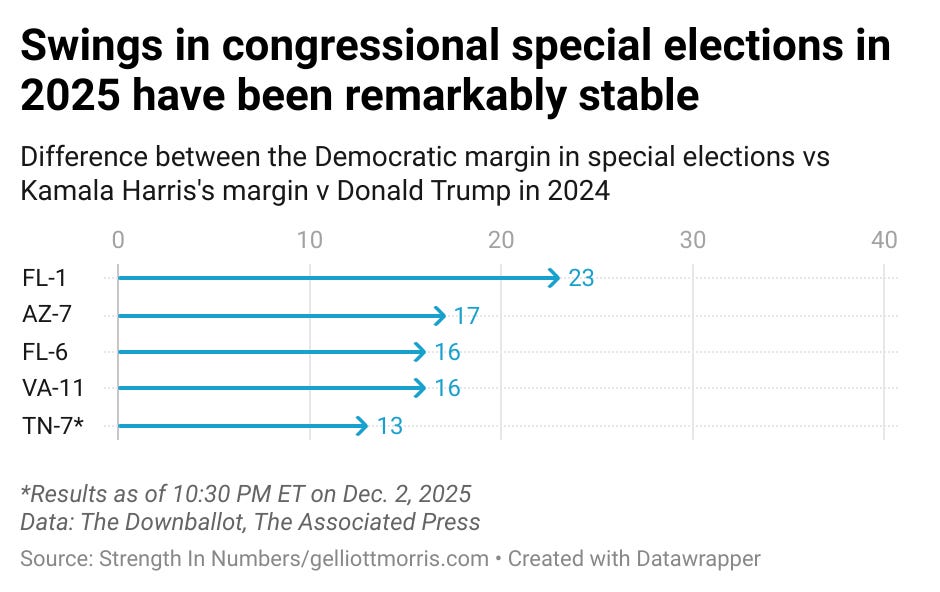
For context, in the 2018 midterm cycle, Democrats beat their benchmarks in special elections by about 11 points. They ended up winning the U.S. House popular vote by about 7 points, accounting for distorted vote totals in uncontested seats. That was an 8-point swing left since 2016.
Turnout in TN-07 was unusually high
But handicappers should be careful not to apply the full special-election swing when forecasting next year’s congressional midterms. Turnout in special elections tends to be much lower than in midterms, with lower-education voters and the party in control of the White House disproportionately staying home. This produces a sort of two-electorate dynamic to elections, where the voters turning out in specials are (currently) much more Democratic than those who vote in presidential races. Swings in specials tend to exaggerate subsequent swings in midterms.
Midterm turnout sits somewhere between turnout in special and presidential elections. In 2022, for example, voters across the
...This excerpt is provided for preview purposes. Full article content is available on the original publication.