Small Thrust, Big Questions: Why Europe is Falling Behind in Cruise Missile Engine Technology
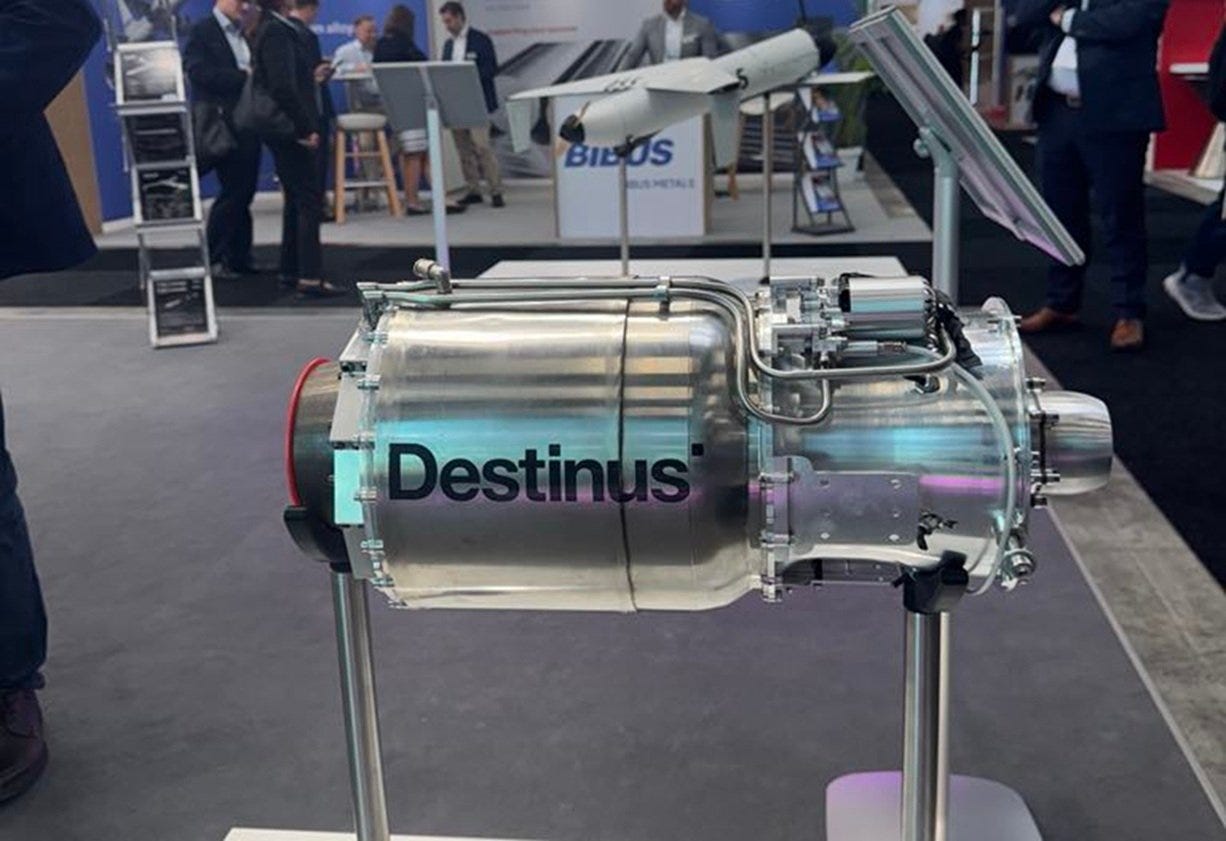
Picture: Destinus
Earlier this year, Czech engine manufacturer PBS announced a significant foreign direct investment in the United States. In the first phase, PBS will invest $20 million in a turbojet production facility in Roswell, Georgia. In the second phase, a further $90 million will be invested to scale production and relocate the supply chain to the United States.
While this investment is relatively small in the grand scheme of things, especially compared to the multi-billion-dollar investment projects currently underway in the defense sector on both sides of the Atlantic, it is a bad sign for Europe. This post explains why.
Mini jet engines and cruise missile propulsion
Jet engines are power units that propel airborne vehicles. Unlike rocket motors, which carry their own oxidizer, jet engines make use of surrounding air drawn in through an inlet. Inside the engine, this air is compressed, mixed with fuel, and ignited, producing thrust that propels the vehicle forward.
Jet engines are a critical and arguably the most complex component of the cruise missile supply chain. While jet engine production is demanding in general, the miniaturization required to fit one inside a cruise missile presents an additional challenge.
In general, two types of jet engines exist: turbojet and turbofan engines. In a turbojet engine, nearly all the drawn-in air passes through and is accelerated in the engine core, which makes it more efficient at supersonic speeds. In contrast, in a turbofan engine, only part of the drawn-in air is directed through the core while the rest bypasses it via a fan at the front of the engine, generating additional thrust with greater fuel efficiency at subsonic speeds.
Because of this, subsonic cruise missiles powered by turbofan engines generally achieve greater range than subsonic cruise missiles of similar size powered by turbojet engines. Most existing subsonic cruise missiles, however, use turbojets, as turbofans are more difficult to produce and require more advanced materials and manufacturing to handle the fan stage, bypass ducting, and airflow management.
Military-grade and dual-use mini jet engines
Broadly speaking, three types of miniature jet engines are used in cruise missiles today.
First, there are high-end, relatively large turbojet and turbofan engines capable of generating significant thrust, typically in the range of 3 to 6 kilonewtons. This level of thrust is necessary to sustain high speed in ground-skimming trajectories where atmospheric density and terrain-following maneuvers create drag and slow the missile
...This excerpt is provided for preview purposes. Full article content is available on the original publication.