The Big Shift in Cardiology to Atheroma and Inflammation
Deep Dives
Explore related topics with these Wikipedia articles, rewritten for enjoyable reading:
-
Atheroma
12 min read
The central subject of the article's 'big shift' - understanding the pathophysiology of fatty deposits in artery walls, their progression from childhood, and why vulnerable plaques rupture to cause heart attacks
-
Optical coherence tomography
15 min read
Key imaging technology discussed that allows visualization inside artery walls to identify vulnerable plaques - understanding how OCT works provides context for the shift from traditional angiograms to modern imaging
For the 4 decades that I’ve been a cardiologist, we’ve been obsessed with obstructive, blood flow-limiting narrowings and blockages in the coronary arteries, and using procedures like stenting and bypass surgery to fix them. This year we’ve gotten signals that a major shift is ongoing, from fixation on obstructive coronary artery disease (simply put “blockages”) to the focus on non-obstructive arterial disease (simply put “atheroma”), as visualized non-invasively to be high-risk, so-called vulnerable atherosclerotic plaque, and/or exhibiting inflammation (Figure below). This Ground Truths edition will take you through the evolution of the thinking and capabilities, with new non-invasive A.I. imaging, and new drugs, that may ultimately lead to a major reduction in heart attacks.

Early Thoughts on Heart Attack Elimination
The dream of eradicating heart attacks was articulated in 1996 in a Science editorial entitled: ”Heart Attacks: Gone with the Century?” It was written by Michael Brown and Joseph Goldstein, awarded the Nobel Prize in 1985 for their groundbreaking cholesterol metabolism work that led to statins. Although statins have helped reduce the risk of heart attack, we still have over 800,000 each year in the United States, which is similar to the data spanning 2012 to 2022, and heart disease remains the number 1 killer despite a marked reduction in death rates over the past 2 decades. Even with 1 in 4 Americans taking statins now, it’s clear we’re far away from their disappearance. One prescient note in the Science editorial was “The challenge is to develop noninvasive screening methods to detect coronary atherosclerosis in its earliest stages.”
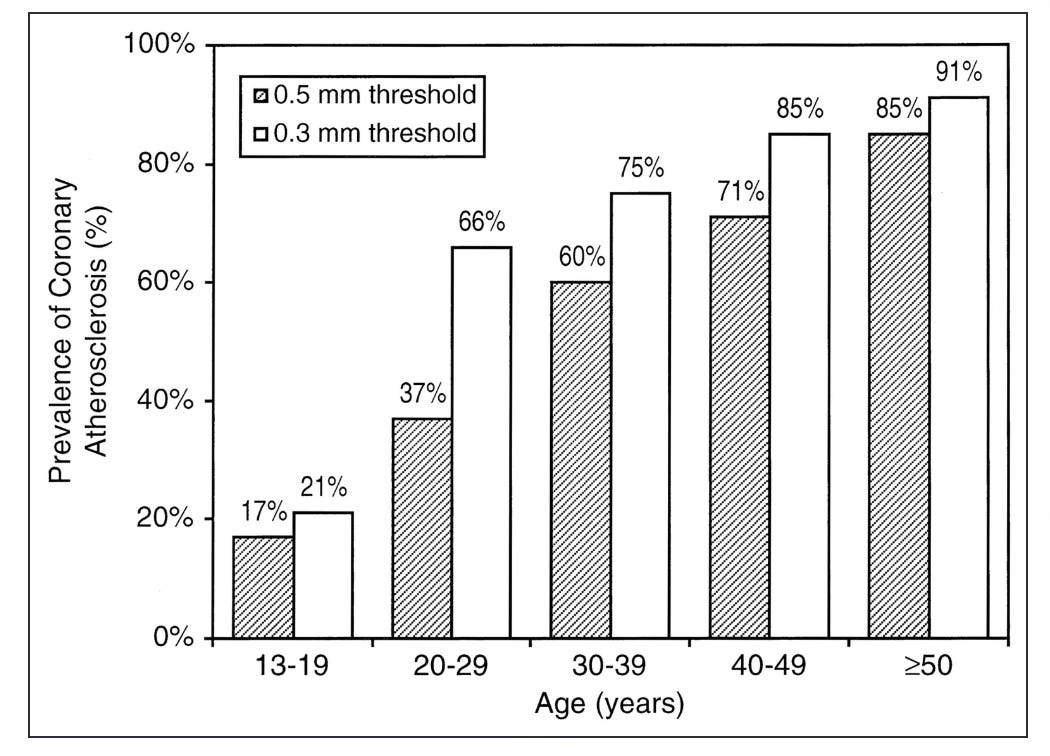
We’ve long known that it takes decades for atherosclerotic plaque to develop, as visualized to be prevalent (albeit not obstructive, i.e severe narrowing, blood flow-liming) at significant frequency in teenagers and young adults (Figure). Yes, it’s an age-related disease, but it typically starts very young.
Finding the Vulnerable Plaque
The pathology studies from post-mortem studies have provided clearcut features of arteries in heart attack victims. Chief among them is the thin fibrous cap of the atheroma (TCFA) plaque (Figure) which leaves it prone to erosion, cracking or rupture, the immediate event (usually accompanied by a blood clot) that precedes a heart attack. A lipid-rich necrotic plaque (dead cells, cellular debris, cholesterol and other lipids) is typically underneath
...This excerpt is provided for preview purposes. Full article content is available on the original publication.