How Can Outrageous CEO Pay be Stopped?
Deep Dives
Explore related topics with these Wikipedia articles, rewritten for enjoyable reading:
-
Share repurchase
14 min read
The article mentions CEOs linking pay to stock prices and cashing in when corporations buy back stock to pump share prices. Understanding the mechanics and controversy around stock buybacks is essential context for grasping how executive compensation has become disconnected from company performance.
-
Executive compensation in the United States
14 min read
Provides historical context for how CEO pay evolved from 20-30x worker pay in the 1960s-70s to 300x+ today, including the regulatory changes, tax policies, and corporate governance shifts that enabled this transformation.
-
Say on pay
14 min read
The article discusses how CEOs have 'rigged their boards' to award excessive pay. Say on pay provisions give shareholders a voice on executive compensation and represent one existing mechanism to address the problem Reich describes, providing useful policy context.
Friends,
As you know by now, I don’t like raising big problems without offering big potential solutions.
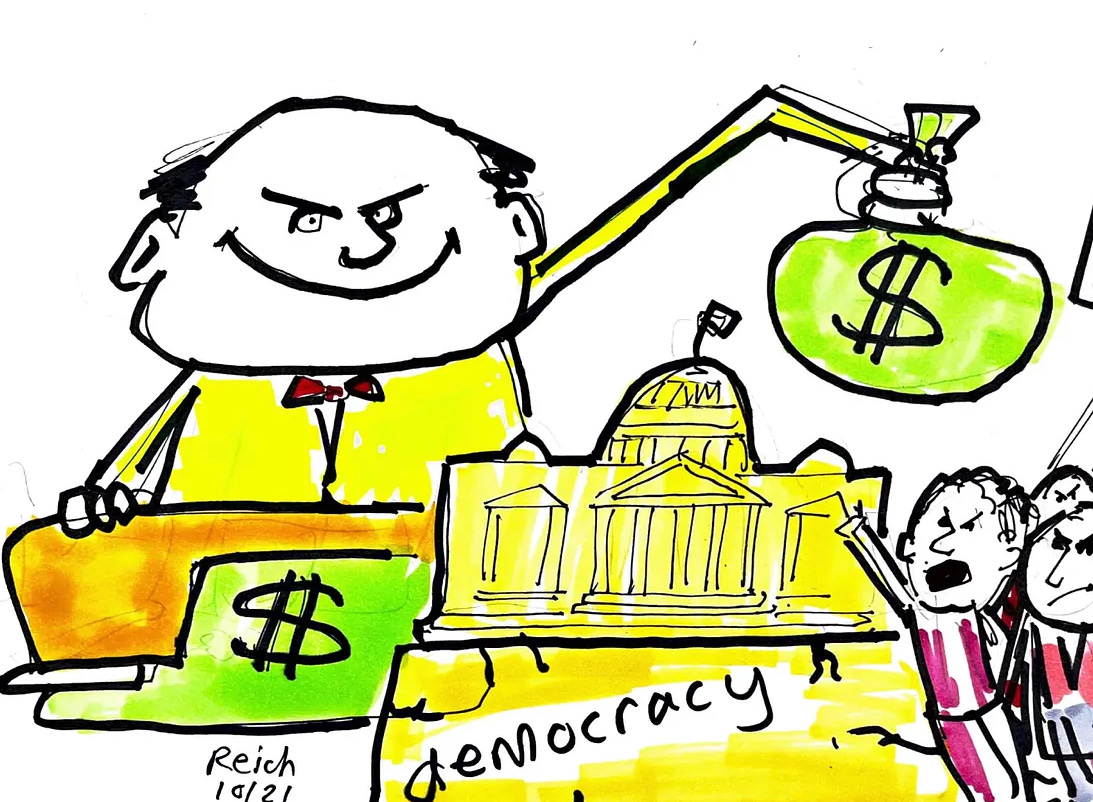
The big problem I want to talk about today is that CEO pay has become utterly untethered from reality.
When I was a young man in the 1960s and ’70s, CEOs typically made 20 to 30 times the pay of their workers. That was enough to reward leadership, but not so much as to distort the entire economy and alienate workers who could still aspire to the American Dream.
Today, the gap between CEO pay and the pay of average workers has exploded. The average CEO at a major corporation now takes home nearly 300 times what their employees earn.
In some cases, the disparity is so grotesque it defies belief. For example:
Walmart’s CEO raked in $27.4 million last year — 930 times the median Walmart worker’s $29,469 salary.
Coca-Cola’s CEO made $28 million — nearly 2,000 times what the average Coke worker earned ($14,144).
Starbucks’ CEO pocketed $95.8 million in 2024 — almost 3,000 times the typical barista salary of $32,000. (By the way, I urge you to boycott Starbucks until they agree to a first contract with their striking baristas.)
Tesla just approved a nearly $1 trillion pay package for Elon Musk — the world’s richest man (except for on September 10, 2025, when Oracle CEO Larry Ellison’s net worth briefly surpassed his). This pay package would make Musk the first trillionaire in history.
The problem isn’t just these ridiculous sums. It’s also what’s happening to ordinary workers.
Undervaluing their labor while overvaluing the labor of CEOs has fueled resentment, anger, disillusionment, and fear — creating conditions ripe for a demagogue to exploit. This is what helped give rise to Trump.
The yawning gap between the wealth of executives and the everyday people who generate that wealth is beyond obscene. The American people agree: A staggering 62% support setting caps on CEO pay relative to worker pay.
CEOs aren’t worth nearly what they’re raking in. They get these pay packages because they’ve rigged their boards to award them.
They’ve also linked their pay to their corporations’ stock prices — and they cash in when their corporations buy back their stock to pump up share prices.
It’s immoral. Even Pope Leo has noted these concerns: “CEOs that 60 years ago might have been making four to six times more than what
...This excerpt is provided for preview purposes. Full article content is available on the original publication.