Strap Rail
Deep Dives
Explore related topics with these Wikipedia articles, rewritten for enjoyable reading:
-
William Murdoch
14 min read
Linked in the article (26 min read)
-
Treaty of Paris (1783)
13 min read
Linked in the article (11 min read)
-
Steam locomotive
1 min read
Linked in the article (76 min read)
The early history of the United States runs along with the first years of the railroad. A small prototype of a steam-powered locomotive was first built by William Murdoch in 1784, just a year after the Treaty of Paris ended the Revolutionary War. The first working steam locomotive, Richard Trevithick’s Coalbrookdale Locomotive, was built in 1802, and the first public steam railway in the world, George Stephenson’s Locomotion No. 1, was built in 1825.
Early railroad development largely took place in the UK (Murdoch, Trevithick, and Stephenson all built their locomotives there), and early US locomotives were British imports. However, British locomotives were quickly found to have difficulties running on American railroads. British railroads were “models of a civil engineering enterprise”, having:
…carefully graded roadbeds, substantial tracks, and grand viaducts and tunnels to overcome natural obstacles. Easy grades and generous curves were the rule. Since capital was plentiful, distances short, and traffic density high, the British could afford to build splendid railways.
All this engineering came at a cost: early British railroads cost $179,000 per mile to build (though part of this was the cost of land). But because of Britain’s high population density, traffic was high, routes could be short, and so the costs could be recovered.
Conditions in the US were far different. Distances were large, populations were lower, and financing for large engineering projects was in short supply. As a result, US railroads evolved differently than British ones. Rather than being straight, American railroads tended to have winding routes that followed the curve of the land, and avoided tunnels, grading, or expensive civil engineering works. Instead of expensive stone bridges, US railroads used wooden trestles. Locomotives in the US needed to cope with steeper grades and much less robust track than in Britain, and thus needed to be designed differently
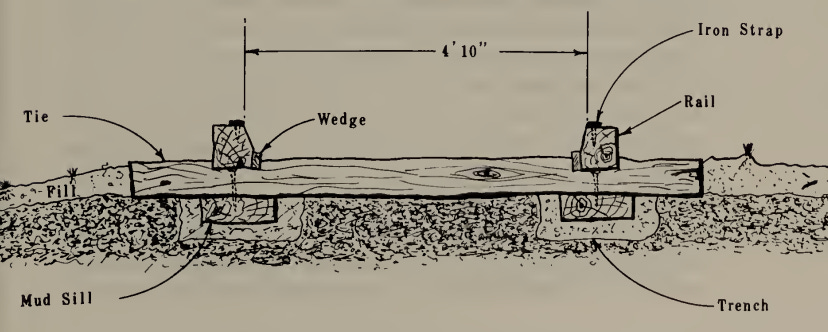
One interesting example of the different railroad conditions in the US and Britain is a railroad technology that was briefly popular for early US railroads: the strap rail track. British railroads were built with solid iron rails which, while effective, were expensive. Strap rail, by contrast, was built by attaching a thin plate of iron to the top of a piece of timber. This greatly reduced the amount of iron required to build railroad track — while British track required 91 tons of iron per mile, strap rail required just 25 tons.
This excerpt is provided for preview purposes. Full article content is available on the original publication.