Five Fundamental Truths About Decarbonization
Deep Dives
Explore related topics with these Wikipedia articles, rewritten for enjoyable reading:
-
Kaya identity
12 min read
The Kaya Identity is the central analytical framework of this article, used to decompose carbon emissions into population, GDP, energy intensity, and carbon intensity factors. Understanding its mathematical derivation and history would deepen comprehension of decarbonization policy options.
-
Carbon sink
13 min read
The article's bathtub metaphor references oceans and land absorbing about half of emitted CO2 - these are carbon sinks. Understanding how natural carbon sinks work, their capacity limits, and how they interact with emissions is essential context for net-zero policy discussions.
-
Jevons paradox
12 min read
The article discusses how improved fuel efficiency in aircraft leads to increased air travel and potentially greater total emissions - this is the rebound effect, formally known as the Jevons paradox. This 19th-century economic observation about coal efficiency remains highly relevant to modern decarbonization efforts.
This part is Part 2 in the THB classroom series Understanding Decarbonization. You can find Part 1 here. This series is in response to reader requests for less technical THB posts that focus on climate mitigation policy.1 I am writing these in the same way that I have taught energy and climate to upper level undergraduates. As always — questions, requests, feedback are most welcome! Class is in . . .
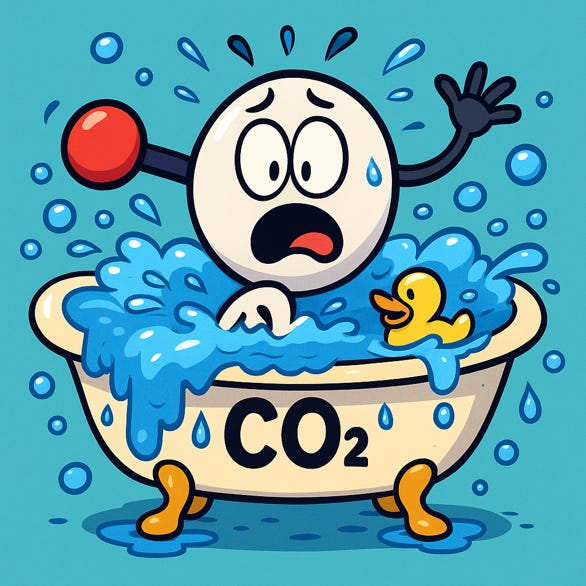
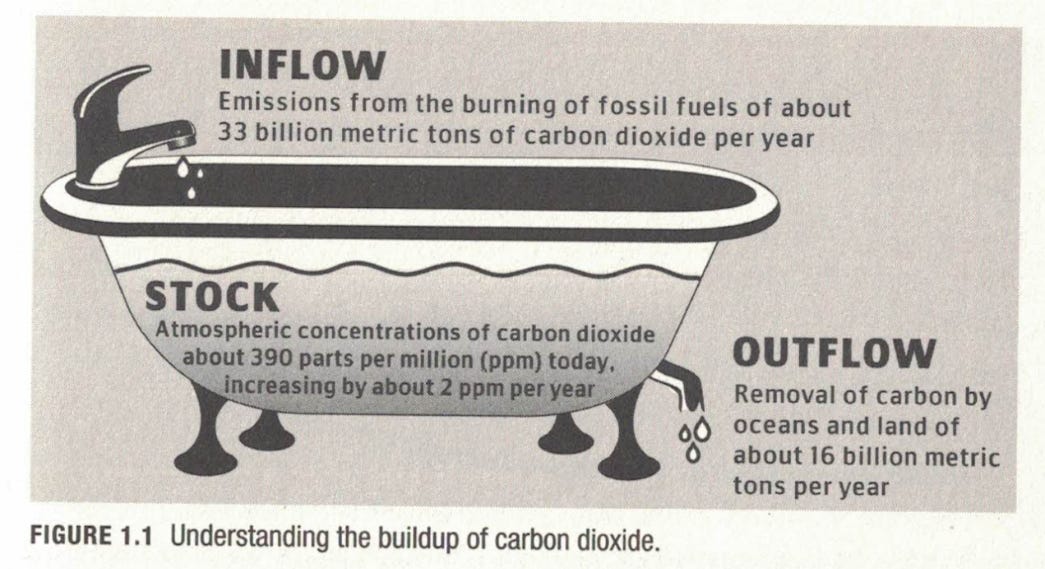
Consider a bathtub. Water comes out of a faucet and fills the tub. If the drain is plugged and there is no other way for water to exit the tub, then leaving the faucet on means that the tub will overflow and flood your house.
Accumulating carbon dioxide in the atmosphere can be thought of like water filling a bathtub.2 We emit carbon dioxide mainly through the burning of fossil fuels — coal, oil, and natural gas. Carbon dioxide stays in the atmosphere for a long time and accumulates, just like water filling a tub.
The accumulation of carbon dioxide in the atmosphere is very well understood. There are however longstanding debates over how much added carbon dioxide might be “dangerous,” in the language of the 1992 U.N. Framework Convention on Climate Change (to which the United States is a signatory).3 That is equivalent to debating how high the side of the bathtub is, and at which point the filling tub overflows and becomes a damaging house flood.
In the early 2000s, climate policy focused on stabilizing concentrations of carbon dioxide in the atmosphere, with 280 parts per million (ppm) characterized as the pre-industrial baseline. Variously, concentrations of 580ppm, 450ppm, and even 350ppm have been proposed as the metaphorical height of the bathtub. Currently the world is at about 425ppm.
About a decade ago, climate policy shifted from a focus on concentrations as a policy metric to projected global temperatures in 2100, a change that I have long thought to be unhelpful for both science and policy. The 2015 Paris Agreement identified 2 degrees Celsius as the point where the metaphorical bathtub overflows, and recommended that the world seek as well to strive to hit a 1.5C target. These temperature targets have been associated with corresponding amounts of cumulative carbon dioxide emissions —
...This excerpt is provided for preview purposes. Full article content is available on the original publication.