BlackNest: Inside Canary Mission’s Secret Web of Unlisted Sites
Deep Dives
Explore related topics with these Wikipedia articles, rewritten for enjoyable reading:
-
Doxing
10 min read
Central to the article's subject - Canary Mission's primary tactic. Readers need to understand the technical methods, legal implications, and history of doxxing as harassment.
-
COINTELPRO
13 min read
Historical parallel to organized surveillance and targeting of activists. Provides context for understanding systematic campaigns to suppress political speech through infiltration and documentation.
-
McCarthyism
10 min read
Historical precedent for blacklisting and punishing Americans for political views. The article describes similar tactics - creating lists, preventing employment, and enforcing ideological conformity through fear.
More and more, legacy media brands are becoming entrenched in authoritarianism, becoming complicit mouthpieces for the powerful and corrupt. Drop Site News was founded to combat this shift: to report free from undue influence, shed light on dark dealings, and amplify silenced voices. To operate as a truly independent organization, we rely entirely on the generosity and support of our community of readers. Please consider making a 501(c)(3) tax-deductible donation to support our work.
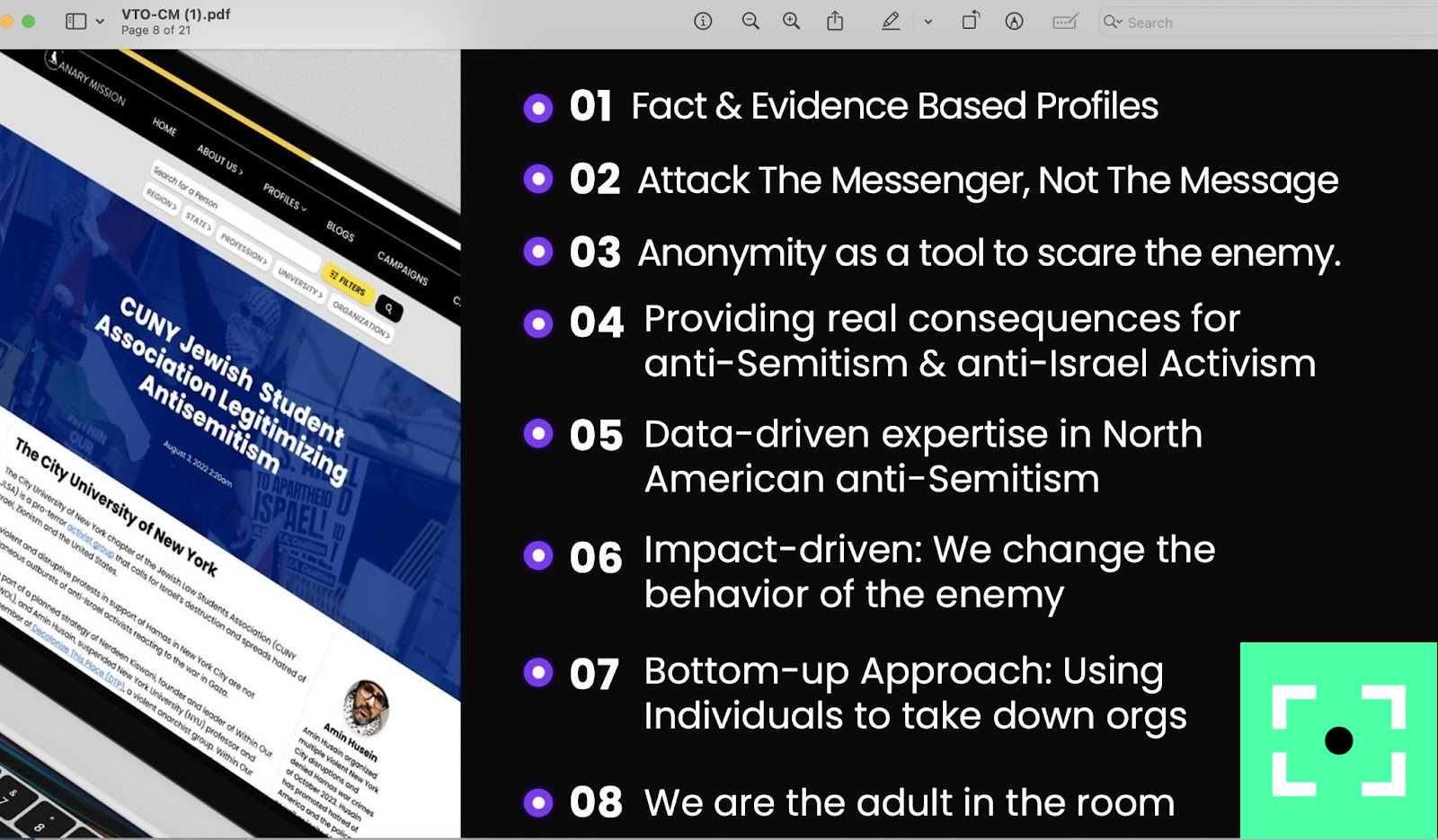
Notorious pro-Israel doxxing outfit, Canary Mission, has an army of anonymous doxxers, international tech vendors, marketing plans, and a secret website called BlackNest, where the group celebrates deportations and firings as “company impact” metrics, according to a collection of unlisted websites discovered by Drop Site.
BlackNest is just one of the names of several unlisted websites and content management systems used by Canary Mission, whose doxxing operation is run out of Israel and used by the highest levels of the Trump administration. The information on these unlisted websites—including dozens of names of workers and contracted vendors,internal communications about meetings and quarterly plans, and even strategic planning documents—demonstrates how the operation evolved over time.
Canary’s non-public websites promise expansion into new avenues to continue the group’s mission of punishing Americans for pro-Palestine speech via doxxing, pressure campaigns, and now arrests and deportations carried out by allies in the State Department.
BlackNest’s web development content reveals how Canary Mission thinks of its “wins” in its efforts to influence U.S. policy. The website categorizes the group’s impacts into categories: “Change of behavior,” job loss, denials of entry to the U.S., arrests, and “deportation/forced to flee.” The site also collects mentions of Canary Mission in media, mostly from U.S. news outlets, and celebrates mentions of their impact.
Drop Site News previously reported how donations are funneled to the group, but who the employees are, how the group functions, and who built their websites have been unknown—due to Canary Mission’s secrecy. Drop Site has now obtained over 100 gigabytes of content and data that was accessed via the backend of Canary Mission’s website, leading to a host of websites that were live but not intended to be found publicly.
A group of software engineers shared the data they collected from BlackNest’s daily
...This excerpt is provided for preview purposes. Full article content is available on the original publication.