The Case Against Social Media is Weaker Than You Think
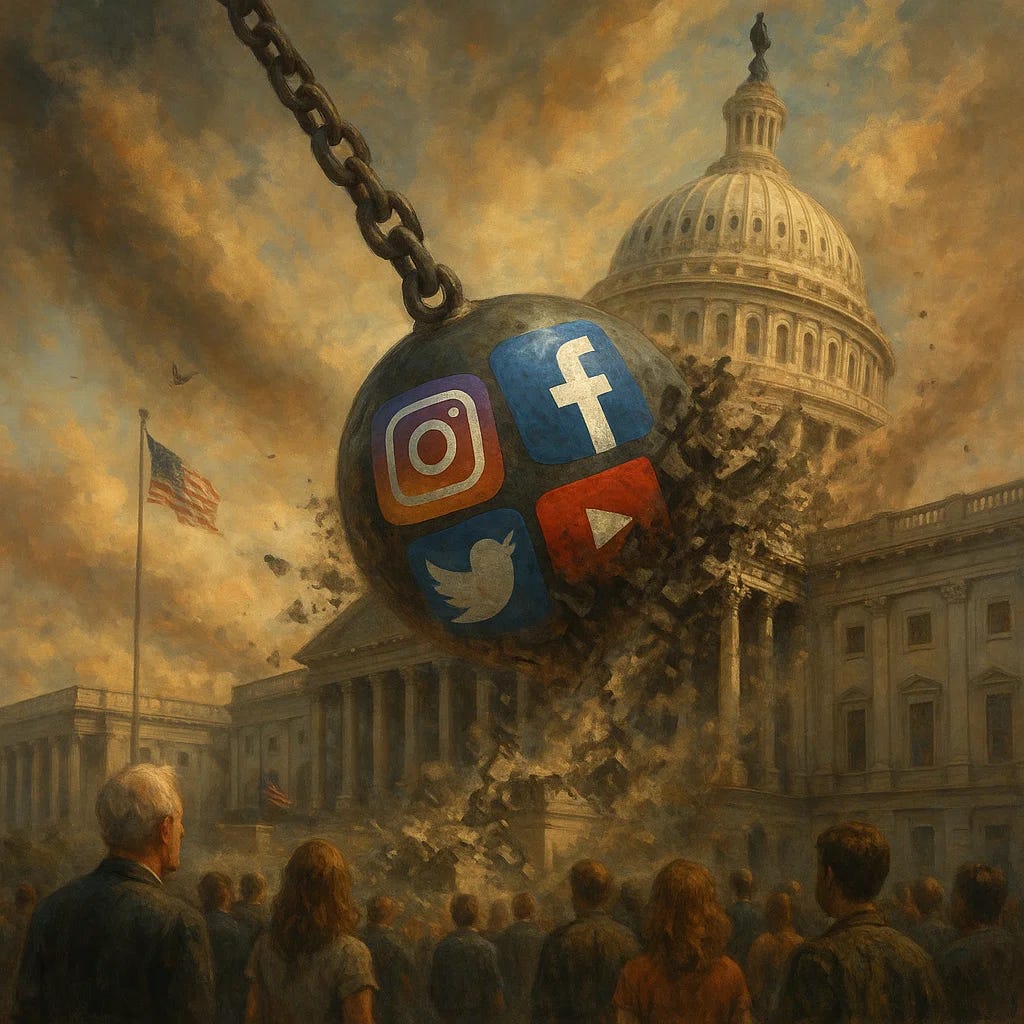
Many people have the intuition that social media broke the USA. More precisely, they place a lot of the blame for America’s current political problems on the emergence of social media platforms like Facebook, Twitter (X), YouTube, and TikTok.
Some examples:
Alexandria Ocasio-Cortez describes Meta as “a cancer to democracy metastasizing into a global surveillance and propaganda machine for boosting authoritarian regimes and destroying civil society.”
Jonathan Haidt has argued that social media platforms “dissolved the mortar of trust, belief in institutions, and shared stories that had held a large and diverse secular democracy [in America] together.”
Obama suggests that one of “the biggest reasons for democracies weakening is the profound change that’s taking place in how we communicate and consume information.”
These viewpoints express a broader conventional wisdom among many intellectuals, pundits, and politicians.
In some ways, this conventional wisdom is understandable.
First, there appears to be a lot more brazen lies, falsehoods, bullshit, conspiracy theories, and plain stupidity and dysfunction in American political culture than there was a few decades ago.
Second, this development appears to coincide with the emergence of social media platforms. Facebook launched in 2004, YouTube in 2005, and Twitter in 2006. As these platforms were adopted by hundreds of millions of users over the next decade, the health of American democracy seemed to deteriorate. By 2016, the year of Trump’s first election, many experts began talking of an "epistemological crisis”, a “disinformation age”, and a new authoritarian era.
Third, social media platforms feature a shocking amount of false, misleading, and incendiary content. And this is not surprising. The absence of traditional gatekeeping allows charlatans and know-nothing pundits to reach vast audiences, and the profit-maximising design of platforms is often hostile to truth and rational discourse. In a competitive attention economy mediated by engagement-grabbing algorithms, outrage-generating, identity-affirming, and bias-confirming content usually outcompetes thoughtful analysis and debate.
For these reasons and more, many people view social media as a kind of technological wrecking ball. As the famous “rationalist” writer Eliezer Yudkowsky recently put it,
“My current rough sense of history is that the last "moral panic" about social media turned out to be accurate warnings. The bad things actually happened, as measured by eyeball and by instrument. Now we all live in the wreckage. Anyone want to dispute this?”
I want to dispute this. More precisely, I don’t think there
...This excerpt is provided for preview purposes. Full article content is available on the original publication.