Selfish and Exhausted
Deep Dives
Explore related topics with these Wikipedia articles, rewritten for enjoyable reading:
-
Jackson Pollock
16 min read
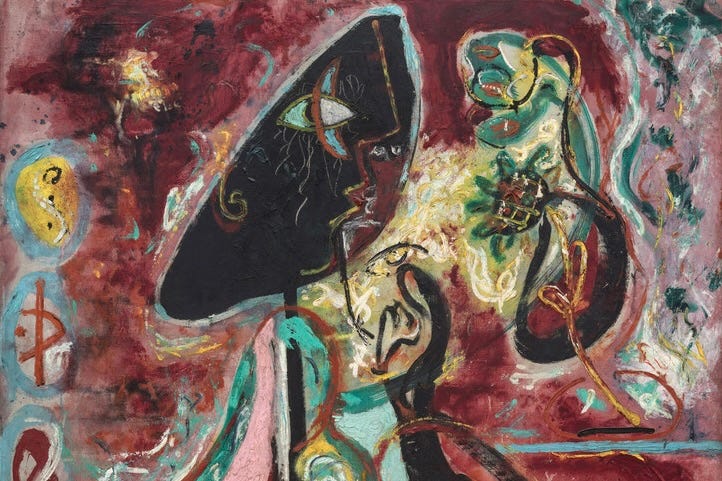
The article opens with a reference to Pollock's 'The Moon Woman' painting from 1942, suggesting thematic connections between Pollock's abstract expressionism and Lockwood's disorienting prose style
-
Walter Benjamin
18 min read
Benjamin is directly quoted in the article regarding his theory of 'aura' in art, which the reviewer uses to critique Lockwood's attempt to mystify her opaque prose
-
Deus ex machina
14 min read
The reviewer explicitly criticizes the novel's ending as a 'deus ex machina resolution' - understanding this classical literary device illuminates the structural critique being made
To be fair, it’s not like Patricia Lockwood doesn’t warn us. “I was having a Protagonist Problem,” she declares. “I could not move, or make anything happen.” Of course, by the time the reader of her second novel, Will There Ever Be Another You, reaches this acknowledgement midway through the book, they’re likely already aware of both the “protagonist problem” at the heart of the novel and the failure of Lockwood’s trademark self-referential humor to solve it. Credit to Lockwood for her self-awareness, but the authorial disclaimer is too little, too late.
Will There Ever Be Another You explores a period of severe disorientation in Lockwood’s life. After falling ill in a hotel bathroom, the protagonist, Patricia, feels her mind has begun to unravel: “The weave of her has loosened.” (There is no real difference between the author and the narrator, but to avoid confusion, I’ll use Lockwood for the author and Patricia for the character.) Readers familiar with Lockwood’s writing might imagine she’d be uniquely suited to plumb the depths of her own confusion — her enviably vast employ of sensory allusion, her enthusiasm for the bizarre, and her visceral delight in her own ability to baffle would seem to equip her well to write from a place of disarray.
But the novel, perhaps in its attempt to represent the experience of disorientation, becomes disorienting itself. I struggled, even on my second go at reading it, to make sense of what was going on. That’s not just because of the lack of traditional novelistic convention — though it is loosely plotted and lacks clearly delineated characters — but because, too often, Lockwood’s admittedly incandescent writing fails to attach to anything. Take the opening paragraph:
As soon as she touched down in Scotland, she believed in fairies. No, as soon as the rock and velvet of Inverness rushed up to her where she was falling, a long way through the hagstone hole of a cloud, and she plunged down into the center of the cloud and stayed there. You used to set a child out for them, she thought, and was caught in the arms, and awoke on the green hillside.
I was able, after a few re-readings, to catch the cadence of the second sentence, and to understand that “the arms” are those of the fairies and “the
...This excerpt is provided for preview purposes. Full article content is available on the original publication.