Trump's Childhood Savings Accounts – A Flawed Policy
Nominal News is an economics newsletter written by a PhD Economist that translates the latest economic research into clear, policy‑relevant insights on current issues. Join 4,000 readers for free to stay-up-to-date with Nominal News directly in your inbox:
Financial well-being, especially of children, is an issue that many countries grapple with. US President, Donald Trump, announced a policy in which newborns born between 2025 to 2028 will receive an investment account with $1,000 in it provided by the US Treasury (i.e. US tax payers). The money in the “Trump Account” can be invested in certain stock market funds, but the funds themselves can only be accessed after the child turns 18.1
Now, on paper, this policy sounds good, as we’re boosting savings for families with children. But, upon closer inspection, this is a policy that does not actually help much at all – and it’s not because the amount of money invested is small. Let’s dive in.

Alleviating Child Poverty
Before we start assessing the Trump Account policy, we should first determine what it is that we want to achieve with the policy. A policy is just a tool to achieve a goal. The goal, at least to me, is to improve outcomes/welfare for children and, perhaps, teach children and families to save/invest via exposure to markets.
Child poverty in the US is a serious problem. Around 12%-14% of children live in poverty2:
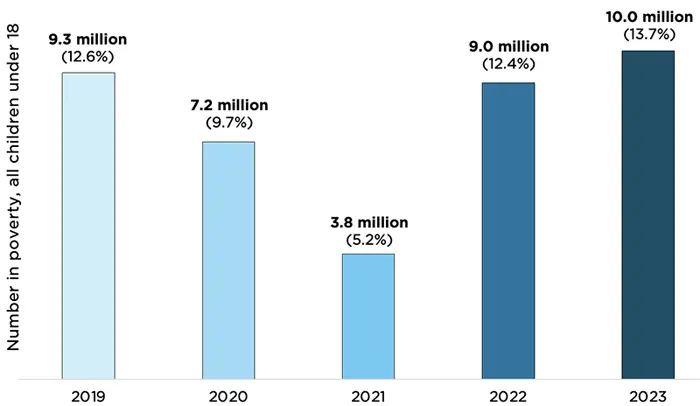
On the above chart, you may notice that, in 2021, there was a dramatic fall in child poverty, which then rebounded to the current highs. The reason child poverty fell in the US was thanks to the numerous government programs helping low income families, of which the 2021 Expanded Child Tax Credit3 (eCTC) was the most important. We’ve discussed this policy extensively here, and argued that it is a policy that pays for itself. The eCTC was a 40 times larger program than “Trump Accounts”, but the reason it worked had to do more with the fact that it immediately alleviated issues for families in need. Per every $100 a family received:
$28 was spent on food;
$31 on housing; and
$15 on child related goods and services.
On the other hand, a savings account will have none of this impact, as the money is locked until age 18.
Some might argue that these families who
...This excerpt is provided for preview purposes. Full article content is available on the original publication.