Living in artificial gravity
Deep Dives
Explore related topics with these Wikipedia articles, rewritten for enjoyable reading:
-
Weightlessness
10 min read
Linked in the article (25 min read)
-
Project Mars: A Technical Tale
12 min read
Linked in the article (7 min read)
-
Herman Potočnik
12 min read
Linked in the article (7 min read)
Works in Progress is now a print magazine. Subscribe to get six full-color editions sent bimonthly, plus subscriber-only invitations to our events.
Without gravity, people’s muscles atrophy and their bones weaken. Astronauts develop eye problems and anemia, get blood clots and have to exercise a few hours each day to overcome weightlessness’s effects on the body. Many experience space-motion sickness.
Animals living at very low or zero gravity develop osteoporosis, problems with their eyes and kidneys, and reproductive issues. In 1962, NASA had viable designs for rotating wheel space stations that could have given astronauts artificial gravity. The Apollo program effectively killed this path. While NASA’s lunar focus delivered its moonshot, it abandoned other promising work. Had NASA maintained its parallel pursuit of artificial gravity, we might now have permanent orbital settlements supporting deep space missions rather than the limited, temporarily occupied outposts we’ve settled for.
This historical pivot point matters today as commercial space companies contemplate artificial gravity once more. In doing so, they could correct this detour in humanity’s path to becoming a spacefaring civilization.
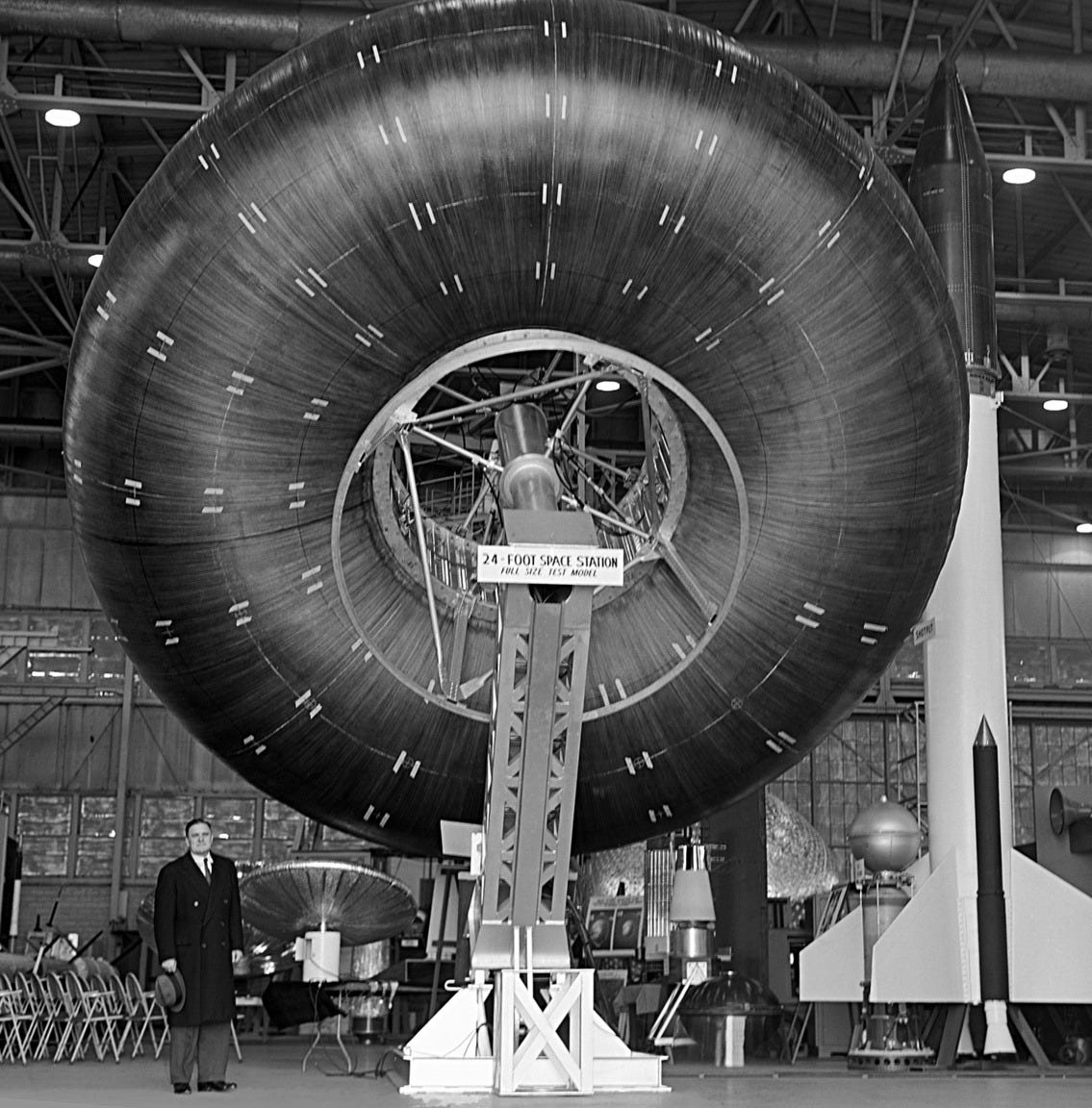
Wernher von Braun and the von Braun wheel
Early space visionaries, from Konstantin Tsiolkovsky to Wernher von Braun, strongly believed that settling the solar system would need technologies to generate artificial gravity within orbiting habitats.
Von Braun was convinced that rotating wheel space stations would be needed to prevent physiological problems associated with space and were thus ‘as inevitable as the rising sun’. In these systems, humans would live in the rim of a wheel where its spin induces perceived weight. While the idea was popularized by von Braun in his 1949 sci-fi novel, Project Mars, the concept actually traces back to Herman Potočnik‘s 1929 book The Problem of Space Travel.
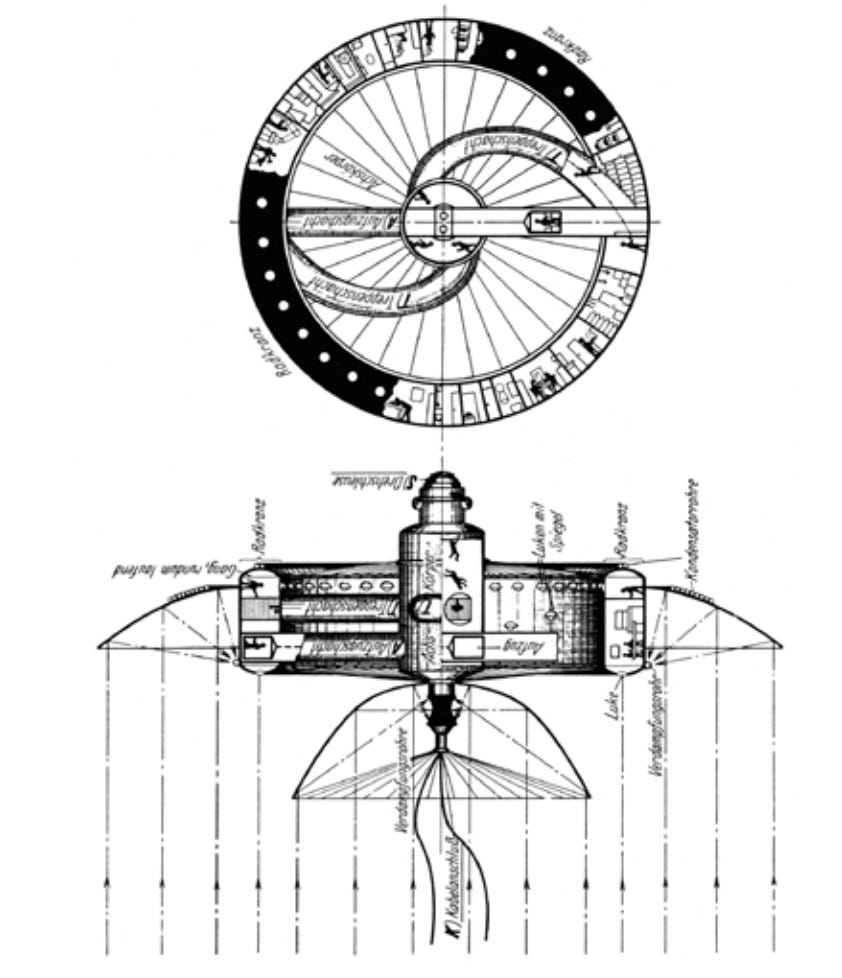
The difficulty of building large stations
This elegant solution comes with a major engineering challenge. Much like a ferris wheel, the rotation of a space station wheel could disorient astronauts if spun too fast. If the wheel spins slowly, then physics dictates it must be quite large – the force pushing you down, which acts like gravity, is stronger the further you are from the central point of rotation. One of von Braun’s
...This excerpt is provided for preview purposes. Full article content is available on the original publication.