Where does a liberal go from here?
Deep Dives
Explore related topics with these Wikipedia articles, rewritten for enjoyable reading:
-
Congress of Vienna
11 min read
Directly referenced as the conservative reaction that ended the French Revolution's liberal ideals. The article uses 1815 as a key metaphorical anchor for understanding political defeat and long-term historical arcs. Most readers won't know the details of how this congress reshaped Europe.
-
Reign of Terror
11 min read
Referenced as 'the Terror and the Committee for Public Safety' - a critical example of how revolutionary liberal ideals descended into violence. The parallel to modern progressivism's unintended consequences is central to the article's argument. Understanding Robespierre's era provides context for the author's concerns.
“You," Said Dr. Yavitch, "are a middle-road liberal, and you haven't the slightest idea what you want.” — Sinclair Lewis
Imagine being a French liberal in the year 1815. You spent your youth dreaming of an end to tyranny and the stultification of the estate society, reading the works of Voltaire and Rousseau and Montesquieu and Diderot, talking of liberty with your friends in cafes. Yours was not among the names that history would remember from that era, but you once attended a salon in a rich woman’s house in Paris. You were not part of the mob that stormed the Bastille in 1789, but you felt your heart leap when you heard the news, because you knew that now everything would change. When you read the terms of the Constitution of 1791, you saw the fulfillment of your youthful daydreams become the solid fabric of a new reality.
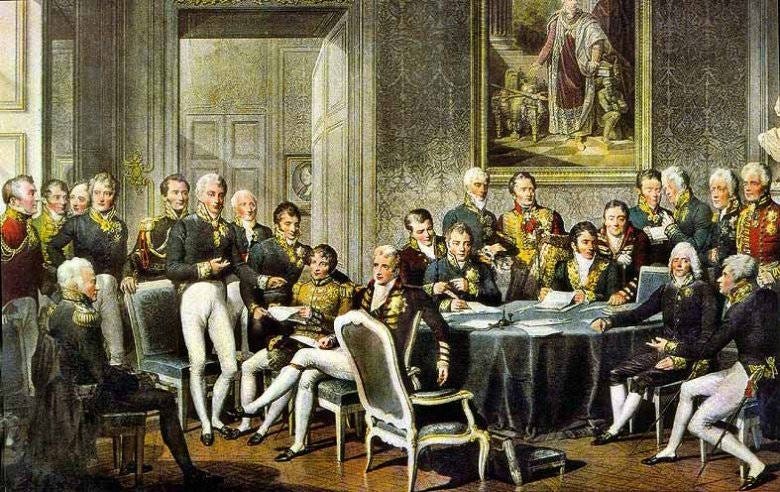
Imagine, then, standing in 1815, a quarter century after the Revolution, looking back at what it had all become. That first bright rush of freedom had given way, first to the murderous insanity of the Terror and the Committee for Public Safety, then to the thuggish new imperialism and endless bloody wars of Napoleon, and finally to the fall of all Europe to conservative reaction under the Congress of Vienna. Imagine looking back on the arc of your beliefs, your movement, and your life, now as an old man, with no prospects for another, better Revolution ahead of you.
Would you think your dreams had failed? Would you decide that everything you had believed had been an illusion, and that freedom, democracy, and the Rights of Man were false idols that led only to chaos and bloodshed?
If so, you would be utterly wrong. The two centuries after 1815 would see the ideals of the early French Revolutionaries continue to advance across the world — unevenly, in fits and starts, and with many reversals, yet almost always leaving society better off than before. Those centuries would also see plenty of successors to Robespierre and Napoleon, but just like the originals, they would usually go down to defeat or see their legacies overturned by people weary of war and oppression. Liberalism may have lost the first French Revolution, but it ended up winning the world — at least, for a while.
I think about this a lot when I reflect on
...This excerpt is provided for preview purposes. Full article content is available on the original publication.