How Federal Law Made Us All Disabled
Deep Dives
Explore related topics with these Wikipedia articles, rewritten for enjoyable reading:
-
Americans with Disabilities Act of 1990
14 min read
The article centers on critiquing the ADA's unintended consequences, but readers would benefit from understanding the law's original intent, scope, and enforcement mechanisms to evaluate the author's arguments
-
ADA Amendments Act of 2008
14 min read
While the article discusses early Supreme Court cases that narrowed disability definitions, Congress responded with this 2008 law that significantly broadened who qualifies as disabled—directly relevant to understanding the dramatic increase in accommodation requests the article describes.
There’s a new article in The Atlantic about how more and more students are identifying as “disabled” to receive extra time on exams.
The increase is driven by more young people getting diagnosed with conditions such as ADHD, anxiety, and depression, and by universities making the process of getting accommodations easier. The change has occurred disproportionately at the most prestigious and expensive institutions. At Brown and Harvard, more than 20 percent of undergraduates are registered as disabled. At Amherst, that figure is 34 percent. Not all of those students receive accommodations, but researchers told me that most do. The schools that enroll the most academically successful students, in other words, also have the largest share of students with a disability that could prevent them from succeeding academically.
“You hear ‘students with disabilities’ and it’s not kids in wheelchairs,” one professor at a selective university, who requested anonymity because he doesn’t have tenure, told me. “It’s just not. It’s rich kids getting extra time on tests.” Even as poor students with disabilities still struggle to get necessary provisions, elite universities have entered an age of accommodation. Instead of leveling the playing field, the system has put the entire idea of fairness at risk…
According to Weis’s research, only 3 to 4 percent of students at public two-year colleges receive accommodations, a proportion that has stayed relatively stable over the past 10 to 15 years. He and his co-authors found that students with learning disabilities who request accommodations at community colleges “tend to have histories of academic problems beginning in childhood” and evidence of ongoing impairment. At four-year institutions, by contrast, about half of these students “have no record of a diagnosis or disability classification prior to beginning college.”
Something similar has happened with standardized tests. Between 2012-2013 and 2016-2017, the number of approved accommodation requests to take the Law School Admission Test (LSAT) jumped from 729 to 3,000. By 2022-2023, the number was over 15,000. About 98% of accommodation requests were approved, meaning the process was basically automatic.
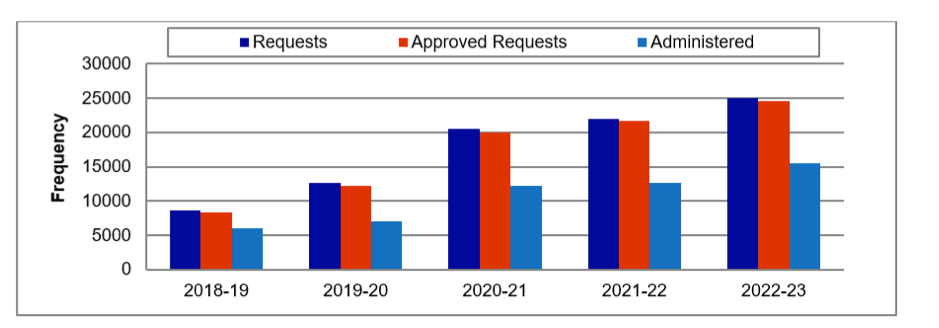
This comes out to about 11% of tests being administered under the condition of some kind of accommodation, up from less than 1% a decade before. When I went to law school, the beauty of the LSAT was that everyone was on equal footing, but a high score appears to be a
...This excerpt is provided for preview purposes. Full article content is available on the original publication.