The 24 hours after a Shahed attack
Deep Dives
Explore related topics with these Wikipedia articles, rewritten for enjoyable reading:
-
Bomb disposal
16 min read
The article follows bomb disposal technician Serhii but assumes readers understand EOD procedures. This Wikipedia article covers the history, techniques, protective equipment, and psychological toll of the profession—directly enriching the human story at the article's core.

Featured Subscriber’s Comment:
“I support this work because it is the most accurate and valuable information and commentary about Ukraine. Authentic voices of serving journalists who work with Tim Mak. And the incredible DNA of fighting for democracy for ALL OF US shines through. Thank you Tim Mak for all you do.”
By: Elizabeth K. Baker
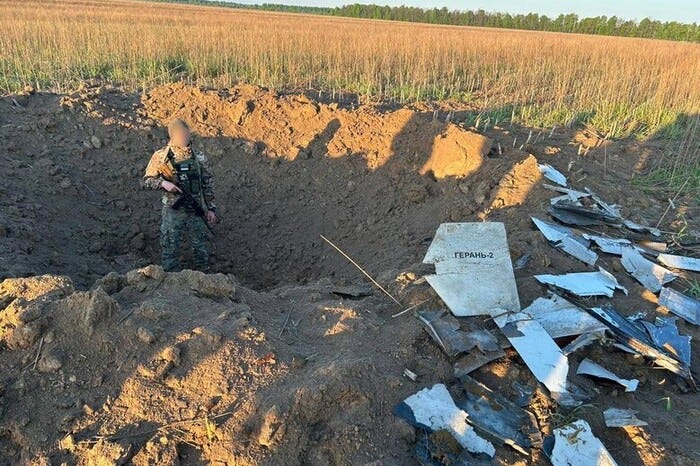
It was October 2022, and Serhii* is staring in dismay at a two-meter-high crater.
He had driven out to the impact site of what was believed to be a missile near a village in the Kyiv region.
But it wasn’t a missile. Fiberglass was scattered around the pit, and farther away lay fragments of circuit boards and pieces of an engine.
He didn’t fully realize that over the next three years, he and his unit would see hundreds of similar craters. They were left by Shahed drones, which swarm over Ukrainian cities at night like vicious wasps.
A sound of Shahed drones flying over the city extracted from a TikTok video.
Since 2022, Russia has used around 60,000 Shahed drones in Ukraine, with almost 44,000 this year only. Reports like last week’s strike on Ukraine, when 600 Shaheds were launched, now barely register with people who live thousands of kilometers away from the war zone. While such news reports appear almost daily, there’s a personal tragedy behind every attack that often goes unnoticed.
Despite tremendous damage, Ukraine is dealing with the destruction from these strikes in record time, becoming an example not only for other countries at war but also for those dealing with other large-scale crises.
Serhii grew up in a village outside Kyiv, among warehouses filled with ammonium nitrate that were stockpiled there. Back then, according to Serhii, childhood was not spent “with phones.” Children went outside to play hide-and-seek or spent time near warehouses because there was little entertainment for kids in the villages. Already as a child, he knew how to make a small, homemade ‘explosive.’
“A bolt with some nuts, pour in match heads, and throw it,” said Serhii, now a bomb disposal technician.
Since many of Serhii’s relatives had tied their lives to the military, explosives were never going to remain just a childhood game. After serving in the Ukrainian police, he became a sapper after Russia’s initial invasion in 2014, before later
...This excerpt is provided for preview purposes. Full article content is available on the original publication.