Scaling the Memory Wall: The Rise and Roadmap of HBM
The first portion of this report will explain HBM, the manufacturing process, dynamics between vendors, KVCache offload, disaggregated prefill decode, and wide / high-rank EP. The rest of the report will dive deeply into the future of HBM. We will cover the revolutionary change coming to HBM4 with custom base dies for HBM, what various different accelerators are doing with custom HBM including OpenAI, Nvidia, and AMD, the shoreline area problem, memory controller offload, repeater PHYs, LPDDR + HBM combos, and various beachfront expansion techniques. We will also discuss SRAM tags, compute under memory, supply chain implications, and Samsung.
A Brief Overview of HBM
As AI models grow in complexity, AI systems require memory with higher capacity, lower latency, higher bandwidth, and improved energy efficiency. Different forms of memory have different tradeoffs. SRAM is extremely fast but low density. DDR DRAM is high density and cheap but lacks bandwidth. The most popular memory today is on-chip HBM which strikes the balance between capacity and bandwidth.
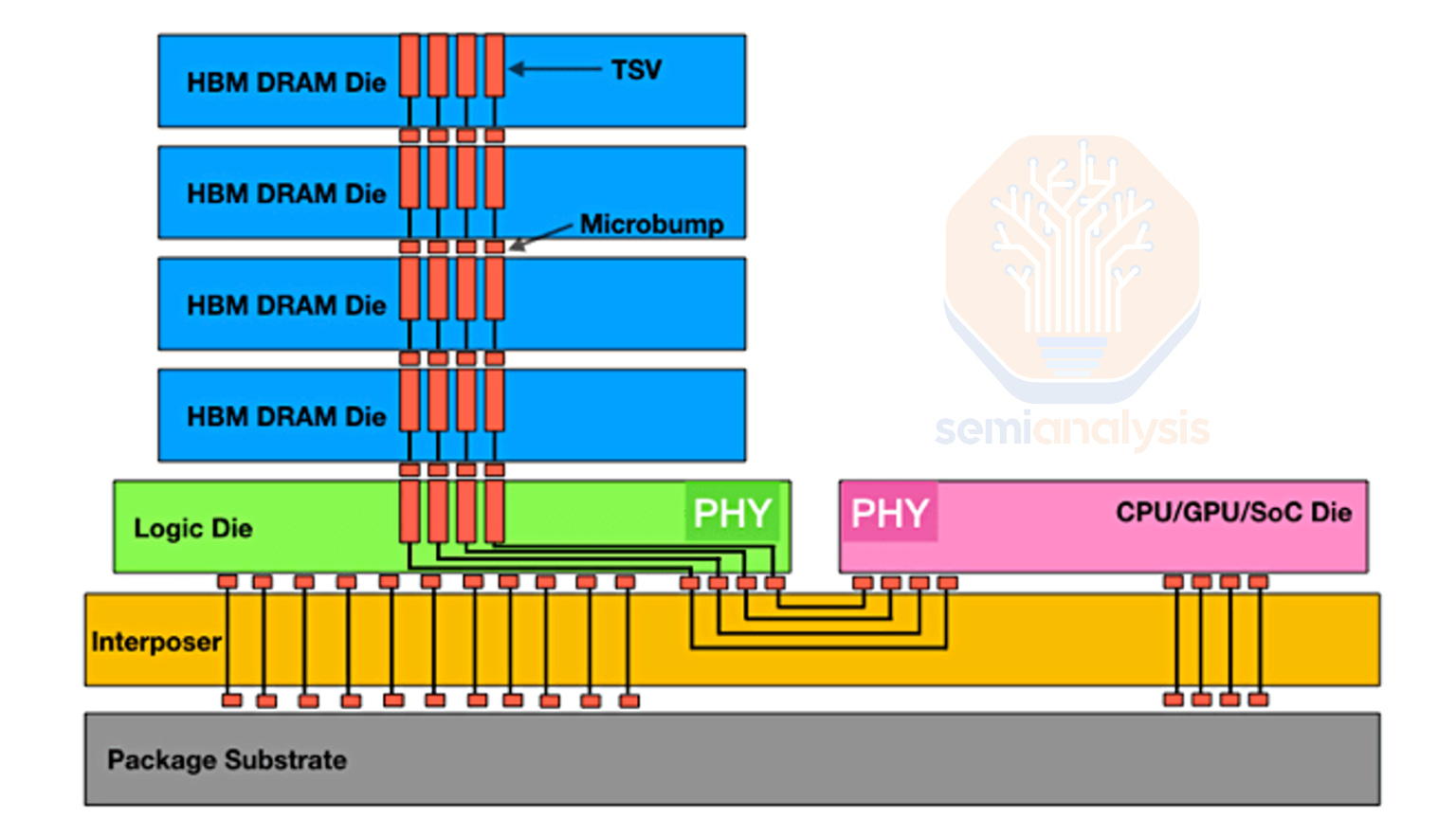
HBM combines vertically stacked DRAM chips with ultra-wide data paths and has the optimal balance of bandwidth, density, and energy consumption for AI workloads. HBM is much more expensive to produce and has a warranted price premium to DDR5, but demand remains strong for HBM. All leading AI accelerators deployed for GenAI training and inference use HBM. The common trend across accelerator roadmaps is to scale memory capacity and bandwidth per chip by adding more stacks, higher layer counts, with faster generations of HBM. Architectures that rely on other forms of memory offer sub-optimal performance, as we have demonstrated.
In this report, we will examine HBM's present state, what’s happening in the supply chain, and the groundbreaking changes happening in the future. We’ll examine HBM’s critical role in AI accelerator architecture, the impact HBM is having on the DRAM market, and why it is upending the way memory market analysis is being performed. For subscribers, we will also address the major questions on Samsung's future viability as a supplier, as well as highlight one technological change that may reverse the trend of increasing HBM capacity.
HBM Primer
First, a brief primer on HBM - what makes it special and challenging to manufacture. While HBM is commonly associated with multiple DRAM dies stacked in a 3DIC assembly, the other key feature is HBM’s much wider data bus, improving bandwidth even with mediocre signaling
...This excerpt is provided for preview purposes. Full article content is available on the original publication.