The Divine Economy
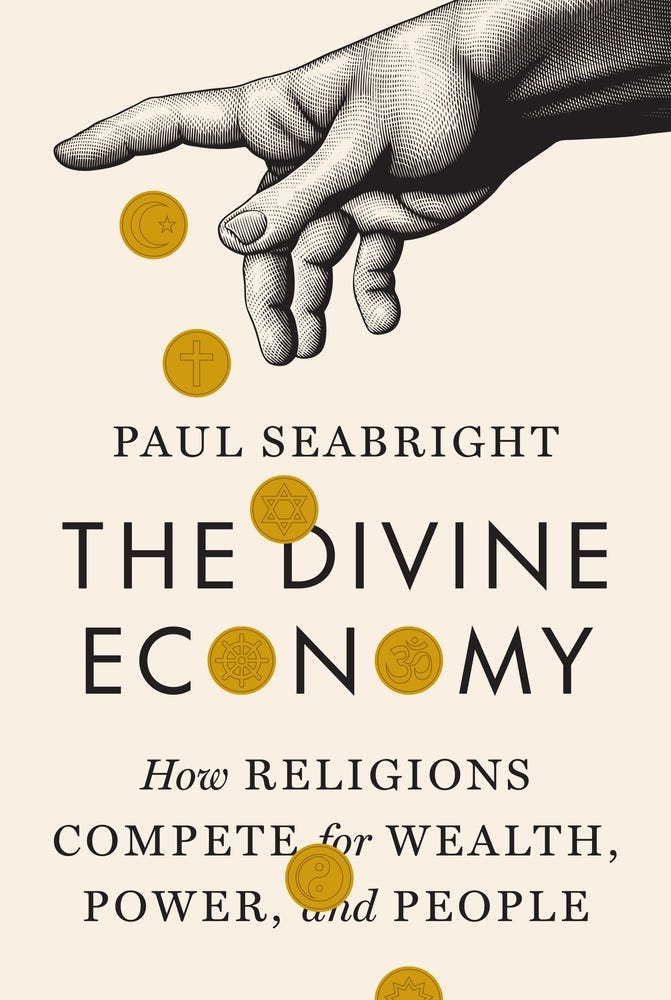
Paul Seabright’s new book The Divine Economy is an original and deeply insightful contribution to the social scientific study of religion. I first encountered Seabright’s work when reading his brilliant 2004 book The Company of Strangers, as a graduate student. At the time when my mind was absorbed solving differential equations and Hamiltonians, The Company of Strangers provided a welcome break: a wide-ranging, perspective on the division of labor and the market economy.
The Company of Strangers is a great book because it took ideas that have been in the ether since Bernard Mandeville and Adam Smith and connected them with insights and evidence from evolutionary biology and anthropology. The Divine Economy does something similar.
The main thesis of The Divine Economy is that religions can be analyzed as platforms akin to Facebook or Amazon. Religion is a difficult topic to study. I should know. Together with Noel Johnson, in our book Persecution & Toleration, we struggled with questions such as how to define religion and religious toleration. Many scholars of religion claim there is no single definition of religion; that our conventional understanding only obtains for Judaism and Christianity. Indeed there are many puzzles in the study of religion: what distinguishes a cult from a religion? Is Confucianism a religion (or a philosophy?) Is Marxism a religion? Religious experiences are so diverse and multifaceted that it is difficult to study them within a single framework.
There is a lot in the book! So if you want a short review mine is: “The Divine Economy is an original and important contribution to the economics of religion. It is accessible and readable but there is also much for specialists and scholars to discuss and debate”.
Below the break, I’ll explore in more detail some specific points of interest. But it should be noted I’m only exploring a small portion of the topics that the book goes into.
Religion and the Economics of Identity
The standard framework for studying religion in economics is the club goods model. Pioneered by Larry Iannaccone in the late 1980s and early 1990s (see here for his seminal paper), the club goods framework is squarely in the Beckerian tradition of analyzing social phenomenon through the lens of microeconomic theory.1 It offers a simple and compelling explanation for the collective aspects of religious experience. Religion cannot be an entirely sole activity. In Iannaccone’s
...This excerpt is provided for preview purposes. Full article content is available on the original publication.