Climate Feedbacks Explained, with Pie
Deep Dives
Explore related topics with these Wikipedia articles, rewritten for enjoyable reading:
-
Climate sensitivity
14 min read
Linked in the article (26 min read)
-
Radiative forcing
11 min read
Linked in the article (21 min read)
A Pie Puzzle
Here’s a puzzle that might not seem like it has anything to do with the climate. But it’s at the heart of reasoning about how climate feedbacks work.

Say someone gave you an entire pie. Then they gave you half a pie. And then a quarter of a pie, and then an eighth of a pie, and so on, to infinity. At every step, you get half as much pie as you got before. How much pie would you end up with in the end?
At the heart of this puzzle is the remarkable realization that you can add up an infinite number of diminishing pieces and yet end up with a finite whole. It turns that all those infinitely many slices will add up to two full pies.

Mathematically, we can sum up this pie puzzle like this:

In math-speak, we’d say that this infinite series converges to a finite sum.
What does this have to do with Earth’s climate?
Earth’s temperature arises from a balance between the energy that we absorb and the energy that we radiate into space as heat. Because carbon dioxide is a heat-trapping gas, every unit of carbon dioxide that we emit tips the scales of Earth’s energy balance.

Adding CO2 tips the scales of Earth’s energy balance.
We’re currently out of balance, and are still tipping the scales further. This means that the Earth absorbs more energy than it can radiate away to space. This forces the Earth to warm up.
As the Earth warms, it’ll gradually start to radiate more heat into space. In the future, the Earth will find itself in a new energy balance, one where it has settled in to a warmer temperature.

Over time, the Earth will settle into a new, warmer energy balance.
Here’s a simple way to visualize this process, using Nicky Case’s feedback loop simulator.
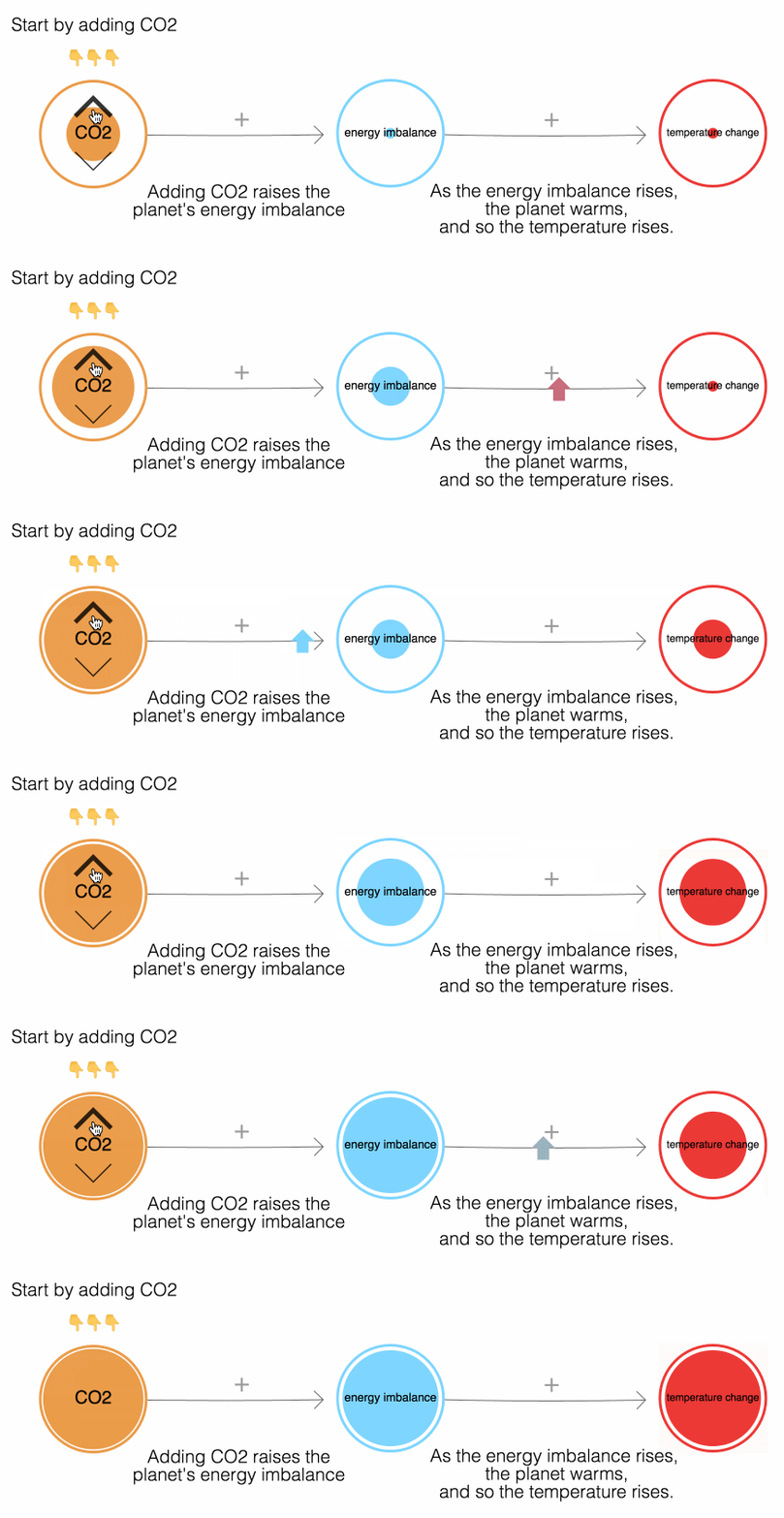
You can press play and experiment with this for yourself. Pushing the up arrow emits carbon dioxide. Pushing the down arrow is equivalent to sucking CO₂ back from the air, either through natural or technological processes. The key takeaway is that the level of carbon dioxide in the air determines our eventual temperature rise.
In the previous newsletter and accompanying interactive, we came up with a number for this temperature rise. This is called the climate sensitivity, and it’s the answer to the question:
...This excerpt is provided for preview purposes. Full article content is available on the original publication.